Retrieval-Augmented Generation for Knowledge-Intensive NLP Tasks
Retrieval-Augmented Generation for Knowledge-Intensive NLP Tasks — L2 #
1. TL;DR #
A general-purpose fine-tuning recipe that couples a pre-trained DPR dense retriever (non-parametric memory: a fixed 21M-passage Wikipedia index) with a pre-trained BART seq2seq generator (parametric memory), treating the retrieved document as a latent variable marginalized end-to-end. Sets SotA on open NQ/WQ/CT and generates more factual, specific, diverse text than BART — with only 626M trainable params vs T5-11B.
2. Q1 / Q2 / Q3 #
Q1 — 痛点. Parametric-only pre-trained LMs (T5, BART) store knowledge implicitly in weights, but (a) cannot easily expand or revise that knowledge, (b) give no provenance for their answers, and (c) hallucinate. Prior differentiable-retrieval hybrids (REALM, ORQA) fixed some of this but were restricted to extractive open-domain QA — they select spans, they do not generate. There was no general recipe that gives a generative seq2seq model a revisable, inspectable external memory across many task types.
Q2 — 方法. RAG endows a pre-trained seq2seq generator with non-parametric memory. For input $x$, the DPR retriever scores passages by inner product of dense query/document embeddings, MIPS returns the top-$K$ documents $z_i$, each is concatenated with $x$ and fed to BART, and the latent document is marginalized to produce $p(y|x)$. Two marginalization orderings are proposed — RAG-Sequence (one document fixed for the whole output) and RAG-Token (a different document per token). Training minimizes the negative marginal log-likelihood end-to-end with no supervision on which document to retrieve; only the query encoder and BART are updated (document encoder/index frozen).
- 核心技术壁垒: the whole system works without ever training the document encoder or refreshing the index. REALM's defining cost is periodically re-embedding all of Wikipedia so the index stays consistent with the trainable document encoder. RAG shows that freezing $\text{BERT}_d$ and the 21M-vector index — updating only $\text{BERT}_q$ — is sufficient for SotA, because the query-side embedding can rotate to match a static document manifold. This is the single hardest thing to rediscover: it is a negative design choice (don't do the expensive thing) that is counterintuitive and only justified empirically (see §7).
Q3 — 结果. New SotA on open Natural Questions (44.5 EM), WebQuestions, CuratedTrec, and strong TriviaQA — beating both closed-book T5-11B and the extractive DPR/REALM pipelines, without salient-span-masking pre-training and without a re-ranker or extractive reader. On generation: +2.6 Bleu / +2.6 Rouge-L over BART on MS-MARCO; human evaluators rate RAG more factual (42.7% vs 7.1%) and more specific on Jeopardy generation; RAG outputs are more diverse. Index hot-swap tracks temporal knowledge (70%/68% correct with matched-year index vs 12%/4% mismatched).
3. 架构 / 方法图 #
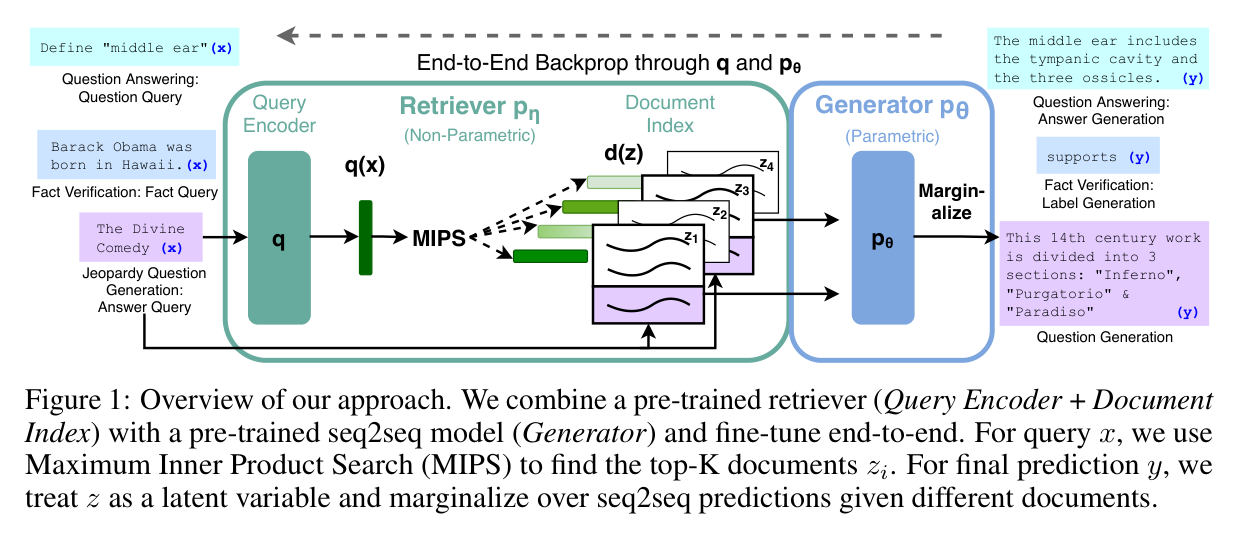
Paper's Figure 1, verbatim (caption: "Overview of our approach. We combine a pre-trained retriever (Query Encoder + Document Index) with a pre-trained seq2seq model (Generator) and fine-tune end-to-end. For query $x$, we use Maximum Inner Product Search (MIPS) to find the top-K documents $z_i$. For final prediction $y$, we treat $z$ as a latent variable and marginalize over seq2seq predictions given different documents.").
The figure is the load-bearing schematic: query $x$ → query encoder $q(x)$ → MIPS over the fixed document index → top-$K$ latent documents $z_i$ → each concatenated with $x$ into the BART generator $p_\theta$ → marginalize over $z$. Notice that the only gradient path back into the retriever is through the query encoder — the document index sits outside the trained loop, which is exactly the architectural choice that makes training cheap.
The one novel mechanism (before vs after). The novelty is not the components (DPR and BART both exist) but the marginalization of a latent retrieved document through a generative seq2seq loss, in two orderings:
| before (REALM / ORQA) | after (RAG) | |
|---|---|---|
| Output | extractive span selection | free-form seq2seq generation |
| Latent doc granularity | one doc per answer | RAG-Seq: one doc/sequence · RAG-Token: one doc/token |
| Document encoder | trained + index periodically refreshed | frozen, index never refreshed |
| Retrieval supervision | weak/latent | none (query encoder + generator only) |
The two variants differ only in where the sum-over-documents sits relative to the product-over-tokens (see §4). RAG-Token's per-token marginalization is what lets a single output aggregate content from several documents — the mechanism behind its Jeopardy advantage.
4. 作者证明 #
RAG has no formal convergence theorem or bound — it is a probabilistic modeling paper, not a proof paper. The "proof" content is the derivation of the two marginal likelihoods and the reduction of RAG-Token decoding to a standard autoregressive transition. Marked: 无形式化作者证明 — 仅实证 for guarantees; below are the notation table, the physical meaning of each equation, and the 6 minimum checks.
Notation table.
| Symbol | Meaning | |
|---|---|---|
| $x$ | input sequence (question / claim / answer-entity) | |
| $y$, $y_i$, $y_{1:i-1}$ | target sequence, its $i$-th token, prefix | |
| $z$, $z_i$ | retrieved document (latent); document for token $i$ | |
| $p_\eta(z\ | x)$ | retriever distribution over top-$K$ documents, params $\eta$ |
| $p_\theta(y_i\ | x,z,y_{1:i-1})$ | generator token distribution, params $\theta$ |
| $\mathbf{d}(z),\ \mathbf{q}(x)$ | dense doc / query embeddings ($\text{BERT}_d$, $\text{BERT}_q$) | |
| $N$ | number of output tokens | |
| $K$ | number of retrieved documents (train $\in\{5,10\}$) |
Loss / objective (write in LaTeX, per the algorithm asks). End-to-end negative marginal log-likelihood over fine-tuning pairs $(x_j,y_j)$:
$$\mathcal{L} = \sum_{j} -\log p(y_j \mid x_j)$$
where $p(y|x)$ is one of the two marginals. RAG-Sequence holds one latent document fixed for the whole output (sum outside the token product):
$$p_{\text{RAG-Seq}}(y\mid x)\approx\sum_{z\in\text{top-}k}p_\eta(z\mid x)\prod_{i}^{N}p_\theta(y_i\mid x,z,y_{1:i-1})$$
RAG-Token marginalizes per token (sum inside, product outside), allowing a different document per token:
$$p_{\text{RAG-Token}}(y\mid x)\approx\prod_{i}^{N}\sum_{z\in\text{top-}k}p_\eta(z\mid x)\,p_\theta(y_i\mid x,z,y_{1:i-1})$$
The retriever is a DPR bi-encoder scored by exponentiated inner product, so top-$k$ reduces to MIPS solvable in sub-linear time:
$$p_\eta(z\mid x)\propto\exp\!\big(\mathbf{d}(z)^\top\mathbf{q}(x)\big),\quad \mathbf{d}(z)=\text{BERT}_d(z),\ \mathbf{q}(x)=\text{BERT}_q(x)$$
At decode time RAG-Token collapses to a standard autoregressive generator with document-marginalized transition $p'_\theta(y_i|x,y_{1:i-1})=\sum_z p_\eta(z_i|x)\,p_\theta(y_i|x,z_i,y_{1:i-1})$, so a normal beam decoder plugs in; RAG-Sequence cannot factor per-token and instead runs beam search per document then re-scores ("Thorough" vs "Fast" decoding).
Loss decomposition. The objective is a single marginal likelihood term — there is no auxiliary retrieval loss. This is the crux: the retriever is trained only through the gradient the generator's likelihood sends back via $p_\eta(z|x)$. There is no term that explicitly enforces "retrieve the gold document."
6 minimum checks.
- Units/probability consistency — each factor is a probability in $[0,1]$; sums are over the top-$K$ truncated support (approximate marginal, hence "$\approx$"). Consistent.
- Limiting case $K=1$ — both marginals collapse to a single $p_\theta(y|x,z)$ term; RAG degenerates to BART-conditioned-on-one-retrieved-doc. Sensible.
- RAG-Seq = RAG-Token when $N=1$ — for length-1 targets (classification, e.g. FEVER) the product has one factor, so sum-outside and sum-inside coincide; paper states this explicitly. Consistent.
- Gradient reaches retriever? — $\partial\mathcal{L}/\partial\eta$ flows through $p_\eta(z|x)$, which depends only on $\mathbf{q}(x)$ since $\mathbf{d}(z)$ is frozen; so only $\text{BERT}_q$ receives updates. Matches the "query-encoder-only" training claim.
- Decoding tractability — RAG-Token's transition is a finite sum over $K$ documents → standard beam; RAG-Seq needs $|Y|$ extra forward passes (Thorough) or the $p_\theta\approx0$ off-beam approximation (Fast). The approximation is the source of any decode-time bias. Flagged.
- Where the model can be wrong — the top-$K$ truncation drops mass from documents ranked below $K$; performance monotonically improving with $K$ (RAG-Seq) confirms this truncation is lossy (Fig. 3). Acknowledged.
- RAG model + marginalization (RAG-Sequence / RAG-Token) and generation loop:
transformers/src/transformers/models/rag/modeling_rag.py - Retriever (DPR query/doc encoders, FAISS/MIPS index wrapper):
transformers/src/transformers/models/rag/retrieval_rag.py - Tokenizer/config plumbing:
transformers/src/transformers/models/rag/tokenization_rag.py,configuration_rag.py - End-to-end fine-tuning + Thorough/Fast decoding scripts:
transformers/examples/research_projects/rag/ - Per-task decoding/K differ and matter: QA uses greedy decoding with 15 docs (RAG-Token) / 50 docs + Thorough decoding (RAG-Sequence); generation uses beam=4, 10 docs, Fast decoding. Using one uniform setting will silently lose points (Appendix A).
- Index vectors live on CPU (~100GB, compressed to 36GB with FAISS quantization at 8-bit) while training runs on 8×32GB V100 — MIPS on CPU is fast enough, so you do not need the index on GPU. Also: the null-document mechanism (à la REALM) was tried and dropped — do not add it (Appendix C, F).
Desirable-but-absent guarantee: a bound on the marginal-likelihood approximation error as a function of $K$ (how much probability mass the top-$K$ truncation discards) would have quantified the retrieval/quality trade-off; the paper substitutes the empirical $K$-sweep in Fig. 3.
5. 实验与数据 #
Open-domain QA (the headline result).
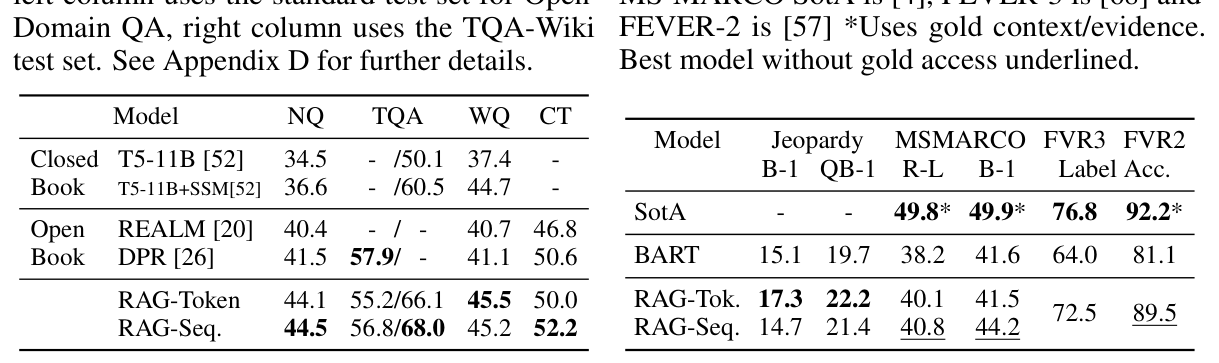
Paper's Table 1 (caption: "Open-Domain QA Test Scores. For TQA, left column uses the standard test set for Open-Domain QA, right column uses the TQA-Wiki test set."). RAG-Sequence reaches 44.5 EM on NQ and RAG-Token 44.1, both above closed-book T5-11B (34.5–36.6) and the extractive Open-Book DPR (41.5) and REALM (40.4). The load-bearing point: a generative model beats extractive readers on tasks everyone assumed were extraction-bound, and does so with no re-ranker/reader and no salient-span-masking pre-training.
Generation & classification.

Paper's Table 2 (caption: "Generation and classification Test Scores. ... Uses gold context/evidence. Best model without gold access underlined."). RAG beats BART on every column and closes most of the gap to SotA systems that use gold context/evidence: MS-MARCO RAG-Seq 40.8 R-L vs BART 38.2 (SotA 49.8 uses gold passages); FEVER-3 RAG-Token 72.5 vs BART 64.0, within 4.3% of the 76.8 pipeline SotA that does use retrieval supervision RAG never sees.
Human evaluation & diversity (why "generate" beats "extract").
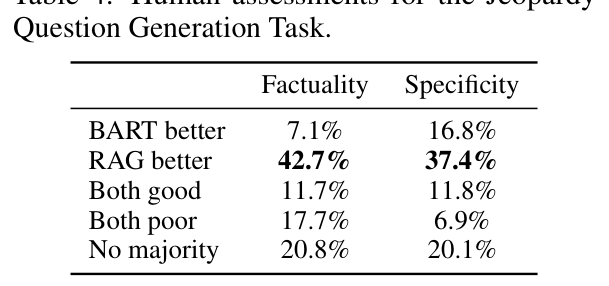
Paper's Table 4 (caption: "Human assessments for the Jeopardy Question Generation Task."). Evaluators rate RAG more factual in 42.7% of pairs vs BART in 7.1%, and more specific 37.4% vs 16.8% — direct human evidence for the "more factual, more specific" claim, not just an automatic metric.
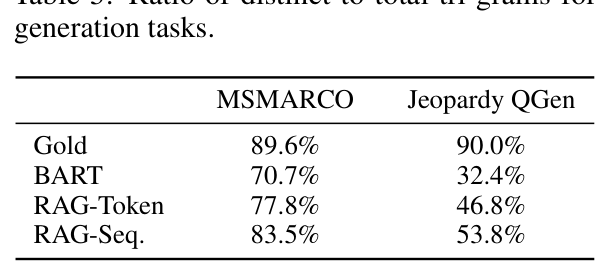
Paper's Table 5 (caption: "Ratio of distinct to total tri-grams for generation tasks."). RAG-Sequence is the most diverse (Jeopardy 53.8% vs BART 32.4%) with no diversity-promoting decoding — grounding on varied retrieved documents naturally spreads the output distribution.
Ablations — is learned retrieval actually doing work?
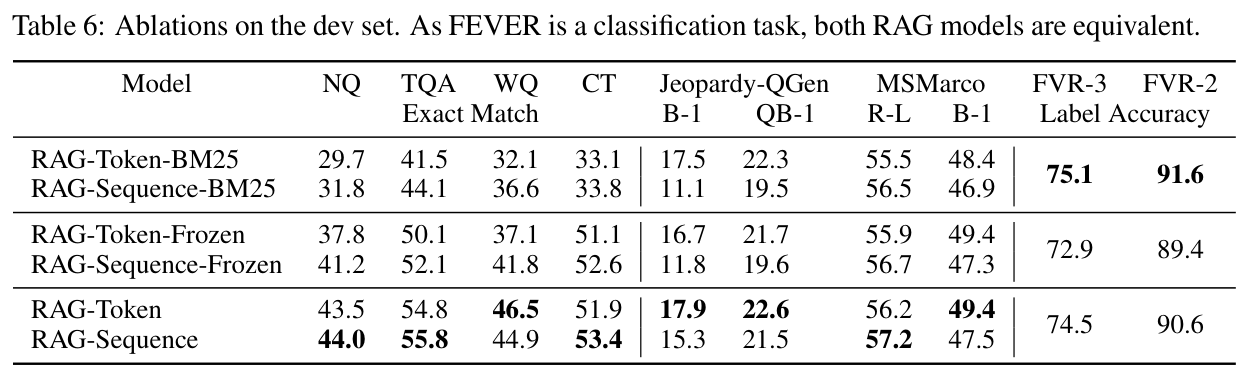
Paper's Table 6 (caption: "Ablations on the dev set. As FEVER is a classification task, both RAG models are equivalent."). Learned dense retrieval beats both the frozen retriever and BM25 on every task except FEVER, where lexical BM25 wins (entity-centric claims favor word overlap). This is the key ablation: it proves the query-encoder gradient (§4 check 4) is contributing signal — the model is genuinely learning to retrieve, it is not riding on the pre-trained DPR init alone.
The per-token document posterior for the "Hemingway" Jeopardy case (Fig. 2 in L1) shows the posterior sharpening on the document that names each book title, then flattening after the first title token — evidence that RAG-Token pulls the salient fact from retrieval, then lets BART's parametric memory complete the entity. This is the clearest mechanistic picture of parametric/non-parametric cooperation in the paper.
6. 论证链 #
| # | Step | Support (paper-internal) |
|---|---|---|
| 1 | Parametric-only LMs store knowledge but can't revise/inspect it and hallucinate; prior hybrids are extractive-only. | §1 motivation; contrast with REALM/ORQA. |
| 2 | Therefore couple a generative seq2seq (BART) with a dense-retrieval non-parametric memory (DPR index), treating the document as a latent variable marginalized end-to-end. | §2 model definitions; Fig. 1. |
| 3 | Train the marginal NLL with document encoder + index frozen (only query encoder + BART updated), avoiding REALM's index-refresh cost. | §2.4 objective; frozen-encoder choice. |
| 4 | On open-domain QA this generative recipe sets SotA, beating extractive readers and closed-book T5-11B. | Table 1. |
| 5 | On generation it beats BART on automatic metrics and human factuality/specificity/diversity judgments. | Tables 2, 4, 5. |
| 6 | Ablations show learned dense retrieval (not just the DPR init) drives the gains on QA, and the frozen index is hot-swappable to update world knowledge without retraining. | Table 6; index hot-swap 70/68 vs 12/4. |
7. 实现 cross-reference #
Official reference implementation is open-sourced in HuggingFace Transformers (the original was Fairseq; ported post-submission to equivalent performance). Repository present in the working tree.
(If the exact line numbers differ by version, the two modeling_rag.py classes RagSequenceForGeneration and RagTokenForGeneration implement the two §4 marginals directly.) Marker for anything not traceable: none required — [实现未公开] does not apply, code is public.
核心技术壁垒 (dedicated paragraph). The reproducibility crux is the frozen-document-encoder decision. A naive reimplementation following REALM would make $\text{BERT}_d$ trainable and rebuild the 21M-vector index every few hundred steps — enormous engineering and compute. RAG's claim (§2.4, ablation Table 6 "Frozen" rows are worse, but the main rows keep $\text{BERT}_d$ frozen and train only $\text{BERT}_q$) is that this is unnecessary: you initialize both encoders from a pre-trained DPR checkpoint, freeze the document side and its FAISS index, and let only the query encoder move. Missing this and either (a) freezing both encoders or (b) trying to train the document side, will either underperform (frozen query) or blow the compute budget (trained doc). The subtlety is that "Frozen" in Table 6 means the query encoder is frozen too — the headline models still learn query-side retrieval, which is the source of most of the QA gain.
关键实现细节 (easy-to-miss tricks).