An Adaptive Placement and Parallelism Framework for Accelerating RLHF Training
An Adaptive Placement and Parallelism Framework for Accelerating RLHF Training #
Youshao Xiao, Zhenglei Zhou, Fagui Mao, Weichang Wu, Shangchun Zhao, Lin Ju, Lei Liang, Xiaolu Zhang, Jun Zhou | 2023-12 | https://arxiv.org/abs/2312.11819 Category: framework | Tags: RLHF, placement, parallelism, distributed-training, scheduling Read: 2026-04-16
Core Contribution #
FlexRLHF提出两种模型放置策略(Interleaving和Disaggregated),打破RLHF训练中四个模型Co-located在所有设备上的固定范式,通过精细化的设备分配和训练/推理运行时解耦,在大规模场景下实现最高11×的吞吐量提升。
粗读 #
核心三问 #
- Q1: 这篇论文试图解决什么核心痛点?
RLHF训练涉及4个相互依赖的模型(Actor、Critic、Ref、Reward),现有框架(DeepSpeed-Chat、trlX)采用Co-located策略将所有模型放在每张卡上,导致内存冗余严重、通信开销大、Generation阶段成为瓶颈(占85%+时间),训练效率极低。
Figure 1: RLHF Workflow and Stage Duration #
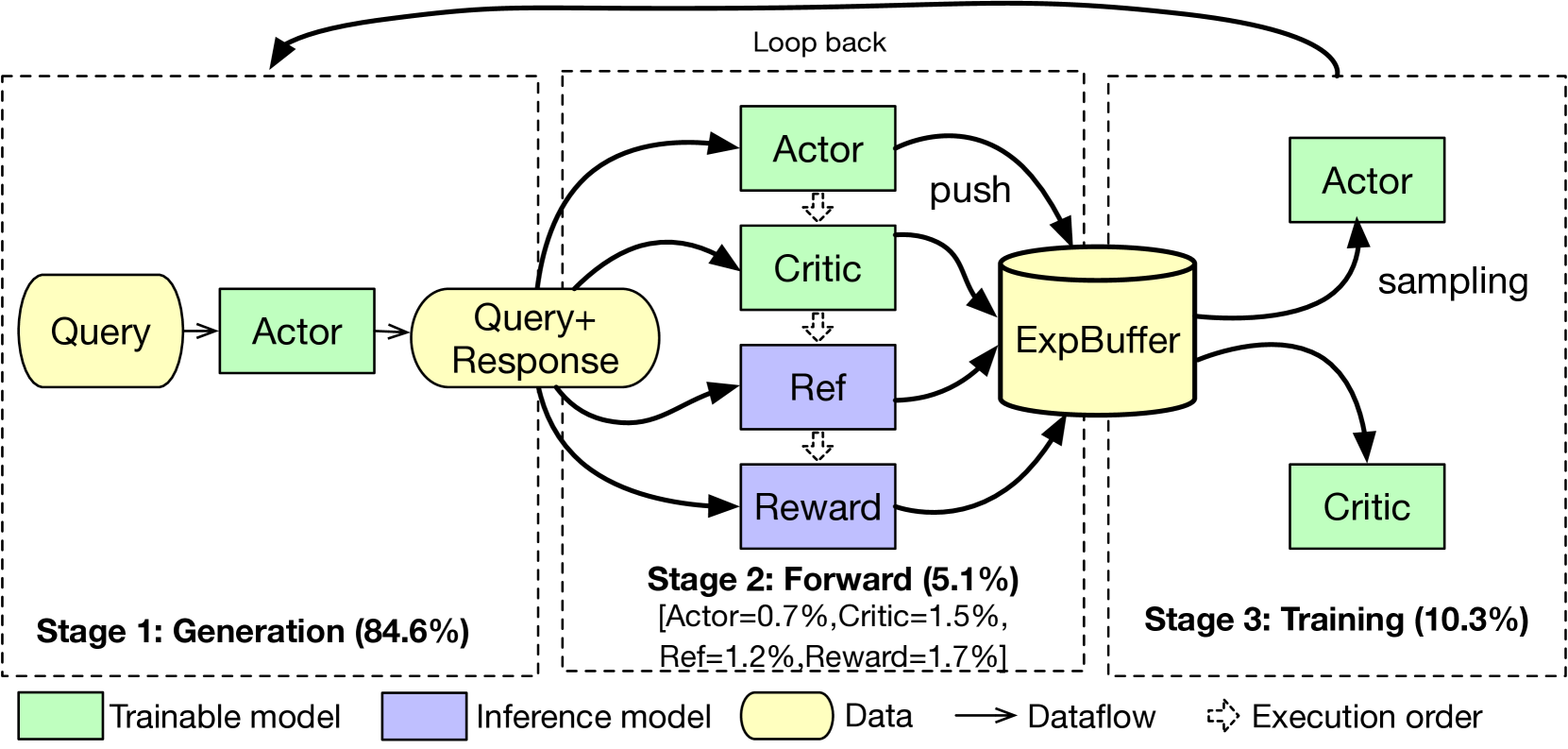
What it shows: RLHF的三阶段流水线(Generation→Forward→Training)及各阶段耗时占比——Generation占84.6%,Forward占5.1%(其中Actor 0.7%, Critic 1.5%, Ref 1.2%, Reward 1.7%),Training占10.3%。
Why it matters: 直观展示Generation阶段占85%以上时间的瓶颈问题,这是全文motivation的核心依据。图中绿色=trainable model(Actor/Critic),紫色=inference-only model(Ref/Reward),四个模型在三阶段的角色差异为后续放置策略优化提供了依据。
- Q2: 作者提出了什么新的"杀手锏"方法?
两种灵活的模型放置策略:(1) Interleaving策略 — 将无依赖关系的Ref和Reward模型分别放在不同设备组上,减半内存冗余和通信参与者;(2) Disaggregated策略 — 引入Shadow Actor/Critic模型,物理分离训练和推理运行时,允许对Generation阶段使用专门的推理优化(如TP+vLLM),并支持异构GPU。核心区别于Co-located:不再"一视同仁",而是按模型特性和阶段特性差异化放置。
- Q3: 最终效果如何?
Disaggregated策略在65B模型+16×8 GPU场景下达到11×加速(vs DeepSpeed-Chat);Interleaving策略在AC-Share结构下对比trlX达到11×加速(4×8 GPUs, 7B模型)。Generation阶段时间占比从93%降至56%。
逻辑故事还原 #
- 背景 (Context):
RLHF的PPO训练需要4个模型(Actor、Critic、Ref、Reward)协同工作,经历Generation→Forward→Training三阶段。现有框架把四个模型"绑在一起"放在每张卡上(Co-located策略),就像让四个厨师都挤在同一个小厨房里做不同的菜 — 空间浪费(内存冗余)、互相干扰(通信开销)、最慢的工序(Generation占85%)决定了整体速度。
- 破局 (Insight):
作者的"aha moment"是:这四个模型并非都需要出现在每张卡上。Ref和Reward模型在Forward阶段完全独立,可以放在不同的设备组上并行执行;Actor/Critic在训练时和推理时的资源需求完全不同(训练要optimizer state,推理只要参数)。这就像一个工厂发现"装配线"和"质检线"不需要共享所有工具 — 分开布置反而更高效。
👉 类比:Co-located就像所有人共用一个超大办公室;Interleaving是给不同团队分配专属会议室;Disaggregated是把研发部门(训练)和测试部门(推理)搬到不同楼层,各自用最适合的设备。
- 拆解 (Deconstruction):
- 分析依赖关系:识别出Ref和Reward在Forward阶段无数据依赖,Actor/Critic在训练阶段无同步需求
- Interleaving策略:将Ref和Reward分配到不同设备组(各占50%设备),通过AllGather/AlltoAll进行少量数据交换,但用计算-通信重叠隐藏开销
- Disaggregated策略:创建Shadow Actor/Critic副本专门做推理,与训练模型物理分离到不同设备组;推理设备用TP+DP,训练设备用ZeRO/Megatron;通过micro-batching pipeline化执行隐藏bubble
- Execution Engine抽象:通过Model Placement Ratio(0~1的比例值)简化配置,自动处理设备映射和中间数据通信
- 异构支持:Disaggregated策略允许将推理模型放在低端GPU(如V100)上,训练模型放在高端GPU(如A100)上
Figure 2: Model Placement Strategies Architecture #
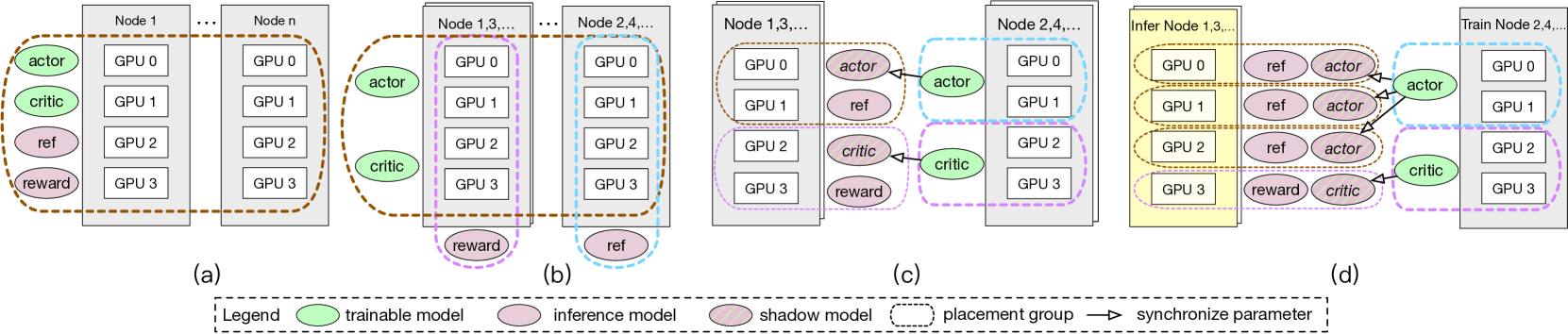
What it shows: 四种放置策略对比 — (a) Co-located:四个模型绑定在所有设备上, (b) Interleaving:Ref和Reward分配到不同设备组, (c) Disaggregated同构:Shadow Actor/Critic分离到专用推理设备, (d) Disaggregated异构:推理模型放在低端GPU(V100),训练放高端GPU(A100)。
Why it matters: 论文最核心的架构图,一图说清三种策略的本质区别——从"全员共享"到"按需分离"。注意(c)(d)中的虚线椭圆表示Shadow模型,箭头表示参数同步方向。
Key Tables #
Table I: Interleaving vs Co-located (AC-NonShare, DeepSpeed-Chat) #
| # GPUs | Strategy | 7B | 13B | 33B | 65B |
|---|---|---|---|---|---|
| 8 | DeepSpeed-Chat | 16.12 | 7.32 | 0.69 | OOM |
| 8 | Interleave₁ | 17.35 | 7.63 | 0.69 | OOM |
| 2×8 | DeepSpeed-Chat | 32.15 | 15.35 | 0.64 | 0.14 |
| 2×8 | Interleave₁ | 34.70 | 15.66 | 0.64 | 0.14 |
| 2×8 | Interleave₂ | 18.27 | 8.27 | 0.97 | 0.24 |
| 4×8 | DeepSpeed-Chat | 61.95 | 28.60 | 0.93 | 0.20 |
| 4×8 | Interleave₁ | 69.44 | 28.54 | 0.95 | 0.20 |
Takeaway: Interleave₁在小模型(7B/13B)上有7-12%提升;Interleave₂在大模型(33B/65B)+ZeRO-3场景下提升52-71%,因为将Actor限制在单节点内避免了跨节点AllGather。
Table II: Disaggregated vs DeepSpeed-Chat (AC-NonShare) #
| # GPUs | Strategy | 33B | 65B |
|---|---|---|---|
| 4×8 | DeepSpeed-Chat | 0.93 | 0.20 |
| 4×8 | Disaggregated | 4.76 | 1.75 |
| 16×8 | DeepSpeed-Chat | 2.11 | 0.55 |
| 16×8 | Disaggregated | 10.07 | 6.80 |
Takeaway: Disaggregated策略在大规模场景下碾压式领先,65B@16×8达到11×加速。核心来源于将Generation解耦后可使用节点内TP,避免ZeRO-3的跨节点通信。
Table V: Interleaving vs trlX (AC-Share, Scalability) #
| # GPUs | trlX | Interleaving | Speedup |
|---|---|---|---|
| 1×8 (7B) | 6.21 | 27.27 | 4.4× |
| 2×8 (7B) | 7.76 | 54.71 | 7.1× |
| 4×8 (7B) | 8.87 | 109.18 | 12.3× |
| 1×8 (13B) | 2.22 | 11.76 | 5.3× |
| 4×8 (13B) | 4.24 | 46.16 | 10.9× |
Takeaway: trlX的单卡Reward瓶颈在扩展时完全暴露——设备数增加但吞吐几乎不变。FlexRLHF近乎线性扩展。
关键细节与启示 #
- 技术细节补充:
- Disaggregated策略利用PPO的off-policy特性——训练阶段从buffer采样,不需要与forward阶段严格同步,因此Shadow模型的参数可以周期性同步而非实时同步,这不是异步训练,不影响模型收敛。
- Interleaving策略中新增的AllGather和AlltoAll通信开销可以通过计算-通信流水线重叠(不同CUDA stream)来近乎完全隐藏。
- 一句话总结: FlexRLHF通过打破"四个模型放在每张卡上"的固有范式,用Interleaving减内存冗余、用Disaggregated解耦训练推理运行时,在大规模RLHF训练中实现最高11×加速,思路简洁但效果惊人。
Summary #
RLHF训练涉及4个模型(Actor、Critic、Ref、Reward)的复杂协同,现有框架采用Co-located策略将所有模型放在每个设备上,导致内存冗余和通信开销严重,且Generation阶段成为性能瓶颈(占85%+时间)。
FlexRLHF提出两种创新的模型放置策略:(1) Interleaving策略将无依赖的Ref和Reward模型放在不同设备组,减半内存冗余和通信参与者数;(2) Disaggregated策略引入Shadow Actor/Critic模型,将训练和推理物理分离到不同设备组,允许各自使用最优的并行策略(训练用ZeRO/Megatron,推理用TP+DP)。框架通过Model Placement Ratio抽象简化配置,支持异构GPU集群。
实验在Llama 7B-65B模型、A100集群上验证,Disaggregated策略在65B@16×8 GPU配置下达到11×加速(vs DeepSpeed-Chat),Generation阶段占比从93%降至56%。对比trlX的AC-Share结构,Interleaving策略在4×8 GPU下实现12×加速,得益于消除了trlX的单卡Reward瓶颈。
Key Findings #
- Interleaving策略在7B模型上减少50%内存冗余,最大batch size从24提升至36,吞吐提升7-12%
- Interleave₂在大模型+ZeRO-3场景下将Actor限制在单节点内,避免跨节点AllGather,65B模型加速71%
- Disaggregated策略通过训练/推理运行时解耦,在33B@4×8下加速4×,65B@16×8下加速11×
- Generation阶段时间占比从93.31%降至56%(AC-NonShare, 33B, 4×8 GPUs)
- trlX的单卡Reward瓶颈在扩展时完全暴露:4×8 GPU时trlX仅8.87 samples/sec,FlexRLHF达109.18
- 异构Disaggregated策略(A100+V100混合)在33B上实现14.49%额外加速
Limitations #
- 仅在PPO算法上验证,未扩展到DPO、GRPO等新型RLHF变体
- Disaggregated策略需要额外GPU内存存放Shadow模型,不适合资源受限场景(小集群+小模型)
- 异构GPU实验仅做了A100+V100的小规模验证(14.49%提升),加速效果有限
- 所有实验使用相同大小的Actor/Critic/Ref/Reward模型,未验证不同大小模型混合的常见实际场景
- 缺乏与OpenRLHF等后续框架的对比(论文发表时间较早)
- 未讨论Shadow模型同步频率对模型收敛质量的影响和最优策略
- 序列长度固定为256(输入+输出),未验证长序列场景的表现
- 未提供开源实现
Infrastructure Impact #
- Algorithm: 为PPO-based RLHF提供了高效的分布式训练范式,但未涵盖DPO/GRPO等offline方法,这些方法正在逐步替代PPO
- Kernel: 未引入自定义kernel,依赖DeepSpeed/Megatron/vLLM的现有实现,但Disaggregated策略天然支持接入任何推理引擎的kernel优化
- Framework: 直接贡献——提出的Model Placement Ratio抽象是RLHF框架设计的关键创新,影响了后续OpenRLHF等系统的设计思路
- LLM: 在Llama 7B-65B上验证,理论上支持任何Transformer架构,但未验证MoE等特殊结构
- Agent: N/A — 纯训练框架,不涉及推理serving或agent系统
Deep Analysis (framework) #
1. System Scope #
- Primary goal: 分布式RLHF训练加速(fine-tuning阶段),专注PPO算法的训练效率
- Scale: 分布式,实验覆盖1-16个DGX A100节点(8-128 GPUs),支持异构集群扩展
- Online/Offline: Offline throughput-optimized。纯训练系统,无serving延迟约束
- Target workload: LLM的RLHF/PPO训练,涉及4个模型的复杂调度(Actor, Critic, Ref, Reward),支持AC-Share和AC-NonShare两种架构
2. Architecture & Data Flow #
2a. End-to-End Data Flow #
[Prompt Dataset] → [Generation Stage] → [Forward Stage] → [Training Stage] → [Model Update]
                     ↓ Actor.generate()    ↓ All 4 models    ↓ Actor + Critic
                     ↓ Auto-regressive     ↓ forward          ↓ PPO loss
                     ↓ 85%+ total time     ↓ ~5% time         ↓ ~10% time
Co-located策略下的数据流:
| Stage | Input → Output | Location | Communication | Duration % |
|---|---|---|---|---|
| Generation | Prompts → Responses | All GPUs (Actor) | AllGather params in ZeRO-3 | ~85% |
| Actor Forward | (Q,R) → logits | All GPUs | ZeRO comm | ~2% |
| Ref Forward | (Q,R) → ref_logits | All GPUs | ZeRO comm | ~2% |
| Reward Forward | (Q,R) → scores | All GPUs | ZeRO comm | ~1% |
| Critic Forward | (Q,R) → values | All GPUs | ZeRO comm | ~1% |
| Experience Buffer | All outputs → buffer | CPU/GPU memory | None | negligible |
| Actor Training | Buffer batch → grad update | All GPUs | ZeRO allreduce | ~5% |
| Critic Training | Buffer batch → grad update | All GPUs | ZeRO allreduce | ~5% |
Figure 3: Co-located vs Interleaving Execution Timeline #
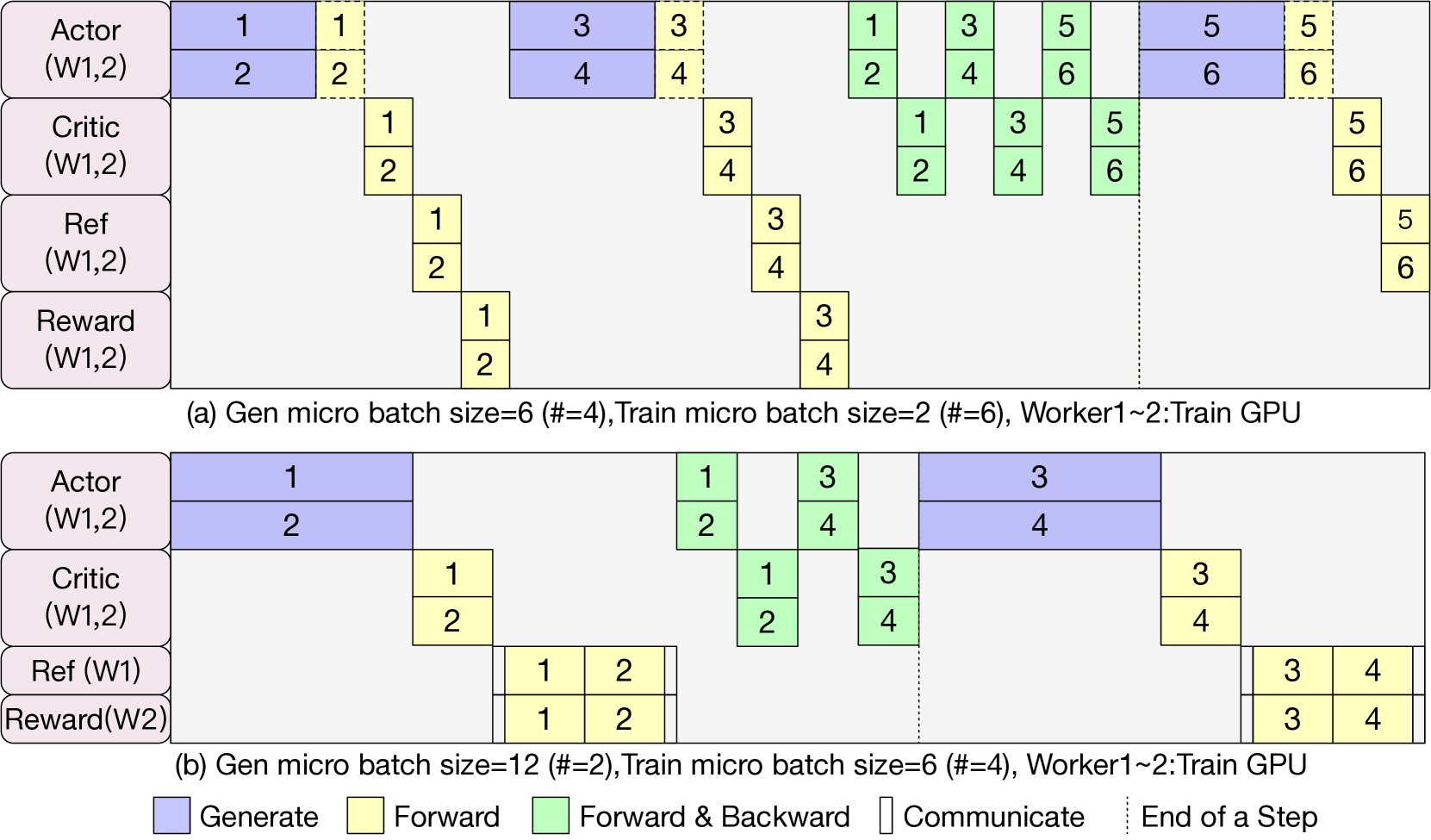
What it shows: (a) Co-located策略下所有模型在W1、W2两个设备上的执行时间线——Ref和Reward均占两个Worker,batch size=6。(b) Interleaving策略将Ref放W1、Reward放W2后的时间线——batch size提升至12,Ref和Reward并行执行。颜色编码:蓝=Generate,黄=Forward,绿=Forward & Backward。
Why it matters: 直观展示Interleaving的两个加速来源:(1) Ref/Reward各只需一个设备,内存冗余减半,batch size翻倍;(2) Ref和Reward在不同设备上并行执行Forward,无需设备间通信。注意(b)中Ref(W1)和Reward(W2)的Forward块完全并行。
Disaggregated策略下的数据流:
| Stage | Input → Output | Location | Communication |
|---|---|---|---|
| Generation | Prompts → Responses | Inference GPUs (Shadow Actor, TP+DP) | Intra-node TP only |
| Forward | (Q,R) → all outputs | Inference GPUs (Shadow Actor/Critic + Ref + Reward) | P2P within inference group |
| Data Transfer | Experience data → Training GPUs | Cross-group | P2P send/recv |
| Training | Buffer → grad update | Training GPUs (Actor + Critic, Megatron) | Intra-group ZeRO/TP |
| Param Sync | Trained params → Shadow models | Cross-group | Broadcast/P2P (periodic) |
Figure 4: Disaggregated Strategy Execution Timeline #
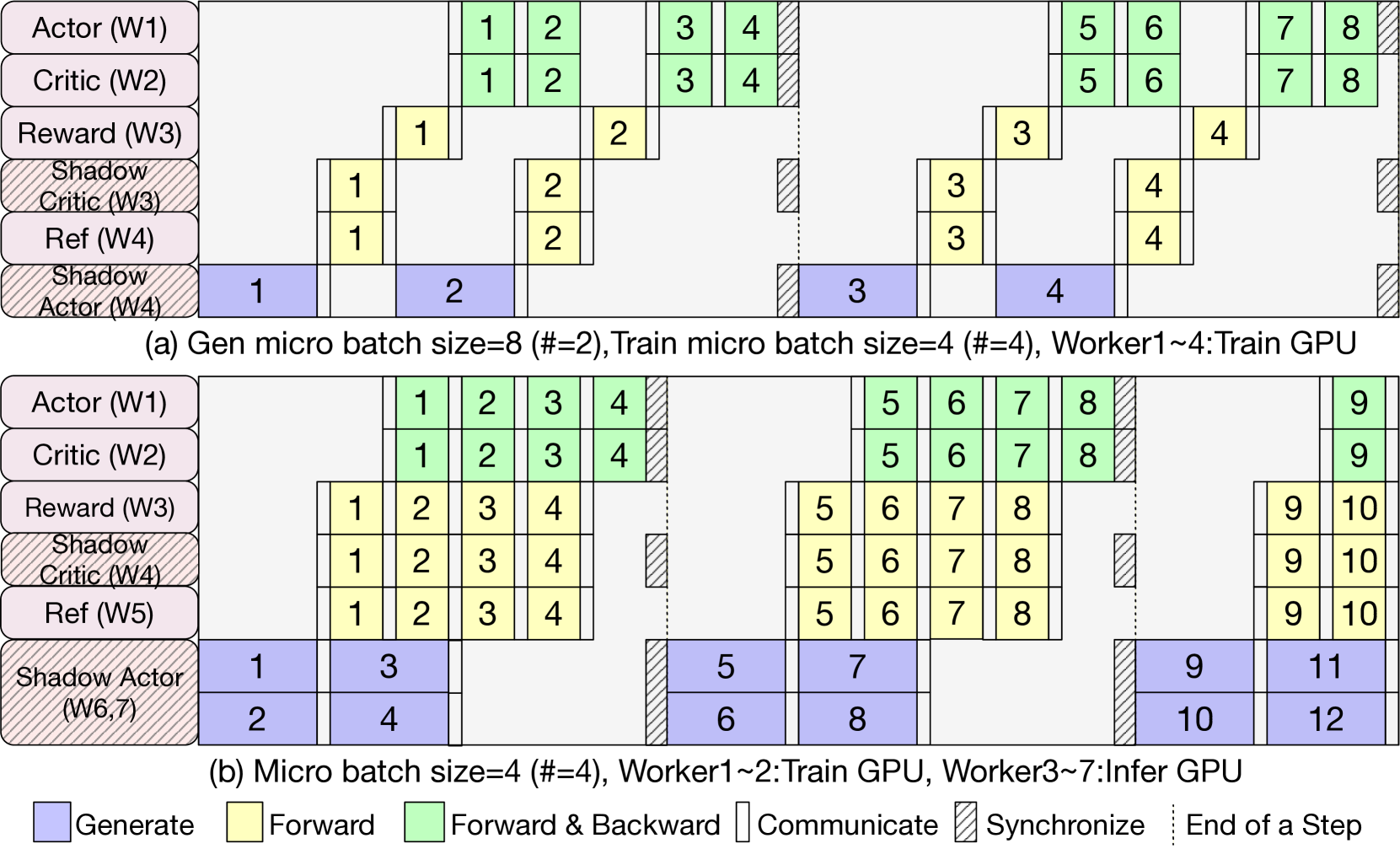
What it shows: (a) 同构Disaggregated策略——W1-W2为训练设备,W3-W4为推理设备(含Shadow Actor/Critic、Ref、Reward)。Generation(G)和Training(F&B)通过micro-batching pipeline化执行。(b) 异构Disaggregated策略——更大规模(7个Worker),Shadow Actor独占W6-W7,展示12个micro-batch的pipeline调度。斜线填充=Shadow模型。
Why it matters: 展示Disaggregated策略的核心机制——训练和推理物理分离后可以pipeline并行执行。(a)中bubble几乎被micro-batching完全隐藏(G1/G2完成后F1/F2立即开始,无需等待G3/G4)。灰色斜线块=参数同步开销,仅在每轮PPO训练后执行一次。
2b. Data Movement Hotspots #
- ZeRO-3 AllGather during Generation (Co-located): 每次Generation需要AllGather完整模型参数到每张卡,对65B模型约130GB参数。频率:每个Generation step一次。Disaggregated策略完全消除此开销——Shadow Actor使用TP,参数常驻。
- Interleaving策略的AllGather+AlltoAll: Ref/Reward模型在Forward前需要AllGather收集所有(Q,R)数据,Forward后AlltoAll分发结果。频率:每rollout step一次。通过计算-通信重叠隐藏。
- Disaggregated的P2P Experience Transfer: 推理设备→训练设备的experience数据传输。频率:每micro-batch一次。通过pipeline化执行与计算重叠。
- Batch formation: 静态batch,最大化内存利用(填到95%内存上限前停止)。不同策略下最大batch size不同。
- Memory management: 依赖底层框架(DeepSpeed ZeRO / Megatron)的内存管理。Interleaving策略的核心价值就是通过减少每设备模型数来释放内存。
- GPU utilization: Co-located策略下训练模型在Generation阶段大量idle但占用内存;Disaggregated通过物理分离消除这种浪费。Pipeline micro-batching进一步减少bubble。
- Multi-tenancy: 不支持。单训练任务独占集群。
- Priority/SLO-aware: 无。纯throughput优化,无延迟约束。
- 7B-13B: Memory-bound(内存冗余限制batch size)→ Interleaving解决
- 33B-65B: Communication-bound(ZeRO-3跨节点AllGather)→ Disaggregated + 节点内TP解决
- 异构: Communication-bound(不同GPU间以太网带宽低)→ Disaggregated隔离通信域
- AC-Share: Scheduling-bound(单卡Reward瓶颈)→ Interleaving分布式化Reward
- Baseline公平性: 对比DeepSpeed-Chat和trlX,使用相同硬件、模型、数据集,公平性可接受
- 但存在问题:
- DeepSpeed-Chat的Hybrid Engine本身实现可能不是最优的(它也在持续改进)
- trlX将Reward放在单卡是一个明显的设计缺陷,FlexRLHF赢得太容易
- 未对比Colossal-AI的RLHF实现、后来的OpenRLHF等
- 序列长度固定256,现代RLHF通常用2048+
- 所有模型同大小的假设不太实际(Reward模型通常比Actor小得多)
- Baseline何时胜出: Co-located在极小规模(单卡、小模型)时因无额外通信开销可能更优;Interleave₁在大模型+ZeRO-3时无效(Table I中33B/65B与baseline相同)
- API: 自定义Python API,非标准化。通过Model Placement Ratio ([1, 1, 0.5, 0.5]) 配置策略
- Model support: 基于PyTorch + DeepSpeed/Megatron,支持HuggingFace格式
- Deployment: 需要在DGX集群上部署,依赖NCCL/InfiniBand
- Configuration: 需要设定4个模型各自的placement ratio + 每个模型的parallelism策略 + batch size。虽然提供了guideline,但仍有较多knobs需要调优
- 资源有限 → Interleaving(Ref/Reward可放单节点时)或 Co-located
- 资源充足 → Disaggregated(30-50%设备给Shadow Actor)
- 异构集群 → Heterogeneous Disaggregated(低端GPU做推理,高端做训练)
- Open source: 未开源,这是最大的限制。论文来自蚂蚁集团,可能作为内部训练基础设施使用
- Community: 无公开社区。论文被引用约50次(截至2025),主要作为RLHF系统设计的reference
- Production: 论文提到在蚂蚁集团内部使用,但无公开的production deployment案例
- Adoption barrier:
- 未开源,无法直接复现或使用
- 核心思想(训练-推理分离、灵活placement)已被OpenRLHF等开源框架吸收
- 如今RLHF训练更多采用DPO/GRPO等不需要4模型的方法,PPO的重要性相对降低
- Historical significance: 作为较早系统性分析RLHF分布式训练效率问题的工作,其Interleaving和Disaggregated的思想有持续影响力。特别是"训练-推理运行时分离"的理念已成为后续系统的标配
Control plane vs Data plane: 未明确分离。Execution Engine作为control plane管理设备分配和通信拓扑;模型计算和数据传输为data plane。
Failure handling: 论文未讨论容错机制,这是一个明显缺失。
3. Key Innovations #
| Innovation | Mechanism | Benefit | Cost/Tradeoff |
|---|---|---|---|
| Interleaving Placement | 将无依赖模型(Ref/Reward)放在不同设备组,各占50%设备 | 减半内存冗余,减少ZeRO通信参与者,增大batch size | 新增AllGather+AlltoAll通信(但可被重叠隐藏);大模型+ZeRO-3时Interleave₁无效 |
| Disaggregated Placement | 创建Shadow Actor/Critic用于推理,物理分离训练和推理到不同设备组 | Generation可用TP代替ZeRO-3 AllGather,训练/推理pipeline并行 | 需额外GPU内存存放Shadow模型;需周期性参数同步;不适合小规模场景 |
| Model Placement Ratio | 用0-1比例值配置每个模型的设备分配比例,自动生成设备映射 | 用户只需设[1,1,0.5,0.5]即可配置Interleaving | 最优比例仍需手动调优或依赖guideline |
| Pipeline Micro-batching | Disaggregated策略中Generation/Forward/Training按micro-batch pipeline执行 | 隐藏bubble开销,提高设备利用率 | 增加实现复杂性;micro-batch数需调优 |
| Heterogeneous Device Support | Disaggregated分离后,推理模型可放低端GPU(V100),训练放高端GPU(A100) | 利用闲置异构资源,降低成本 | 不同GPU间只能用以太网连接,通信受限;实验仅14.49%提升 |
4. Scheduling & Resource Management #
批判性评价: 调度仍然较为静态——设备分组和比例在训练前确定,运行时不动态调整。如果不同stage的workload随训练进度变化(如Generation越来越快或慢),无法自适应调节资源分配。
5. Target Scenarios #
| Scenario | Workload Pattern | Goal | Why existing fails |
|---|---|---|---|
| 中小模型RLHF (7B-13B) | 4模型全放单节点/少节点 | 最大化throughput | Co-located浪费内存冗余 |
| 大模型RLHF (33B-65B) 同构 | 多节点,ZeRO-3必须 | 最大化throughput | ZeRO-3跨节点AllGather开销巨大 |
| 大模型RLHF 异构 (A100+V100) | 混合GPU集群 | 利用闲置资源 | Co-located无法在异构GPU上运行 |
| AC-Share结构 | Reward模型需独立放置 | 消除单卡瓶颈 | trlX把Reward放单卡,扩展性差 |
Primary bottleneck per scenario:
6. Performance Evaluation #
6a. Metrics #
| Metric | Definition | Unit | Higher/Lower |
|---|---|---|---|
| Sample Throughput | 端到端每秒处理的样本数 | samples/sec | Higher |
| Maximum Batch Size | 不OOM情况下最大可用batch size | # samples | Higher |
| Generation Stage Duration % | Generation阶段占总时间的比例 | % | Lower |
批判: 指标过于单一。缺少GPU utilization、通信占比、内存效率、cost/sample等关键指标。未报告P99延迟或per-step time breakdown。
6b. Before-After Comparison #
| Optimization | Metric | Baseline | After | Improvement | Conditions |
|---|---|---|---|---|---|
| Interleave₁ | Throughput | 16.12 | 17.35 | +7.6% | 7B, 8 GPUs, AC-NonShare, ZeRO-2 |
| Interleave₁ | Throughput | 61.95 | 69.44 | +12.1% | 7B, 4×8 GPUs, AC-NonShare |
| Interleave₂ | Throughput | 0.14 | 0.24 | +71% | 65B, 2×8 GPUs, ZeRO-3 |
| Disaggregated | Throughput | 0.93 | 4.76 | 5.1× | 33B, 4×8 GPUs, ZeRO-3 |
| Disaggregated | Throughput | 0.55 | 6.80 | 12.4× | 65B, 16×8 GPUs, ZeRO-3 |
| Disaggregated | Gen Stage % | 93.31% | 56% | -37pp | 33B, 4×8 GPUs |
| Interleaving (vs trlX) | Throughput | 6.21 | 27.27 | 4.4× | 7B, 1×8, AC-Share, GC-ON |
| Interleaving (vs trlX) | Throughput | 8.87 | 109.18 | 12.3× | 7B, 4×8, AC-Share, GC-ON |
| Interleaving (vs trlX) | Max Batch | 2 | 50 | 25× | 13B, AC-Share |
| Heterogeneous | Throughput | 0.69 | 0.79 | +14.5% | 33B, 8 A100 + 8 V100 |
6c. Bottleneck Shift Analysis #
Co-located baseline: Communication-bound (ZeRO-3 AllGather during Generation, 93% time)
  → After Interleaving: Still Generation-bound but reduced (fewer comm participants)
  → After Disaggregated: Generation reduced to 56%, Training becomes more visible
     Remaining bottleneck: Generation still dominant; pipeline bubble overhead; param sync cost
Figure 7: Generation vs Training Duration — Disaggregated vs DeepSpeed-Chat #
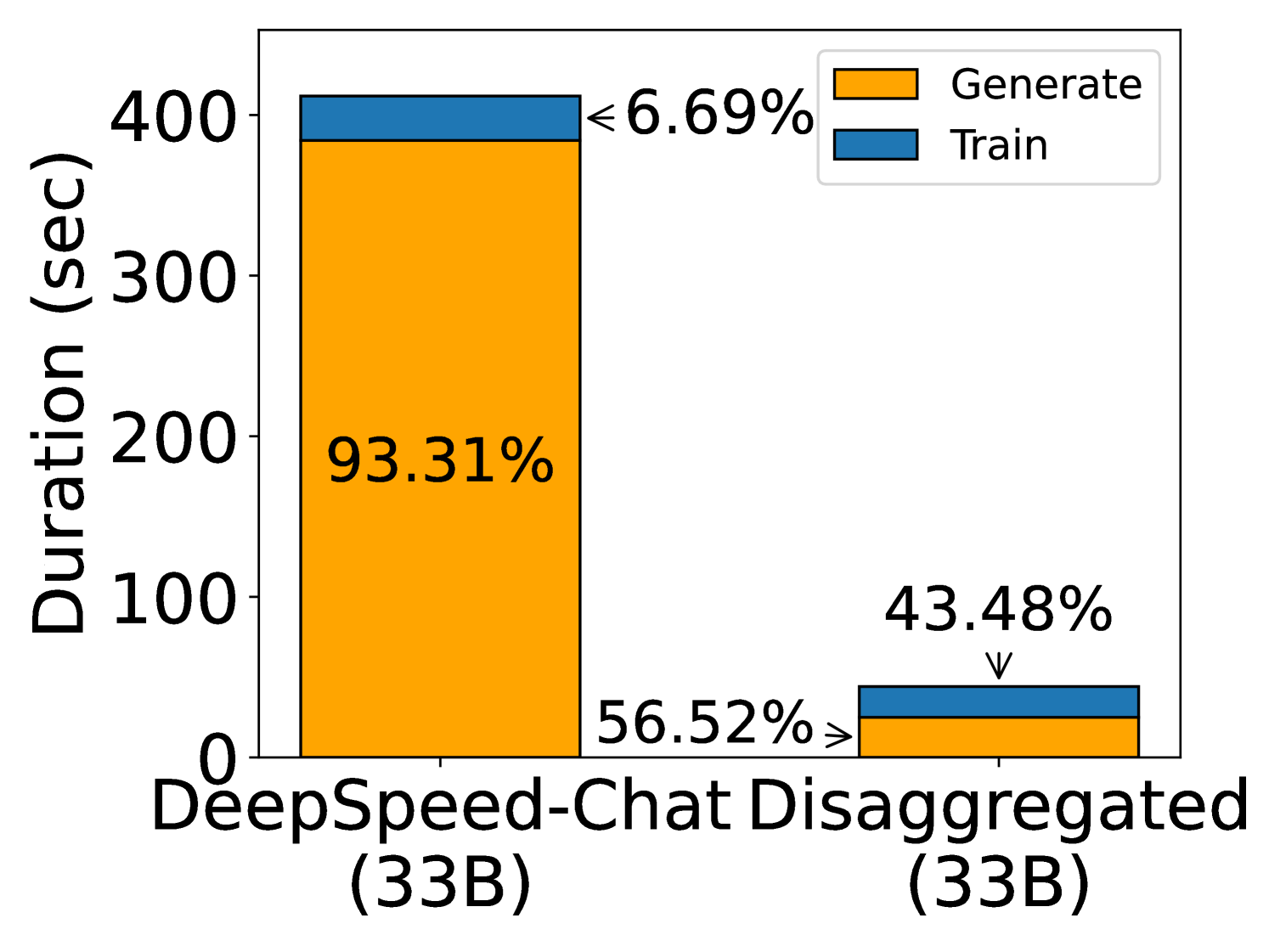
What it shows: AC-NonShare场景下Llama 33B在4×8 GPU上的per-step耗时分解。DeepSpeed-Chat:总耗时~400秒(Generation 93.31% + Training 6.69%)。Disaggregated策略:总耗时~30秒(Generation 56.52% + Training 43.48%)。
Why it matters: 最直观的加速效果图——Disaggregated策略将Generation从~370秒压缩到~17秒(约22×加速),总step时间从~400秒降至~30秒(约13×加速)。Generation占比从93%降至56%,bottleneck开始向Training转移,说明进一步优化需要同时关注两个阶段。
关键观察: Disaggregated策略成功地将Generation从93%降到56%,但并没有完全消除Generation瓶颈。进一步优化需要更强的推理引擎(如vLLM/SGLang的speculative decoding等)。
6d. Baselines & Fairness #
7. API & Usability #
Guideline总结:
8. Infrastructure Impact #
| Layer | Impact |
|---|---|
| Algorithm | 为PPO训练提供了高效分布式范式,但PPO正在被DPO/GRPO替代;Disaggregated的训练-推理分离思想对GRPO(也有generation阶段)同样适用 |
| Kernel | 不依赖自定义kernel,使用标准DeepSpeed/Megatron/vLLM kernel。Disaggregated策略的价值在于允许推理端自由选择最优kernel |
| LLM | 支持标准Transformer架构(Llama系列),MoE模型的支持未验证——MoE的expert parallelism会增加placement的复杂度 |
| Agent | N/A — 纯训练框架 |
| Ops | 缺乏自动化配置能力,需要人工根据guideline确定最优配置;无自动profiling或auto-tuning功能 |
9. Comparison Matrix #
| Feature | FlexRLHF | DeepSpeed-Chat | trlX | OpenRLHF (后发) |
|---|---|---|---|---|
| Model Placement | Interleaving + Disaggregated + Co-located | Co-located only | Co-located variant (Reward单卡) | Ray-based placement |
| Training-Inference分离 | ✅ (Disaggregated) | ❌ (Hybrid Engine混合) | ❌ | ✅ (vLLM integration) |
| 异构GPU支持 | ✅ | ❌ | ❌ | 部分支持 |
| Pipeline执行 | ✅ (micro-batching) | ❌ (sequential) | ❌ (sequential) | ✅ |
| AC-Share支持 | ✅ | ❌ | ✅ | ✅ |
| AC-NonShare支持 | ✅ | ✅ | ❌ | ✅ |
| 推理引擎集成 | Megatron TP | Hybrid Engine | HuggingFace | vLLM |
| 配置简易度 | 中等(Placement Ratio + guideline) | 低(自动但不灵活) | 低 | 高(Ray自动调度) |
| 开源 | ❌ | ✅ | ✅ | ✅ |
| 扩展性 (>64 GPU) | ✅ (tested 128 GPUs) | ✅ | ❌ (单卡瓶颈) | ✅ |
| 容错 | 未提及 | CheckPoint | 未提及 | CheckPoint |