RouteLLM: Learning to Route LLMs with Preference Data
RouteLLM: Learning to Route LLMs with Preference Data — L2 #
§1 TL;DR #
Trains lightweight routers on human preference data (Chatbot Arena) to dynamically route queries between strong (GPT-4) and weak (Mixtral) LLMs. Achieves >2× cost savings while maintaining >90% strong-model quality. Routers generalize across unseen model pairs without retraining.
§2 痛点 / 方法 / 结果 #
Q1 痛点 #
Deploying LLMs forces a hard trade-off between quality and cost. Strong models (e.g. GPT-4 at \$24.7/M tokens) deliver top-tier results but are prohibitively expensive at scale; weak models (e.g. Mixtral 8×7B at \$0.24/M tokens) are 100× cheaper but noticeably worse on complex queries. The price gap between Claude 3 Haiku and Opus alone is 60×. Prior routing approaches either (a) query multiple LLMs per request (LLM-Blender, FrugalGPT, AutoMix), inflating latency and cost, or (b) rely on synthetic labels from reward models that inherit training biases (Zooter), or (c) use a single router architecture without demonstrating out-of-distribution generalization (Hybrid-LLM).
Three desiderata for a practical router: (1) invoke exactly one LLM per query; (2) generalize to unseen query domains without per-domain retraining; (3) transfer across different strong/weak model pairs.
Q2 方法 #
Core idea: reframe model routing as a binary preference prediction problem. Given a query $q$, predict $P_{\bm{\theta}}(\text{win}_s \mid q)$ — the probability the strong model outperforms the weak model — then threshold at $\alpha$ to decide which model to call.
Training data: 80K pairwise human battles from Chatbot Arena. Models clustered into 10 tiers via dynamic programming on leaderboard scores; top 2 tiers → $\mathcal{M}_{\text{strong}}$, tier 2 → $\mathcal{M}_{\text{weak}}$. Only query text and winner identity are retained (no model responses).
Data augmentation (the key to OOD performance):
- Golden-label: ~1,500 MMLU validation questions with known answers; derive preference labels by comparing $M_s$ / $M_w$ correctness.
- LLM-judge: GPT-4 judges ~120K open-ended query pairs (leveraging Nectar dataset), costing only ~\$700.
Four router architectures spanning a cost–capacity spectrum:
| Router | Params | Training | Inference |
|---|---|---|---|
| SW Ranking | 0 (non-parametric) | None — solved at inference | 2.9 req/s (CPU) |
| Matrix Factorization | ~$d_q \times d_m$ | 10 epochs, 1×8GB GPU | 155 req/s (L4) |
| BERT classifier | 110M | 2K steps, 2×L4 | 70 req/s (L4) |
| Causal LLM (Llama 3 8B) | 8B | 2K steps, 8×A100 | 42 req/s (L4) |
核心技术壁垒: The decisive insight is that human preference data from Chatbot Arena already encodes query-difficulty signal — a query where the strong model wins is harder than one where weak ties. By clustering models into tiers, the paper overcomes label sparsity (raw pairwise coverage <0.1%) and learns a query-complexity classifier that transfers across model families. This is the hardest-to-replicate element: obtaining large-scale, debiased human preference data with broad model coverage.
Q3 结果 #
- MT Bench: best router (MF + augmentation) achieves CPT(50%) = 13.4% and APGR = 0.802 (+60.4% over random). At CPT(50%), quality is 95% of GPT-4 (8.8/9.3 score). Up to 3.66× cost savings.
- MMLU: augmentation with just ~1,500 golden-label samples drives CPT(50%) from ~50% to ~35% across all routers — a ~20% reduction in GPT-4 calls.
- GSM8K: augmentation flips all routers from below-random to above-random (Causal LLM: CPT(50%) = 33.6%, +25.3% improvement).
- Cross-model transfer: routers trained on GPT-4/Mixtral generalize to Claude 3 Opus/Sonnet and Llama 3.1 70B/8B without retraining, achieving comparable improvements (Table 4).
- Overhead: most expensive router (SW Ranking) adds <0.4% cost vs. GPT-4 generation.
§3 架构 / 方法图 #
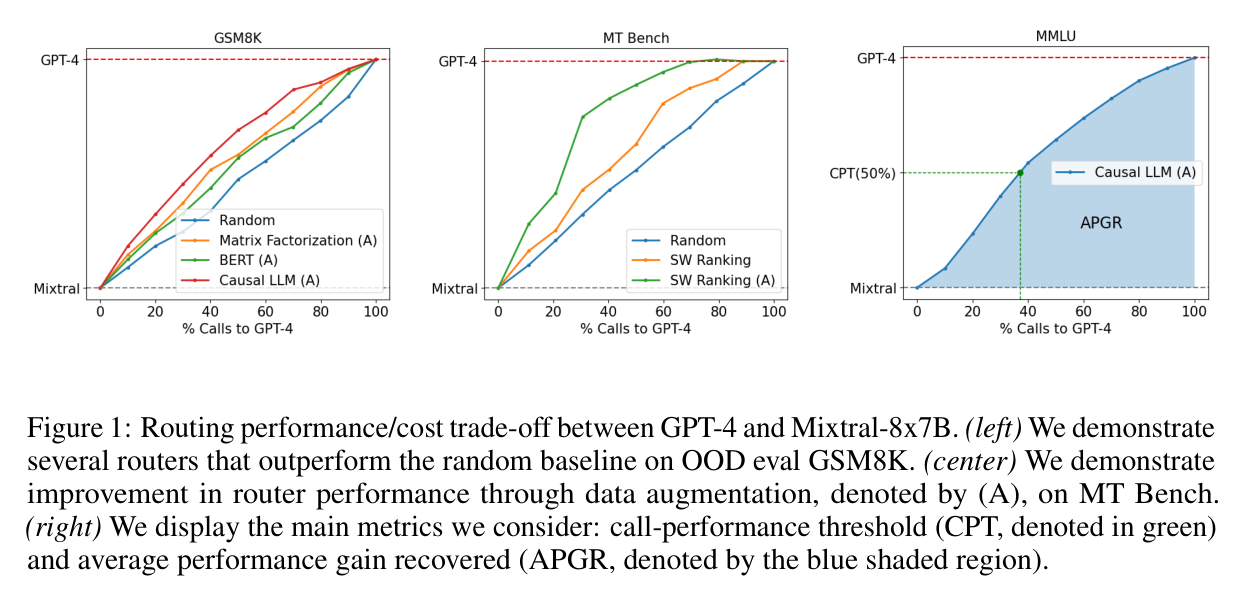
Paper Figure 1: (left) GSM8K — augmented routers outperform random baseline. (center) MT Bench — data augmentation (A) sharply improves routing. (right) MMLU — defines CPT (green) and APGR (blue shaded area).
The three subplots establish the paper's core visual argument: the call-performance curve (% calls to GPT-4 on x-axis, quality on y-axis) is the Pareto frontier for cost–quality trade-off. A router that hugs the upper-left corner dominates. The right subplot defines the two summary metrics: CPT(x%) = minimum strong-model call fraction to achieve x% PGR; APGR = area under the curve above the weak-model baseline.
Routing decision flow (no single architecture figure exists in the paper):
P(win_s | q)"] Router -->|"P ≥ α"| Strong["Strong Model
(GPT-4)"] Router -->|"P < α"| Weak["Weak Model
(Mixtral)"] subgraph Training Arena["Chatbot Arena
80K battles"] --> Tier["Tier clustering
(DP, 10 tiers)"] Tier --> Pref["Pref data D_pref"] Aug["Augmentation
(gold / judge)"] --> Pref Pref --> MLE["MLE: max Σ log P(l|q)"] MLE --> Router end
The router operates as a single binary gate: at serving time, the query is embedded, the router predicts $P_{\bm{\theta}}(\text{win}_s \mid q)$, and the threshold $\alpha$ determines the target model. No cascading, no multi-model queries — exactly one LLM call per request.
Interaction pattern: single-shot per query. No multi-turn state, no memory, no tool use. The router is a stateless classifier inserted before LLM inference in the serving pipeline.
§4 作者证明 #
无形式化作者证明 — 仅实证 #
The paper provides no formal convergence guarantees, optimality bounds, or theoretical analysis of routing error rates. All claims rest on empirical evaluation across three benchmarks and two transfer settings.
What could have been bounded: an upper bound on routing regret — the expected quality loss from misrouting — as a function of calibration error of $P_{\bm{\theta}}(\text{win}_s \mid q)$. If the win predictor is well-calibrated, the threshold policy is Bayes-optimal for binary routing. The paper does not establish calibration.
Notation table #
| Symbol | Meaning |
|---|---|
| $\mathcal{M}$, $\mathcal{M}_{\text{strong}}$, $\mathcal{M}_{\text{weak}}$ | Model set, strong tier, weak tier |
| $q \in \mathcal{Q}$ | User query |
| $l_{s,w} \in \{\text{win}_s, \text{tie}, \text{win}_w\}$ | Preference label |
| $P_{\bm{\theta}}(\text{win}_s \mid q)$ | Router's predicted probability strong model wins |
| $\alpha \in [0, 1]$ | Cost-quality threshold knob |
| $R^{\alpha}(q)$ | Routing decision function |
| $c(M_{R^{\alpha}})$ | Fraction of queries sent to strong model |
| $r(M_{R^{\alpha}})$ | Average response quality |
| $\text{PGR}$ | Performance Gap Recovered (quality metric, 0–1) |
| $\text{APGR}$ | Area under PGR curve (aggregate metric) |
| $\text{CPT}(x\%)$ | Minimum strong-call % to reach PGR = x% |
Key equations and physical meaning #
Eq. 1 — MLE objective: $\max_{\bm{\theta}} \sum_{(q, l_{s,w}) \in \mathcal{D}_{\text{pref}}} \log P_{\bm{\theta}}(l_{s,w} \mid q)$
Standard maximum likelihood over preference outcomes. The router learns to predict which queries the strong model wins on, purely from the query text — no model responses needed at training time.
Eq. 2 — Threshold routing: $R^{\alpha}(q) = \mathcal{M}_{\text{strong}}$ if $P(\text{win}_s \mid q) \geq \alpha$, else $\mathcal{M}_{\text{weak}}$.
Higher $\alpha$ → more aggressive cost cutting (more queries to weak model). Lower $\alpha$ → bias toward quality. The single scalar $\alpha$ serves as the operator's cost–quality knob at serving time, requiring no retraining to adjust.
Eq. 6 — PGR: $\text{PGR} = \frac{r(M_{R^{\alpha}}) - r(M_w)}{r(M_s) - r(M_w)}$
Normalized quality score: PGR = 1 matches the strong model; PGR = 0 matches the weak model. Enables comparison across benchmarks with different absolute score scales.
Eq. 7 — APGR: $\text{APGR} = \int_0^1 \text{PGR} \; d(c)$
Area under the call-performance curve. Captures the full Pareto trade-off in a single scalar. Random routing yields APGR = 0.5; a perfect oracle yields APGR = 1.0.
Agent-specific empirical checks #
- Success-rate model: the paper sweeps over (router architecture × augmentation data × benchmark), but not over task difficulty bins or backbone model sizes. Monotonicity holds along the augmentation axis (more data → better routing) but not along the router-capacity axis (MF often beats Causal LLM despite being far smaller).
- Latency per routing decision: Table 7 gives per-router throughput. MF at 155 req/s adds ~6.4 ms overhead per query, negligible vs. LLM generation latency.
- Failure mode classification: one dominant failure class — OOD distribution mismatch. All routers fall to random-or-worse on MMLU and GSM8K without domain-appropriate augmentation. The method specifically targets this via data augmentation, which is effective.
§5 实验与数据 #
5.1 Main results: MT Bench #
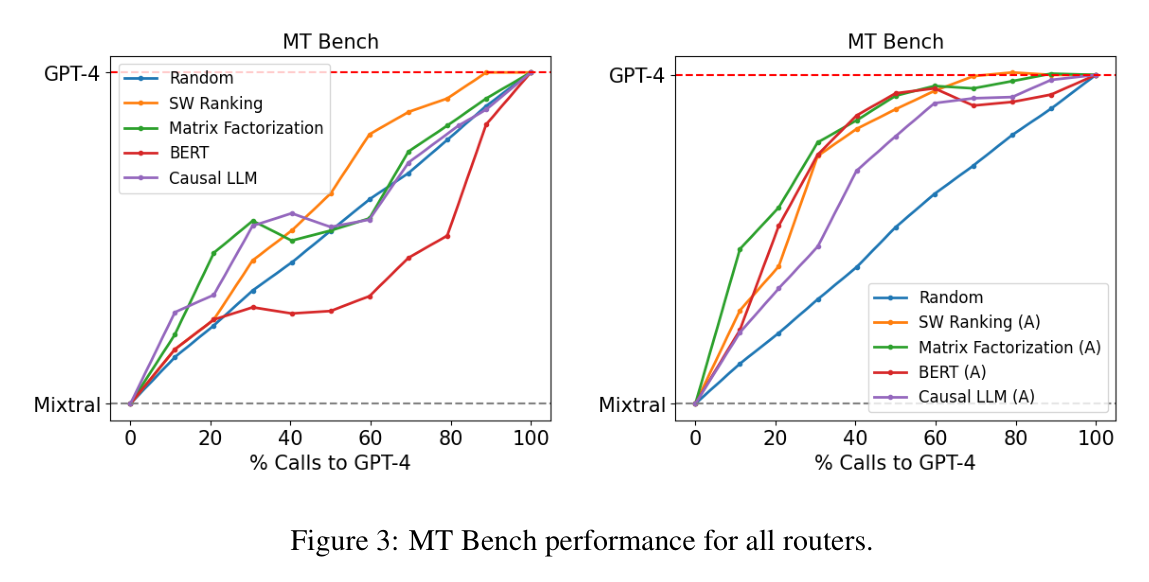
Paper Figure 3: (left) Arena-only training — SW Ranking and MF outperform random; BERT underperforms. (right) With augmentation — all routers substantially outperform random, with MF achieving the highest APGR.
The MT Bench results reveal two key dynamics:
- Low-data regime penalizes high-capacity models: on Arena-only data, BERT (110M params) actually underperforms random (APGR 0.391 vs. 0.500), while the non-parametric SW Ranking leads (APGR 0.610). This suggests 80K preference pairs are insufficient for models with many trainable parameters.
- Augmentation is transformative: with GPT-4 judge data, MF jumps to APGR 0.802 (+60.4%), requiring only 13.4% GPT-4 calls to reach CPT(50%) — meaning 86.6% of queries go to the cheap model while maintaining 95% of GPT-4 quality.
- Router implementations: four router architectures (SW Ranking, Matrix Factorization, BERT, Causal LLM) with training scripts and serving integration.
- Data pipeline: Chatbot Arena data preprocessing, tier clustering via dynamic programming, augmentation with golden-label and LLM-judge methods.
- Serving integration: routers deployed as lightweight inference endpoints alongside the LLM serving stack.
- Evaluation harness: benchmark evaluation across MMLU, MT Bench, GSM8K with metric computation (PGR, APGR, CPT).
- Embedding-based similarity normalization (Eq. 9): SW Ranking normalizes cosine similarity by the maximum similarity of the training query to the entire dataset, not just raw cosine. This relative scaling prevents high-dimensional embedding spaces from compressing all similarities into a narrow range, and is crucial for the exponential weighting ($\gamma^{1+S}$ with $\gamma = 10$) to produce meaningful differentiation.
- Tier clustering via DP: the 10-tier assignment minimizes intra-tier score variance using dynamic programming on sorted leaderboard scores. This is a one-time preprocessing step but determines the quality of preference labels — too few tiers dilute the signal; too many re-introduce sparsity. The choice of top-2 tiers as strong and tier-2 as weak is hand-selected.
- The routing framework is backbone-agnostic: it learns query complexity independent of which models are deployed at serving time.
- The Causal LLM router requires a model with instruction-following capability (Llama 3 8B used in paper); structured output is not required since win probability is extracted from next-token logits over label tokens.
- Minimum effective router: MF works on an 8GB GPU, making it the most cost-efficient choice; SW Ranking requires no GPU at all but is 50× slower.
- Serving cost: MF router adds \$3.32 per million requests; total overhead including embedding generation is <0.4% of GPT-4 cost.
- No sandboxing required: the router is a pure classifier with no tool execution or side effects.
- Latency: MF adds ~6.4 ms per query (155 req/s on L4). This is negligible compared to LLM generation latency (typically 500 ms–10 s).
- Limitations acknowledged: no single best router across all benchmarks (L4 in §6); real-world distributions may differ from benchmarks (L1 in §6); binary routing only — N-way extension is future work (L2 in §6).
| Router (augmented) | CPT(50%) ↓ | CPT(80%) ↓ | APGR ↑ |
|---|---|---|---|
| Matrix Factorization | 13.40% | 31.31% | 0.802 |
| SW Ranking | 23.21% | 36.04% | 0.759 |
| BERT | 19.58% | 34.02% | 0.751 |
| Causal LLM | 31.50% | 48.75% | 0.679 |
| Random baseline | 49.03% | 78.08% | 0.500 |
5.2 OOD generalization: GSM8K #
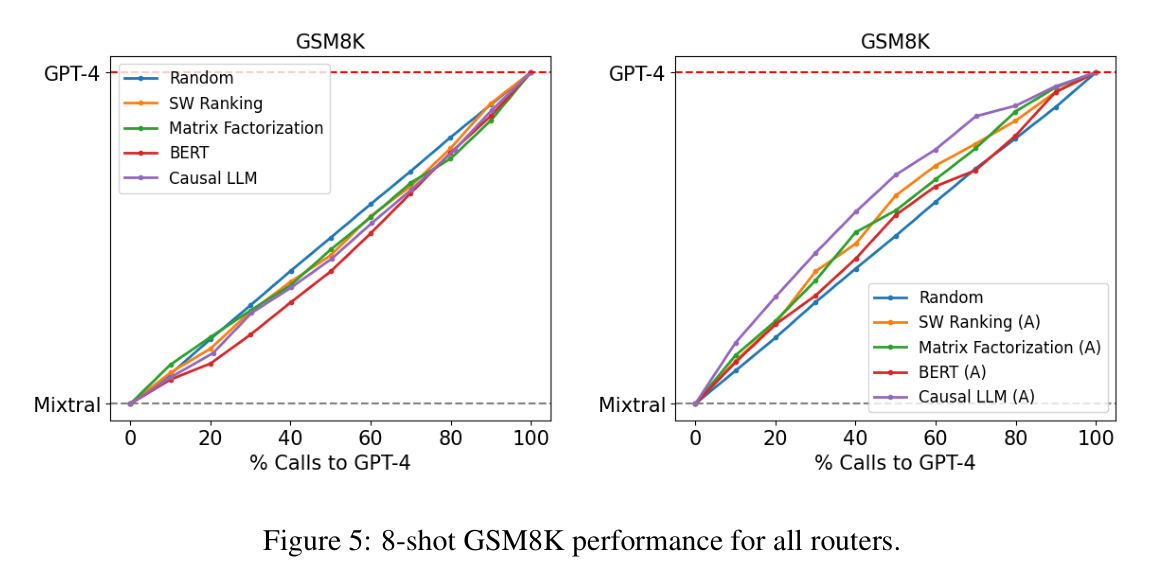
Paper Figure 5: (left) Arena-only — all routers cluster around or below the random diagonal, confirming OOD failure. (right) With augmentation — routers pull above random, with Causal LLM leading.
GSM8K is the hardest benchmark for the routers because math reasoning is poorly represented in Chatbot Arena's conversational distribution. Without augmentation, every router performs at or below random. With judge augmentation, the Causal LLM (Llama 3 8B) becomes the strongest router (CPT(50%) = 33.6%, APGR = 0.622), likely because its larger capacity better captures the reasoning-complexity signal present in the augmented data.
5.3 Cross-model generalization #
| Model pair | Best router | CPT(50%) | APGR | vs. Random |
|---|---|---|---|---|
| GPT-4 / Mixtral (training pair) | MF(A) | 13.40% | 0.802 | +60.4% |
| Claude 3 Opus / Sonnet | SW Ranking(A) | 23.27% | 0.772 | +56.6% |
| Llama 3.1 70B / 8B | SW Ranking(A) | 21.18% | 0.767 | +49.8% |
Routers trained solely on GPT-4/Mixtral preference data transfer to completely unseen model families (Claude 3, Llama 3.1) with comparable improvement margins. This suggests the routers learn query-intrinsic complexity features rather than model-specific artifacts — queries that are "hard" for one strong/weak pair tend to be hard for others.
5.4 Comparison with commercial systems #
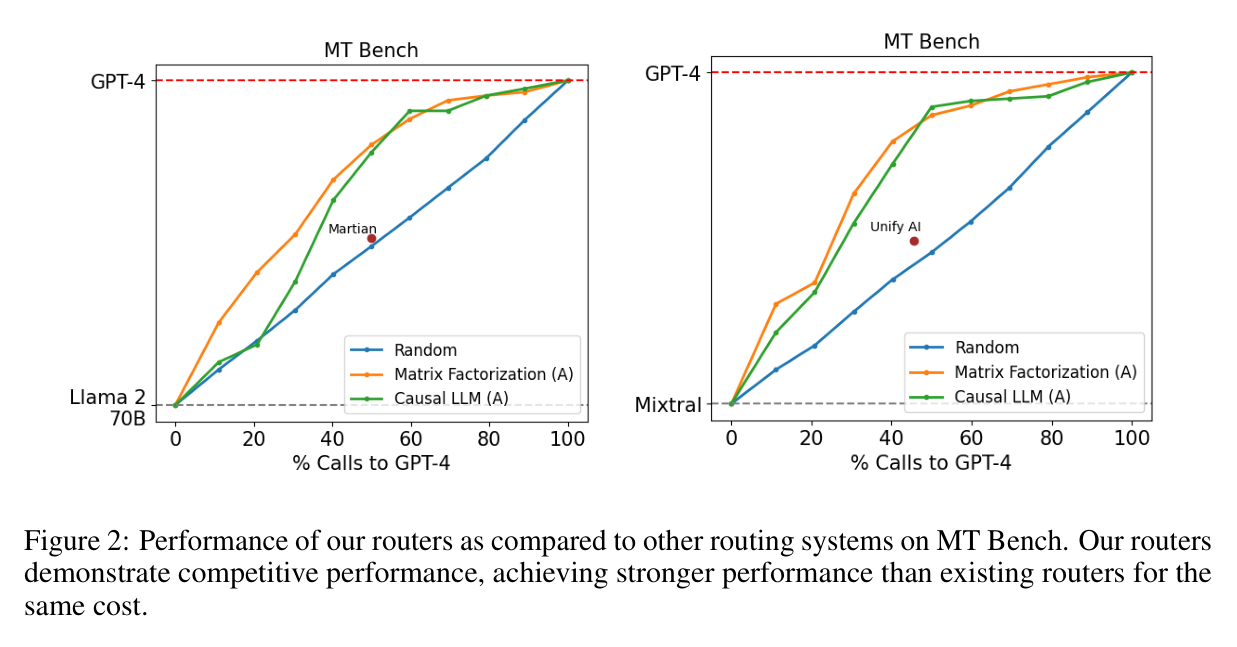
Paper Figure 2: On MT Bench, MF and Causal LLM routers outperform both Martian (left) and Unify AI (right), achieving the same quality with up to 40% fewer GPT-4 calls.
The comparison with two commercial routing systems (Martian, Unify AI) validates that RouteLLM's approach is competitive in practice, not just on synthetic benchmarks. Both commercial systems appear as single points below the RouteLLM Pareto frontier.
5.5 Cost analysis #
| Benchmark | Cost saving ratio at CPT(50%) | Quality retained |
|---|---|---|
| MT Bench | 3.66× | 95% of GPT-4 |
| MMLU | 1.41× | 92% of GPT-4 |
| GSM8K | 1.49× | 87% of GPT-4 |
Router overhead is negligible: even the most expensive router (SW Ranking) adds <0.4% cost relative to GPT-4 generation. GPU-based routers (MF, BERT, Causal LLM) run on a single L4 GPU at \$0.80/hr, costing \$3–5 per million routed requests.
§6 论证链 #
| Step | Claim | Evidence | §Ref |
|---|---|---|---|
| 1 | Preference data from Chatbot Arena encodes query-difficulty signal that distinguishes strong-vs-weak model performance. | Tier-based clustering reduces 64 models to 10 tiers; strong-model win labels correlate with query complexity. SW Ranking and MF outperform random on Arena-only MT Bench data (APGR 0.610, 0.580 vs. 0.500). | §4.1, §5.1 Table 1 |
| 2 | Data augmentation bridges the distribution gap between Arena conversations and domain-specific benchmarks. | Without augmentation, all routers ≤ random on MMLU and GSM8K. With ~1,500 golden-label samples (<2% of training), MMLU CPT(50%) drops from ~50% to ~35%. With ~120K judge samples, GSM8K flips from below-random to above-random. Benchmark-dataset similarity scores (Table 5) increase with augmentation and correlate with performance. | §4.1.1, §5.1, §5.3 |
| 3 | Routers learn query-intrinsic complexity features, not model-specific artifacts. | Routers trained on GPT-4/Mixtral transfer to Claude 3 Opus/Sonnet and Llama 3.1 70B/8B with comparable APGR improvements (Table 4: +54.6% and +44.1% for MF on the two new pairs). No retraining or fine-tuning required. | §5.2 Table 4 |
| 4 | The full system delivers practical cost savings with negligible routing overhead. | Best router achieves 3.66× cost savings on MT Bench while maintaining 95% GPT-4 quality. Router inference overhead is <0.4% of generation cost. Framework is open-sourced for training, serving, and evaluation. | §5.4 Table 6, §5.5 Table 7 |
§7 实现 cross-reference #
Open-source repository: github.com/lm-sys/RouteLLM
The paper announces an open-source framework (Contribution C3) for training, serving, and evaluating LLM routers. Key implementation components: