The Llama 3 Herd of Models
The Llama 3 Herd of Models — L2 #
1. TL;DR #
A dense 405B Transformer trained on 15.6T tokens at $3.8\times10^{25}$ FLOPs, deliberately choosing a boring architecture + SFT/rejection-sampling/DPO alignment over MoE + RL. The bet: quality comes from data curation, scale, and complexity management, not architectural novelty.
2. Q1/Q2/Q3 #
Q1 — 痛点. Frontier-quality foundation models (GPT-4 class) were closed, and the open recipes that existed (Llama 2, 1.8T tokens, complex RLHF) trailed badly. The open question: can a simple, reproducible recipe reach GPT-4 parity if you scale data and compute correctly and forecast the right model size before committing a $3.8\times10^{25}$-FLOP run? Two sub-pains: (a) scaling laws predict next-token loss, not downstream accuracy, so budget→size→benchmark mapping is unreliable; (b) at 16K-GPU scale a single fault stalls the whole synchronous job.
Q2 — 方法. Three "levers" made explicit — data (15T-token curated multilingual corpus with a fixed 50/25/17/8 knowledge/reasoning/code/multilingual mix), scale (compute-optimal 405B chosen via a two-step scaling law), and managing complexity (dense Transformer + GQA; alignment via SFT + rejection sampling + DPO instead of PPO). The pre-training recipe is three staged phases (initial → long-context → annealing); post-training is six iterative rounds of RM→SFT→DPO with per-capability synthetic-data pipelines.
核心技术壁垒: the two-step downstream-scaling-law forecast — first fit compute→optimal-token-count as $N^\star(C)=AC^\alpha$ with $(\alpha,A)=(0.53,0.29)$, then fit a sigmoidal map from normalized NLL to task accuracy calibrated against the older Llama 2 family. This lets Meta commit to "405B on 16.55T tokens" and predict ARC-Challenge accuracy four orders of magnitude out before spending the flagship budget. Reproducing it requires the small-model IsoFLOPs sweep plus a family of higher-compute anchor models — the piece nobody else has.
Q3 — 结果. Llama 3 405B reaches GPT-4-class scores (MMLU 87.3, HumanEval 89.0, GSM8K 96.8, MATH 73.8; Table 2) and the 8B/70B are best-in-class for their size. The two-step scaling-law only slightly underestimated the final flagship accuracy. Achieved >90% effective training time on 16K H100s despite 419 unexpected interruptions in 54 days.
3. 架构 / 方法图 #
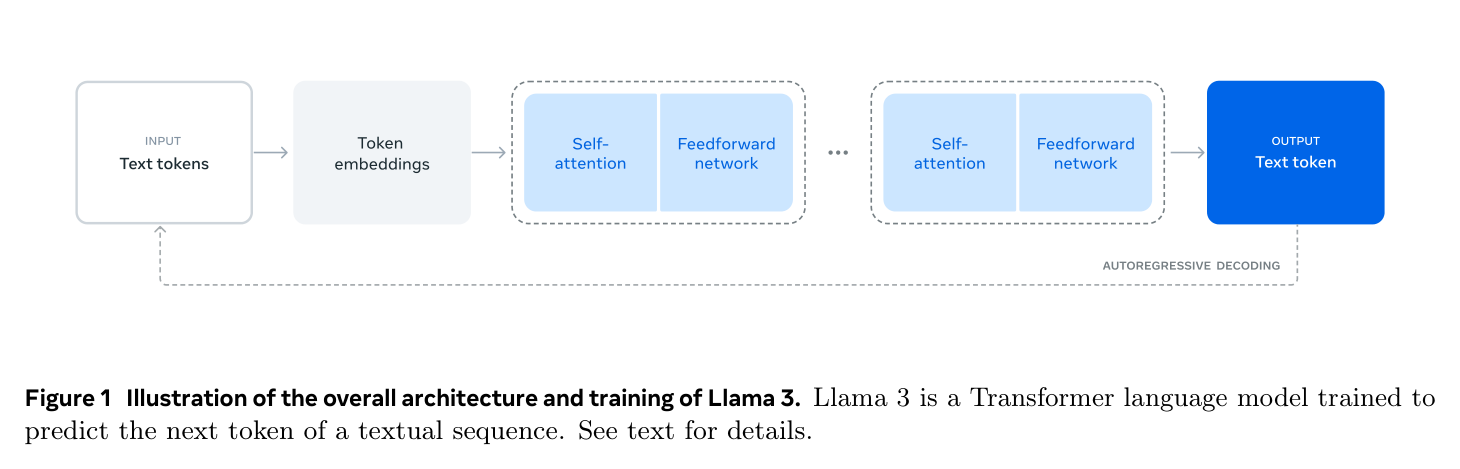
Paper's Figure 1, verbatim (caption: "Illustration of the overall architecture and training of Llama 3. Llama 3 is a Transformer language model trained to predict the next token of a textual sequence.").
The deliberate anticlimax of this figure IS the argument: no MoE, no exotic attention — just token embeddings → stacked (self-attention + FFN) → next-token, with autoregressive decoding. The only Llama-2 deltas are GQA (8 KV heads), a cross-document attention mask, a 128K-token tokenizer (3.17→3.94 chars/token compression), and RoPE base $\theta=500{,}000$. "Managing complexity" is enforced at the architecture level so training stays stable at 405B.
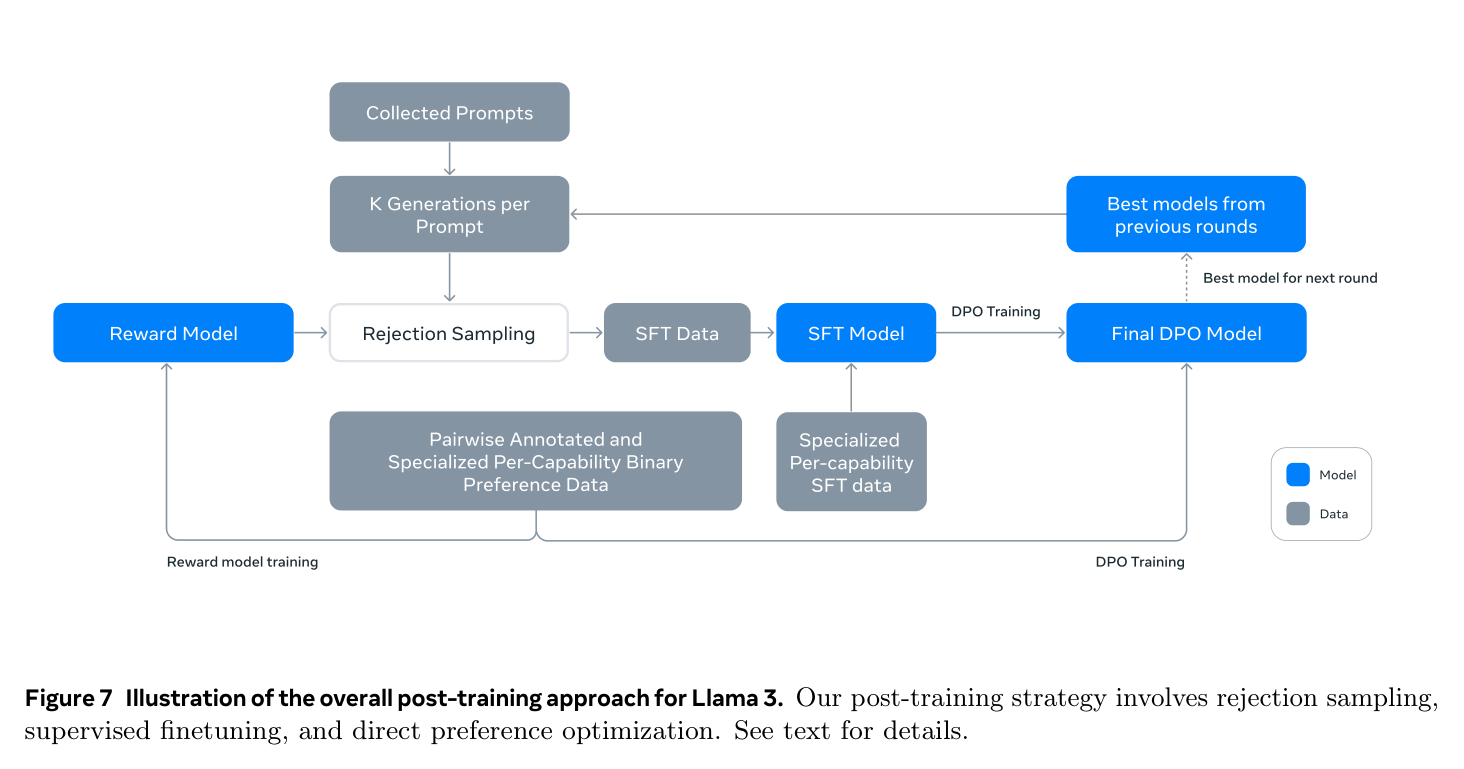
Paper's Figure 7, verbatim (caption: "Illustration of the overall post-training approach for Llama 3. Our post-training strategy involves rejection sampling, supervised finetuning, and direct preference optimization.").
The alignment engine: a reward model scores $K$ (10–30) generations per prompt (rejection sampling) to produce SFT data; the SFT model is then aligned with DPO; the best DPO model feeds the next round's generations. Note the feedback edge "Best model for next round" — this is the iterative-rounds mechanism (six cycles) that keeps preference data on-policy.
The one algorithm-level novelty vs. the prior method:
| before (Llama 2 / standard RLHF) | after (Llama 3) |
|---|---|
| PPO on-policy RL for alignment | DPO (offline pair loss) — less compute, better IFEval |
| Reward-margin term in RM loss | margin term removed (diminishing returns after data scaling) |
| Pairs (chosen, rejected) | triples (edited > chosen > rejected) via an annotator edit step |
| DPO loss over all tokens | mask formatting/header/termination tokens + add 0.2·NLL on chosen |
4. 作者证明 #
无形式化作者证明 — 仅实证(核心方法为工程/配方,非定理)。以下是论文赖以立论的经验性/半形式化关系。
Notation table.
| 符号 | 含义 |
|---|---|
| $C$ | pre-training compute budget (FLOPs) |
| $N^\star(C)$ | compute-optimal number of training tokens at budget $C$ |
| $A,\alpha$ | scaling prefactor / exponent, fitted $(0.29,0.53)$ (Fig.3: $A=0.299,\alpha=0.537$) |
| $S$ | observed benchmark score (accuracy/EM) |
| $N$ | benchmark sample size |
| $PP,V,M$ | pipeline ranks / interleaved stages per rank / total micro-batches |
Load-bearing equations & 物理意义.
- Compute-optimal token law: $$N^{\star}(C) = A C^{\alpha}$$ Sub-linear ($\alpha\approx0.53$) growth means each extra order of compute warrants ~$10^{0.53}\approx3.4\times$ more tokens, not $10\times$ — this is why the flagship is 405B/16.55T rather than a much larger, undertrained model.
- Benchmark confidence half-width (binomial): $$CI(S) = 1.96 \times \sqrt{\frac{S(1-S)}{N}}$$ Standard-normal 95% interval; the authors flag it is a lower bound on true variation since subsampling is not the only noise source.
- Pipeline bubble ratio: $$\text{bubble ratio} = \frac{PP-1}{V \cdot M}$$ Idle-time fraction shrinks with interleaving $V$ and micro-batch count $M$; the "make $N$ tunable" schedule fix (Fig.6) exists to relax the $N=PP$ / $N=M$ constraints so $M$ can grow.
- Assumption of the token law: a clean power-law holds between $6\times10^{18}$ and $10^{22}$ FLOPs — extrapolated 4 orders of magnitude to $3.8\times10^{25}$. Breaks if the loss-vs-token curvature changes off-regime.
- Sigmoidal NLL→accuracy step leans on Llama 2 anchors; if Llama 2 sat in a different loss regime the calibration would bias the forecast.
- IsoFLOPs flattening (Fig.2) is the stated justification that 405B is "safe" — the claim is that near the parabola minimum, size/token trade-off barely moves loss.
- Robustness-as-implicit-guarantee: §5.1.2 shows MMLU scores stable across label/order/format perturbations, standing in for a formal generalization argument.
- DPO stabilizers are ablation-backed, not proven: token masking + 0.2·NLL are justified by observed "tail repetition"/logprob-collapse, not a convergence theorem.
- Annealing value is scale-dependent: +24.0%/+6.4% (GSM8k/MATH) at 8B, negligible at 405B — an empirical, not theoretical, result about in-context capability saturating.
- DPO + NLL-regularized loss (§4.1.4): mask formatting tokens, add 0.2·NLL on chosen. Reproducible via TRL's
DPOTrainer(rpo_alphaimplements the Pang-et-al. NLL term). Verl / OpenRLHF also expose DPO. - Rejection sampling with PagedAttention (§4.2.2): $K$∈[10,30] generations, RM-select best, max-length gating + KV-page sharing → >2× throughput. Reproducible on vLLM (PagedAttention upstream).
- Execution-feedback code synthesis (§4.3.1): generate problem → solve → static/dynamic (linter + containerized unit tests) → iterative self-correct; only all-pass dialogs kept (~20% self-corrected). No public artifact; must be rebuilt.
- DPO formatting-token masking — header/termination tokens appear in both chosen and rejected, so an unmasked DPO loss issues a contradictory push/pull and produces tail-repetition / premature EOS. Masking them (plus 0.2·NLL on chosen to stop logprob collapse) is what actually stabilizes DPO at 405B.
- 0.1% long-context data suffices — mixing just 0.1% synthetic long-context samples into short-context SFT jointly optimizes short- and long-context benchmarks; more hurts short-context. DPO can stay short-context entirely (fewer optimizer steps) without regressing 128K performance.
6 minimum checks.
A desirable-but-absent guarantee: a bound on the forecast error of the two-step scaling law (they only report "slightly underestimates").
5. 实验与数据 #
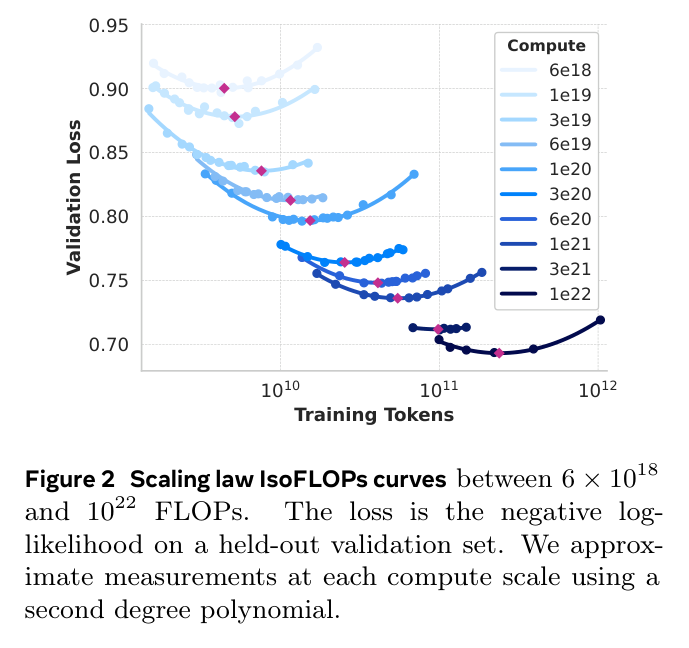
Paper's Figure 2, verbatim (caption: "Scaling law IsoFLOPs curves between $6\times10^{18}$ and $10^{22}$ FLOPs. The loss is the negative log-likelihood on a held-out validation set.").
Each parabola is one compute budget; the pink minima are the compute-optimal points fed into Fig.3's power-law fit. The key visual claim: as compute grows (darker curves), the parabola flattens near its minimum — the empirical backing for choosing 405B without fear of mis-sizing.
Scaling-law forecast (Fig.4). The two-step NLL→accuracy pipeline on ARC-Challenge extrapolates over four orders of magnitude and only slightly underestimates the delivered Llama 3 405B score — the paper's single most load-bearing predictive result, since it justified the entire flagship budget.
Headline benchmarks (Table 2, post-trained).
| Benchmark | L3 8B | L3 70B | L3 405B | GPT-4 (0125) | GPT-4o | Claude 3.5 Sonnet |
|---|---|---|---|---|---|---|
| MMLU (5-shot) | 69.4 | 83.6 | 87.3 | 85.1 | 89.1 | 89.9 |
| HumanEval | 72.6 | 80.5 | 89.0 | 86.6 | 90.2 | 92.0 |
| GSM8K | 84.5 | 95.1 | 96.8 | 94.2 | 96.1 | 96.4 |
| MATH | 51.9 | 68.0 | 73.8 | 64.5 | 76.6 | 71.1 |
| GPQA | 32.8 | 46.7 | 51.1 | 41.4 | 53.6 | 59.4 |
405B beats GPT-4 (0125) on MMLU/HumanEval/GSM8K/MATH/GPQA and trails GPT-4o/Claude 3.5 on the hardest reasoning (GPQA, MATH). Where it loses: consistently to GPT-4o/Claude on GPQA and to Claude on HumanEval — the frontier-reasoning gap the paper is candid about.
Reliability at scale (Table 5). Over a 54-day snapshot: 466 interruptions (47 planned, 419 unexpected). GPU-attributed causes dominate — faulty GPU 30.1%, HBM3 17.2%, SRAM 4.5% — ~78% of unexpected stops were hardware. Only 3 needed manual intervention; the rest were automated, enabling >90% effective training time. This table is the load-bearing evidence that a synchronous 16K-GPU dense run is operationally feasible.
Parallelism/MFU (Table 4). 4D parallelism [TP,CP,PP,DP] holds 38–43% BF16 MFU; MFU dips 43%→41% going 8K→16K GPUs (smaller per-DP batch to keep 16M tokens/batch constant), and 38% at 128K context (CP=16).
6. 论证链 #
| # | 论证步骤 | 依据(paper-internal) |
|---|---|---|
| 1 | Frontier quality is achievable from a simple recipe if you get data/scale/complexity right. | §1 three-levers framing |
| 2 | To pick the right size, forecast downstream accuracy, not just loss: fit $N^\star(C)=AC^\alpha$ then NLL→accuracy sigmoid on Llama 2 anchors. | §3.2.1, Fig.2–4 |
| 3 | Forecast says 405B on ~16.55T tokens is compute-optimal for the $3.8\times10^{25}$ budget; IsoFLOPs flattening makes 405B a safe choice. | §3.2.1 (Fig.2–3) |
| 4 | Realize the run: 4D parallelism at 38–43% MFU on 16K H100s, with automated fault recovery for >90% effective training time. | §3.3, Tab.4–5 |
| 5 | Stage the data: initial → 800B-token long-context (8K→128K) → 40M-token annealing with Polyak averaging. | §3.4 |
| 6 | Align simply: six rounds of RM→SFT→DPO; DPO (not PPO) is cheaper and better on IFEval; stabilize with token masking + 0.2·NLL. | §4.1 |
| 7 | Fill capability gaps with verifiable synthetic data (execution feedback for code, correctness-filtered CoT for math). | §4.3 |
| 8 | Result: 405B ≈ GPT-4 class; 8B/70B best-in-class; forecast validated. | §5, Tab.2 |
7. 实现 cross-reference #
[实现未公开] — weights are released (Llama 3.1 8B/70B/405B) but the training/data pipeline is not open-sourced. Closest open references for reproducing the algorithm layer:
核心技术壁垒 (§7 dedicated paragraph). The un-replicable asset is not any single loss or kernel — it is the calibrated two-step downstream scaling law. Step 1 (compute→token power law) is reproducible with a small-model IsoFLOPs sweep. Step 2 — mapping normalized NLL to task accuracy — requires a family of higher-compute anchor models spanning the loss regime (here, the entire Llama 2 herd). Without those anchors the sigmoid is unconstrained and the four-order-of-magnitude extrapolation collapses. Everyone can copy the dense-Transformer-plus-DPO recipe; almost nobody has the prior generation of frontier models to calibrate the forecast that de-risks a nine-figure training run.
关键实现细节 (easy-to-miss tricks).