SageAttention: Accurate 8-Bit Attention for Plug-and-Play Inference Acceleration
SageAttention: Accurate 8-Bit Attention for Plug-and-Play Inference Acceleration #
Jintao Zhang, Jia Wei, Haofeng Huang, Pengle Zhang, Jun Zhu, Jianfei Chen | Tsinghua University | 2024-10 | https://arxiv.org/abs/2410.02367 Category: algorithm | Tags: attention-quantization, int8, smooth-quantization, mixed-precision, post-training-quantization
§1 TL;DR #
Smooth K(减均值消除 K 的 channel outlier,softmax 平移不变性保证精确)+ INT8 $QK^\top$ / FP16-with-FP16-accumulator $PV$ 混合精度 attention,RTX4090 达 341 TOPS(2.1× FlashAttention2),端到端精度损失 <0.2%,即插即用。
§2 Q1 / Q2 / Q3 #
Q1 痛点 #
Attention 的 $O(N^2)$ 复杂度在长序列场景(视频生成 8K–128K tokens、LLM prefill)下成为推理瓶颈。现有量化加速工作几乎全部集中在 Linear 层,attention 仍以 FP16 运行。直接将 attention 中的 $Q, K, P, V$ 量化为 8-bit 会导致灾难性精度退化:
- (C1) $K$ 矩阵存在显著的 channel-wise outlier——某些 channel 的值远大于其他 channel,导致 per-token 量化精度极差
- (C2) $\widetilde{P}V$ 的 INT8 量化在部分层的 worst-case 余弦相似度仅 56.4%,完全不可用
证据:Unidiffuser 使用 INT8 attention 生成完全模糊的图像;Llama2 在 MMLU 上降至 25.5%(随机猜测水平)。FlashAttention3 的 FP8 版本在扩散模型上同样灾难性失败(Unidiffuser FID: 394 vs 163)。
Q2 方法 #
SageAttention 提出三个核心技术组成的 post-training quantization 算法:
- Smooth K:$\gamma(K) = K - \mathrm{mean}(K)$,减去所有 token 共享的 channel 均值消除 outlier。由于 softmax 的平移不变性 $\sigma(qK^\top - q \cdot \mathrm{mean}(K)) = \sigma(qK^\top)$,该变换精确保留注意力分布,开销 < 0.2%
- 混合精度 Matmul:$QK^\top$ 使用 INT8 per-block 量化(RTX4090 上 INT8 比 FP16 快 4×),$\widetilde{P}V$ 保持 FP16 并使用 FP16 accumulator(比 FP32 accumulator 快 2×,精度完全一致)
- 自适应量化:对每层 profiling 余弦相似度,> 99.8% 的层使用全 INT8 kernel(额外提速 ~4%),其余层回退到混合精度
- RTX4090 上达到 341 TOPS(INT8 理论峰值 660 TOPS 的 52%),FlashAttention2 仅 165 TOPS
- 比 FlashAttention2 快 2.1×,比 xformers 快 2.7×,实际模型平均加速 2.83×
- 在 Llama2、CogVideoX、Unidiffuser、UltraPixel、TIMM、Llava1.6 六个模型上,端到端指标损失平均仅 ~0.2%
- 即插即用,无需再训练或校准数据(仅 adaptive 选择需少量 profiling)
- Softmax 平移不变性:$\sigma(x + c) = \sigma(x)$,对任意标量 $c$
- INT8 Tensor Core 可用且比 FP16 Tensor Core 快(Ampere/Ada 架构上 4× 理论峰值比)
- $\widetilde{P} = \exp(S - \mathrm{rowmax}(S))$ 的最大值恒为 1(softmax 性质),因此 per-block 量化的 static scale $s = 1/127$ 等价于 per-token 精度
- 输入:$Q, K, V \in \mathbb{R}^{N \times d}$(FP16),block sizes $b_q, b_{kv}$
- 输出:$O \in \mathbb{R}^{N \times d}$(FP16),与全精度 attention 输出误差极小(CosSim > 99.8%)
- 预处理:$K \leftarrow K - \mathrm{mean}(K)$
- 量化:$(\delta_Q, \hat{Q}) = \psi_Q(Q/\sqrt{d})$,$(\delta_K, \hat{K}) = \psi_K(K)$,INT8 per-block
- 分块:$\hat{Q}$ 分 $T_m = N/b_q$ 块,$\hat{K}, V$ 分 $T_n = N/b_{kv}$ 块
- 并行外循环(每个 SM 处理一个 $\hat{Q}_i$):
- 内循环遍历所有 $\hat{K}_j, V_j$:
- $S_i^j = \mathrm{INT8\_Matmul}(\hat{Q}_i, \hat{K}_j^\top) \times \delta_Q[i] \times \delta_K[j]$
- Online softmax 更新 $m_i^j, \widetilde{P}_i^j, l_i^j$
- $O_i^j = \mathrm{rescale}(O_i^{j-1}) + \mathrm{FP16\_Matmul}(\widetilde{P}_i^j, V_j, \text{accum=FP16})$
- 归一化:$O_i = \mathrm{diag}(l_i^{T_n})^{-1} O_i^{T_n}$
- GitHub: https://github.com/thu-ml/SageAttention
- 安装:
pip install sageattention - 语言: Python + Triton(GPU kernel DSL → PTX)
- 依赖: PyTorch 2.4.0+cu121, Triton nightly (20240816), Python 3.11
- ROPE 与量化融合:$Q, K$ 经过 ROPE 计算后在 shared memory 写回 global memory 之前直接量化为 INT8,避免了一次额外的 HBM round-trip。同时将 $1/\sqrt{d}$ 系数融合进 $Q$ 的量化步骤。这一融合使得量化的 IO 开销为零。
- $\widetilde{P}$ 的 static scale:由于 $\widetilde{P} = \exp(S - \mathrm{rowmax}(S))$ 的最大值恒为 1,per-block 量化可使用固定 scale $s = 1/127$,省去了运行时计算 scale 的开销,同时精度等价于 per-token 量化。
- 代码完全开源,
pip install sageattention即可使用 - SageAttention 已被广泛集成到视频/图像生成推理流程中
- 后续工作 SageAttention2(2411.10958)扩展到 4-bit $\widetilde{P}V$,SageAttention3(2505.11594)进一步利用 Blackwell FP4 Tensor Core
- 社区已在 ComfyUI、Diffusers 等框架中集成 SageAttention 作为加速后端
- 论文的 Smooth K 技术已被后续多个 attention 量化工作采用
核心技术壁垒:$K$ 的 channel-wise outlier 不是 token 间的信号变异,而是所有 token 共享的大偏置。这一洞察使得均值减法成为精确变换(非近似),是整个方法准确性的基石。如果不认识到这一点,自然会尝试 per-channel 量化(但 $QK^\top$ 的内轴无法用 per-channel scale 反量化)或 SmoothQuant 式迁移(但 $Q$ 同样存在 outlier,无法将 $K$ 的 scale 迁移到 $Q$)。
Q3 结果 #
Problem Formulation #
目标函数:最小化量化 attention 输出与全精度输出的误差,同时最大化 kernel 吞吐量:
$$\min_{\psi_Q, \phi_K, \psi_P, \psi_V} \mathbb{E}[\|O_{\text{quant}} - O_{\text{fp16}}\|] \quad \text{s.t. throughput}(\text{kernel}) \gg \text{throughput}(\text{FlashAttention2})$$
其中 $O_{\text{quant}}$ 由量化后的 matmul 计算(Eq. 4-5),$\phi_K = \psi_K \circ \gamma$ 包含 smooth 变换。
假设:
算法一步的输入/输出:
§3 架构 / 方法图 #
Method Core: Smooth K — 唯一关键创新 #
每篇算法论文都有一个核心创新机制。SageAttention 的核心是 Smooth K:将 $K$ 矩阵的 channel-wise outlier 识别为共享偏置并精确消除。
| Before(直接 INT8 量化) | After(SageAttention) | |
|---|---|---|
| K 处理 | 直接 per-token/per-block INT8 量化 | $\gamma(K) = K - \mathrm{mean}(K)$,消除共享偏置后再量化 |
| $QK^\top$ matmul | FP16 或 FP8 | INT8 per-block(4× 硬件加速) |
| $\widetilde{P}V$ matmul | FP16 with FP32 accumulator,或 INT8 | FP16 with FP16 accumulator(2× 加速,零精度损失) |
| Unidiffuser FID | 221.18(per-token INT8)/ 394.13(FA3 FP8) | 166.93(vs full-precision 163.33) |
| CogVideo Fscore | 1.924(per-token INT8,严重退化) | 3.718(vs full-precision 3.768) |
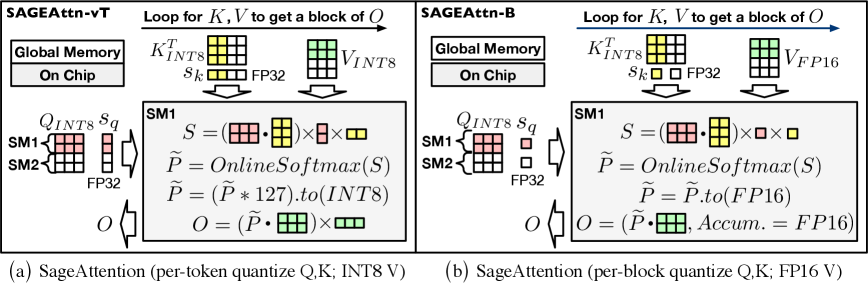
Paper's Figure 5, verbatim (caption: "Workflow of SageAttention").
Figure 5 展示了 SageAttention 的两种 kernel variant:(a) SAGEAttn-vT 将 $QK^\top$ 和 $\widetilde{P}V$ 都用 INT8 量化;(b) SAGEAttn-B 对 $QK^\top$ 用 INT8,对 $\widetilde{P}V$ 保持 FP16 并使用 FP16 accumulator。SAGEAttn-B 是主推 kernel,精度更高且速度已达 2× FA2。
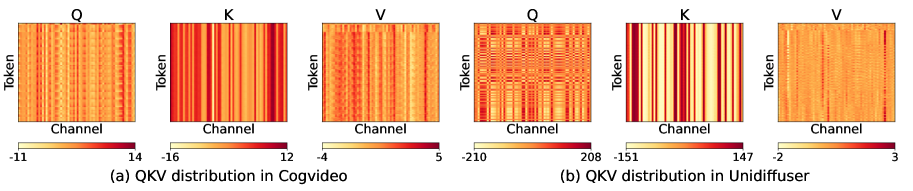
Paper's Figure 4, verbatim (caption: "Typical examples of data distribution of (Q, K, V)").
Figure 4 直观展示了 Smooth K 的动机:$K$ 矩阵在 Unidiffuser 和 CogVideoX 中呈现显著的 channel-wise outlier(某些 channel 所有 token 的值都偏大),而这些 outlier 本质上是共享偏置——减去均值后 $K$ 的数值范围显著缩小,量化误差随之降低。$Q$ 虽也有 outlier 但程度较轻,$V$ 分布相对均匀。
完整算法流程(Algorithm 1: SAGEAttn-B) #
§4 作者证明 #
符号表 #
| 符号 | 含义 | 维度 |
|---|---|---|
| $Q, K, V$ | Query, Key, Value 矩阵 | $N \times d$ |
| $S = QK^\top / \sqrt{d}$ | 注意力分数矩阵 | $N \times N$ |
| $P = \sigma(S)$ | Softmax 后的注意力权重 | $N \times N$ |
| $O = PV$ | 注意力输出 | $N \times d$ |
| $\gamma(K) = K - \mathrm{mean}(K)$ | Smooth 变换 | $N \times d \to N \times d$ |
| $\psi(\cdot)$ | 量化器:$(A) \mapsto (\delta_A, \hat{A})$ | 输出 scale + INT8 tensor |
| $\psi^{-1}_{\delta}(\hat{A})$ | 反量化器:$\delta \cdot \hat{A}$ | INT8 → FP16 |
| $\phi_K = \psi_K \circ \gamma$ | K 的完整变换:smooth 后量化 | $N \times d \to$ INT8 |
| $\widetilde{P}_i^j$ | Online softmax 的未归一化权重 | $b_q \times b_{kv}$ |
| $m_i^j, l_i^j$ | Online softmax 的 running max 和 running sum | $b_q \times 1$ |
核心方程与物理意义 #
Eq. 6 — Smooth K 变换:
$$\gamma(K) = K - \mathrm{mean}(K), \quad \mathrm{mean}(K) = \frac{1}{N}\sum_{t=1}^{N} K[t,:]$$
物理意义:减去所有 token 共享的 channel 偏置,使剩余信号(token 间差异)的动态范围缩小,量化误差随之降低。
正确性证明:对任意 query $q$:
$$\sigma(q \cdot \gamma(K)^\top) = \sigma(q K^\top - q \cdot \mathrm{mean}(K)^\top) = \sigma(qK^\top)$$
第二个等号成立是因为 $q \cdot \mathrm{mean}(K)^\top$ 是标量(对所有 key 位置相同),softmax 对输入加常数不变。
Eq. 4-5 — 量化 attention 计算:
$$S = \psi^{-1}_{\delta_Q \delta_K}(\hat{Q}\hat{K}^\top), \quad (m', \widetilde{P}) = \tilde{\sigma}(m, S), \quad O = \mathrm{diag}(\exp(m' - m))O_{\text{prev}} + \psi^{-1}_{\delta_P \delta_V}(\hat{P}\hat{V})$$
物理意义:将 FlashAttention 的 tiled computation 中的两个 matmul 替换为量化版本,online softmax 保持全精度。
6 项验证检查 #
| # | 检查项 | 结论 |
|---|---|---|
| 1 | Smooth K 的 softmax 平移不变性是否严格成立? | 成立。$\sigma(x + c\mathbf{1}) = \sigma(x)$ 是 softmax 的基本性质,$q \cdot \mathrm{mean}(K)^\top$ 对每个 key 位置是相同标量 |
| 2 | INT8 比 FP8 更精确的声明是否有充分证据? | Table 2 在 Llama2 和 Unidiffuser 所有层上对比了 INT8 vs E4M3 vs E5M2 的三项指标(CosSim, L1, RMSE),INT8 在 $Q,K$ 量化上全面领先 |
| 3 | FP16 accumulator 与 FP32 精度一致的声明是否可靠? | Tables 4-5 给出平均和最差精度,FP16 与 FP32 的三项指标数值完全相同(到小数点后 4 位),在 $\widetilde{P} \in [0,1]$ 的有界条件下合理 |
| 4 | Smooth K 的 <0.2% 开销声明是否可信? | Table 10 在 Appendix 中验证。均值计算是 $O(Nd)$ 的 reduction + broadcast,相比 $O(N^2 d)$ 的 attention 计算确实可忽略 |
| 5 | Per-block 量化是否优于 per-tensor/per-token? | Table 1 显示 per-block + Smooth K 和 per-token + Smooth K 精度接近且都远优于无 smooth 版本,per-block 在所有模型上表现稳定 |
| 6 | Adaptive 选择的 99.8% 阈值是否充分验证? | 阈值选择基于 SAGEAttn-B 的 worst-case CosSim(99.8%),确保 SAGEAttn-vB 仅在精度不劣于主 kernel 时启用。但阈值的 sensitivity analysis 未详述 |
本文不包含收敛定理或形式化 bound——属于 post-training 量化方法,核心证明是 Smooth K 的精确性(softmax 不变性)和经验验证。
§5 实验与数据 #
关键结果一览 #
Table 1: Smooth K 的消融实验
| 量化方式 (Q,K) | Smooth K | Llama WikiText ↓ | CogVideo Fscore ↑ | Unidiffuser FID ↓ | UltraPixel FID ↓ | TIMM ImageNet ↑ |
|---|---|---|---|---|---|---|
| Full-Precision | - | 5.823 | 3.768 | 163.33 | 179.78 | 84.79% |
| Per-token | ✗ | 5.824 | 1.924 | 221.18 | 193.36 | 84.21% |
| Per-token | ✓ | 5.824 | 3.734 | 166.52 | 179.79 | 84.74% |
| Per-block | ✗ | 5.825 | 2.014 | 229.08 | 195.67 | 84.18% |
| Per-block | ✓ | 5.824 | 3.718 | 166.93 | 179.98 | 84.76% |
| FlashAttn3 FP8 | - | 5.850 | 3.394 | 394.13 | 383.61 | 84.70% |
Smooth K 将 CogVideo 从 1.924 恢复到 3.734(接近 full-precision 的 3.768),Unidiffuser FID 从 221→167(full-precision 163)。FlashAttention3 的 FP8 在扩散模型上灾难性失败(FID 394 vs 163)。
Table 7: 真实模型加速
| Model | Q,K,V shape | Original Attention (TOPS) | SageAttention (TOPS) | Speedup |
|---|---|---|---|---|
| CogVideoX | (2, 30, 17776, 64) | 163.37 (FA2) | 340.76 | 2.09× |
| Unidiffuser | (2, 24, 1105, 64) | 105.68 (xformers) | 246.93 | 2.34× |
| UltraPixel | (8, 30, 4096, 64) | 79.05 (xformers) | 252.47 | 3.19× |
| Llama2 | (1, 32, 4096, 128) | 152.18 (FA2) | 341.00 | 2.24× |
| TIMM | (12, 64, 197, 64) | 18.91 (Torch) | 111.41 | 5.89× |
平均加速 2.83×。长序列模型(CogVideoX 17K tokens)获得稳定 2× 加速,短序列模型(TIMM 197 tokens)因 baseline 较弱获得最大加速。
Speed Benchmarks #
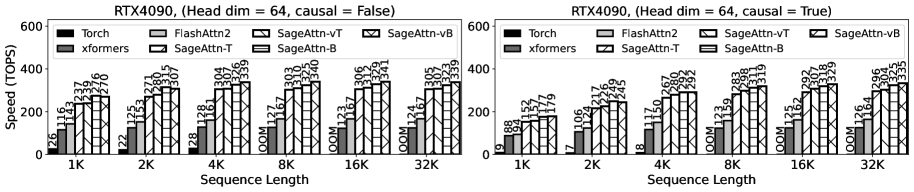
Paper's Figure 6, verbatim (caption: "Speed of SageAttention on RTX4090 (headdim=64)").
Figure 6 展示在 headdim=64 配置下,SageAttention 在所有序列长度(1K–32K)上一致达到 ~340 TOPS,而 FlashAttention2 峰值仅 ~165 TOPS,xformers ~130 TOPS。causal 和 non-causal mask 下加速比一致。
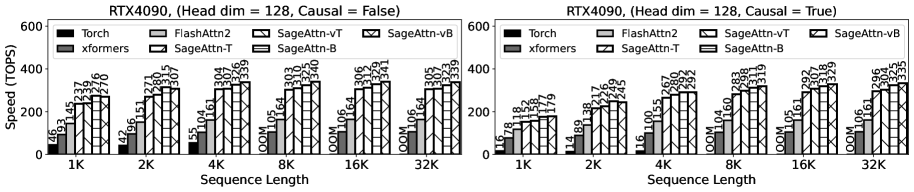
Paper's Figure 7, verbatim (caption: "Speed of SageAttention on RTX4090 (headdim=128)").
Figure 7 确认 headdim=128 下同样保持 ~2× 优势。两种常用 head dimension 都验证了加速的一致性。SageAttention 在 RTX4090(消费级 GPU)上的吞吐量接近 FlashAttention3 在 H100(数据中心 GPU)上 490 TOPS 的水平。
端到端质量验证 #
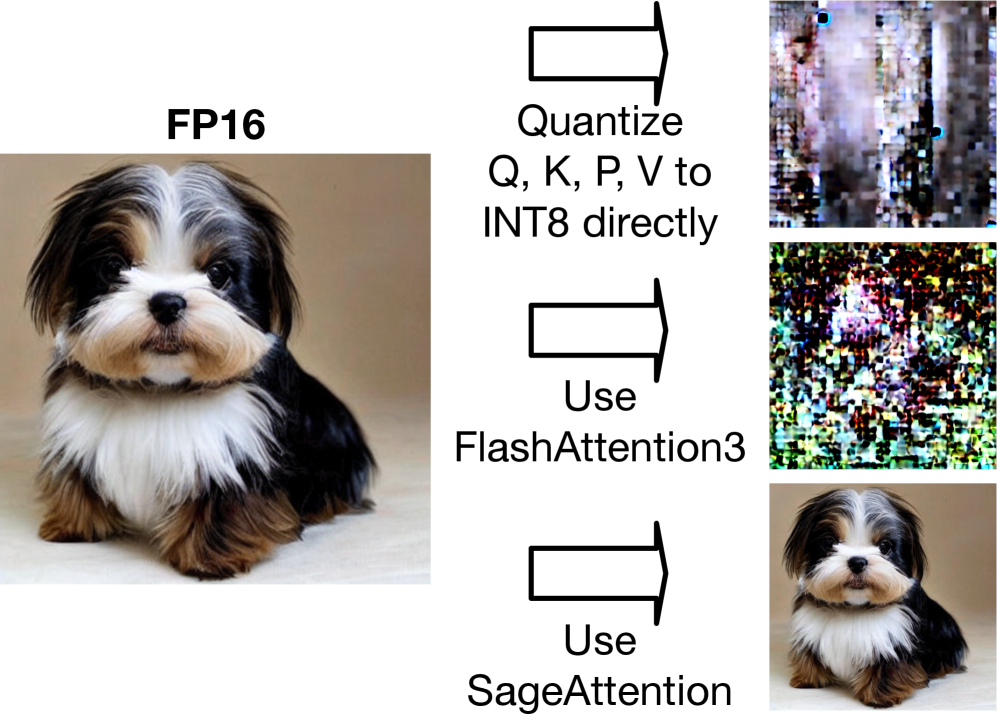
Paper's Figure 3, verbatim (caption: "A comparison example").
Figure 3 直观展示了量化方法对图像生成质量的影响:Full-Precision 和 SageAttention 生成清晰一致的图像,而直接 INT8 量化和 FlashAttention3 的 FP8 版本都生成完全模糊的图像。这是 Smooth K 效果最有力的视觉证据。
Table 8: 端到端指标损失(代表性结果)
| Model | Task | Metric | Full-Precision | SageAttention | 损失 |
|---|---|---|---|---|---|
| Llama2 (7B) | WikiText | Perplexity ↓ | 5.823 | 5.824 | +0.001 |
| Llama2 (7B) | MMLU | Accuracy ↑ | 45.97% | 45.89% | -0.08% |
| CogVideoX | Video Gen | Fscore ↑ | 3.768 | 3.718 | -1.3% |
| Unidiffuser | Image Gen | FID ↓ | 163.33 | 166.93 | +2.2% |
| UltraPixel | Image Gen | FID ↓ | 179.78 | 179.98 | +0.1% |
| TIMM | ImageNet | Accuracy ↑ | 84.79% | 84.76% | -0.03% |
所有模型的端到端指标损失均在 2.2% 以内,LLM 的 perplexity 变化仅 0.001。
INT8 vs FP8 数据类型对比(Table 2) #
| $Q,K$ dtype | $\widetilde{P},V$ dtype | CosSim ↑ | Relative L1 ↓ | RMSE ↓ |
|---|---|---|---|---|
| INT8 | FP16 | 99.99% | 0.0116 | 0.0091 |
| INT8 | E4M3 | 99.94% | 0.0345 | 3.53e-3 |
| E4M3 | E4M3 | 99.81% | 0.0607 | 5.93e-3 |
| E5M2 | E5M2 | 99.22% | 0.1213 | 1.20e-2 |
| INT8 | INT8 | 99.70% | 0.1035 | 6.82e-3 |
INT8 用于 $Q,K$ 在精度和速度上都优于 FP8(E4M3/E5M2)。$\widetilde{P},V$ 保持 FP16 可达 99.99% CosSim,而 INT8 的 worst-case 仅 56.4%(Table 3),这决定了混合精度策略的必要性。
Dataset Analysis #
评估数据集:
| Model | Dataset | Task | Metric |
|---|---|---|---|
| Llama2 (7B) | WikiText / LAMBADA / MMLU | Language modeling / comprehension / knowledge | PPL / Acc / Acc |
| CogVideoX | Open-Sora prompts | Text-to-video | Fscore |
| Unidiffuser, UltraPixel | COCO annotations | Text-to-image | FID |
| TIMM | ImageNet / CIFAR-10/100 | Image classification | Accuracy |
| Llava1.6 | MMMU | Visual QA | Accuracy |
数据集覆盖了 LLM、视频生成、图像生成、图像分类和视觉问答五类任务。论文未提及评估集与训练集的重叠检查,但所使用的基准(WikiText, ImageNet, MMLU 等)均为标准公开测试集。
§6 论证链 #
| Step | 前提 | 论证 | 结论 |
|---|---|---|---|
| 1 | $K$ 的 channel-wise outlier 本质是共享偏置,而非 token 间信号差异(Figure 4) | Softmax 平移不变性保证 $\sigma(qK^\top - c) = \sigma(qK^\top)$,减均值是精确变换 | Smooth K ($\gamma(K) = K - \mathrm{mean}(K)$) 消除 outlier 且不改变 attention 输出 |
| 2 | INT8 for $\widetilde{P},V$ worst-case CosSim 仅 56.4%(Table 3);FP16 accum 与 FP32 accum 精度完全一致(Tables 4-5) | $\widetilde{P} \in [0,1]$ 有界,FP16 精度足够且 accumulator 不溢出 | FP16 $\widetilde{P}V$ with FP16 accumulator 是最优折衷:2× 快于 FP32 accum,远准于 INT8 |
| 3 | INT8 per-block + Smooth K 在所有模型上 CosSim > 99.8%(Table 1, Table 2) | 结合 Step 1 和 Step 2,INT8 $QK^\top$ + FP16 $PV$ 的混合精度流水线精度有保证 | SAGEAttn-B kernel 实现 2.1× FA2 加速且端到端损失 <0.2%(Table 7, 8) |
| 4 | 部分层的全 INT8 variant(SAGEAttn-vB)CosSim > 99.8%(等于 SAGEAttn-B 的 worst case) | Profiling 每层精度后,安全地切换到更快 kernel | Adaptive 选择额外提速 ~4%,无精度风险 |
§7 实现 cross-reference #
代码仓库 #
核心技术壁垒(详述) #
$K$ 的 channel-wise outlier 是共享偏置这一洞察是整个方法的基石。实际开发中,面对 $K$ 的 outlier,直觉做法是 (a) per-channel 量化——但 $QK^\top$ 的内轴(channel dim)的 scale factor 无法在 dequantization 中使用;(b) SmoothQuant 式 channel-to-token 迁移——但 $Q$ 也有 outlier,迁移后 $Q$ 的量化更差。唯一正确的路径是认识到 outlier 的偏置本质 + softmax 的平移不变性,使得直接减均值成为精确变换。这种洞察来自对真实模型 $K$ 分布的仔细分析(Figure 4),不是理论推导能自动得到的。
关键实现细节 #
Reproducibility & Ecosystem #
Built: 2026-05-26T13:50:00Z | L1 hash: b00160c73a8d2a69ce95c7398453c3b1f46e8be7d39eaf5e2793b44611fc6c5c