DeepSeek-V3 Technical Report
DeepSeek-V3 Technical Report #
DeepSeek-AI | 2024-12 | https://arxiv.org/abs/2412.19437 Category: framework | Tags: algorithm, kernel, llm, MoE, pipeline-parallelism, FP8-training Read: 2026-04-16
Core Contribution #
DualPipe — a bidirectional pipeline parallelism algorithm achieving full computation-communication overlap for cross-node MoE training, enabling 671B parameter model training at only \$5.576M cost.
核心三问 #
Q1: 核心痛点?
MoE 大模型跨节点训练时,expert parallelism 的 all-to-all 通信开销巨大(计算:通信 ≈ 1:1),传统 pipeline 方法 bubble 大且无法隐藏通信。
Q2: 杀手锏方法?
DualPipe — 将 forward/backward chunk 拆为 attention/dispatch/MLP/combine 四个细粒度组件,双向调度 micro-batch,让 forward 的通信与 backward 的计算完全重叠,反之亦然。SM 资源通过 warp specialization 动态分配给通信和计算。
Q3: 效果?
- Pipeline bubble 比 1F1B 减少 60%+,all-to-all 和 PP 通信完全隐藏
- 671B 模型总训练成本仅 \$5.576M(2.788M H800 GPU 小时)
- MMLU 88.5, MATH-500 超 o1-preview, 14.8T token 预训练零 loss spike
逻辑故事还原 #
背景: DeepSeek-V3 用 256 routed experts + 64-way EP 横跨 8 节点。IB 带宽(50GB/s)远低于 NVLink(160GB/s),每个 token 的 all-to-all 通信时间几乎等于计算时间。1F1B 和 ZeroBubble 无法有效隐藏这个通信开销。
破局: 核心直觉 — 像双向车道一样从 pipeline 两端同时注入 micro-batch,在"会车点"把一个方向的通信和另一个方向的计算重叠。具体做法是把每个 chunk 拆成可独立调度的细粒度组件,对 forward+backward chunk 配对交错排列。
拆解:
- 拆分:每个 chunk → attention / all-to-all dispatch / MLP / all-to-all combine
- 配对:forward chunk 的通信 与 backward chunk 的计算 交错重叠
- 双向:从 pipeline 两端同时注入,正反对称,中间汇合
- SM 分配:20 SM 给通信(warp specialization),剩余 SM 做计算
- DualPipe reduces pipeline bubble by ~60%+ vs 1F1B, fully hides all-to-all and PP communication
- First FP8 mixed-precision training validated at 671B scale
- Total cost: \$5.576M (2.788M H800 GPU hours), 180K GPU hours per trillion tokens
- Zero loss spikes, zero rollbacks across 14.8T token pre-training
- MMLU 88.5, MATH-500 > o1-preview, LiveCodeBench #1 open-source
- Auxiliary-loss-free load balancing via dynamic bias — no performance degradation from balance losses
- What it shows: DeepSeek-V3 的整体模型架构,包含 MLA (Multi-head Latent Attention) 和 DeepSeekMoE 两大核心模块
- Why it matters: 展示了 KV cache 如何通过低秩压缩从
d_h × n_h降到d_c,以及 MoE 的 shared expert + routed expert 结构 - What it shows: 一对 forward+backward chunk 的组件重排方式。橙色=forward,绿色=backward-input,蓝色=backward-weights,紫色=PP通信,红色=barrier
- Why it matters: 这是 DualPipe 的核心图 — 展示了如何将 all-to-all 和 PP 通信完全隐藏在计算间隙中
- What it shows: 8 PP ranks、20 micro-batches 的双向调度全貌。两个方向的 micro-batch 对称流动
- Why it matters: 直观展示了"双向车道"概念 — 正反两个方向同时注入,在中间汇合,大幅减少 pipeline bubble
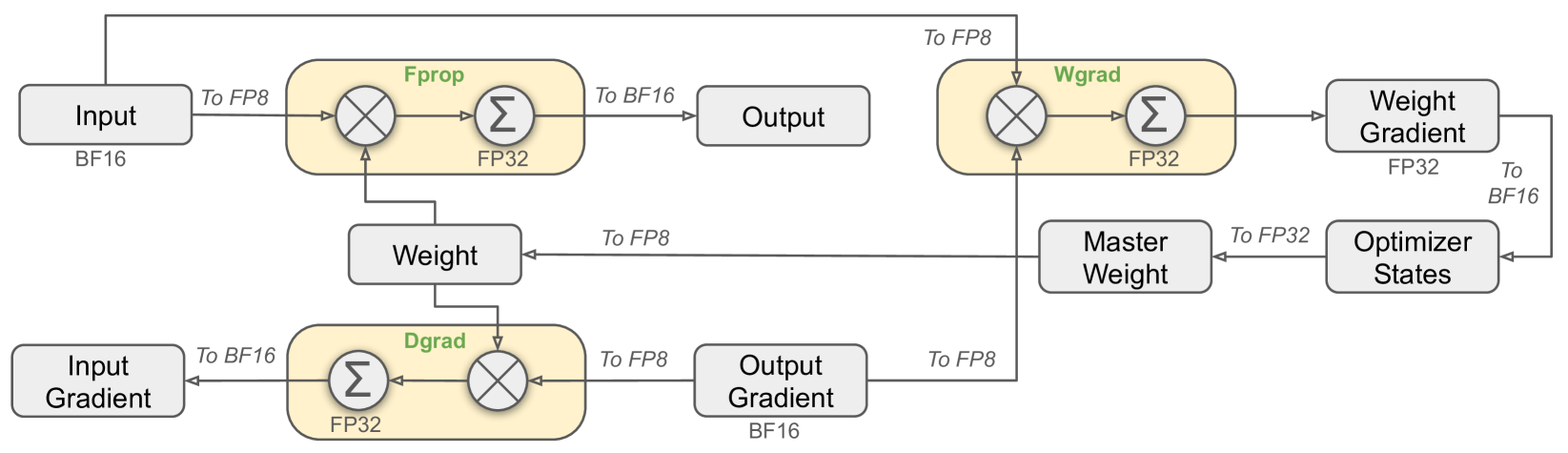
- What it shows: FP8 训练中 Linear 算子的数据流。Fprop/Dgrad/Wgrad 三个 GEMM 的精度选择和量化策略
- Why it matters: 首次在 671B 规模验证 FP8 训练的完整框架设计
- DualPipe requires PP stages and micro-batches divisible, limiting flexibility
- 2x model parameter memory (mitigated by large EP)
- Communication kernels tightly coupled to H800 NVLink+IB topology
- MTP modules discarded at inference
- Algorithm: Auxiliary-loss-free load balancing + MTP objective applicable to any MoE
- Kernel: Custom all-to-all kernels with warp specialization, PTX, dynamic SM allocation
- Framework: DualPipe — new pipeline parallelism paradigm for near-zero comm overhead
- LLM: 671B MoE with MLA achieves frontier performance at 10x lower cost
- Agent: N/A
- 跨节点 all-to-all kernel: 每 token 最多发 4 节点,IB 先发到同编号 GPU,NVLink 转发到目标 GPU。20 SM 分 10 channel,dispatch 和 combine 各有 3 种 warp(IB send / IB-NVLink forward / NVLink recv),动态调整 warp 数量。
- 内存优化: DualPipe 首尾 stage 同 rank 部署 → embedding/output head 物理共享;RMSNorm/MLA recomputation;FP8 存储激活值 → 完全避免 TP。
- Control plane: MoE gating(routing decision),auxiliary-loss-free bias 调整(每 step 结束),node-limited routing 约束(M=4)。控制面非常轻量 — bias 更新只是一个标量加减。
- Data plane: Token dispatch/combine(all-to-all),PP activation 传输,ZeRO-1 gradient all-reduce,FP8 quantization/dequantization。
- Model parameters: 2× 副本(DualPipe 双向需要首尾 PP stage 各一份),FP8 存储但 master copy 为 FP32
- Optimizer states: AdamW 的 first/second moments 用 BF16(非常规的 FP32),master weights 和 gradients 仍为 FP32
- Activations: FP8 存储(Wgrad 需要),部分敏感位置用 E5M6 自定义格式
- EMA: 异步存储在 CPU memory,不占 GPU 显存
- Bias terms: 每 expert 一个标量,每 step 末尾 $\pm\gamma$ 更新
- Batch size 从 3072 线性增长到 15360(在前 469B tokens 内),之后保持 15360
- Sequence length 固定 4K(预训练阶段),后续 context extension 到 32K 和 128K 时分别用 batch 1920 和 480
- DualPipe 要求 micro-batches 能被 2 整除,20 micro-batches 在 Figure 5 的示例中从两端同时注入
- Pre-allocated + recomputation hybrid: 模型参数 FP8 存储(master copy FP32 在 optimizer),激活值 FP8 存储 + selective recomputation(RMSNorm, MLA up-proj)
- 无 Tensor Parallelism: 通过上述内存优化,每张 GPU 可以容纳其所需的参数和激活,无需在 TP group 内切分
- 2× 参数内存(DualPipe)被大 EP size(64-way)稀释 — 每张 GPU 只存 256/64 = 4 个 routed expert + shared expert + attention 参数
- DualPipe bubble 公式: $(PP/2 - 1)(\text{F\&B} + B - 3W)$。对于 $PP=16$, 系数从 15 降到 7
- 关键洞察: $\text{F\&B}$(forward 与 backward 重叠后的时间)远小于 $F+B$,因为 comm 被完全隐藏
- 但论文没有给出 actual bubble ratio 或 MFU 数字 — 这是一个重大遗漏。180K GPU-hours/T tokens 是最终结果,但无法反推 MFU
- 16-PP: 跨 2 个节点,每个 PP stage ≈ 4 layers (61/16 ≈ 3.8,需要不等分)
- 64-EP: 跨 8 节点(8 GPU/node × 8 nodes),每张 GPU 存 4 routed experts
- ZeRO-1 DP: 在 EP group 内,optimizer states sharded across DP ranks
- 无 TP: 这是一个非常大胆的设计选择 — 通过内存优化避免了 TP 通信
- 20 SM / 132 SM (15%) 专门用于 all-to-all 通信
- 112 SM 用于计算(attention, MLP GEMM)
- Warp specialization 在通信 SM 内部进一步分工: IB send / IB→NVLink forward / NVLink recv
- 论文在 §3.5.1 明确指出这个设计的问题: SM 上的 Tensor Core 在通信时完全闲置,建议未来硬件做专用通信 co-processor
- Before DualPipe: 瓶颈是 all-to-all 通信 — compute:comm ≈ 1:1,GPU 几乎一半时间在等通信
- After DualPipe: 通信被隐藏,瓶颈转移为 pipeline bubble — 但 DualPipe 本身已将 bubble 减少 60%+
- After FP8: compute 进一步加速(理论 2×),但 FP8 GEMM 精度问题成为新的隐忧 — H800 的 14-bit 累加精度需要频繁 promote to CUDA Core
- After memory optimization (no TP): 内存不再是瓶颈,但 scaling 受限 — 如果模型更大(e.g. 2T params),可能又需要 TP
- 在推理阶段: 瓶颈转移为 expert load imbalance 和 memory access(decode 阶段 batch size 小,bottleneck 是 HBM bandwidth 而非 compute)
- DualPipe vs 1F1B/ZB1P: 比较是公平的 bubble 公式对比,但论文只给了公式没给实测数字。实际 wall-clock time 的差异可能因为 DualPipe 的 F&B overlap 质量、SM allocation、内存带宽竞争等因素而不同。
- FP8 vs BF16: 比较在 16B 和 230B 模型上进行,但不是在 671B 目标模型上做 A/B test — 论文假设小规模验证可以外推到 671B。这是合理但未经证明的。
- Aux-loss-free vs Aux-loss: 在 1B 和 3B 模型上验证,但 auxiliary loss 的系数选择(baseline 用 DeepSeek-V2 的设置)是否是最优的?可能存在更好的 aux loss 系数使得差距缩小。
- 缺失的关键对比: 没有与 Megatron-LM 或 DeepSpeed 的直接 head-to-head throughput 对比。我们无法知道 HAI-LLM + DualPipe 相对于 Megatron-LM + interleaved 1F1B 的实际 MFU 差异。
- Baseline 可能赢的场景: 当 PP stages 很少(e.g. PP=2)时,DualPipe 的 2× 参数内存代价高但 bubble 减少有限;当 compute:comm >> 1(通信不是瓶颈)时,DualPipe 的 overlap 优势不明显;当 micro-batch 数不能被 2 整除时,DualPipe 不适用。
- 模型权重: 完全开源 (GitHub: deepseek-ai/DeepSeek-V3)
- DualPipe 算法: 论文发布后,DeepSeek 在 GitHub 上开源了 DualPipe 的参考实现
- HAI-LLM 框架: 未开源
- All-to-all 通信 kernel: 未开源(PTX 级别,高度硬件耦合)
- FP8 训练框架: 未开源
- 训练: 2048 H800 GPU,NVLink+NVSwitch 节点内,IB 节点间全互联
- 推理 Prefill: 最小 4 节点 32 GPU (TP4×SP + EP32 + DP8)
- 推理 Decode: 最小 40 节点 320 GPU (TP4×SP + EP320 + DP80)
- 这意味着小团队无法部署完整模型 — 论文在 §6 明确承认这是 limitation
- 模型权重: ✅ 完全开源(GitHub + HuggingFace)
- DualPipe 算法代码: ✅ 参考实现已开源
- HAI-LLM 框架: ❌ 未开源
- 通信 kernel: ❌ 未开源
- FP8 框架: ❌ 未开源
- DeepSeek 自身的 API 服务(chat.deepseek.com)使用 DeepSeek-V3
- Prefill/Decode 分离部署已在生产环境运行
- 40 节点 320 GPU 的 decode 部署规模意味着这是一个非trivial的生产系统
- MTP speculative decoding 的 85-90% acceptance rate 和 1.8× TPS 已在线验证
- 如果复现 DualPipe: 算法描述足够清晰,DualPipe 参考代码已开源。但需要与 all-to-all kernel 配合才能发挥全部价值。中等难度。
- 如果复现完整训练系统: 需要(a) 2048+ H800 GPU 集群, (b) IB+NVLink 拓扑匹配, (c) 自研 all-to-all kernel (PTX 级别), (d) FP8 训练框架开发, (e) memory optimization 工程。极高难度,估计需要 10+ 资深 GPU 工程师 6+ 月。
- 如果迁移到非 NVIDIA 硬件 (e.g. AMD MI300X): All-to-all kernel 需要完全重写(RDMA 模型不同,NVLink→Infinity Fabric),FP8 GEMM kernel 需要适配 CDNA 的 Matrix Core,warp specialization 概念需要映射到 AMD 的 wavefront。高难度但理论可行。
- 如果只用模型权重做推理: 通过 vLLM / TensorRT-LLM 等已有框架即可部署,社区已有适配。部署门槛主要在 GPU 数量(最小 32 GPU prefill)。
Summary #
DeepSeek-V3 is a 671B MoE model (37B active/token) using MLA + DeepSeekMoE architecture. Key infra innovations: DualPipe for pipeline parallelism with full compute-comm overlap, FP8 mixed precision training at scale, custom IB+NVLink all-to-all kernels, and memory optimizations eliminating tensor parallelism. Pre-trained on 14.8T tokens for \$5.576M, matching GPT-4o/Claude-3.5-Sonnet.
Key Findings #
Key Figures #
Figure 2: DeepSeek-V3 基础架构 #
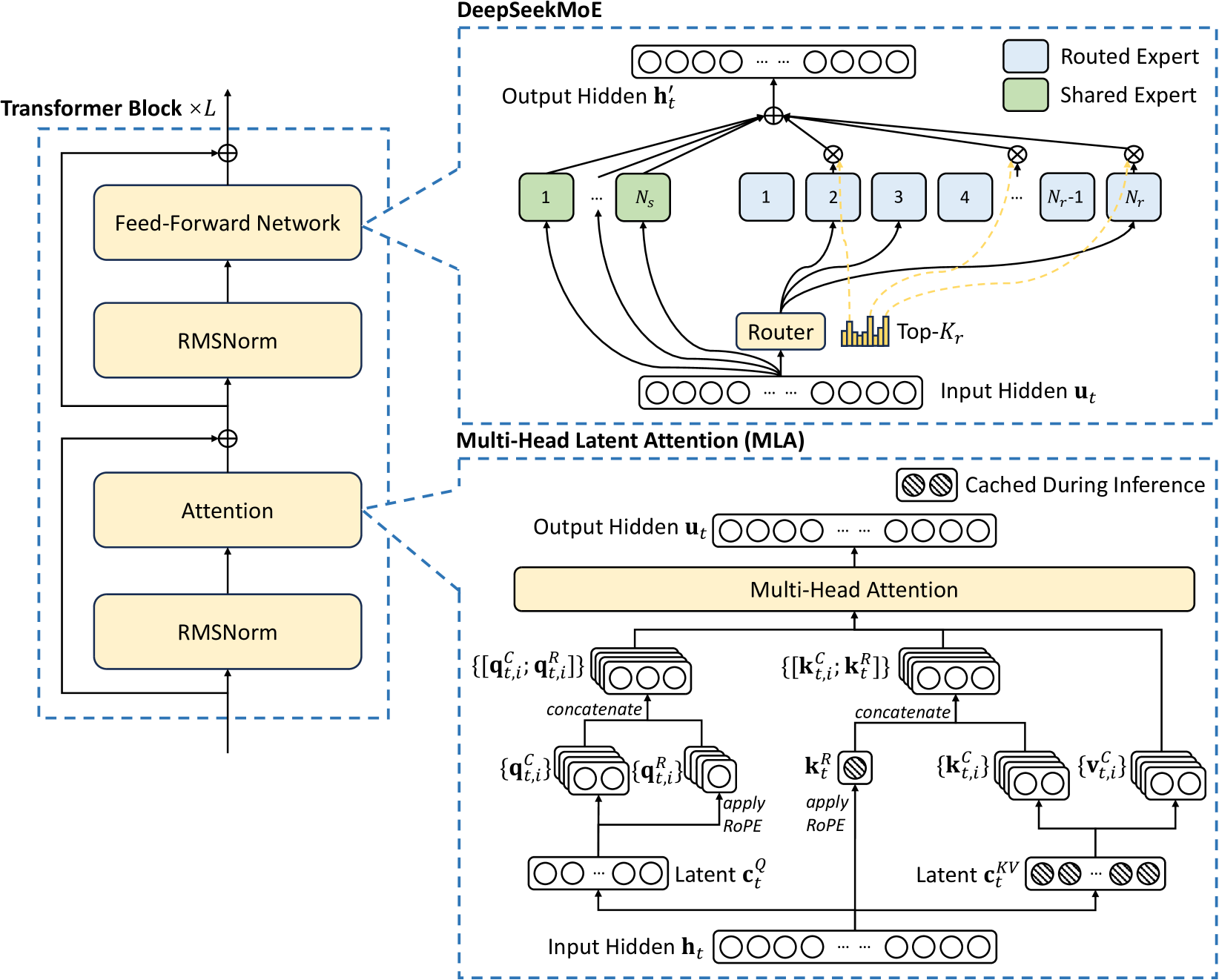
Figure 4: DualPipe 计算-通信重叠策略 #

Figure 5: DualPipe 全局调度示意 #

Figure 6: FP8 混合精度训练框架 #
Key Tables #
Table 1: 训练成本 #
| Stage | H800 GPU Hours | USD |
|---|---|---|
| Pre-Training | 2,664K | \$5.328M |
| Context Extension | 119K | \$0.238M |
| Post-Training | 5K | \$0.01M |
| Total | 2,788K | \$5.576M |
Takeaway: 全部训练仅花费 $5.576M(H800 $2/GPU-hour),其中预训练占 95.6%,每万亿 token 仅需 180K GPU 小时。
Table 2: Pipeline 并行方法对比 #
| Method | Bubble | Parameter Memory | Activation Memory |
|---|---|---|---|
| 1F1B | $(PP-1)(F+B)$ | 1× | PP |
| ZB1P | $(PP-1)(F+B-2W)$ | 1× | PP |
| DualPipe (Ours) | $(PP/2-1)(\text{F\&B}+B-3W)$ | 2× | PP+1 |
Takeaway: DualPipe 的 bubble 公式中系数从 PP-1 降到 PP/2-1,在 16-PP 时 bubble 减少约 60%+。代价是 2× 参数内存,但在大 EP 下影响可忽略。
Table 3: DeepSeek-V3 模型配置 (§4.1) #
| Params | 671B total, 37B active | Layers | 61 |
|---|---|---|---|
| Hidden | 7168 | Heads | 128 |
| KV compress dim | 512 | Routed experts | 256 |
| Shared experts | 1 | Active experts | 8 |
| Vocab | 129,280 | Context | 128K |
Takeaway: 671B 总参数中每 token 仅激活 37B(5.5%),MLA 将 KV cache 压缩到 512 维,推理显存极低。
Limitations #
Infrastructure Impact #
关键技术细节 #
一句话总结 #
DualPipe 通过双向 pipeline + 细粒度计算-通信重叠,将 MoE 跨节点 all-to-all 通信完全隐藏,以不到 560 万美元训出与 GPT-4o 可比的 671B 模型。
Deep Analysis (framework) #
1. System Scope #
Primary goal: 大规模 MoE LLM 的预训练(pre-training)为核心,兼顾推理部署(inference deployment)。训练系统占全文 Section 3 的绝大部分篇幅,推理部署在 §3.4 有独立描述但深度明显不足。
Scale target: 分布式,2048 H800 GPU(256 节点 × 8 GPU/节点)。16-way PP 跨 2 个节点(每 PP stage = 8 GPU = 1 节点),64-way EP 跨 8 节点,ZeRO-1 DP 在 EP group 内。总计 2048 GPU 的集群,全 IB 互联 + 节点内 NVLink/NVSwitch。
Online or offline: 训练是离线批处理;推理部署同时覆盖 online serving(prefill/decode 分离,有 SLO 约束)和 offline batch。
Workload: MoE LLM training — 671B total params, 37B active/token, 256 routed experts + 1 shared expert, 61 layers, 4K→128K context length。这是目前公开报道的最大规模 FP8 MoE 训练。
批判性评论: 论文标题是"Technical Report"而非"System Paper",但 §3 的系统设计深度足以成为一篇独立的系统论文。然而,推理部署(§3.4)的细节远不如训练充分 — 缺少 latency/throughput 数据、没有 prefill 与 decode 的 SLO 数字、IBGDA 的效果未量化。这暗示推理系统在发表时可能尚未完全优化。
2. Architecture & Data Flow #
System Component Diagram #
┌──────────────────────────────────────────────────────────────┐
│                      HAI-LLM Framework                       │
│                                                              │
│  ┌─────────┐  ┌──────────┐  ┌──────────┐  ┌──────────────┐ │
│  │ Data     │  │ Pipeline │  │ Expert   │  │ FP8 Mixed    │ │
│  │ Pipeline │→│ Parallel │→│ Parallel │→│ Precision    │ │
│  │ (ZeRO-1) │  │ (DualPipe│  │ (64-way  │  │ Framework    │ │
│  │          │  │  16-way) │  │  EP)     │  │              │ │
│  └─────────┘  └──────────┘  └──────────┘  └──────────────┘ │
│       │              │              │              │         │
│  ┌─────────────────────────────────────────────────────────┐ │
│  │           Custom All-to-All Communication Kernels       │ │
│  │     IB (50GB/s) + NVLink (160GB/s) co-optimized        │ │
│  └─────────────────────────────────────────────────────────┘ │
│       │              │              │              │         │
│  ┌─────────┐  ┌──────────┐  ┌──────────┐  ┌──────────────┐ │
│  │ H800    │  │ NVLink   │  │ IB       │  │ CPU (EMA,    │ │
│  │ GPU×2048│  │ NVSwitch │  │ Network  │  │  Optimizer)  │ │
│  └─────────┘  └──────────┘  └──────────┘  └──────────────┘ │
└──────────────────────────────────────────────────────────────┘
Control plane vs Data plane:
State management:
Failure handling: 论文完全未提及 fault tolerance、checkpoint、或 failure recovery。2788K GPU-hours 的训练(约 57 天×2048 GPU),零 loss spike 零 rollback — 这要么说明硬件和软件极其稳定,要么说明他们有 checkpoint 机制但没写。考虑到 H800 集群的规模,这是论文的一个显著遗漏。
2a. End-to-End Data Flow Diagram #
Training forward pass — 单个 micro-batch 在单层 MoE Transformer block 的数据流:
| Stage | Input → Output | Location | Data Format & Size |
|---|---|---|---|
| 1. Token Embedding | Token IDs → Hidden states | GPU HBM | int32 → BF16, [B×4K, 7168] |
| 2. RMSNorm | h → norm(h) | GPU (recompute in bwd) | BF16, [B×4K, 7168],不存输出 |
| 3. MLA Q/K/V compress | h → c_Q, c_KV, k_R | GPU | BF16→FP8 存储, c_KV=[B×4K, 512] |
| 4. Attention compute | Q, K, V → attn_out | GPU Tensor Cores | BF16 (保留高精度) |
| 5. MLA output proj | attn_out → u | GPU | BF16, [B×4K, 7168] |
| 6. RMSNorm | u → norm(u) | GPU (recompute in bwd) | BF16 |
| 7. MoE Gate (Sigmoid + TopK) | u → routing decisions | GPU | BF16→routing table |
| 8. All-to-All Dispatch | Token features → target GPUs | GPU→NIC→IB→NIC→GPU | FP8, 每 token 发往 ≤4 nodes |
| 9. Expert FFN (MLP) | dispatched tokens → expert output | GPU Tensor Cores | FP8 GEMM (E4M3), accum FP32 |
| 10. All-to-All Combine | expert outputs → source GPUs | GPU→NIC→IB→NIC→GPU | BF16 (combine 保持高精度) |
| 11. Residual Add | u + MoE_out → h' | GPU | BF16 |
| 12. MTP Module (depth=1) | h' → next-token prediction | GPU | 共享 embedding/output head |
Backward pass: 分为 B_input (Dgrad) 和 B_weight (Wgrad)。Wgrad 从 FP8 存储的激活值读取,Dgrad 对 attention 后的 linear 输入使用 E5M6 自定义格式。
2b. Data Movement Hotspots #
TOP 3 数据搬运瓶颈:
| Rank | Bottleneck | What Data | How Much | From→To | Frequency | Overlapped? |
|---|---|---|---|---|---|---|
| #1 | Cross-node All-to-All (MoE dispatch/combine) | Token hidden states | 每 token 7168 dim × FP8 = ~7KB,每层 2× dispatch+combine,61 MoE layers,batch_size up to 15360 | GPU→IB(50GB/s)→GPU→NVLink(160GB/s)→GPU | 每 micro-batch 每 MoE layer 2 次 | 是,DualPipe 的核心创新就是把这个完全隐藏 |
| #2 | PP 跨节点 Activation/Gradient 传递 | 层间 hidden states | [micro_batch_size, seq_len, 7168] BF16 ≈ 数百 MB/次 | PP stage N 的 GPU → PP stage N+1 的 GPU(跨节点 IB) | 每 micro-batch 每 PP boundary 1 次 forward + 1 次 backward | 是,与 all-to-all 一起被 DualPipe 隐藏 |
| #3 | FP8 Quantization/Dequantization 带来的 HBM 读写 | Activations, weights | 每个 Linear 需要: 读 BF16 → 量化 → 写 FP8 → 读 FP8 → GEMM → 写 BF16 | GPU HBM ↔ GPU SRAM (L2/shared mem) | 每个 GEMM 前后 | 部分 — online quantization 需要额外读写,论文在 §3.5.3 明确指出这是瓶颈,建议未来硬件融合 FP8 cast 和 TMA |
批判性分析: 论文声称"near-zero all-to-all communication overhead",但这只在 compute:comm ≈ 1:1 时成立。如果 expert 更细粒度(e.g. 512 experts),compute 更少而 comm 不变,overlap 就会破裂。论文没有测量当 compute:comm 比率变化时的 degradation curve。
3. Key Innovations #
| Innovation | Mechanism | Benefit | Cost/Tradeoff |
|---|---|---|---|
| DualPipe | 双向 pipeline scheduling + 细粒度组件(attention/dispatch/MLP/combine)交错排列,forward 的 comm 与 backward 的 compute 重叠 | Pipeline bubble 从 $(PP-1)(F+B)$ 降到 $(PP/2-1)(\text{F\&B}+B-3W)$,约减少 60%+;all-to-all 和 PP comm 完全隐藏 | 2× 模型参数内存(首尾 PP rank 各存一份完整模型);要求 PP stages 和 micro-batches 均能被 2 整除;调度逻辑复杂度显著增加 |
| Custom All-to-All Kernels | 20 SM 分 10 channel,warp specialization 区分 IB send / IB-NVLink forward / NVLink recv 三种角色,动态调整 warp 分配;PTX 手写指令 | 充分利用 IB 50GB/s + NVLink 160GB/s 异构带宽;只占 20/132 SM(15%);支持每 token 最多 4 节点、平均 3.2 experts/node | 高度耦合 H800 拓扑(NVLink 8-GPU + IB 互联),换其他硬件需要完全重写;PTX 级别优化无法跨架构移植 |
| FP8 Mixed Precision Training | Tile-wise (1×128) activation quantization + Block-wise (128×128) weight quantization + E4M3 all tensors + 每 128 元素 promote to CUDA Core FP32 累加 + online quantization | 理论 2× 计算加速 + 显存节省(激活值 FP8 存储);671B 规模验证 relative loss error < 0.25% | H800 Tensor Core 的 FP8 累加精度只有 14-bit,必须每 128 元素手动 promote 到 CUDA Core — 这降低了 WGMMA 发射率;不支持 block-wise activation quantization(Dgrad 对精度敏感,会 diverge) |
| Memory Optimization | RMSNorm/MLA up-proj recompute;EMA 异步存 CPU;DualPipe 首尾同 rank 物理共享 embedding/output head;FP8 activation 存储 | 完全避免 Tensor Parallelism,减少 TP 通信开销和实现复杂度 | Recomputation 增加约 5-10% 额外计算;首尾同 rank 部署约束了 PP stage 分配灵活性 |
| Auxiliary-Loss-Free Balancing | 每 expert 维护一个 bias term $b_i$,仅用于 routing decision 不用于 gating value;每 step 末根据 expert load 动态 $\pm\gamma$ 调整 | 消除 auxiliary loss 对模型性能的损害;实现 batch-wise balancing(而非 sequence-wise),允许 expert 跨 domain 更好地 specialize | 推理时的 domain shift 可能导致 load imbalance — 论文承认了这个问题并用 redundant expert deployment 缓解,但没有量化 imbalance 的程度 |
4. Scheduling & Resource Management #
Batch formation strategy:
Memory management:
GPU 利用率与 Bubble 消除:
PP/EP/DP 并行策略:
SM allocation:
5. Target Scenarios & Workload Characterization #
| Scenario | Workload Pattern | SLO/Goal | Why Existing Systems Fail |
|---|---|---|---|
| 大规模 MoE 预训练 (primary) | 671B params, 14.8T tokens, 4K seq, batch 15360, 61 layers × (attention + 256-expert MoE) | ≤\$5.576M 总成本;零 loss spike;180K GPU-hours/T tokens | 1F1B pipeline bubble 太大;EP 的 all-to-all 通信 ≈ 计算时间(1:1 ratio),传统方法无法隐藏;TP 带来大量冗余通信且增加内存 |
| 长上下文训练 (secondary) | 32K→128K context extension, 2×1000 steps | 保持 NIAH 性能 | YaRN 需要的额外计算与通信在 DualPipe 框架内无缝扩展 |
| 在线推理 serving (tertiary) | Prefill: TP4+SP+EP32+DP8, 4 节点 32 GPU;Decode: TP4+SP+EP320+DP80, 40 节点 320 GPU | >2× DeepSeek-V2 速度;SLO 未明确给出 | 标准 EP 部署下 expert load imbalance → redundant expert deployment |
Primary bottleneck: 通信(cross-node all-to-all)。论文反复强调 compute:communication ≈ 1:1 是核心痛点。在 DualPipe 成功隐藏通信后,瓶颈转移为 pipeline bubble(但已被大幅缩小)和 FP8 GEMM 精度/效率。
批判性评论: 论文没有给出 roofline analysis 或 MFU (Model FLOPs Utilization) 数字。我们只知道 180K GPU-hours/T tokens,但不知道这对应多少 MFU。按 H800 ~990 TFLOPS FP8 粗算: 14.8T tokens × ~7.5B active FLOPs/token × 6(forward+backward)≈ 6.66e20 FLOPs,2.664M GPU-hours × 3600s × 990e12 = 9.49e24 可用 FLOPs,MFU ≈ 6.66e20 / 9.49e24 ≈ 很低... 但这个计算可能有误因为 MoE 的 FLOP 计算复杂。论文刻意回避了 MFU 这个关键指标。
6. Performance Evaluation & Before-After Comparison #
6a. Metrics Definition #
| Metric | Definition | Unit | Higher/Lower is Better |
|---|---|---|---|
| Pipeline Bubble | 空闲时间占比,用 (idle time units) 的公式表示 | Time units (F, B, W) | Lower |
| Parameter Memory | 存储模型参数所需的副本数 | ×(倍数) | Lower |
| Activation Memory | pipeline 中需要同时保持的 activation 数量 | PP stages | Lower |
| Training Cost | 完成全部训练所需的 GPU 小时数和美元 | GPU-hours, USD | Lower |
| Relative Loss Error | FP8 vs BF16 训练的 loss 相对误差 | % | Lower |
| MTP Acceptance Rate | Speculative decoding 时第二个 token 被接受的比率 | % | Higher |
| TPS | 推理时每秒生成的 token 数 | Tokens/s | Higher |
6b. Before-After Comparison Table #
| Optimization | Metric | Baseline Value | After Optimization | Improvement | Conditions |
|---|---|---|---|---|---|
| DualPipe vs 1F1B | Pipeline Bubble | $(PP-1)(F+B) = 15(F+B)$ | $(PP/2-1)(\text{F\&B}+B-3W) = 7(\text{F\&B}+B-3W)$ | ~60%+ reduction (paper claim) | $PP=16$, 20 micro-batches |
| DualPipe vs ZB1P | Pipeline Bubble | $(PP-1)(F+B-2W) = 15(F+B-2W)$ | $(PP/2-1)(\text{F\&B}+B-3W) = 7(\text{F\&B}+B-3W)$ | 显著减少(系数从 15 降到 7 + $\text{F\&B} < F+B$) | $PP=16$ |
| DualPipe comm overlap | All-to-All visibility | 完全暴露(1:1 compute:comm ratio) | 完全隐藏 | ~2× effective throughput | Compute:comm ≈ 1:1 |
| FP8 vs BF16 | Relative Loss Error | 0% (BF16 baseline) | < 0.25% | Negligible quality loss | 16B model on 1.33T tokens; 230B model on 0.9T tokens |
| FP8 vs BF16 | Compute Speed | 1× (BF16) | 理论 2× (实际未给出) | 未量化 | H800 FP8 Tensor Core |
| Aux-loss-free vs Aux-loss | Validation Loss (1B MoE) | 2.258 | 2.253 | -0.005 loss | 1B MoE model |
| Aux-loss-free vs Aux-loss | Validation Loss (3B MoE) | 2.085 | 2.080 | -0.005 loss | 3B MoE model |
| MTP (D=1) vs Baseline | HumanEval (Large MoE) | 44.5% | 53.7% | +9.2% | 228.7B MoE, 540B tokens |
| MTP Speculative Decoding | TPS | 1× baseline | 1.8× TPS | +80% decoding speed | 85-90% acceptance rate |
| No TP vs with TP | TP Communication | TP comm overhead > 0 | 0 (eliminated) | ~15-20% comm saving (estimated) | Memory optimization enables this |
6c. Bottleneck Shift Analysis #
6d. Baselines & Fairness #
公平性问题:
7. API & Usability #
Framework: HAI-LLM — DeepSeek 内部自研的轻量级训练框架,"crafted by our engineers from the ground up"。未开源,外部无法复现。
Open source status:
Deployment requirements:
批判性评论: HAI-LLM 不开源是 DeepSeek 的核心竞争壁垒。DualPipe 算法本身可以复现,但 all-to-all kernel、FP8 框架、memory optimization 的完整工程组合才是真正的 know-how。论文给出了足够的算法描述但不够的工程细节 — 例如 warp specialization 的具体 warp 数量分配策略、PTX 指令选择、L2 cache 干扰的量化等。
8. Infrastructure Impact #
| Layer | Impact |
|---|---|
| Algorithm | Auxiliary-loss-free load balancing (dynamic bias) — 可泛化到任意 MoE 模型,消除 balance loss 对模型质量的损害;MTP objective — 训练信号加密但推理时可丢弃或用于 speculative decoding |
| Kernel | 跨节点 all-to-all kernel with warp specialization + PTX — 为 IB+NVLink 异构拓扑定制的通信内核,dynamic SM allocation (20 SM/132),NVLink 做 IB→GPU 的二级转发;FP8 GEMM with per-128 CUDA Core promotion — 绕过 H800 Tensor Core 累加精度限制 |
| Framework | DualPipe — 新的 pipeline parallelism paradigm,双向调度 + 细粒度 overlap,可推广到任意 compute:comm ≈ 1 的分布式训练场景;消除 TP 的内存优化策略 — 为大 MoE 模型提供了 TP-free 的可行路径 |
| LLM | 671B MoE + MLA 验证了 MoE 的 scaling 路径:37B active params 达到 GPT-4o 级别性能,成本仅 \$5.576M。MLA 的 KV cache 压缩(512 dim) 使推理显存极低。MTP 的 speculative decoding 带来 1.8× TPS |
| Agent | 间接影响 — DeepSeek-V3 的 code/math 能力(LiveCodeBench #1, MATH-500 90.2%)使其成为 agent 场景的强 backbone。SWE-Bench 42.0% 虽不及 Claude-3.5 但已是 open-source 最佳 |
| Ops | 零 loss spike 零 rollback 的训练稳定性 — 如果可复现,将大幅降低大模型训练的运维成本。Redundant expert deployment 策略为 MoE serving 的 load balancing 提供了实践参考 |
9. Comparison Matrix #
| Feature | HAI-LLM + DualPipe | Megatron-LM | DeepSpeed | Chimera | ZeroBubble (ZB1P) |
|---|---|---|---|---|---|
| Communication Overlap | ✅ Full overlap (all-to-all + PP comm completely hidden) | ⚠️ Partial (interleaved 1F1B can overlap some PP comm) | ⚠️ Limited (ZeRO focuses on memory, not comm-compute overlap) | ✅ Bidirectional pipeline, partial overlap | ❌ No communication overlap (focuses only on bubble) |
| Pipeline Bubble | $(PP/2-1)(\text{F\&B}+B-3W)$ — 最小 | $(PP-1)(F+B)$ for 1F1B; smaller for interleaved | Depends on schedule, typically similar to 1F1B | $\sim(PP/2)(F+B)$ — bidirectional but no fine-grained overlap | $(PP-1)(F+B-2W)$ — 减少 W 部分 bubble |
| Parameter Memory | 2× (双向需两份参数) | 1× | 1× (ZeRO shards optimizer/gradient, not params in Stage 1) | 2× (同 DualPipe) | 1× |
| Activation Memory | PP+1 | PP (1F1B), varies for interleaved | Varies with ZeRO stage | PP | PP |
| EP Support | ✅ 原生 64-way EP,自定义 all-to-all kernel | ✅ 支持但 kernel 非针对 IB+NVLink 异构优化 | ✅ 支持 MoE (DeepSpeed-MoE) | ❌ 不针对 MoE 设计 | ❌ 不针对 MoE 设计 |
| FP8 Training | ✅ 完整框架(tile/block quantization, E4M3 all, online quant, CUDA Core promotion) | ⚠️ 通过 TransformerEngine 支持,但用 NVIDIA 默认策略(tensor-wise, delayed quant, E5M2 for Dgrad/Wgrad) | ⚠️ 有 FP8 支持但非核心设计 | ❌ 无 | ❌ 无 |
| Requires divisibility | PP stages 和 micro-batches 被 2 整除 | 无特殊要求 | 无特殊要求 | Micro-batches 被 PP stages 整除 | 无特殊要求 |
| Hardware Coupling | 高 — 深度绑定 H800 NVLink+IB 拓扑 | 中 — 通用 NCCL | 低 — 通用 | 低 — 通用 | 低 — 通用 |
| Open Source | ❌ 框架未开源(DualPipe 算法参考代码已开源) | ✅ 完全开源 | ✅ 完全开源 | ✅ 论文+代码 | ✅ 论文+代码 |
批判性评论: DualPipe 在 MoE training 的 comm overlap 上确实领先,但这种优势高度依赖于 compute:comm ≈ 1 的特定条件。对于 dense model(没有 all-to-all),DualPipe 的价值主要体现在 bubble 减少,此时它相对于 ZeroBubble 的优势需要以 2× 参数内存为代价。Megatron-LM 和 DeepSpeed 的通用性和社区支持远超 HAI-LLM。
10. Adoption & Maturity #
Open source status:
Production deployments:
What would it take to adopt?:
成熟度评估: 训练系统已经在 14.8T tokens × 671B 模型的完整训练中验证,零故障 — 这是极高的工程成熟度。但由于核心组件未开源,外部团队的采用仍然受限于算法层面的参考实现,完整系统的可复现性很低。
Hidden risks: 论文完全没有提及 (a) fault tolerance / checkpointing 策略, (b) 硬件故障率与恢复时间, (c) gradient 通信的 bit-flip 检测, (d) 多 job 资源竞争。对于一个声称零故障完成 57 天训练的系统,这些遗漏令人好奇 — 是真的没遇到问题(H800 集群质量极好),还是有未披露的容错机制?