Autellix: An Efficient Serving Engine for LLM Agents as General Programs
Autellix: An Efficient Serving Engine for LLM Agents as General Programs — L2 #
§1 TL;DR #
现有LLM serving引擎将agentic program的每次LLM call视为独立请求调度,导致program-level head-of-line blocking。Autellix将OS的Least Attained Service调度提升到program级别(PLAS/ATLAS),按program累计服务时间排优先级,配合anti-starvation和locality-aware load balancing,在相同延迟下实现4-15×吞吐提升。
Agent scope #
- Task class: 通用agent serving基础设施——覆盖single-turn chatbot、multi-step ReAct、parallel Map-Reduce、tree-search MCTS等所有DAG模式的agentic program。不限定具体task domain。
- Interaction pattern: 多轮sequential(chatbot/ReAct)和高并行multi-threaded(MCTS数十到数百并行线程)混合。Program结构仅在运行时逐步揭露。
- Autonomy: Autellix本身是serving层,不参与agent决策。所服务program从human-in-the-loop(chatbot)到fully autonomous(MCTS search)全覆盖。系统对program结构zero knowledge——non-clairvoyant设计。
§2 Q1 痛点 / Q2 方法 / Q3 结果 #
Q1 痛点 #
现有LLM serving系统(vLLM、SGLang)将每次LLM call视为独立请求调度,完全忽略同一agentic program内call之间的依赖和program-level统计。这导致两层HoL blocking:
- Call-level HoL blocking:长decode call阻塞短call——已知问题,MLFQ preemption可缓解。
- Program-level HoL blocking:更隐蔽且更致命。长program(如100-call MCTS)每完成一个call就提交新call,新call在MLFQ中被放入最高优先级队列,反复挤占短program(如2-call chatbot)。实测中MLFQ在program级别的表现 ≈ FCFS甚至更差。
- Single-engine throughput:相同median latency下 Autellix vs vLLM FCFS = 4-15×(Chatbot ~4×, ReAct ~4-5×, MapReduce ~6×, MCTS ~15×)
- Multi-engine throughput:locality-aware load balancer vs round-robin = up to 1.5×
- KV-cache swap优化:batched transfer减少18× swap operations, 3-7× swap time, ~1.3× throughput
- Tail latency:anti-starvation机制使p95/p99可控,无starvation
- ATLAS vs PLAS:在MapReduce和MCTS上ATLAS优于PLAS,验证critical-path设计
- ReAct (think-then-act loop):单线程sequential call链,call长度高度可变。PLAS通过累计service自动将长conversation deprioritize。
- MCTS (tree search):最高并行度,单engine仅能处理 ~0.2 programs/sec。ATLAS通过critical-path max精确追踪program进度,避免对并行线程数的惩罚。
- Map-Reduce:fork-join模式,critical path取决于最慢线程。ATLAS优先调度critical path上的call减少idle等待。
- PLAS定义一致性:§4.2.1定义的 $p(c_j)$ 与Algorithm 1中queue assignment一致——新call被放入对应program累计service的queue,而非 $Q_1$。✓
- ATLAS max vs sum:§4.2.1说明用max(critical path),Algorithm 1 line 4中
pd.service = max(...)确认。✓ - Anti-starvation不破坏correctness:promote后reset service/wait(Algorithm 1 lines 29-30),避免永久高优先级。✓
- MLFQ demotion与program priority正交:call在queue内按quantum demotion处理call-level HoL,跨queue的初始assignment处理program-level HoL——两层机制互不干扰。✓
- Load balancer threshold无循环依赖:input token count是call自身属性,不依赖scheduler状态。✓
- Non-clairvoyant假设一致性:所有scheduling决策仅依赖已完成call的runtime(past),不使用future预测。✓
- Success-rate model:论文不测量task success rate(如SWE-bench resolve rate),仅测量serving层指标(throughput/latency)。Autellix作为serving基础设施不改变program的output质量,仅改变完成速度——scope界定合理。但无法排除极端preemption导致cache eviction进而影响output的edge case。
- Latency budget per turn:Fig. 5提供wait time vs execution time vs interrupt time分解。Wait time在中等负载下主导(>50% of total)。Per-turn absolute latency未给出,通过throughput-latency Pareto curves间接展示。论文未声称"interactive latency"。
- Failure mode classification:识别三类failure mode——(a) call-level HoL blocking(已知,MLFQ解), (b) program-level HoL blocking(本文发现,PLAS/ATLAS解), (c) long-program starvation(anti-starvation机制解)。方法精确针对(b),(a)(c)作为辅助机制覆盖。
- 无形式化作者证明 — 仅实证。LAS在DHR分布下的optimality是已知结果;program-level LAS的formal competitive ratio未证明。可被bounded的metric:在特定分布假设下program-level mean response time的competitive ratio相对于clairvoyant SRPT。
- Rai et al. (2003): LAS在DHR分布下non-clairvoyant optimal for mean response time。
- Kim et al. (HPCA 2010, ATLAS): per-thread attained service用于DRAM scheduling——ATLAS命名和max-across-threads思路直接受此启发。
- Hardware:NVIDIA A100-80GB GPU
- Models:LLaMA-3.1-8B(单卡),LLaMA-3.1-70B(多卡tensor parallel)
- Baselines:vLLM FCFS, vLLM + MLFQ (FastServe-style), round-robin load balancer
- Workloads:Chatbot(多轮对话), ReAct(tool call交替), Map-Reduce(fork-join), MCTS(树搜索)
- Metrics:program-level throughput, end-to-end latency (median/p95/p99), wait time breakdown
- API形式:Stateful session API。与OpenAI stateless API不同,program先建立session获得session_id,后续LLM call附带session_id提交。与LangChain/AutoGen等框架compatible——替换endpoint + 添加session lifecycle即可。
- Side effects:Autellix是read-only中间层——不修改program逻辑,不拦截tool call。Tool call在program端直接执行,结果作为下一次LLM call的input提交。
- Error surface:scheduling/routing failure对program透明——失败call按OpenAI error convention返回。Engine-level error(OOM, CUDA error)由vLLM处理。
- Environment contract:stateful(session间保持process table entry)但non-deterministic(scheduling依赖concurrent workload)。Engine间无shared state,靠routing维持locality。
- 新call的MLFQ queue assignment(Algorithm 1核心修改):传统MLFQ将新请求放入 $Q_1$,Autellix根据process table中program的累计service time决定初始queue。这一改动是program-level scheduling生效的关键——没有它,长program的新call仍享受最高优先级。vLLM的scheduler代码(
vllm/core/scheduler.py)是最接近的实现base。 - Batched KV-cache block transfer:vLLM默认逐block swap,preemptive scheduling下频繁swap成为bottleneck。Autellix将同一call的多个KV block打包为单次PCIe transfer,减少18× operations——使preemption实际可行的实现前提。
- Model-agnostic:Autellix在serving层工作,不依赖特定模型能力。已验证LLaMA-3.1-8B和70B,设计上对任何decoder-only LLM适用。
- 无特殊能力要求:不要求long-context、tool-call format、structured output——这些由program层负责。
- Serving cost:MCTS workload下单A100-80GB engine ~0.2 programs/sec。以每MCTS program ~100 calls × ~1K output tokens估算,需5 engines处理1 program/sec。Multi-engine routing可近线性扩展(with locality benefit up to 1.5×)。
- Backbone sensitivity:scheduling策略不依赖model特性——PLAS/ATLAS仅依赖call runtime统计。绝对throughput随model大小变化(8B vs 70B需要不同engine数量)。
- Chatbot: 基于ShareGPT / LMSYS-Chat-1M数据集的多轮对话分布
- ReAct: 单线程agent with tool call interrupts
- Map-Reduce: parallel fork-join pattern
- MCTS: 基于LATS-style tree search
- Primary: program-level throughput(programs completed per unit time at target latency)
- Secondary: end-to-end latency distribution (median/p95/p99)
- Diagnostic: wait time breakdown, cache hit rates, swap overhead
- Not measured: task success rate (pass@1/pass@k), cost per task, output quality
- vLLM FCFS (default scheduler)
- vLLM + MLFQ (FastServe-style preemption, per-request)
- Round-robin load balancer (multi-engine)
- SRPT (optimal clairvoyant, simulation only)
- Topology: 评估了hierarchical(MCTS: expand → evaluate → backpropagate)和fan-out/fan-in(Map-Reduce)。通过DAG IR支持任意topology。
- Coordination: 同一program内的多个thread(agents)共享session和process table entry,通过scheduling隐式协调。无显式message passing。
- Role specialization: Autellix不区分agent角色——所有thread的LLM call统一调度。不同角色使用不同LLM model的场景(如planner用大模型、executor用小模型)提及为future work。
- Failure isolation: thread-level failure不影响其他thread的scheduling——process table仅追踪completed calls,某thread crash不污染其他thread的priority。
- Sandboxing: Autellix不执行tool call或code——所有side-effect execution在用户端program内完成。LLM engine isolation依赖vLLM existing机制。Multi-engine部署中engine间无shared memory,单engine crash不影响其他engine。
- Observability: process table提供per-program实时可观测性(cumulative service、waiting time、active threads)。Stateful session API天然支持trace logging——每次call附带session_id可重建program timeline。
- Non-deterministic replay: scheduling依赖runtime statistics和concurrent workload,相同program在不同load下获得不同优先级。
- Deployment: vLLM之上的additional layer,需modified vLLM scheduler集成。Client-side需session management(替换endpoint + 添加session lifecycle),与LangChain/AutoGen compatible。
- Cost controls: anti-starvation threshold $\beta$ 是关键tuning parameter。无per-program token budget或rate limiting机制——依赖program层自行控制。
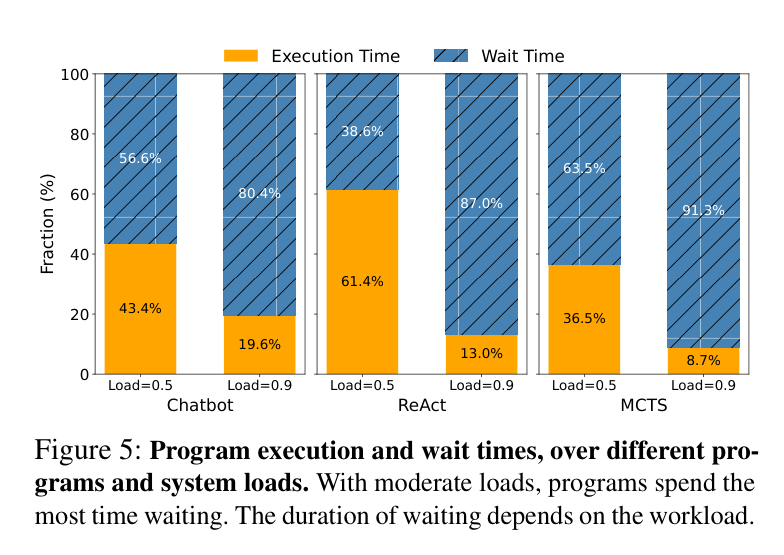
Paper's Figure 5 (caption: "Program execution and wait times, over different programs and system loads. With moderate loads, programs spend the most time waiting.").
Fig. 5展示了在Chatbot、ReAct、MCTS三类workload下,wait time随负载增加迅速主导program总延迟。中等负载下program等待时间已超过执行时间数倍。减少wait time既降低延迟,又通过加速program完成提高后续call的到达率,形成正反馈循环提升GPU utilization。
Q2 方法 #
Problem formulation. 给定 $N$ 个program以未知模式到达serving系统,每个program $i$ 是一个动态DAG,由LLM call和external interrupt(tool call/human input)交替组成。DAG结构仅在运行时逐步揭露(non-clairvoyant)。目标:
$$\min \frac{1}{N}\sum_{i=1}^{N} W_i$$
其中 $W_i$ 是program $i$ 所有LLM call的累计等待时间。同时追求GPU利用率最大化和公平性(p95/p99延迟可控)。
核心机制:将Least Attained Service (LAS) 从per-request提升到per-program。新call的初始优先级继承program已消耗的累计服务时间,而非从最高优先级开始。
| Aspect | Before: LAS/MLFQ per-request | After: PLAS/ATLAS per-program |
|---|---|---|
| Priority unit | 单个LLM call | Program(所有call共享state) |
| 新call初始队列 | 最高优先级 $Q_1$ | 按program累计service分配 |
| Service metric | 本call已用时间 | PLAS: $\sum t_k$; ATLAS: $\max s_i$ |
| 跨call状态 | 无 | Global process table |
PLAS(单线程program):
$$p(c_j) = \sum_{k < j,\; c_k.\text{id} = c_j.\text{id}} t_k$$
物理意义:program消耗的总服务越少,优先级越高——偏好短/新program。在DHR分布(Pareto/log-normal)下,LAS最小化mean response time。
ATLAS(多线程program):
$$p(c_j) = \max_{T_i \in \text{program}(c_j)} s_i$$
物理意义:以critical path(最长线程)的累计服务作为program优先级。用max而非sum避免高并行度program(MCTS数十线程)的priority被过度膨胀。同时在program内部优先调度critical path上的call以缩短makespan。
Anti-starvation:当program的wait/service ratio超过阈值 $\beta$,call被提升到 $Q_1$:
$$\frac{W_{\text{total}}}{S_{\text{total}}} \geq \beta \implies \text{promote to } Q_1$$
Promote后reset wait和service,防止oscillation。
核心技术壁垒:将LAS从单请求扩展到program级需要两个非trivial insight的组合:(1) 新call必须继承program累计service而非从零开始——打破传统MLFQ的基本假设(新请求享受最高优先级);(2) 多线程program的priority必须用critical-path max而非sum——sum会使MCTS等高并行program被过度惩罚。这两个选择的正确组合使ATLAS在MCTS上获得15×吞吐提升,而naive扩展无法达到。
Q3 结果 #
§3 架构 / 方法图 #
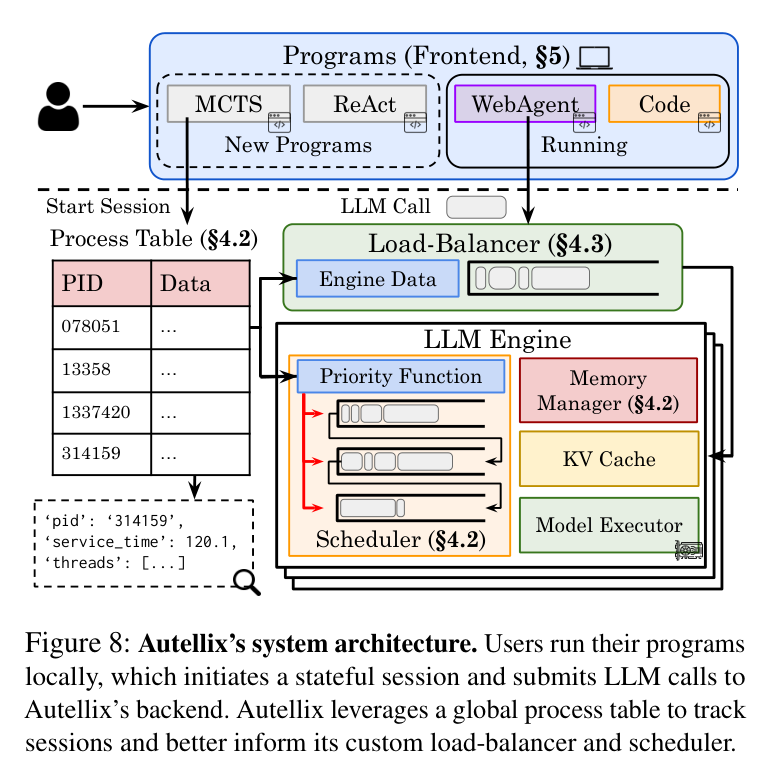
Paper's Figure 8 (caption: "Autellix's system architecture. Users run their programs locally, which initiates a stateful session and submits LLM calls to Autellix's backend. Autellix leverages a global process table to track sessions and better inform its custom load-balancer and scheduler.").
Autellix在vLLM之上增加一层program-aware serving层。用户端program通过stateful session API与后端通信,每个session对应一个program在global process table中的entry。Backend包含两个核心组件:(1) Load balancer根据input length将call路由到合适engine(长call → program's primary engine保持KV-cache locality,短call → least-loaded engine均衡负载);(2) 每个engine内的scheduler使用MLFQ + program-level priority调度。
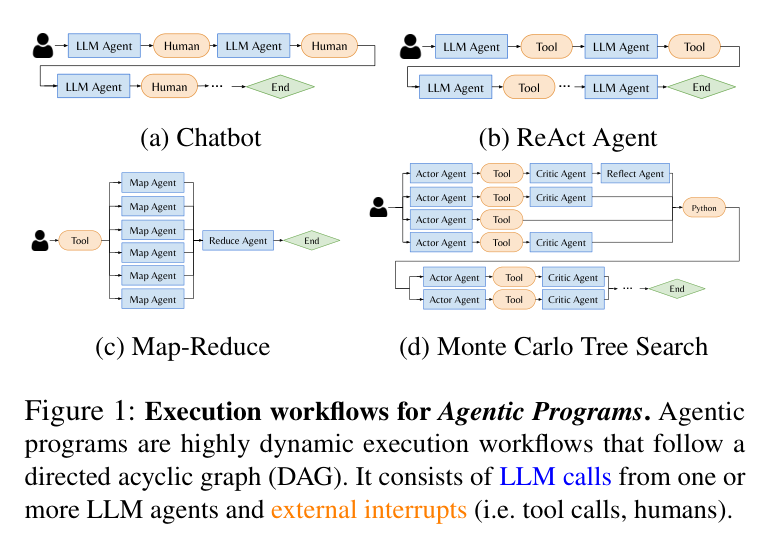
Paper's Figure 1 (caption: "Execution workflows for Agentic Programs. Agentic programs are highly dynamic execution workflows that follow a directed acyclic graph (DAG). It consists of LLM calls from one or more LLM agents and external interrupts (i.e. tool calls, humans).").
Fig. 1展示了四类代表性program的DAG结构:(a) Chatbot为线性链,(b) ReAct在LLM call和tool call之间交替,(c) Map-Reduce在某步fork出并行线程后join,(d) MCTS形成树状结构(expand/evaluate/backpropagate)。DAG的dynamic和non-deterministic特性使scheduling必须是non-clairvoyant的。
Agent loop — 请求生命周期 #
Planning & reasoning(被服务的program侧) #
Autellix本身不执行planning——它是serving基础设施。但其调度算法的设计充分考虑了不同planning模式产生的serving压力特征:
Autellix不限制program的decomposition方式、搜索深度、backtracking策略——这些均由program层(LangChain/AutoGen等)决定。
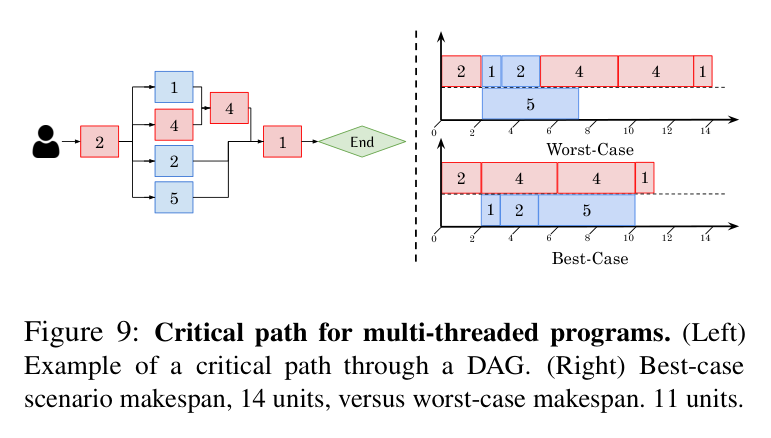
Paper's Figure 9 (caption: "Critical path for multi-threaded programs. (Left) Example of a critical path through a DAG. (Right) Best-case scenario makespan, 14 units, is achieved by prioritizing calls on the critical path.").
Fig. 9说明ATLAS的critical-path逻辑。多线程program的makespan取决于最长线程。ATLAS通过 $\max s_i$ 识别critical path,在program内部优先调度该path上的call。右图对比:critical-path-aware调度达到最优makespan 14 units,而非critical-path-aware调度的makespan更长。
§4 作者证明 #
Notation table #
| Symbol | Meaning |
|---|---|
| $c_j$ | 第 $j$ 个到达的LLM call |
| $c_j.\text{id}$ / $c_j.\text{pid}$ | Call所属program的ID |
| $t_k$ | 已完成call $c_k$ 的执行时间 |
| $p(c_j)$ | Call的优先级(值越小优先级越高) |
| $T_i$ | 多线程program中第 $i$ 个线程 |
| $s_i$ | 线程 $T_i$ 的累计服务时间 $= \sum_{c_k \in T_i} t_k$ |
| $Q_1, \ldots, Q_K$ | MLFQ的 $K$ 个优先级队列,$Q_1$ 最高 |
| $\beta$ | Anti-starvation阈值(wait/service ratio) |
| $W_i$ | Program $i$ 所有call的累计等待时间 |
方程物理意义 #
PLAS priority: $p(c_j) = \sum_{k < j,\; c_k.\text{id} = c_j.\text{id}} t_k$
累计已消耗服务越多优先级越低。借鉴OS的LAS调度,但作用域从单个job扩展到program(多个sequential calls)。在DHR分布下LAS最小化mean response time(Rai et al. 2003)。
ATLAS priority: $p(c_j) = \max_{T_i \in \text{program}(c_j)} s_i$
用program中最长线程的累计服务作为优先级。Max准确捕捉program进度——critical path决定completion time;sum会使高并行program被过度惩罚。
Process table update: $\text{pd.service} \leftarrow \max(\text{pd.service},\; c.\text{service} + c.\text{model\_time})$
对单线程退化为简单累加;对多线程取max追踪critical path。
Anti-starvation condition: $W_{\text{total}} / S_{\text{total}} \geq \beta \implies \text{promote to } Q_1$
其中 $W_{\text{total}} = \text{pt}[c.\text{pid}].\text{wait} + c.\text{wait}$,$S_{\text{total}} = \text{pt}[c.\text{pid}].\text{service} + c.\text{model\_time}$。Promote后reset wait和service——不reset则service归零后立即再次被promote → oscillation。
6 base checks #
Agent-specific checks #
理论连接 #
Autellix不证明新的optimality theorem。理论基础来自已知结果:
期望但缺失的理论保证:(1) program-level LAS跨sequential calls的formal optimality条件——当call数量也服从DHR时是否仍optimal?(2) ATLAS在DAG调度下的competitive ratio vs SRPT。Fig. 18的simulation对比量化了non-clairvoyance的代价。
§5 实验与数据 #
实验设置 #
HoL blocking实证 #
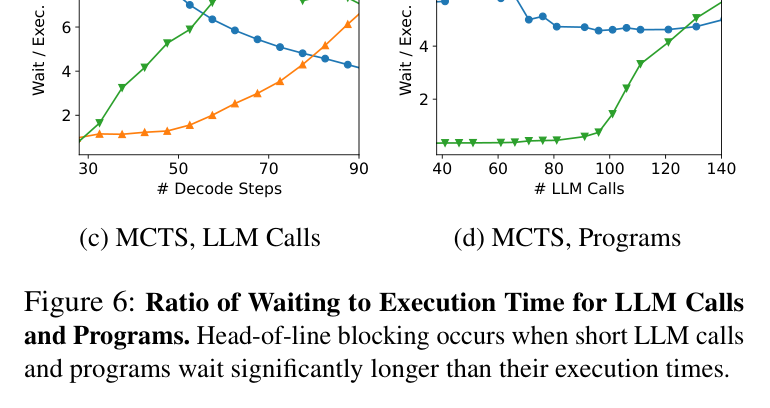
Paper's Figure 6 (caption: "Ratio of Waiting to Execution Time for LLM Calls and Programs. Head-of-line blocking occurs when short LLM calls and programs wait significantly longer than their execution times.").
Fig. 6是论文最重要的diagnostic figure。横轴按decode steps(call级)或LLM call数(program级)分组,纵轴是wait/exec ratio。关键观察:(a)(c) MLFQ在call级改善了HoL(短call ratio下降),但 (b)(d) 在program级MLFQ ≈ FCFS甚至更差——短program仍被长program的高优先级新call阻塞。这直接证明了program-level scheduling的必要性。
Data locality #
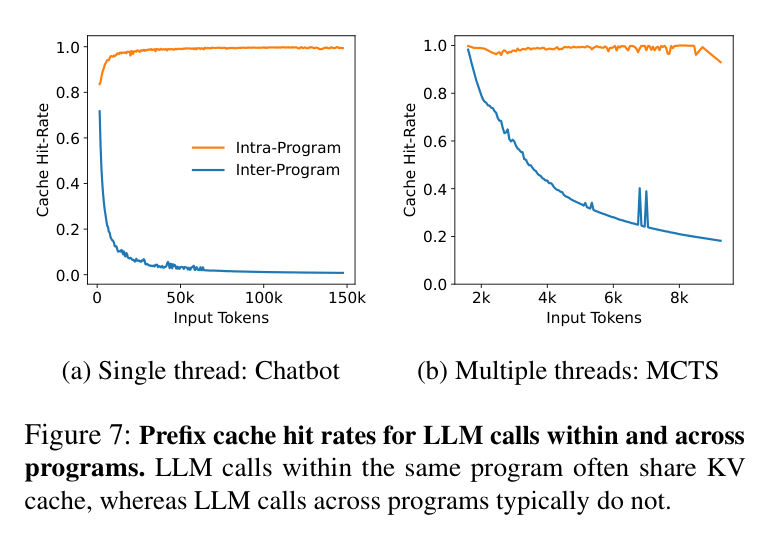
Paper's Figure 7 (caption: "Prefix cache hit rates for LLM calls within and across programs. LLM calls within the same program often share KV cache, whereas LLM calls across programs typically do not.").
Intra-program cache hit rate在各input length下均 >90%,inter-program hit rate随input length指数衰减。这验证了load balancer设计的前提:长call应路由到primary engine(高cache reuse),短call可分散(仅system prompt,routing不敏感)。
主要吞吐结果 #
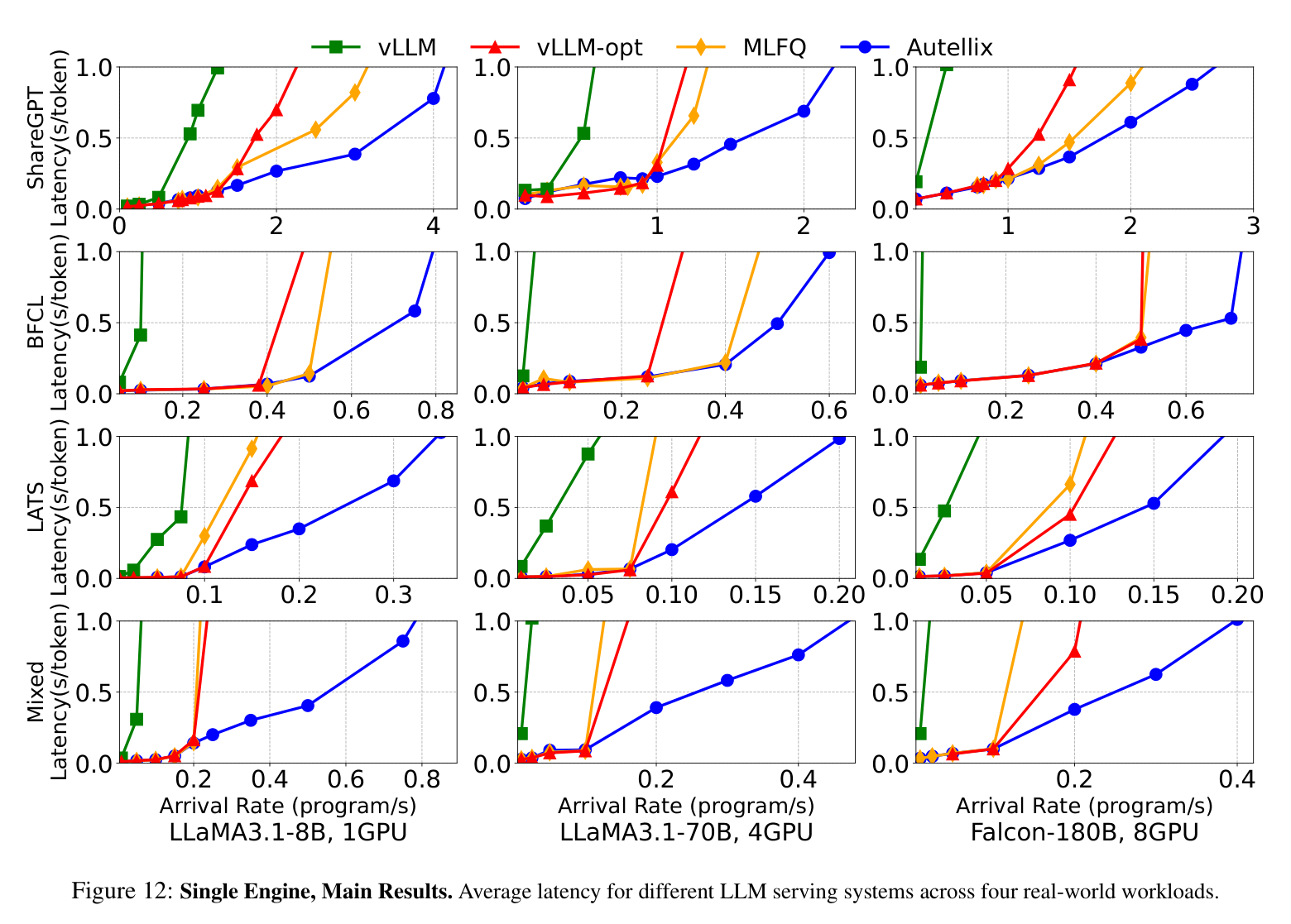
Paper's Figure 12: single-engine throughput-latency Pareto curves — Autellix (PLAS/ATLAS) vs vLLM (FCFS) vs MLFQ across Chatbot and ReAct workloads on LLaMA-3.1-8B, A100-80GB.
Fig. 12展示了单engine下Chatbot和ReAct的throughput-latency Pareto curves。Autellix的Pareto frontier在所有latency target下显著优于FCFS和MLFQ。MLFQ因program-level blocking几乎无法改善甚至劣于FCFS。
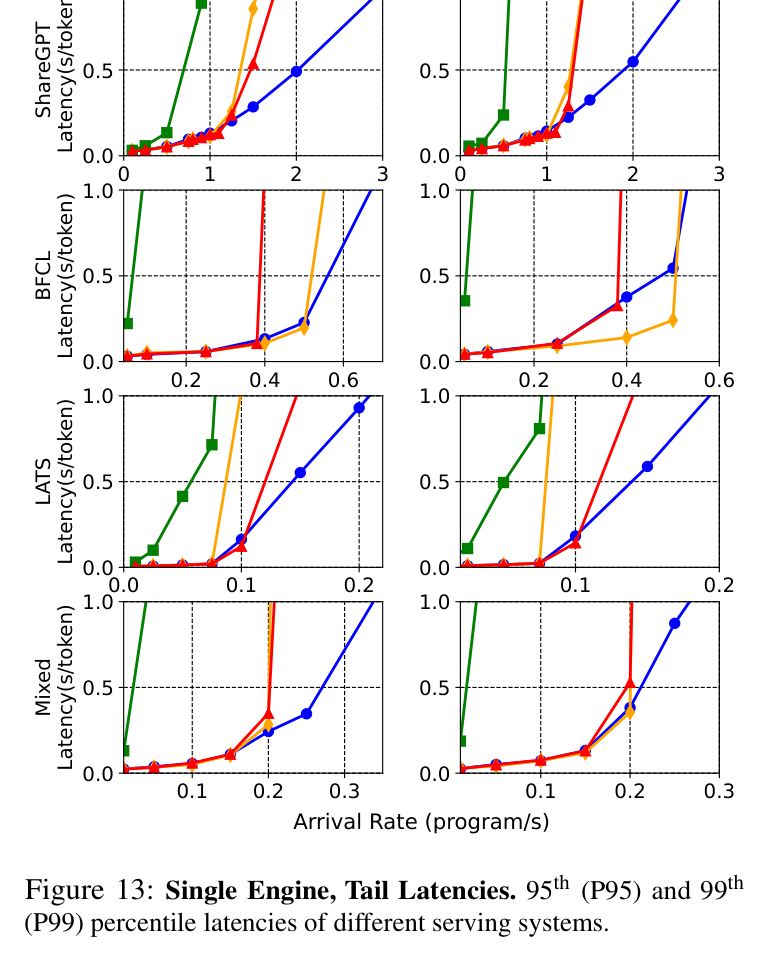
Paper's Figure 13: single-engine throughput-latency curves for MCTS and Map-Reduce workloads, showing 10-15× improvement for MCTS.
Fig. 13展示了MCTS和Map-Reduce的结果。MCTS获得最大提升(~15×),因为单engine仅能处理 ~0.2 programs/sec,program-level blocking极其严重,每个program含数十到数百个call。
| Workload | Autellix vs FCFS | Autellix vs MLFQ | ATLAS vs PLAS |
|---|---|---|---|
| Chatbot | ~4× | ~4× | N/A (single-threaded) |
| ReAct | ~4-5× | ~4-5× | N/A (single-threaded) |
| Map-Reduce | ~6× | ~6× | ATLAS > PLAS |
| MCTS | ~15× | ~15× | ATLAS > PLAS |
Comparison to optimal policy #
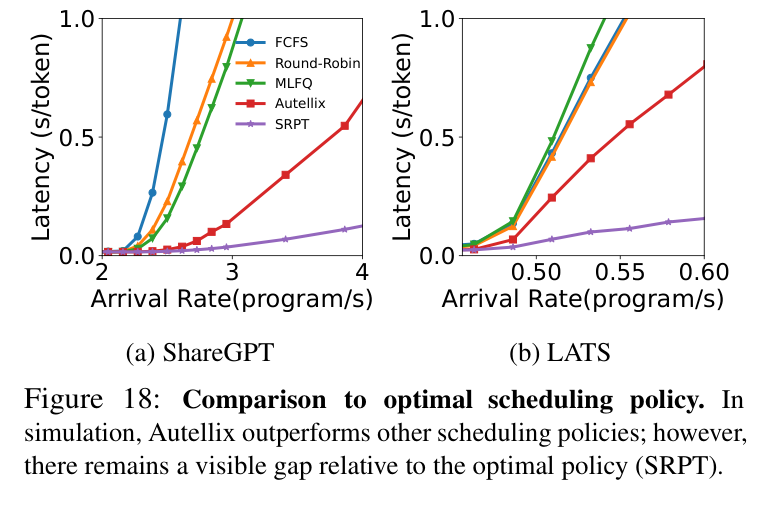
Paper's Figure 18 (caption: "Comparison to optimal scheduling policy. In simulation, Autellix outperforms other scheduling policies; however, there remains a visible gap relative to the optimal policy (SRPT).").
Fig. 18在simulation中对比Autellix与clairvoyant最优策略SRPT。Autellix优于所有non-clairvoyant baseline,但与SRPT存在明显gap——量化了non-clairvoyance的fundamental cost,指明进一步优化方向(如partial workload prediction)。
Steady-state与ablation #
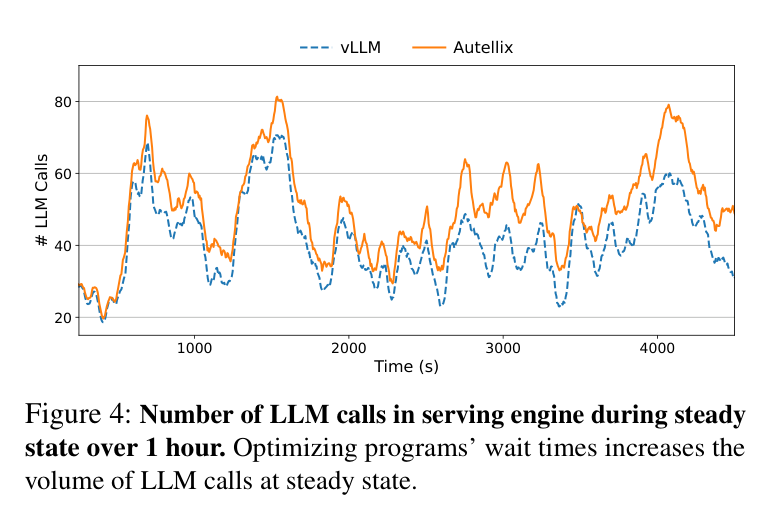
Paper's Figure 4 (caption: "Number of LLM calls in serving engine during steady state over 1 hour. Optimizing programs' wait times increases the volume of LLM calls at steady state.").
Fig. 4展示正反馈效应:减少wait time → program更快完成 → 后续call更早提交 → 稳态下GPU同时处理的call数增加 ~10个。Program-level scheduling不仅改善延迟,还通过提高到达率提升GPU utilization。
KV-cache swap:preemptive scheduling增加swap频率,Autellix通过batching parallel block transfers减少18× swap operations, 3-7× swap time, ~1.3× throughput。使preemption实际可行。
Anti-starvation $\beta$:$\beta$ 过低 → 频繁promote → 退化为FCFS;过高 → 长program饿死。有效范围:wait/service ratio 3-7。
MLFQ队列数 $K$:更多queue提供更细粒度preemption,$K = 8\text{-}16$ 后收益递减。
Tool & environment interface #
Autellix作为serving中间层的接口设计:
§6 论证链 #
| Step | Claim | Evidence | 强度 |
|---|---|---|---|
| 1 | Agentic program延迟由wait time主导 | Fig. 5: 中等负载下wait >> exec across all workloads | 强——直接测量,三类workload一致 |
| 2 | Wait time根源是双层HoL blocking(call-level + program-level) | Fig. 6: MLFQ解决call-level但program-level不变/更差 | 强——MLFQ反而更差是convincing counterexample |
| 3 | 按program累计service排优先级可消除program-level blocking | PLAS/ATLAS定义 + LAS在DHR分布下的已知optimality | 中——理论依赖分布假设(paper未验证workload是否DHR) |
| 4 | ATLAS的critical-path max优于naive sum用于多线程program | Fig. 9 example + ATLAS vs PLAS ablation on MapReduce/MCTS | 中——ablation有力但缺formal competitive analysis |
| 5 | 综合系统实现4-15× throughput at same latency | §6全套实验:4 workloads × 2 models × single/multi-engine | 强——多维度一致性高,MCTS 15×尤为显著 |
| 6 | Intra-program KV-cache locality支持locality-aware routing | Fig. 7: intra >90% vs inter指数衰减 + multi-engine 1.5× | 中——1.5× multi-engine gain相对modest |
| 7 | Non-clairvoyant scheduling仍有提升空间 | Fig. 18: Autellix vs SRPT存在visible gap | 信息——定量了upper bound,指明future work |
§7 实现 cross-reference #
代码开源状态:论文未提供public repository。[实现未公开]
关键实现细节:
核心技术壁垒(详述):co-design scheduler与program-level metadata tracking。Process table必须在call completion时同步更新(Algorithm 1 line 4),且update必须用max(for ATLAS)而非sum——错误的聚合函数导致高并行program被过度惩罚。Anti-starvation的reset逻辑也是subtle:不reset则service归零 → 再次promote → oscillation。这些设计选择的组合空间大,正确组合是核心贡献。
LLM backbone requirements #
§8 Evaluation #
Benchmarks #
论文使用自构建synthetic workloads基于real trace distributions,而非标准agent benchmarks:
未使用SWE-bench / WebArena / AgentBench / τ-bench等task-level benchmarks。这是合理的scope界定——Autellix的贡献在serving throughput而非task success rate——但无法验证scheduling优化是否在极端条件下影响agent task quality。
Metrics #
Baselines #
缺失baseline:SGLang——尽管反复引用为predecessor(有prefix caching和program-level constructs),未直接对比。SGLang的RadixAttention tree-based caching与Autellix的session-based routing可能有interesting交互。
Task difficulty distribution #
Workload分布为long-tailed(Fig. 11):decode steps per call和calls per program均服从heavy-tail分布。这是HoL blocking严重的根本原因,也是LAS-based scheduling理论适用的前提条件(DHR分布)。但论文未formal地验证workload分布是否满足DHR。
§9 Multi-agent & Production readiness #
Multi-agent #
Autellix的multi-threaded program支持自然覆盖multi-agent场景: