LMCache: An Efficient KV Cache Layer for Enterprise-Scale LLM Inference
LMCache: An Efficient KV Cache Layer for Enterprise-Scale LLM Inference — L2 #
§1 TL;DR #
LMCache is an out-of-GPU KV cache layer that extracts KV cache from vLLM/SGLang and stores/shares it across a storage hierarchy (CPU, disk, Redis, remote, network) for two use cases: cross-query prefix reuse and prefill–decode disaggregation. Its core trick is moving KV at a large chunk granularity (default 256 tokens) instead of the engine's 16-token page, plus layer-wise compute–I/O overlap, yielding up to 15× throughput and ≥2× lower latency vs vLLM/commercial baselines.
§2 Q1 / Q2 / Q3 #
Q1 — 痛点 (Pain point) #
Production KV cache has outgrown GPU memory and is increasingly reused across queries, so it must live outside the GPU. But moving it out is hard for three interlocking reasons: (1) paged-attention engines store KV in 16–64 KB non-contiguous pages, and naive per-page transfer badly underutilizes bandwidth (a transfer must reach ~16 MB to saturate a 400 Gbps NIC; sub-1 GB/s with torch.save); (2) inference engines evolve too fast (one prominent LLM every ~4 days in 2025) — every engine update can change the in-GPU KV layout and break any caching library glued to it; (3) there is no management API for higher-level components (routers, ops teams) to locate/pin/evict/compress caches in a KV-aware way.
Q2 — 方法 (Method) #
A KV caching layer sitting between the engine and heterogeneous storage, with three matching design pillars:
- Performance — batched chunk-level I/O (contiguous streaming GPU buffer + custom CUDA scatter/gather kernels), layer-wise compute–I/O pipelining on separate CUDA streams, asynchronous prefetch during queue wait, and zero-copy multi-destination writes via reference counting.
- Standardized connector API — a 7-function interface split across vLLM's scheduler (3 fns) and model runner (4 fns), co-designed and co-maintained with the vLLM team, so LMCache tracks engine evolution without ad-hoc patches.
- Controller API — a centralized manager + per-instance workers exposing
lookup / move / clear / pin / compress(external) andbatched_admit / batched_evict / batched_p2p_lookup(internal) for cache-aware routing, migration, and P2P sharing. - The crossover point between "load KV from remote" and "recompute prefill" — §8.7/Fig 15 shows it empirically as a function of context length and bandwidth (256K tokens at 32 Gbps), but there is no closed form $L^* = f(\text{BW}, \text{model FLOPs})$. A model of the form "load wins when $\frac{S_{kv}}{\text{BW}} < T_{\text{prefill}}(L)$" would predict the crossover instead of sweeping.
- The chunk-size sweet spot: default 256 tokens is asserted, not derived. Table 1's message-size→throughput curve is the empirical basis, but no optimization of chunk size vs per-transfer CUDA-launch overhead is given.
- The dynamic-offloading duplication window trade-off (§5.3) is described qualitatively (smaller window ⇒ fewer duplicated pages but more allocation stalls) with no stall-probability model as a function of window size and arrival rate.
get_num_new_matched_tokensreturningNoneis not an error path — it is a deliberate admission-control lever that pushes a cache-hit request back to the waiting queue precisely so its (slow) KV load overlaps other requests' compute. Miss this and you serialize I/O.- Zero-copy via reference counting (§5.3): a multi-destination write (CPU→disk + CPU→remote simultaneously) increments a single refcount on the shared source instead of duplicating; the buffer frees at count 0 (the paper's PCB-counter analogy). Combined with dynamic offloading's three-pointer (start/current/end) window, which duplicates only a subset of free GPU pages to cap duplication ratio at the cost of possible allocation stalls.
- Serving stage: both prefill (prefix reuse lowers TTFT) and decode (delayed chunk-based storing of generated KV), plus a cross-engine orchestration mode (PD). It is a caching/movement layer, not a scheduler — batching stays in the host engine.
- Concurrency regime: shines at mid-to-high QPS where GPU-only prefix cache thrashes and CPU/remote capacity buys hit-ratio (Fig 8 gains widen with QPS). At low QPS / short contexts on slow links it can lose to plain prefill (Fig 15, 32 Gbps < 256K tokens).
- Hardware affinity: benefits scale with the transfer link — full-duplex PCIe / NVLink / RDMA let chunked parallel store+load run concurrently; low-bandwidth remote (≤32 Gbps) narrows the win. Supports NVIDIA/AMD/Ascend/TPU processors and NVLink/RDMA/TCP transports.
- Ecosystem integration: plugs into vLLM (primary, connector co-maintained upstream) and SGLang (§8.8, comparable to native offload but adds hierarchical storage); embedded in Dynamo, llm-d, AIBrix, vLLM production stack, KServe. Integration cost is a connector implementation, not an engine fork.
- Migration path: a shop on vLLM adopts LMCache by enabling the KV connector and pointing it at a backend (CPU / disk / Redis / Mooncake / S3 / InfiniStore / NIXL) — config-level, no custom attention ops, typically via the official Docker image (§9: most users never read the source).
核心技术壁垒: the chunk-vs-page transfer redesign — grouping scattered pages across multiple layers into a contiguous streaming buffer with a custom CUDA kernel, then DMA-ing at chunk granularity, while keeping only a single-layer-sized GPU buffer alive via layer-wise pipelining. This is what turns 88 Gbps (vLLM native, per-page) into 400 Gbps (Table 5), and it is co-tied to the connector's layerwise start_load_kv / wait_load_kv hooks — hard to replicate without owning both the data-movement kernels and the engine-side hook contract.
Q3 — 结果 (Results) #
Up to 15× throughput over baselines. CPU-offload scenario: 1.9–8.1× smaller TTFT, 2.3–14× higher throughput at equal TTFT, 7–92% lower ITL (§8.2). Real-trace: TTFT down 3.7–6.8×, ITL down 19–58% at high QPS (§8.3). Central remote storage: 1.3–3× throughput (§8.4). PD disaggregation: mean TTFT 1.53–1.84× lower, mean ITL 1.12–1.66× lower (§8.5). Component isolation: CPU-load bandwidth 400 vs 88 Gbps (Table 5); async overlap gives 1.46× end-to-end reduction (§8.6). Portable to SGLang (§8.8).
§3 架构 / 方法图 #
LMCache positions itself as a distinct layer between engines and storage/network backends.
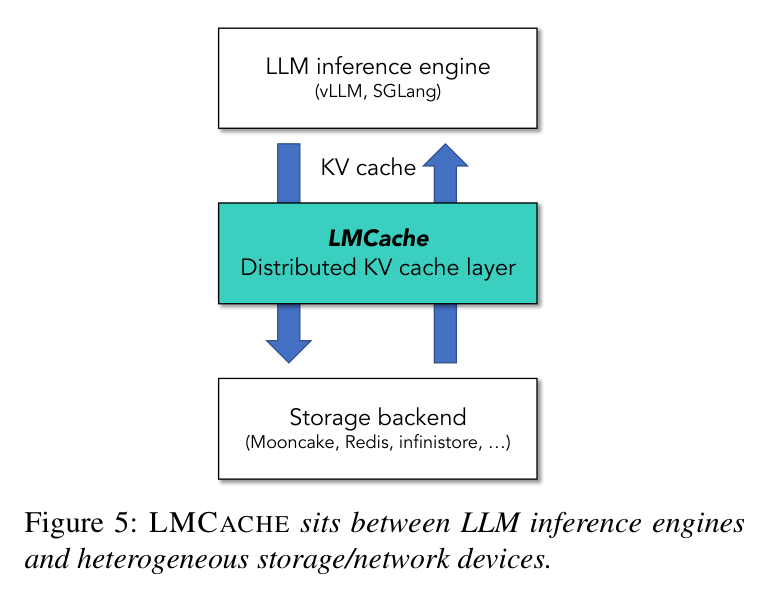
Paper's Figure 5, verbatim (caption: "LMCACHE sits between LLM inference engines and heterogeneous storage/network devices."). The three-tier stack — engine on top (vLLM/SGLang), LMCache in the middle owning the KV cache abstraction, and swappable storage backends (Mooncake, Redis, InfiniStore, …) at the bottom — is the whole thesis: KV cache becomes a first-class, engine-independent data structure with its own movement/management substrate.
The end-to-end component graph shows where scheduling and memory management actually live:
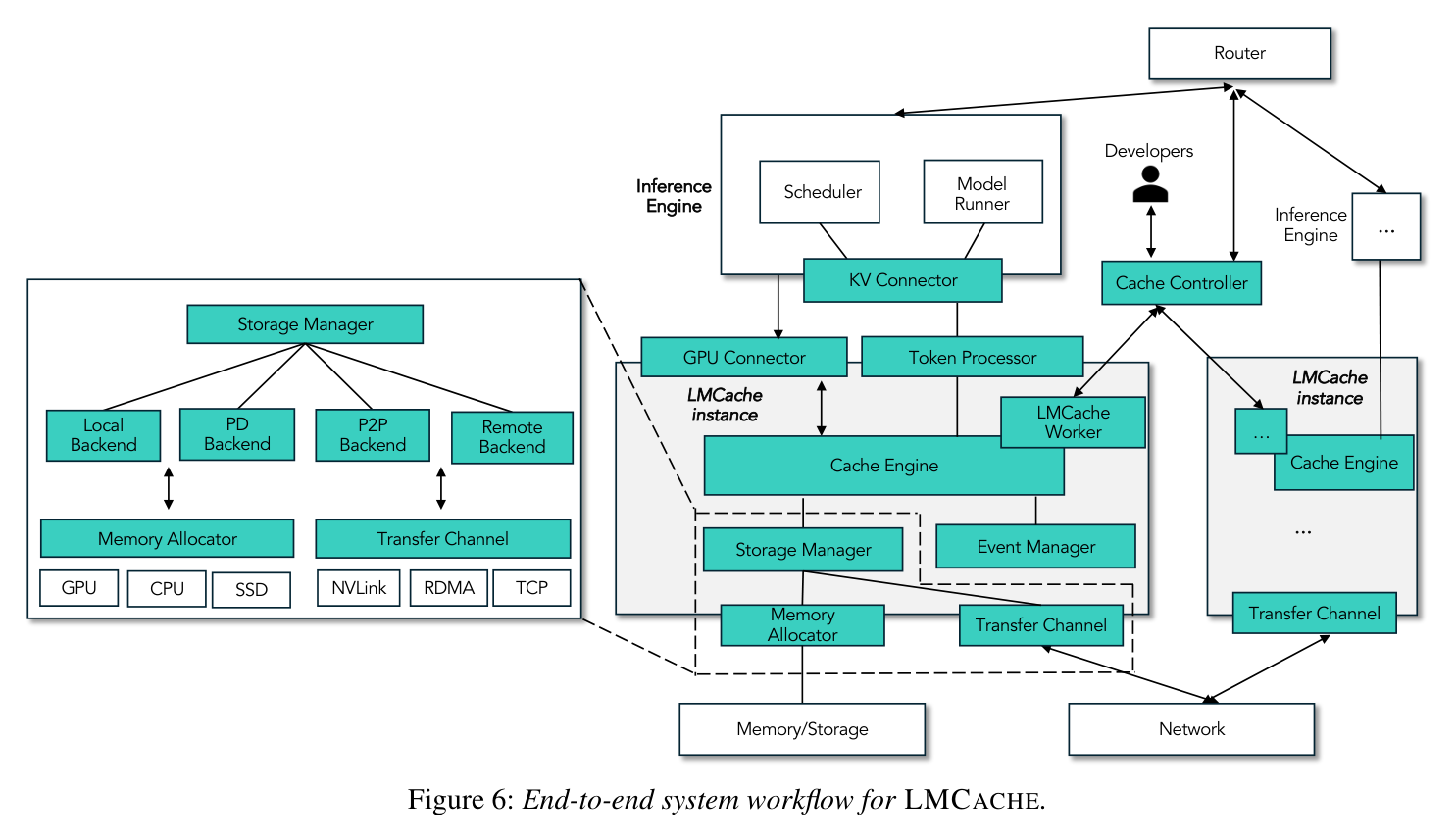
Paper's Figure 6, verbatim (caption: "End-to-end system workflow for LMCACHE."). Note the separation the framework enforces: the KV Connector is the only touch point with the engine's scheduler + model runner; inside a LMCache instance the Token Processor (decides how many tokens are new / prefix-matched), Event Manager (tracks query IDs, launches async layer-wise load events), and Storage Manager (looks up backend addresses, drives transfers) are distinct; the Transfer Channel + Memory Allocator feed four backends (PD / P2P / Remote / Local) over NVLink / RDMA / TCP; and the Cache Controller + LMCache Worker form a separate control plane used by the Router. Scheduling decisions (batching) remain in the vLLM scheduler — LMCache only feeds it extra "matched tokens" so cache hits change how many tokens need prefill.
The two supported deployment modes — cross-query offloading vs cross-engine transfer — are one abstraction with two data paths:
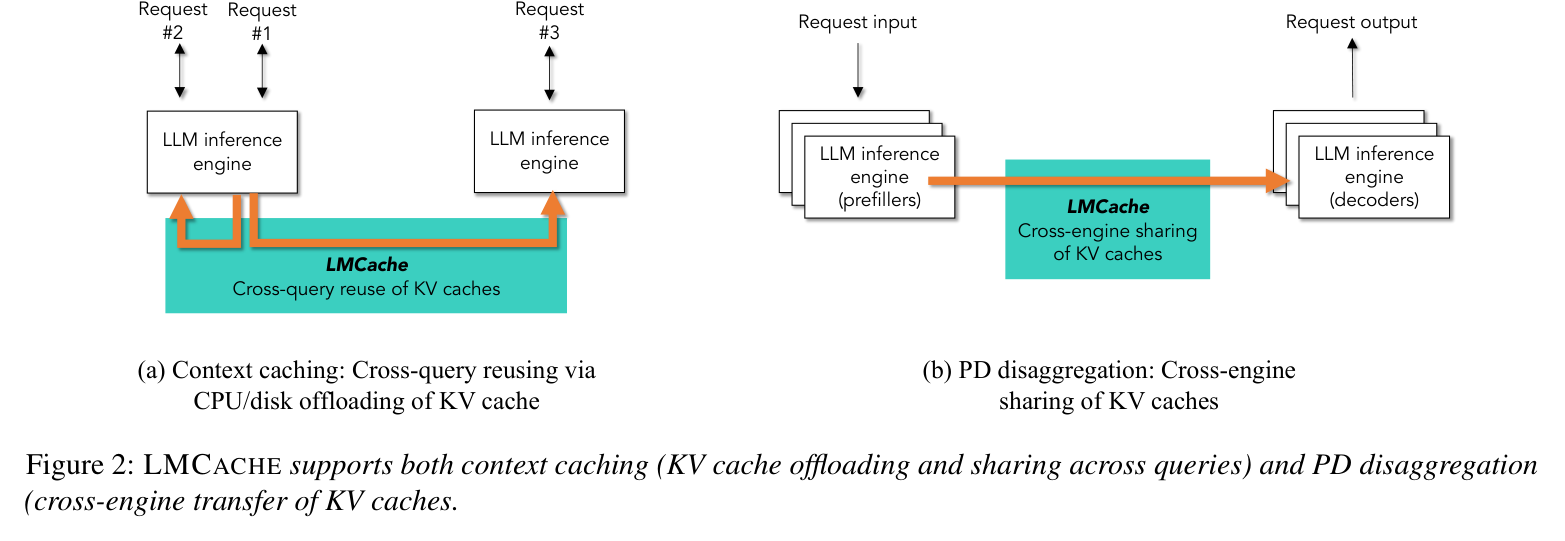
Paper's Figure 2, verbatim (caption: "LMCACHE supports both context caching (KV cache offloading and sharing across queries) and PD disaggregation (cross-engine transfer of KV caches"). (a) One engine reuses KV across requests via CPU/disk offload; (b) prefiller engines hand KV to decoder engines cross-engine. The reader should notice the same connector/storage-manager machinery serves both — the difference is only the backend chosen (Local vs PD/P2P).
Request lifecycle through the connector hooks (the scheduler→runner path the framework owns):
Scheduler discipline: the framework delegates batching (FCFS-style continuous batching) to vLLM; its only scheduling lever is returning None from get_num_new_matched_tokens to push a request back to the waiting queue so its I/O overlaps others' compute. Memory-manager allocation unit: the chunk (default 256 tokens = 16 pages of 16 tokens each), materialized in a contiguous streaming GPU buffer; the persistent buffer footprint is only one layer's KV cache (layer-wise pipelining).
§4 作者证明 #
无形式化作者证明 — 仅实证. This is a systems/experience paper with zero numbered display equations and no analytical throughput/latency model. There is no notation table (λ, μ, B, N_p) to reproduce; all claims are empirical (§8) or field-observational (§9).
What a formal model would have clarified (and is currently left to measurement):
Because no equations exist, the standard 6 formal checks (notation / physical meaning / monotonicity / convexity / boundary optimum / first-order plug-in) are not applicable; the paper's rigor lives in ablations (Table 5, Fig 13/14) rather than derivations.
§5 实验与数据 #
The headline CPU-offload result across five models:
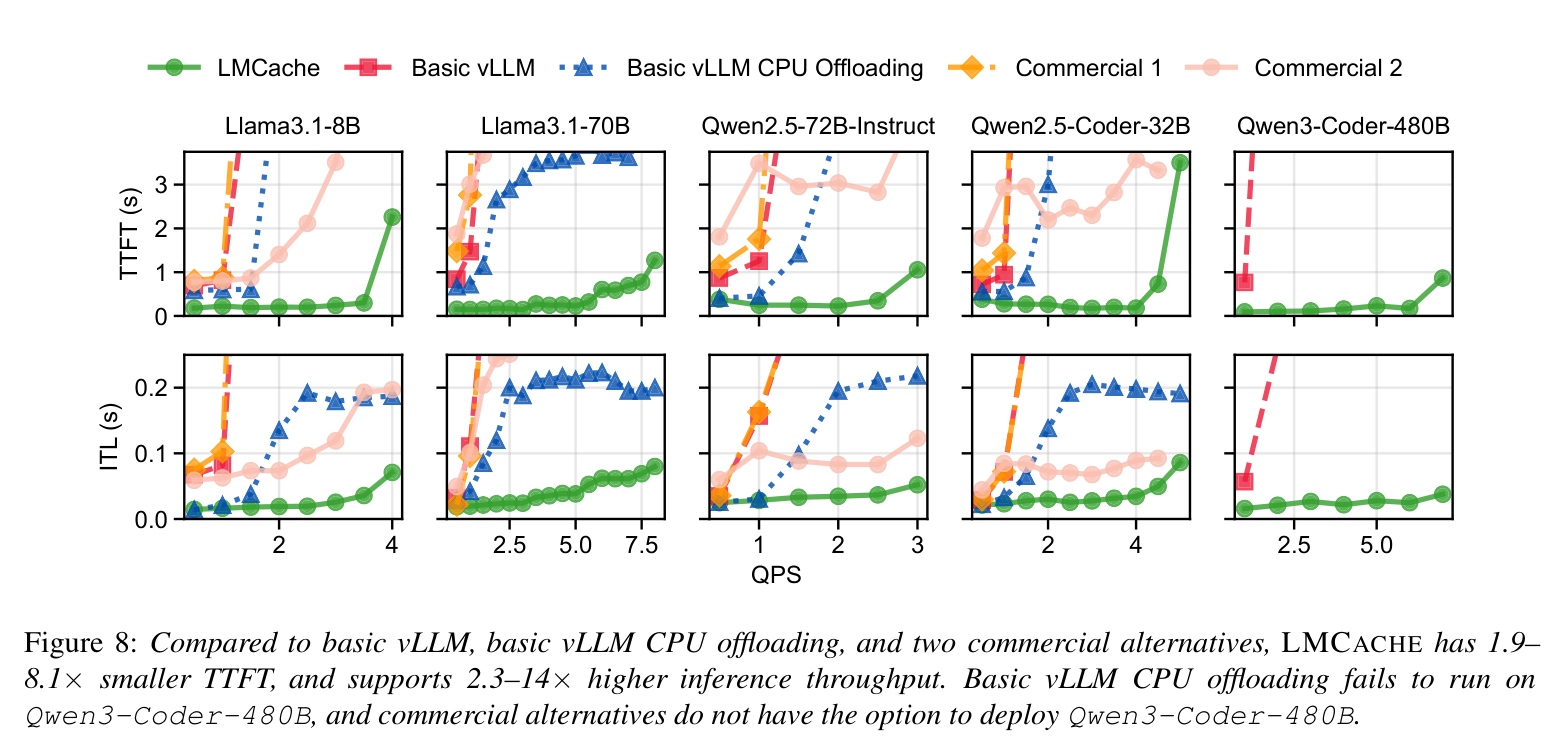
Paper's Figure 8, verbatim (caption: "Compared to basic vLLM, basic vLLM CPU offloading, and two commercial alternatives, LMCACHE has 1.9–8.1× smaller TTFT, and supports 2.3–14× higher inference throughput..."). Both TTFT and ITL rows show LMCache's curve staying flat while baselines blow up as QPS rises — the flatness is the point: larger CPU cache capacity ⇒ higher hit ratio ⇒ prefill work avoided. Notice Basic vLLM CPU Offloading disappears on Qwen3-Coder-480B (fails to run) and both commercial options can't host it at all — a completeness gap the baselines are hiding.
Component isolation proves the chunk-vs-page mechanism is the real cause, not incidental tuning:
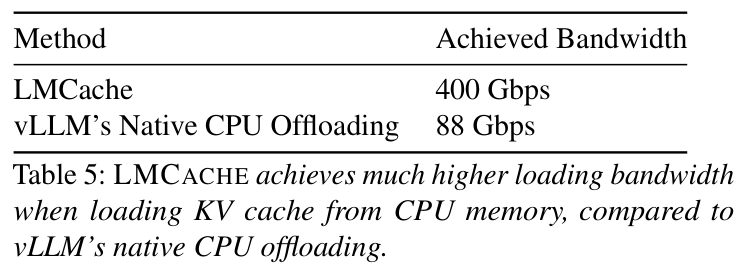
Paper's Table 5, verbatim (caption: "LMCACHE achieves much higher loading bandwidth when loading KV cache from CPU memory, compared to vLLM's native CPU offloading."). The ~4.5× bandwidth gap (400 vs 88 Gbps) comes purely from transfer granularity: per-page copies pay CUDA-launch + metadata + completion-signal overhead on every 16-token page, whereas chunked copies amortize it. This is the single most load-bearing ablation in the paper.
Async compute–I/O overlap, visualized as a timeline:
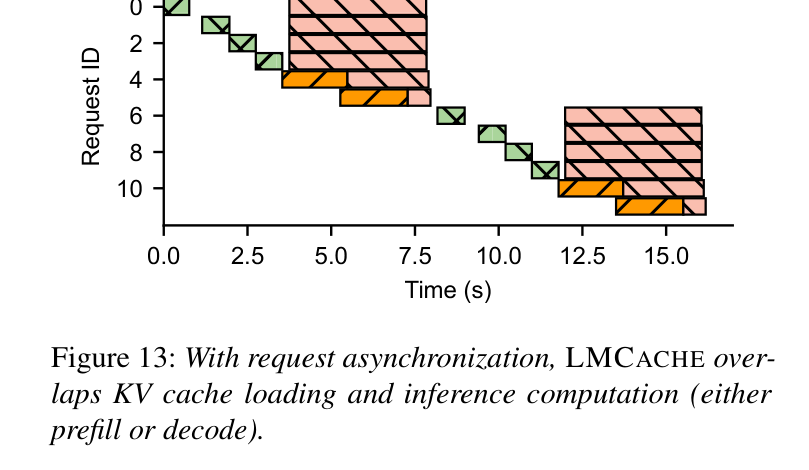
Paper's Figure 13, verbatim (caption: "With request asynchronization, LMCACHE overlaps KV cache loading and inference computation (either prefill or decode)."). Top timeline (LMCache async) packs loading bars underneath compute bars; bottom (vLLM sync) serializes them. The measured effect is a 1.46× end-to-end reduction — the mechanism behind the flat ITL curves in Fig 8.
The regime where loading loses to prefill (the honest failure boundary):
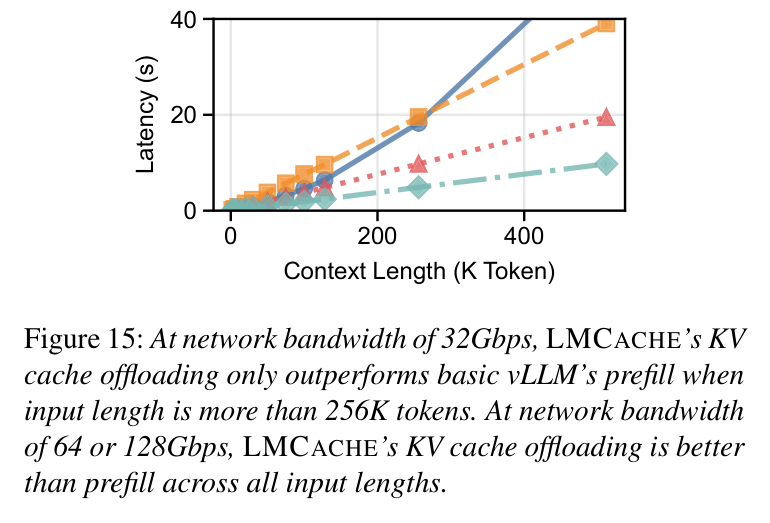
Paper's Figure 15, verbatim (caption: "At network bandwidth of 32Gbps, LMCACHE's KV cache offloading only outperforms basic vLLM's prefill when input length is more than 256K tokens..."). At 32 Gbps, prefill is faster below 256K tokens — LMCache loses there and must be adaptive; at 64/128 Gbps loading wins everywhere. This directly motivates the "adaptive load-vs-compute" decision the paper flags as future work.
PD disaggregation tail-latency win:
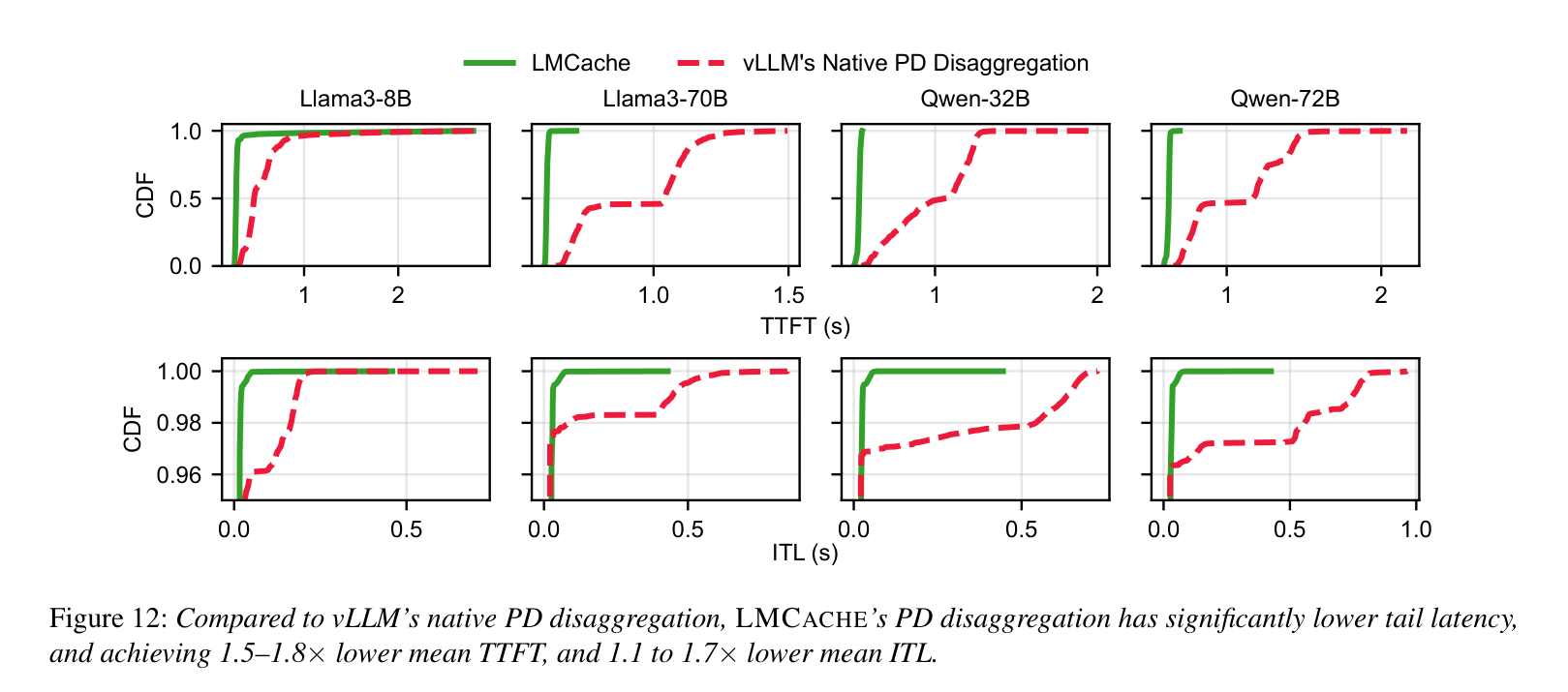
Paper's Figure 12, verbatim (caption: "Compared to vLLM's native PD disaggregation, LMCACHE's PD disaggregation has significantly lower tail latency, and achieving 1.5–1.8× lower mean TTFT..."). The CDFs (top row zoomed to 0.96–1.00) show LMCache's tail pulled left. Root cause per §8.5: vLLM's native path uses NIXL page-by-page copy of scattered prefiller pages (bandwidth underutilized), while LMCache stages each chunk into a contiguous GPU buffer before transfer — again the chunk-vs-page theme.
§6 论证链 #
| Step | Claim (paper-internal) | Support |
|---|---|---|
| 1 | KV cache now exceeds GPU memory and is reused across queries at growing rates | Real usage telemetry: Fig 1 (users ↑23×, stored size ↑5.6×), Fig 3 (non-GPU KV portion grows), Fig 4 (>19% users reuse tokens >1.5×) |
| 2 | Therefore KV must move out of GPU, but paged (16–64 KB) memory makes per-page transfer bandwidth-starved | §3.1.1 + Table 1: must reach ~16 MB to saturate 400 Gbps; sub-1 GB/s with torch serialization |
| 3 | So move KV at large chunk granularity with contiguous staging + custom CUDA kernels | §5.1 design; validated by Table 5 (400 vs 88 Gbps) and Fig 14 (PD transmit time 3.68 vs 4.47 s) |
| 4 | Overlap the (now-efficient) transfer with compute via per-layer CUDA-stream pipelining + async prefetch | §5.2 design; validated by Fig 13 (1.46× end-to-end reduction) |
| 5 | Decouple from fast-evolving engines via a co-maintained 7-fn scheduler/runner connector so the above survives engine churn | §6 design + Table 2; validated by 6-month upstream adoption (Dynamo, llm-d, AIBrix, production-stack) |
| 6 | Expose a control-plane API so routers/ops can act cache-aware (locate/move/pin/compress) | §7 design + Table 3; enables cache-aware routing / migration / P2P |
| 7 | End-to-end this yields up to 15× throughput and ≥2× latency across offload / remote / PD scenarios | §8.2–§8.8 across 6 models and 3 scenarios |
§7 实现 cross-reference #
Source is open at https://github.com/LMCache/LMCache but no file:line anchors are given in the paper; treat concrete internals as [实现未公开] at the citation level. The connector API is upstreamed into vLLM (co-maintained), so the 7 functions in Table 2 are the reproducible contract:
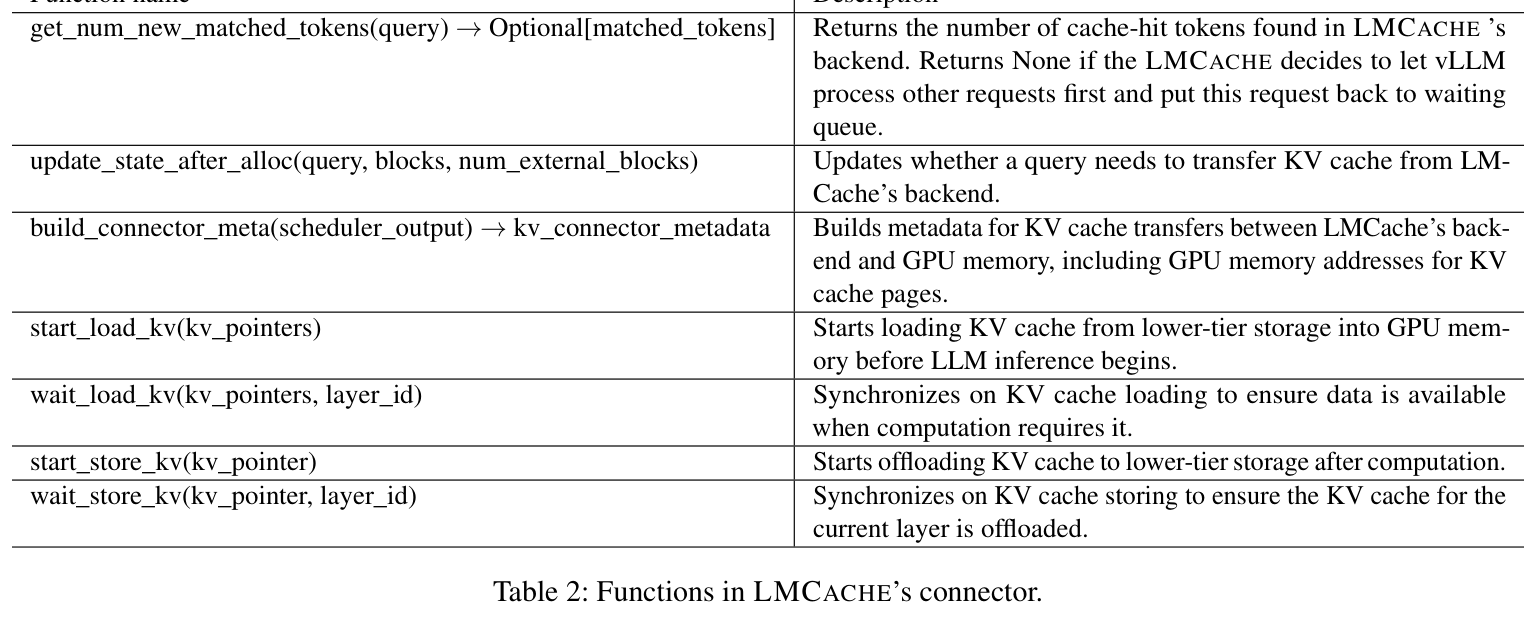
Paper's Table 2, verbatim (caption: "Functions in LMCACHE's connector."). Scheduler side: get_num_new_matched_tokens (returns matched-token count, or None to requeue for I/O overlap), update_state_after_alloc, build_connector_meta. Model-runner side: start_load_kv / wait_load_kv / start_store_kv / wait_store_kv — the layerwise pairing is exactly what the §3 mermaid sequence encodes.
核心技术壁垒 (detail). The hardest-to-replicate insight is not any single function but the co-design of two things that must agree: (i) the chunk-staging data path — a custom CUDA kernel gathers scattered paged KV from multiple layers into one contiguous streaming buffer, DMA-offloads at chunk granularity, and on load DMA-fetches then scatters back into pages; and (ii) the layerwise hook contract where wait_load_kv(l) synchronizes layer l while kicking off layer l+1's prefetch, so only a single-layer-sized GPU buffer is ever pinned. Owning only one half (fast kernels or engine hooks) reproduces neither the 400 Gbps bandwidth nor the fixed-buffer memory bound. Anyone lacking the upstreamed vLLM hooks must fork the scheduler/runner — the exact ad-hoc maintenance burden §3.1.2 warns against.
关键实现细节 (easy-to-miss tricks).
§8 部署上下文 (Deployment context) #
Workload regime table (where it wins / loses):
| Workload regime | LMCache | Baseline (vLLM) | Why |
|---|---|---|---|
| short prompts, low concurrency, slow remote link | can lose | competitive | prefill faster than remote load below crossover (Fig 15, 32 Gbps) |
| long prompts, high concurrency | large win (up to 15×) | thrashes GPU cache | CPU/remote capacity ⇒ high hit ratio; chunked load saturates BW (Fig 8) |
| mixed prefill–decode (PD disagg) | 1.5–1.8× lower mean TTFT | page-by-page NIXL copy underutilizes BW | contiguous chunk staging before cross-engine transfer (Fig 12/14) |
Software→hardware reverse implication: LMCache is hardware-proximal (KV physical layout control, DMA chunk staging, interconnect-aware parallel store/load). Its complexity argues for hardware/ISA primitives that make scattered-gather DMA of paged tensors cheap — e.g. a gather-DMA engine that reads a page-index list into a contiguous descriptor without a custom CUDA kernel, or cache/interconnect support to transfer non-contiguous KV pages at large-message efficiency. That would eliminate the streaming-buffer copy that the whole §5.1 chunk design exists to work around.