Justitia: Fair and Efficient Scheduling of Task-parallel LLM Agents with Selective Pampering
Justitia: Fair and Efficient Scheduling for LLM Applications #
Mingyan Yang, Guanjie Wang, Manqi Luo, Yifei Liu, Chen Chen, Han Zhao, Yu Feng, Quan Chen, Minyi Guo (Shanghai Jiao Tong University) | 2025-10 | arXiv:2510.17015 Category: framework | Tags: agent-scheduling, fair-queuing, kv-cache, vllm, application-level-scheduling Read: 2026-04-18
Core Contribution #
Justitia 把 网络包调度里的 Virtual-Time Fair Queuing (WFQ) 搬到 LLM 应用级调度——以 KV token-time(显存占用 × 持续时间)作为成本度量,用 per-app 轻量 MLP 在应用到达瞬间预测其成本,再以 GPS (Generalized Processor Sharing) 参考系统下的 virtual finish time 作为优先级,在保证最坏延迟 $\le 2c_{\max}+C_{\max}/M$ 的前提下,把平均应用完成时间比 VTC 降低 57.5%。
Summary #
动机:现代 LLM 应用(MapReduce 摘要、Doc Merging、Fact Verification、Self-Consistency 等)由多条并行的 LLM 推理组成,用户只关心整个应用的端到端完成时间(JCT)。现有调度器要么在推理级 FCFS(vLLM、Parrot)产生 head-of-line blocking,要么严格执行瞬时公平分享(VTC、FairServe),把每个应用锁死在"公平份额"里,导致本可以更快完成的应用被无谓拖慢。作者的洞察是用户真正需要的是 长期公平(long-term fairness / finish-time fairness) 而非 短期公平:只要保证没有任何应用比在理想公平调度下更慢完成,就可以允许应用串行"吃饱"(saturated serving),通过近似 SJF 的顺序降低平均 JCT。
方法:Justitia 由三件配套工具组成。(1) Memory-centric cost modeling — 因为 vLLM 的吞吐瓶颈在 KV cache 显存而不是算力,Justitia 把一条推理的成本定义为整个生命周期里的 KV 累计占用 $c=\sum_{i=1}^{d}(p+i)=pd+d^2/2$(KV token-time),一个应用的成本是其所有推理成本之和,成本与输出长度 $d$ 的关系天然是 二次 的,比 VTC 的线性 $p+2d$ 更能反映真实资源压力。(2) Per-app MLP demand predictor — 应用到达时用 TF-IDF 向量化 prompt,送入该应用类型专属的 4 层 MLP(每类 100 样本训练),预测其总 KV token-time;对比 S³ 用 Distillbert(66M 参数)的方案,MLP 把预测开销从 55.7ms 降到 2.16ms,相对误差从 452% 降到 53%。(3) Virtual-time fair queuing — 借鉴 1990 年代网络 WFQ:定义虚拟时间 $V(t)$,其变化率 $dV/dt = M/N_t$($M$ 是总 KV blocks,$N_t$ 是 GPS 下的活跃应用数),应用 $j$ 到达时一次性算出虚拟完成时间 $\bar f_j = V(a_j)+C_j$,之后无论有多少新应用到来都不需要刷新这个值,调度时按 $\{\bar f_j\}$ 升序(即 GPS 完成顺序)优先;堆操作 $O(\log N_t)$。
结果:在 A100 + LLaMA-7B(单卡)与 4×V100 + LLaMA-13B(多卡)上,用 300 个 9 类混合应用、按 Mooncake 到达 trace 测试。相比 VTC 平均 JCT 降低 57.5%(相对 Parrot 降低 61.1%),且 92% 的应用在 Justitia 下比在 VTC 下更早完成,最坏延迟 26% 远小于其它调度器。同时理论证明了常数延迟界 $f_j - \bar f_j \le 2c_{\max}+C_{\max}/M$。消融实验显示去掉 memory-centric(改回 VTC 的 compute-centric 成本)JCT 恶化 42.3%;scheduling overhead 即使在 100 app/min 下也只有 8ms。
Key Findings #
- 显存是 vLLM 类框架的真正瓶颈 — 成本建模必须落到 KV cache 占用(空间 × 时间),而非 VTC 那样的 token 数加权;KV token-time 与输出长度呈二次关系。
- 长期公平 ≠ 短期公平 — 放弃"时时刻刻等分资源"后,串行"吃饱"应用能同时获得近似 SJF 的效率与 WFQ 的公平性。
- Per-app 小模型打败通用大模型 — 4 层 MLP + TF-IDF(per application type)在预测误差、延迟、训练时间三项全面碾压 Distillbert 单模型(误差 53% vs 452%,开销 2.16ms vs 55.7ms,训练 1min vs 2h)。
- 网络调度老理论的跨域复用 — 1989/1993 的 WFQ/GPS 几乎无损地映射到"KV-block 是一种可分资源、推理请求是不可抢占 packet",借到其 $O(\log N_t)$ 一次性优先级计算与常数延迟界。
- 常数延迟界的工程意义 — $2c_{\max}+C_{\max}/M$ 意味着只要单条推理成本远小于总 KV 空间(Mooncake 中平均单请求仅 3.20%),延迟 bound 就非常紧。
- 规避 SRJF 的 starvation — SRJF 在 "elephant + 不断到来的 mice" 下大应用完成时间线性发散,而 Justitia 的大应用 JCT 随 mice 数量保持有界。
Limitations #
- 只在单节点 vLLM 上评估 — 多卡只做到 4×V100 TP,跨节点 + 多副本 + 动态扩缩容场景未评估;作者承认"setup 与现有 scheduling 工作相似,结论可推广"但未给出数据。
- 需要 per-application-type 预训练数据 — 假设云服务商已经 profile 了应用,对 freshly-submitted 未见过的应用类型缺省处理未描述(冷启动)。
- 不考虑 prefix caching / speculative decoding 等新机制 — KV token-time 公式 $pd+d^2/2$ 在有 shared prefix 或 speculative 验证回退时会高估成本。
- 假设碎片化可以忽略 — 证明里显式要求 prompt $\ll M$;在 128K+ 长上下文或单 prompt 占 20%+ KV 时常数延迟界可能松弛。
- 非抢占设计 — 一条已启动的长 decode 仍可能被自身 vLLM 的 swap 机制挤占,但 Justitia 只能在 inference 结束时做应用级切换,突发 priority inversion 无显式处理。
- 公平性指标绑定 VTC 为 "ground truth" — finish-time fair ratio 用 VTC 的 JCT 作分母,若 VTC 本身在某场景极慢则 ratio ≤ 1 容易达到,缺乏独立的公平基准(如 max-min fairness 的绝对数值)。
Key Figures #
Figure 1: Concurrent vs Sequential Serving (Motivation) #
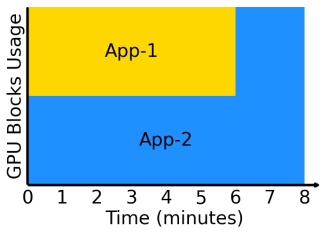
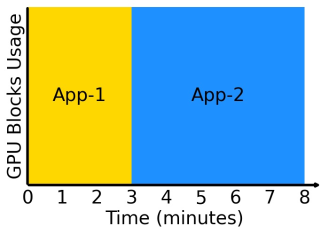
What it shows: 两个 LLM 应用并发(instantaneous fair sharing)时总 JCT 长,而按 GPS 完成顺序串行"吃饱"(saturated serving)时平均 JCT 更短,且没有任何一个应用比并发情况下更晚完成。
Why it matters: 这是整篇论文的"灵魂图"——说明 trade 短期公平换长期公平 + 效率 的可行性。
Detailed description: 两个甘特图。左图每个应用只占总资源的一半并行跑到各自 endpoint;右图 app-1 先独占所有资源、提前完成、然后 app-2 独占、同一时刻结束。平均完成时间右图 < 左图,但右图 app-2 的完成时刻 ≤ 左图 app-2 的完成时刻。
Figure 3: KV Block Usage — Two DocMerging Apps on LLaMA2-7B A100 #
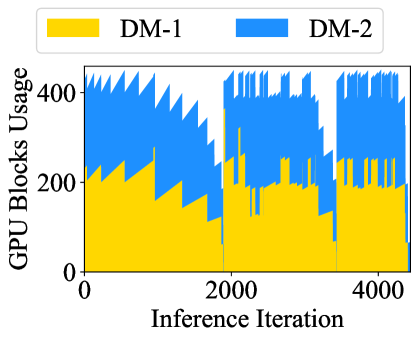
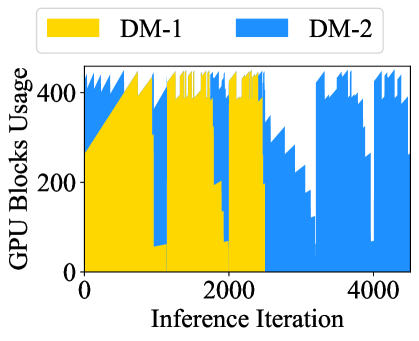
What it shows: 真实 testbed 中,并发公平分享下 DM-1 与 DM-2 每个被限制在约 230 blocks(总 459),平均 JCT = 210s;串行"吃饱"时 DM-1 先用满 459 blocks、完成后 DM-2 接上,平均 JCT = 166s。
Why it matters: 这是 Fig.1 概念图的实测验证,直接量化出 21% 的平均 JCT 下降且无应用被延迟。
Detailed description: 横轴是 inference iteration (0-4000+),纵轴是 GPU Blocks Usage (0-400+)。左图两条曲线重叠在中间高度;右图一条曲线先拉满、后让另一条拉满,像两个连续的方波。
Figure 5: KV Token-Time Cost Model #
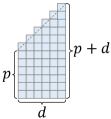
What it shows: 一条推理的 KV 累计占用示意——prefill 阶段固定 $p$ tokens,decode 阶段每步增加 1 个 token,直到总长 $p+d$,积分面积即成本 $c=pd+d^2/2$。
Why it matters: 这是 核心技术壁垒——整个调度器的每一步排序都依赖这一个公式;它把 VTC 的线性 $p+2d$ 替换为二次 $pd+d^2/2$,是 Justitia/C 消融实验 42.3% JCT 恶化的根源。
Detailed description: 一个梯形图:横轴是 iteration,纵轴是 token 数。左边矩形(宽度 1、高度 $p$)代表 prefill;右边三角形(宽度 $d$、高度从 $p$ 线性增到 $p+d$)代表 decode。阴影面积 = $p \cdot d + d \cdot d/2$。
$$c = \sum_{i=1}^{d}(p+i) = pd + \frac{d^2}{2}$$
Figure 6: MLP-based Demand Prediction Workflow #
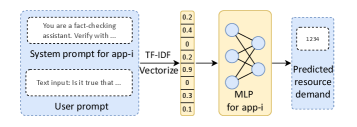
What it shows: 应用到达时,system prompt + user prompt 被 TF-IDF 向量化成定长向量,送入该应用类型专属的 4 层 MLP,输出预测的总 KV token-time。
Why it matters: 这是把 "预测 application cost" 从 S³ 那种 66M DistillBert 推理 降维到 数千参数 MLP 前向 的关键——2.16 ms vs 55.7 ms 的 25× 加速;训练只需 100 样本。
Detailed description: 左边是两段文字(系统 prompt 与用户 prompt),中间是 TF-IDF 向量化箭头,向量元素如 [0, 0, 0.3, 0.2, 0.9, 0.4, 0.2, 0.1] 送入方框标注 "MLP for app-i",输出箭头指向 "Predicted resource demand"。
Figure 7: Justitia Queuing — GPS vs Real Execution #
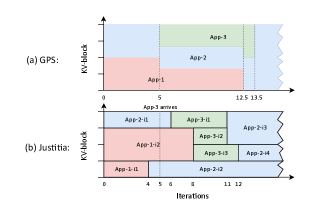
What it shows: 上图展示 GPS 参考系统下三应用(App-1/2/3)的完成顺序;下图展示 Justitia 按这个 GPS 完成顺序作优先级,实际执行时每个应用独占 KV-block 依次跑完。
Why it matters: 展示了 virtual-time fair queuing 的调度决策——GPS 里 App-1 最先完成、App-3 次之、App-2 最后;Justitia 就按这个顺序做非抢占式独占调度,既近似 SJF 又保证最坏延迟界。
Detailed description: 双甘特图。(a) GPS 横轴虚拟时间 [0,5,12.5,13.5],三条彩色横条分别代表 App-1/2/3,在 5 时 App-1 结束、App-1 退出使剩余两个应用的 rate 增大、13.5 时 App-2 完成。(b) Justitia 横轴真实时间 [0,4,5,6,8,11,12],App-1 的 i1/i2 先串行执行,接 App-2 的 i1(因其已到达且 App-3 还未到)、App-3 的 i1/i2/i3 插入执行、最后 App-2 的 i2/i3/i4 完成。
Figure 8: JCT Performance under LLaMA-7B #
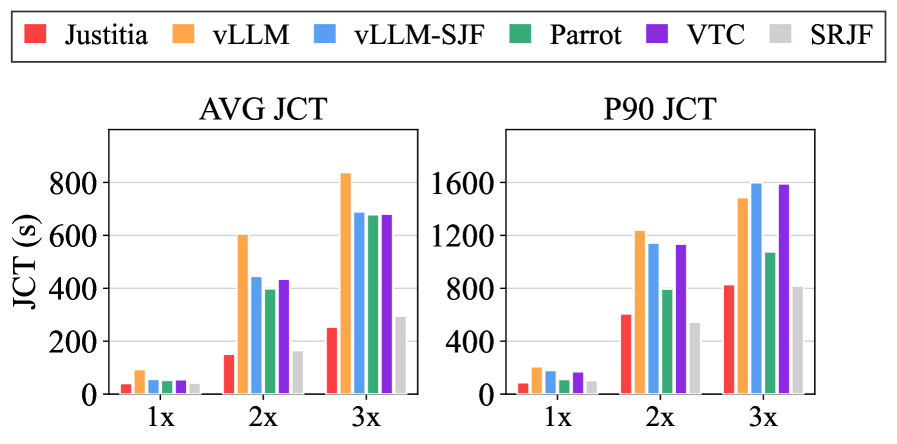
What it shows: 在 1×/2×/3× 负载强度下,Justitia 与 5 个 baselines(vLLM FCFS、vLLM-SJF、Parrot、VTC、SRJF)的平均 JCT 和 P90 JCT。
Why it matters: 这是论文的 主结果图——Justitia 明显优于所有 fair baselines(VTC/Parrot),并逼近 SRJF(效率上界)但无 SRJF 的 starvation 问题。
Detailed description: 左子图 Avg JCT、右子图 P90 JCT;每组 6 个柱子对应 6 个调度器,随负载强度递增柱高递增。3× 下 Justitia Avg ≈ 300s,VTC ≈ 700s,Parrot ≈ 770s,SRJF ≈ 290s。
Figure 10: CDF of Finish-Time Fair Ratio #
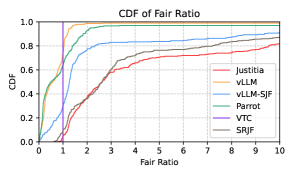
What it shows: 3× 负载下各调度器的公平率(realistic JCT / VTC JCT)的 CDF。
Why it matters: 这是 公平性证据——Justitia 有 92% 的应用 ratio ≤ 1(比 VTC 更早完成),最坏 ratio 仅 1.26;vLLM/Parrot/vLLM-SJF 的 CDF 长尾严重,大量应用 ratio > 2 甚至 > 10(因 head-of-line blocking)。
Detailed description: 横轴 Fair Ratio (0-10),纵轴 CDF (0-1)。Justitia 曲线在 1.0 处迅速逼近 0.92,1.26 处到 1.0;VTC 严格在 ratio=1 处跳到 1.0(作为基准);SRJF 类似 Justitia 但有更长尾;vLLM/Parrot 曲线平缓上升,很多在 5-10。
Figure 11: Starvation Micro-benchmark (Elephant + Mice) #
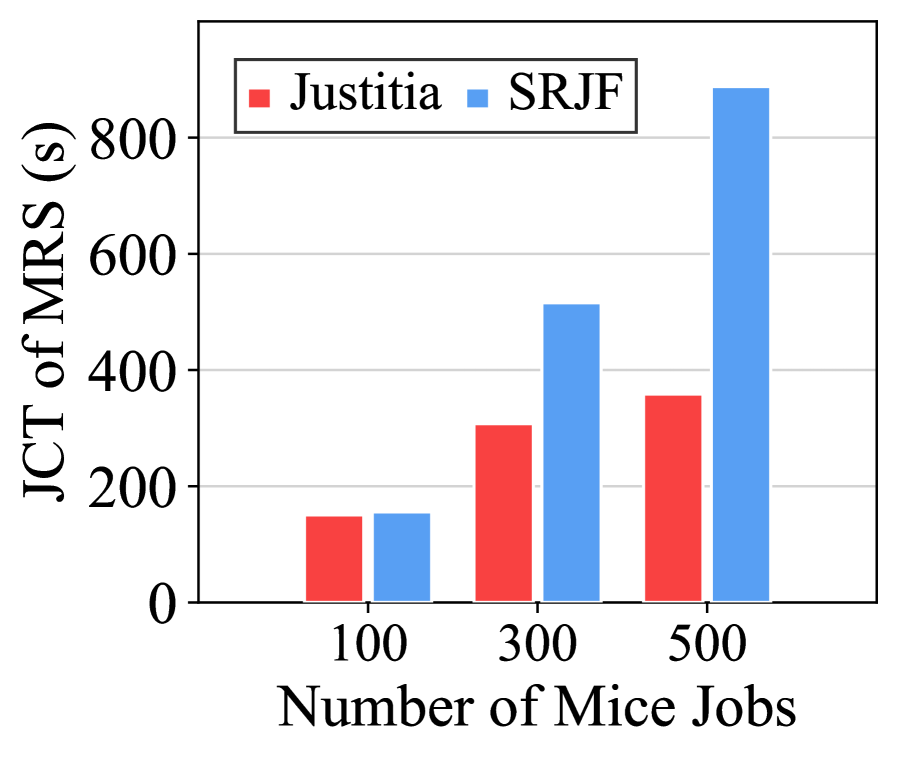
What it shows: 先提交 1 个大 MapReduce-Summarization(elephant),再每秒提交小的 KBQAV/CC/ALFWI(mice)。横轴 mice 数量 (100/300/500),纵轴 elephant 的 JCT。
Why it matters: 证明 Justitia 没有 SRJF 的 starvation 问题——elephant JCT 在 Justitia 下基本不随 mice 数增加(延迟有界),而 SRJF 下随 mice 数量线性增加(饥饿加剧)。
Detailed description: 两条柱状图系列。SRJF 的 elephant JCT 从 100 mice 时的约 400s 增长到 500 mice 时的约 800s;Justitia 维持在 200-300s 附近几乎平坦。
Key Tables #
Table II: MLP vs Distillbert Prediction Comparison (2× workload) #
| Prediction Model | Avg Relative Error (%) | Avg Inference Overhead (ms) | Avg JCT (s) | Training Time |
|---|---|---|---|---|
| MLP | 53.0 | 2.16 | 151.1 | ~1 min |
| Distillbert | 452 | 55.7 | 366.7 | ~2 h |
Takeaway: per-app 小 MLP 在误差(8.5× 更准)、预测延迟(25× 更快)、端到端 JCT(2.4× 更低)、训练时间(120× 更快)全面碾压 Distillbert 单模型;这也解释了为什么 "light-weight yet accurate" 不是空话。
Table III: Scheduling Overhead vs Arrival Rate #
| Arrival Rate (app/min) | 15 | 20 | 30 | 50 | 100 |
|---|---|---|---|---|---|
| Scheduling Overhead (ms) | 0.778 | 1.827 | 3.076 | 5.190 | 8.093 |
Takeaway: 从 15 到 100 app/min(实际生产非常高的负载),调度延迟始终 < 10ms,相对秒级 LLM 推理可忽略;这是 $O(\log N_t)$ 堆操作 + 常数更新的直接体现。
Infrastructure Impact #
- Algorithm: 为 agentic / multi-inference 应用训练提供灵感——RL rollout / best-of-N sampling 场景里同样可以把 KV 成本度量作为 reward shaping 或 early-stopping 依据。
- Kernel: N/A — 不涉及 kernel 改动。
- Framework: 直接是 vLLM 的应用级调度器补丁;与 SGLang 的 Radix tree 调度、Parrot 的 semantic variable 形成新的"层次调度"设计点。
- LLM: N/A — 与模型架构无关。
- Agent: 强相关——它是为 agentic 工作流(Plan-and-Execute、Self-Consistency、Fact Verification)量身定做的调度器;agent runtime 里的并行 tool call / branching reasoning 可直接套用此公平队列。
- Cluster: 对共享 GPU 集群的多租户调度给出了一个"finish-time fairness + SJF-like efficiency"的设计模板;与 Pollux/Sia 等 cluster scheduler 的 goodput-optimized 思路互补。
- Hardware: N/A。
- Code: 提供一个可在 vLLM 中 ~几百行实现的调度器替换点(替换
SchedulerOutputs的排序逻辑),KV token-time 只需 prompt 长度 + 预测的 decode 长度即可计算。
Deep Analysis (framework) #
1. System Scope #
- Primary goal: serving-time inter-application scheduler——在共享 GPU 服务器上为 task-parallel LLM applications 分配 KV-block 与执行顺序。
- Single-node or distributed: 实现原型为单节点 vLLM(A100 或 4×V100 TP),作者声称可扩展到多节点但未给出分布式队列与全局虚拟时间的同步方案。
- Online vs offline: 在线 请求级调度,延迟敏感(目标是 JCT),支持动态到达(trace 是 Mooncake 的 6-18min 提交窗口)。
- Workload: 9 类 LLM application(MRS/PE/CC/KBQAV/EV/FV/ALFWI/DM/SC),即 "几个到几十个并行 LLM 推理 + 可选 reduce 步骤" 的多步 agentic 工作流。
2. Architecture & Data Flow #
2a. End-to-End Data Flow #
[User submits App] → [Per-app TF-IDF Vectorize] → [Per-app MLP predict C_j]
                           ↓                              ↓
                    [Compute V(a_j)]  →  [virtual finish time F_j = V(a_j)+C_j]
                           ↓
                    [Insert into min-heap keyed by F_j]
                           ↓
                    [On scheduling tick:
                       pick app with smallest F_j that has inference pending
                       allocate all remaining KV-blocks it needs
                       vLLM's existing paged attention + continuous batching runs]
                           ↓
                    [App completes → remove from heap → pick next]
| Stage | Input → Output | Location | Latency | Data format |
|---|---|---|---|---|
| TF-IDF vectorize | prompt text → feature vec | CPU | µs | sparse float vec |
| MLP predict | feature vec → KV token-time | CPU | ~2.16 ms | scalar (int) |
| V(t) update | Δt, N_t → ΔV | CPU | O(1) | scalar |
| Heap insert | F_j → ordered queue | CPU | O(log N_t) | min-heap |
| KV allocation | next app's inferences | GPU HBM | vLLM scheduler tick (~10ms) | block ids |
| Inference exec | tokens → KV + logits | GPU | 10-50 ms/token | paged KV |
2b. Data Movement Hotspots #
- prompt text → CPU MLP (once per application arrival, < 1KB, CPU-local). 不是瓶颈。
- KV-block allocation bitmap refresh (每个 scheduling tick,几百到几千 entries,CPU 完全可控)。
- 无新增 GPU↔GPU 流量——Justitia 只改变 "哪个请求先进 batch",不触碰 TP/PP 通信路径,因此与 DistServe/DualPipe 等正交。
- 为何不可纯 SJF? —— SJF 理论上最优,但缺乏延迟保证;当存在长应用 + 源源不断的短应用时,长应用会饥饿。Justitia 的 virtual finish time 同时编码了 到达时刻 $V(a_j)$ 与 成本 $C_j$,使得即使是长应用,其 $F_j$ 也 不会被更晚到达的短应用超越(因为短应用的 $V(a_k) > V(a_j)$)。这是 Justitia 与 SRJF 的根本差别。
- 为何不可 compute-centric 成本(VTC 的 $p+2d$)? —— 在 vLLM 中瓶颈是 KV 显存而非算力:当一个 batch 的总 token 数 = $B \cdot L$ 达到 $M$ 时,新请求无法加入,必须 swap。compute-centric 成本低估了 长 decode 的显存占用扩张 — 一条 decode 从 100 tokens 涨到 2000 tokens,显存占用增 20×,但 VTC 里只记为 +1900 个 token 单位(忽略了 占用时长 $d$ 的乘法效应)。
- 为何需要 per-app MLP 而非全局模型? —— 不同应用的 cost 分布差异极大(如 FV 的 generate-queries 输入固定在 360-380 tokens,而 MRS 输入横跨 0-600+);单一模型被平均化,per-app 模型利用了 application-specific similarity。
- Batch formation: 继承 vLLM 的连续 batching;Justitia 只是改变 "等待队列出队顺序",同时被选中的应用里的多条推理 不被其它应用的推理打断,除非 KV 耗尽进入 swap。
- Memory management: paged KV(vLLM 原生),Justitia 不动内存管理,只决定谁先分配。
- GPU utilization: 通过 saturated serving 让被选中的应用尽可能填满 KV 空间,避免 VTC 下每个应用只用一半造成的 batch 变小、计算 utilization 下降。
- Multi-tenancy / isolation: 有——每个 app 视为一个 tenant,常数延迟界给出 worst-case 隔离。
- SLO-aware: 未显式支持优先级 tier,但可通过赋予不同 $C_j$ 权重扩展。
- 5 个 baselines 覆盖 FCFS / SJF / app-FCFS / app-fair / app-SJF 五个象限,设置公平(同 hw、同 trace、同 workload mix)。
- workload: 3× 负载强度下 Justitia 优势最大(6min 提交窗口 = 最拥挤);1× 下 Justitia 与 VTC 差距缩小到 ~30%,因为竞争少时 VTC 的短期公平约束不 binding。
- Framework overhead: Table III 显示 100 app/min 下仅 8ms,< 1% 单请求时间。
- Where baselines win?: 论文没明确承认,但可以推测:单应用独占 / 无竞争时 VTC = Justitia = FCFS;长 DAG dynamic fanout(像 ToT) 下 Justitia 的预测失效,可能输给 SRJF + 后期 refresh 版本。
- API: 继承 vLLM HTTP/gRPC API,增加
application_id+application_type字段让客户端声明应用类别。 - Model format: vLLM 支持的全部(HF、safetensors)。
- Deployment: 单节点即可部署;集成点是 vLLM 的
Scheduler类替换。 - Tuning knobs: MLP 结构(层数/宽度)、TF-IDF vocab 大小、per-app 训练样本数。默认 4 层 MLP + 100 样本已够用。
- 冷启动: 论文未解答——推测用应用类型的 default priority(如 input 长度作为 proxy)。
- Open source: 论文未给出 release plan;作者来自上海交大 IPADS/CS 系,过去的调度工作(如 Themis 的 fair ratio 定义)通常开源。
- Community: 当前 arXiv preprint(2025-10-19),尚未被主流系统(vLLM/SGLang)采纳;但 WFQ 思路已被 VTC 的后续工作 FairServe 间接借鉴。
- Production deployments: 无报告。
- Adoption path: 可作为 vLLM 的第三方 scheduler plugin 发布,需要与
vllm.core.scheduler的 API 对齐。 - Downstream influence prediction: 三点可能被下游采纳——
- KV token-time cost 度量 最通用,可直接用于 SLO-aware 调度、autoscaling;
- Per-app MLP demand predictor 与 S³、Learning to Rank (ICLR'25) 形成同一方向,可能合流为一个"prediction-aware scheduler"子领域;
- Virtual-time 作为 LLM 调度器优先级 是新创,值得进 vLLM 主线评估。
- 在 prefix caching / SGLang RadixAttention 下,KV token-time 公式如何修正?是否应改为 $\sum_i (p_i - p_{\text{shared}_i}) d_i + d_i^2/2$?
- 在 disaggregated prefill/decode (DistServe) 下,prefill 和 decode 各自的 KV 占用时间差异巨大,单一 cost metric 是否还适用?
- 对 dynamic fanout 应用(ToT、MCTS、agentic loop)中 $C_j$ 未知的情况,是否能用 online learning / bandit 边跑边修正 virtual finish time?
- 在 多节点集群 中,全局虚拟时间 $V(t)$ 的同步成本是否会让 O(log N) 优势消失?
- 与 SLO-aware 优先级(如付费用户)结合时,是否仍能保持常数延迟界?WFQ 本身支持 weighted 版本,但论文未评估。
- VTC (Sheng 2024, arXiv:2401.00588) — 最直接的 baseline,Justitia 在成本度量和 fair queue 策略上都 override 了 VTC。
- Parrot (Lin OSDI'24) — 同样做 app-level 调度但 FCFS;Justitia 在此基础上引入 finish-time fair-ordering。
- S³ (Jin NeurIPS'23) — output length 预测 baseline;Justitia 用 MLP 替换 Distillbert。
- FastServe (Wu arXiv:2305.05920) — MLFQ 多级反馈队列;Justitia 用 WFQ 避免 MLFQ 的频繁队列切换开销。
- Themis (Mahajan NSDI'20) — finish-time fairness 概念的原创;Justitia 把它从 DL 训练 cluster 搬到 LLM serving。
- Parekh-Gallager GPS (IEEE ToN 1993) — WFQ 的原始定理;Justitia 是其在 LLM serving 场景的非平凡移植。
- Mooncake (Qin arXiv:2407.00079) — 提供了 trace 和碎片化 3.20% 的实测依据;未来 Justitia 若与 Mooncake 的 kvcache-centric 分离架构集成,可作为 application-level 上层调度器。
3. Design Space & Constraint Analysis #
3a. Alternative approaches considered & rejected
| Alternative | Failure Mode |
|---|---|
| FCFS at inference level (vLLM 原生) | Head-of-line blocking:一个长 decode 阻塞一串短推理 |
| FCFS at application level (Parrot) | 应用级 HoL blocking 不减少,只是换了粒度 |
| VTC (instantaneous fair share) | 短期公平约束死应用上限 = $M/N_t$,错过 "独占吃饱" 的加速 |
| SRJF on predicted cost | 饥饿 —— mice 不断到达,elephant 永久延迟 |
| 模拟 VTC 得到完成顺序 | 需要未来请求全信息 + 每次到达/完成重算,成本 $O(N_t^2)$ 以上 |
| 纯 virtual-time without demand prediction | $F_j = V(a_j) + C_j$ 里没有 $C_j$,退化为到达顺序(FCFS) |
| 用 Distillbert (S³) 做成本预测 | 55.7ms 预测 + 66M 参数训练,2h 训练成本;误差 452% 过大 |
3b. Constraint Derivation
3c. Assumption audit
| Assumption | Where used | When it breaks |
|---|---|---|
| 应用类型已知且有 100 样本的 profile | MLP 训练 | 新应用冷启动无数据;用户自定义 agent 工作流 |
| prompt 尺寸 $\ll M$(< 3.20% 实测) | 证明 $f_j - \bar f_j \le 2c_{\max}+C_{\max}/M$ | 128K+ 单 prompt 占比 > 20% 时延迟界松弛 |
| 非抢占粒度足够细 | vLLM 非抢占原语 | 单条 decode 数分钟时优先级颠倒 |
| $C_j$ 可预测 | Virtual finish time | SC/PE 这种 reasoning-depth 动态应用预测不准 |
| GPS 完成顺序 = 实际最优顺序 | WFQ 定理 | 网络世界的 WFQ 假设 packets 相互独立;LLM 推理有 shared-prefix 复用时成本模型偏高 |
3d. Core Technical Barrier
真正的核心壁垒不是 virtual-time 算法,而是 KV token-time 这个成本度量的"量纲选择"本身——把时间 × 空间的 KV 占用变成一个可加的标量 $C_j = \sum_i (p_i d_i + d_i^2/2)$。这个度量有三个巧妙之处:
(1) 它是 加性 的(一个应用 = 各推理求和),天然适配 WFQ 的 $F_j = V(a_j) + C_j$;
(2) 它的量纲与 virtual time 兼容($M/N_t$ 表示 "每单位时间每应用得到的 KV blocks",乘以时间恰好就是 KV token-time);
(3) 消融实验 Fig.12 显示去掉它退化 42.3%——单是这个度量就贡献了近半增益。换言之,哪怕别人照抄 WFQ 和 per-app MLP,如果用 VTC 的 $p+2d$ 做成本,效果也不会如此显著。
3e. Design binding critique
| Forced dependency | Flexibility lost |
|---|---|
| 必须运行在 vLLM 的非抢占 paged attention 上 | 不能直接搬到 SGLang 的 radix tree + prefix cache(因为 cost 公式没建模 shared prefix 复用) |
| 每类应用单独训一个 MLP | 应用类型必须事先定义,agentic system 里 prompt template 频繁变化时维护成本大 |
| 假设应用是 task-parallel 结构(fanout + join) | 不支持长 DAG reasoning(如 Tree-of-Thoughts 分支数运行时决定) |
| 单全局队列 | 多 GPU 集群里需要额外的全局/局部虚拟时间同步,论文未设计 |
4. Key Innovations #
| Innovation | Mechanism | Benefit | Cost/Tradeoff |
|---|---|---|---|
| Memory-centric KV token-time | $c = pd + d^2/2$ | 成本度量与 vLLM 真实瓶颈(KV cache)对齐,消融显示贡献 42.3% JCT | 不支持 prefix caching 与 P-D 分离场景下的成本偏差 |
| Per-app TF-IDF + 4-layer MLP | 每应用独立模型,100 样本、1 分钟训练 | 预测误差 53%(vs Distillbert 452%)、开销 2.16ms(vs 55.7ms) | 需要云端 profile 数据;冷启动无 fallback |
| Virtual-time based fair queuing (from WFQ) | $V(t)$ 率 = $M/N_t$,$F_j = V(a_j)+C_j$,一次性确定 | 避免 refresh、$O(\log N_t)$ 调度、理论常数延迟界 | 仅在非抢占 vLLM 下成立,假设 GPS 完成顺序 ≈ 真实最优 |
| Saturated serving (trade short-term fairness) | 被选中的应用独占所有剩余 KV blocks | 近似 SJF 效率(57.5% JCT 降) | 并发度骤降时单请求尾部 latency 可能变高 |
5. Scheduling & Resource Management #
6. Target Scenarios & Workload #
| Scenario | Pattern | SLO / Goal | Existing systems fail because |
|---|---|---|---|
| MapReduce summarization | 几十条并行 prefill + merge | 低 JCT、公平 | vLLM FCFS → HoL;VTC → 每条只占 1/N 资源变慢 |
| Self-Consistency reasoning | N 条并行 CoT rollout | 低 JCT(majority vote 出最后答案) | SRJF 会饿死长 rollout |
| Fact Verification (FacTool) | claim-by-claim 验证 | 端到端 JCT | Parrot FCFS app-level → 跟在大 app 后面被阻塞 |
| Multi-tenant shared GPU | elephant + mice 混合 | 保证 elephant 不饥饿 | SRJF → elephant 饥饿;FCFS → mice HoL |
Primary bottleneck: memory-bound(KV cache capacity)——作者明确在 §IV-A 说 "inference throughput is bounded commonly on the GPU memory"。这是整篇设计的根基。
7. Performance Evaluation #
7a. Metrics #
| Metric | Definition | Direction | ||
|---|---|---|---|---|
| Avg JCT | 应用到达到所有推理完成的平均时长 | ↓ | ||
| P90 JCT | 90% 分位 JCT | ↓ | ||
| Finish-time fair ratio | realistic JCT / VTC JCT | ↓(< 1 即优于 VTC) | ||
| Scheduling overhead | 每应用到达/完成的调度决策耗时 | ↓ | ||
| Prediction error | 预测 - 真实 | / 真实 | ↓ |
7b. Before-After Comparison #
| Optimization | Metric | Baseline | Justitia | Gain | Conditions |
|---|---|---|---|---|---|
| Virtual-time WFQ (vs VTC) | Avg JCT | — (VTC) | 57.5% 下降 | 2.35× | LLaMA-7B A100, 300 apps, Mooncake trace |
| WFQ (vs Parrot FCFS) | Avg JCT | — (Parrot) | 61.1% 下降 | 2.57× | same |
| Memory-centric cost (vs Justitia/C) | Avg JCT | Justitia/C | ~42.3% 下降 | 1.73× | 2× workload, same hw |
| MLP predictor (vs Distillbert) | Pred error | 452% | 53% | 8.5× better | per-app data |
| MLP predictor (vs Distillbert) | Pred overhead | 55.7ms | 2.16ms | 25.8× faster | same |
| Justitia (vs SRJF in elephant+mice) | Elephant JCT | 线性发散 | 有界 | bounded delay | micro-bench |
7c. Bottleneck Shift Analysis #
Before: HoL blocking (Parrot FCFS)     → scheduling-bound
      ↓ apply WFQ with virtual time
Intermediate: short-term fair sharing (VTC) → underutilization-bound
      ↓ trade short-term for long-term fairness, saturated serving
Justitia: memory-bound (KV cache capacity,  still)
调度侧基本榨干,剩余瓶颈回到 KV cache 物理容量 $M$ 与单条推理时长 $c_{\max}$ — 这也是 $f_j - \bar f_j \le 2c_{\max}+C_{\max}/M$ 里两个常数的来源。
7d. Baselines & Fairness #
8. API & Usability #
9. Infrastructure Impact #
| Layer | Impact |
|---|---|
| Algorithm | 不涉及 training 算法;但对 RL rollout、best-of-N 等 inference-time 算法的调度提供更好底座 |
| Kernel | 无改动 |
| LLM | 模型无关,但假设是标准 Transformer + KV cache;MLA / absorb-style 架构下 KV token-time 公式需要调整 |
| Agent | 强相关——本质就是 agent-workload 调度器,可与 ReAct、ToT、MCTS 等 runtime 集成 |
| Ops | 新增 per-app profiling pipeline;scheduling 决策可 log 用于审计 |
10. Comparison Matrix #
| Feature | Justitia | vLLM | SGLang | Parrot | VTC | FairServe |
|---|---|---|---|---|---|---|
| Continuous batching | 继承 | ✓ | ✓ | 继承 | 继承 | 继承 |
| Paged attention | 继承 | ✓ | ✓ (+RadixAttention) | 继承 | 继承 | 继承 |
| App-level scheduling | ✓ | ✗ | 部分 (via programs) | ✓ (FCFS) | ✓ (fair) | ✓ (fair) |
| Fairness guarantee | 常数延迟界 | 无 | 无 | 无 | 短期公平 | 短期公平 |
| Cost prediction | per-app MLP | 无 | 无 | 无 | 无 (按 token 记账) | 无 |
| Memory-centric cost | ✓ | — | — | — | ✗ (compute-centric) | ✗ |
| Starvation-free | ✓ | ✓ | ✓ | ✓ | ✓ | ✓ |
| Avg JCT (relative to VTC, 3×) | 0.425× | ~1.5× | — | ~1.1× | 1× | 类似 VTC |