TokenCake: A KV-Cache-centric Serving Framework for LLM-based Multi-Agent Applications
1. TL;DR #
TokenCake targets LLM multi-agent serving where tool calls create long KV-cache idle windows and graph-critical agents compete for scarce GPU blocks. It co-designs an event-driven Temporal Scheduler (opportunistic offload + predictive upload) and an agent-aware Spatial Scheduler (dynamic reserved/shared partitioning), cutting end-to-end latency by up to 47.06% and improving effective KV-cache utilization by up to 16.9% versus vLLM under load.
2. Q1 / Q2 / Q3 #
Q1: It solves what pain? #
- Temporal underutilization: during
LLM -> function call -> LLM, stalled agents keep KV blocks on GPU but do no compute, wasting capacity. - Spatial critical inversion: non-critical agents can arrive earlier, consume blocks, and evict critical-path agents, forcing expensive recomputation.
- Existing systems are usually one-sided: either workflow-aware but memory-agnostic, or memory-aware but agent-agnostic.
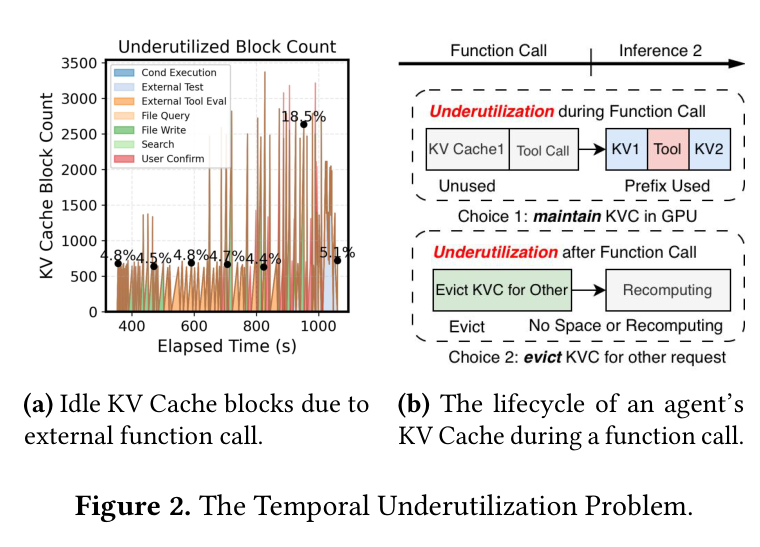
Figure 2 visualizes the central temporal pathology: idle cache occupancy grows while agents wait on tool latency. The paper uses this to justify that "wait time" must become an explicit cache-scheduling signal rather than passive background time.
Q2: What is the core method? #
TokenCake introduces a KV-cache-centric but agent-aware serving stack with three cooperating pieces:
- Frontend graph API: users register agent DAG, function-call stages, and timing hints.
- Temporal Scheduler: offloads stalled KV blocks only when expected net gain is positive, then uploads ahead of resume using urgency + importance ranking.
- Spatial Scheduler: dynamically partitions memory into shared and reserved pools, and reserves blocks for critical agent types using hybrid static/dynamic priority.
- End-to-end latency improvement over vLLM and Mooncake across representative multi-agent workloads, with best reported gain at 47.06%.
- Effective GPU KV-cache utilization improvement up to 16.9%.
- Ablations show complementarity: agent-aware spatial control and temporal opportunistic offload each help in different regimes; neither dominates the other.
- Migration practicality validated: for 4096-token context on A100 PCIe, offload+upload (~63.7 ms) is much lower than recomputation (~1815 ms).
- Cost-benefit premise check: migration vs recomputation is measured directly (Figure 17), showing large margin in tested setup.
- Isolation check: spatial-only and temporal-only ablations isolate component contributions (Figure 11).
- Bridge check: comparisons against Mooncake and Parrot test both sides of the design-space bridge (Figures 12-13).
- Policy robustness check: sensitivity to prediction error and threshold parameters is evaluated (Figures 15-16).
- No-free-lunch check: always-offload is shown to risk overhead/bandwidth pressure, motivating opportunistic gating.
- Coordination consistency check: shared pressure snapshot plus ordered step protocol is specified to avoid scheduler conflict.
- Implementation is described conceptually and with API/endpoint names, but full source-level mapping is unavailable in this artifact: [实现未公开].
- Paper-level concrete hooks include the stateful graph registration frontend,
fc_start/fc_endstyle lifecycle endpoints, asynchronous migration stream handling, and a CPU KV block pool design. - Gradual destination reservation (
B_{reserve}capped per step) prevents predictive upload from front-running active critical work. - CPU block-pool recycling with hash-index linkage avoids host allocator churn and keeps high-frequency offload practical.
核心技术壁垒: the hardest-to-replicate part is not isolated offload or isolated priority scheduling, but a unified pressure-consistent coordination protocol that keeps temporal upload/offload and spatial admission decisions aligned on the same real-time capacity/debt view, avoiding destructive cross-scheduler interference.
Q3: What are the key results? #
3. 架构 / 方法图 #
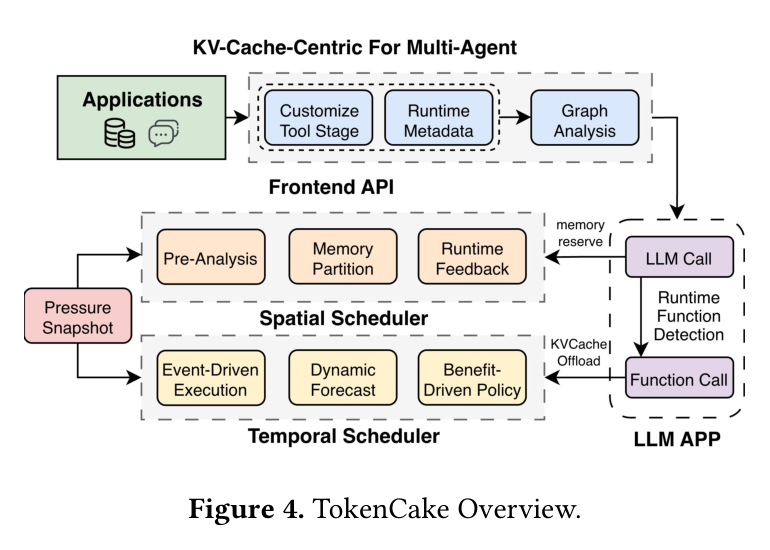
Figure 4 gives the high-level architecture: frontend graph specification feeding two schedulers that co-manage KV lifecycle. The key structural decision is splitting temporal and spatial concerns while forcing a shared pressure view.
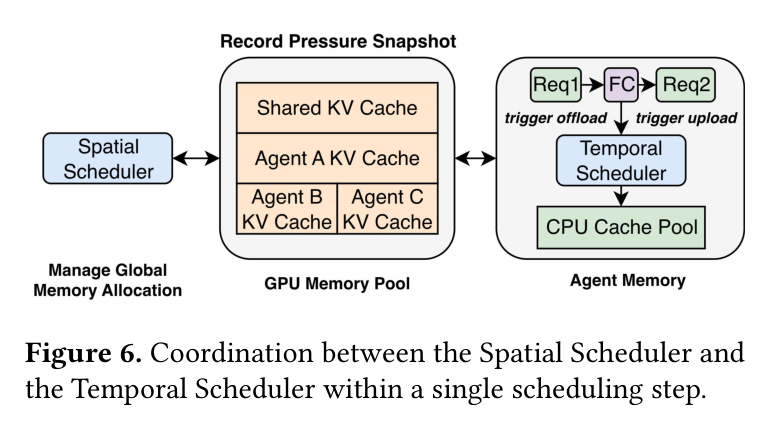
Figure 6 is the load-bearing control-flow figure. It shows the per-step ordering (snapshot -> reservation update -> temporal actions -> spatial batching), which is how TokenCake prevents upload and admission from racing over the same blocks.
The state machine captures the paper's agent-turn lifecycle and clarifies where policy gates apply. It complements the raster figures by making transition semantics explicit for implementation reasoning.
4. 作者证明 #
无形式化作者证明 — 仅实证 #
The paper does not provide a formal convergence/optimality proof for the two-scheduler policy. Its claims are justified by measurements, ablations, and sensitivity analyses.
Notation and mechanism anchors #
| Symbol | Meaning | Role |
|---|---|---|
| $t_{estimate}$ | predicted tool-call duration | determines offload/upload timing window |
| $T_{transfer}$ | D2H + H2D migration round-trip cost | gate for whether offload is worth it |
| $B_{upload}$ | safe upload block budget | prevents upload from stealing critical waiting capacity |
| $B_{reserve}$ | per-step gradual reservation amount | avoids abrupt memory shock under high occupancy |
| $P_{req}$ | per-request priority | admission ordering for waiting requests |
| $S_a$ | per-agent-type score | decides who gets reserved capacity |
Six empirical checks #
5. 实验与数据 #
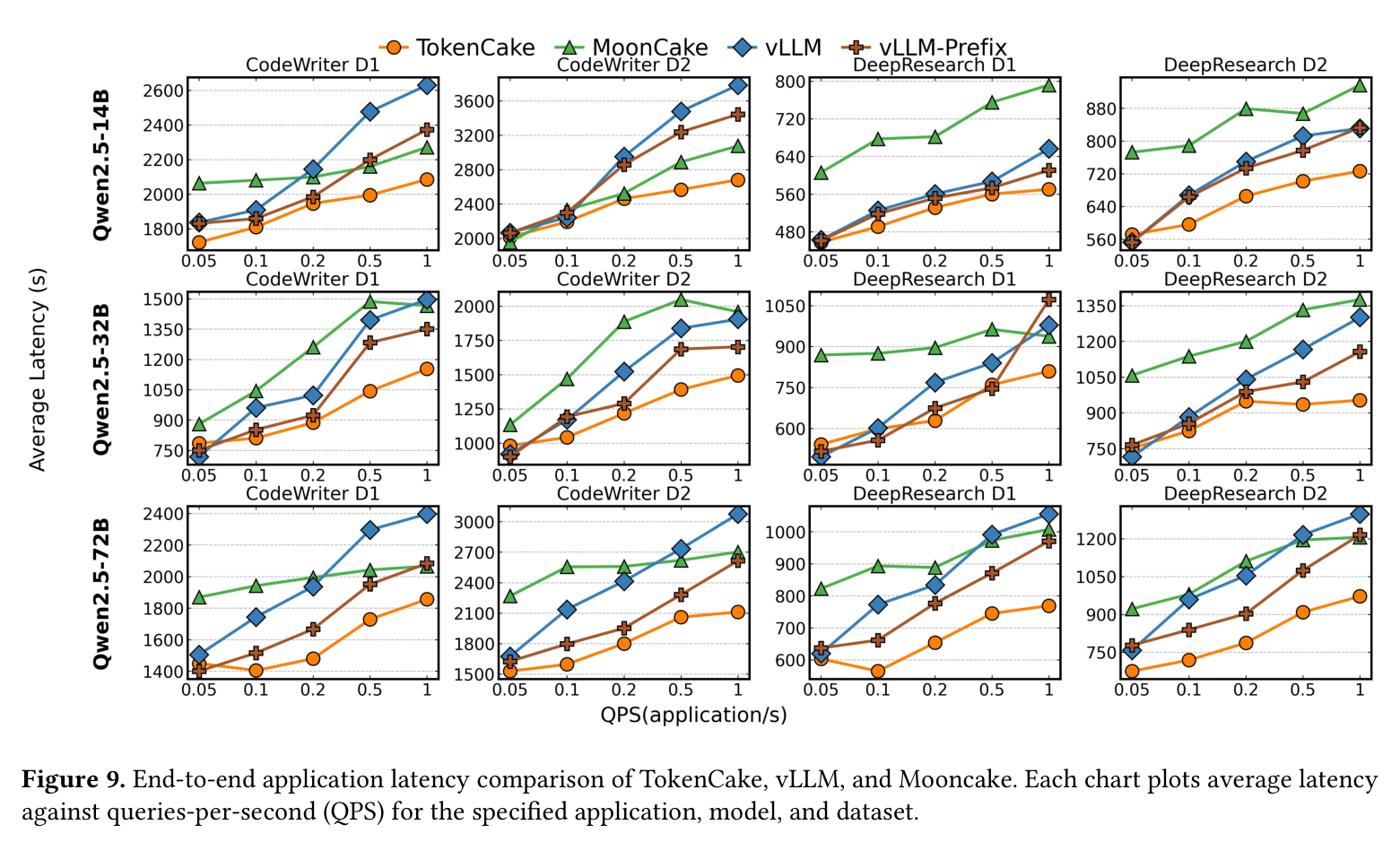
Figure 9 shows the headline throughput-latency behavior across workloads and models. TokenCake maintains lower latency under increasing QPS, indicating that KV-centric policies matter most when contention rises.
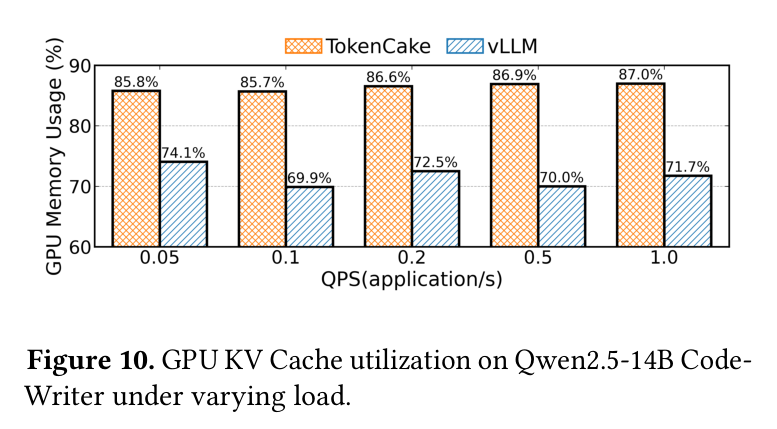
Figure 10 ties system speedup to memory-use quality rather than raw occupancy. The utilization lift supports the claim that reclaimed idle blocks are turned into useful active work.
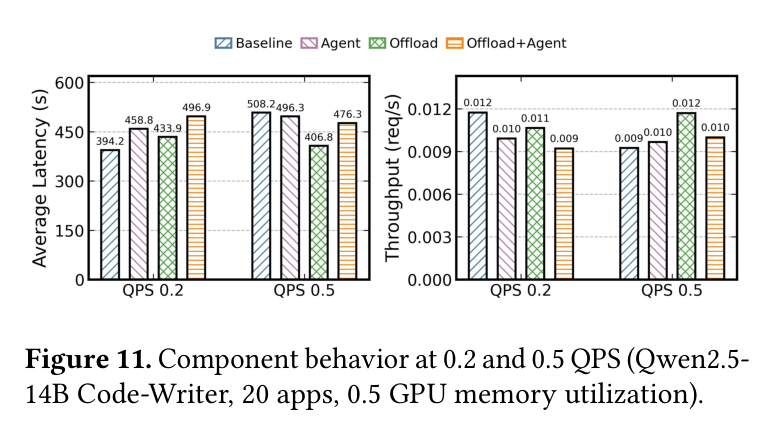
Figure 11 is key for mechanism attribution: spatial-only and temporal-only each help partially, while the full design gives the best outcome. This supports the paper's "co-optimization, not substitution" argument.
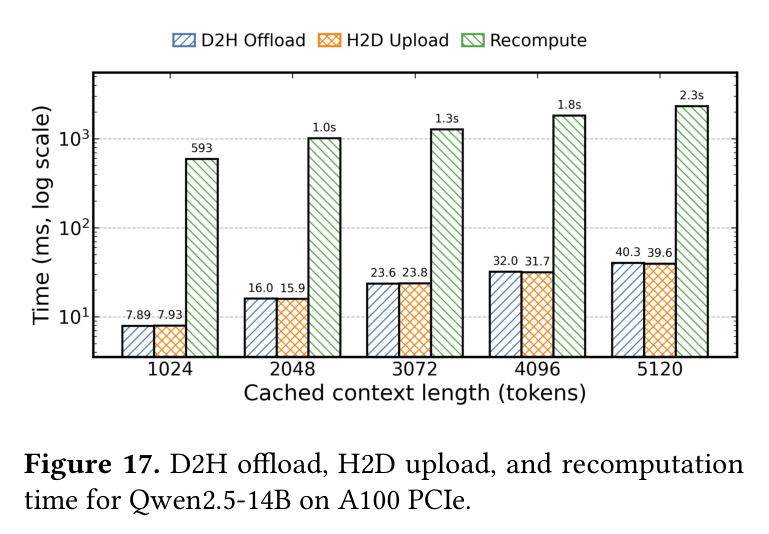
Figure 17 validates the temporal policy's physical premise. The migration round trip remains much smaller than recomputation across tested context lengths, but still non-trivial enough to justify selective rather than unconditional offload.
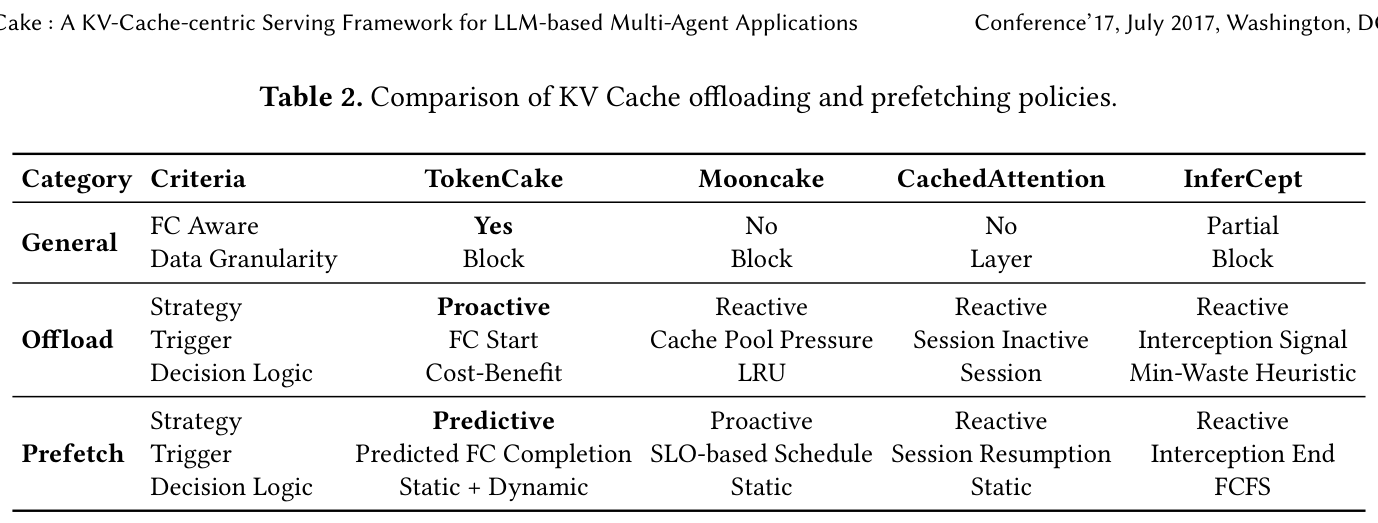
Table 2 positions TokenCake against prior triggers/decision logic and helps explain why event-driven and agent-aware criteria are central to the observed gains.
6. 论证链 #
| Step | Claim | Evidence in paper | Why it matters |
|---|---|---|---|
| 1 | Multi-agent tool-use workloads create two distinct KV-cache pathologies (idle waste + critical inversion). | Intro motivation figures and background taxonomy (Figures 2-3, Section 2 framing). | Establishes that classic single-request serving assumptions break. |
| 2 | Existing systems each miss one dimension (agent context or memory control). | Comparative analysis vs Teola/Parrot/Autellix and vLLM/Mooncake/CachedAttention. | Justifies a jointly agent-aware and cache-centric design target. |
| 3 | A dual scheduler with shared pressure protocol can simultaneously address both dimensions. | Architecture and scheduling-step protocol (Figures 4, 6, 8; Temporal/Spatial sections). | Provides concrete mechanism linking design to expected behavior. |
| 4 | Opportunistic offload + predictive upload and dynamic partitioning are each necessary but insufficient alone. | Component ablation and sensitivity (Figures 11, 15, 16). | Supports additive/cooperative design rather than single-knob tuning. |
| 5 | The combined design yields practical end-to-end benefits under load. | End-to-end latency/utilization results and migration-cost validation (Figures 9, 10, 17). | Closes the loop from pathology diagnosis to measurable system impact. |
7. 实现 cross-reference #
关键实现细节 #
核心技术壁垒展开 #
The central barrier is building a low-overhead runtime that keeps temporal and spatial decisions consistent at every scheduling tick. Missing this coordination usually causes one scheduler to optimize local metrics while harming global latency, which is exactly the failure mode TokenCake's pressure-snapshot contract is designed to avoid.