FlowMesh: A Service Fabric for Composable LLM Workflows
FlowMesh: A Service Fabric for Composable LLM Workflows — L2 #
§1 TL;DR #
FlowMesh treats multi-stage LLM workflows (RLHF, agentic pipelines) as a shared elastic service by decomposing them into fine-grained DAG operators with deterministic identities — enabling cross-tenant deduplication via $H_{\mathrm{task}}$, batching via $H_{\mathrm{exec}}$, and heterogeneous GPU scheduling via a single utility function — achieving up to 3.8× cost reduction and 2.0× energy savings over baselines.
§2 痛点 · 方法 · 结果 #
Q1 痛点 #
Modern AI workflows (RLHF, RLAIF, multi-agent systems) are graph-structured DAGs of interdependent tasks, but infrastructure treats them as opaque black-box jobs. Three challenges arise:
- Redundant compute: Multiple teams iterating on variants of the same base model re-execute identical sub-tasks (SFT, reward inference). No cross-workflow sharing.
- Heterogeneous infrastructure mismatch: Production clusters mix H100, A100, and consumer GPUs with varying interconnects. Naive scheduling fails the multi-objective optimization.
- Non-trivial provisioning: Static allocation (Ray, Slurm) forces an overprovisioning/underprovisioning tradeoff — idle GPU capacity or prohibitive queueing delays.
- DAG abstraction with deterministic operator identity: Each operator gets a content-hash identity $H_{\mathrm{task}} = \texttt{hash}(H_{\mathrm{model}}, \mathrm{canonical}(P), H_{\mathrm{in},1..n})$ enabling exact-match deduplication across tenants. For batching, a coarser $H_{\mathrm{exec}} = \texttt{hash}(H_{\mathrm{model}}, \mathrm{canonical}(P), \mathrm{resource\_class})$ groups compatible operators.
- Unified utility-based scheduling: A single objective $U(j,B) = w_t T_{\mathrm{eff}}(j,B) - w_c C(j) + w_\ell G_{\mathrm{loc}}(j,B)$ simultaneously optimizes placement, batching, and routing across heterogeneous GPUs.
- Stateless elastic data plane: Workers are stateless containers backed by a content-addressable store (CAS). Scaling is automatic — join = load weights + accept admissions; leave = drain + flush to CAS.
- Cost reduction: 1.8–3.8× vs baselines.
- Energy reduction: 1.3–2.0×.
- CDP/EDP improvement: 2–10× better cost/energy–delay products.
- Latency: Matches or beats all baselines; advantage more significant with fewer workers.
- Ablation: Removing consolidation → 1.36× latency, 1.25× cost; removing elasticity → 1.78× cost; removing multi-objective scheduling → 1.33× latency.
- Resilience: Worker crash → 13.3% latency increase with 30s detection; wrong resource spec → 5.1% increase.
- Scalability: Sub-linear throughput to 48 K8s nodes; elastic scaling on Vast.ai with 30–60s lag.
- Exact match ($H_{\mathrm{task}}$): includes input hashes — if multiple ready operators across DAGs share $H_{\mathrm{task}}$, compute at most once.
- Compatible match ($H_{\mathrm{exec}}$): omits input hashes — groups operators that can run in one microbatch, improving throughput without losing lineage.
- Stage coverage: Both inference and training (SFT, DPO, PPO pipelines).
- Serving vs training: Unified — treats post-training and serving as the same service.
- Parallelism: Topology-aware placement across heterogeneous GPUs; workers can span different GPU architectures.
- Deployment mode: Dual-backend: centralized Kubernetes and decentralized Vast.ai. Same containerized workers for both.
- Queueing discipline: Per-request DAG queue (FCFS); within each DAG, operators scheduled by readiness.
- Admission control: Continuous admission — each worker maintains live admission queues $Q_j(H_{\mathrm{exec}})$ for every execution signature it currently serves.
- Preemption: Workers are stateless — preempted tasks atomically return to READY state.
- Fairness: Implicit via utility function weights $(w_t, w_c, w_\ell)$ encoding cluster policy.
- Data management: Content-addressable store (CAS) — all artifacts (checkpoints, adapters, rollout samples) named by content hash.
- Locality: Emerges naturally — hot workers retain weights, KV cache, tokenizers resident.
- No explicit KV cache management at the framework level — delegated to underlying inference engines (vLLM, TRL).
- $U(j,B)$: Unified objective that collapses placement, batching, and routing into a single scalar. Different weight settings trade off latency-sensitive (high $w_t$, low $w_c$) vs cost-sensitive (low $w_t$, high $w_c$) policies. The locality term $G_{\mathrm{loc}}$ prevents cold-start overhead.
- $H_{\mathrm{task}}$: Content-addressed identity enables exact-match deduplication — the fundamental mechanism for eliminating redundant compute across tenants.
- $H_{\mathrm{exec}}$: Deliberately omits input hashes to group compatible operators for batching without conflating provenance.
- CDP/EDP: Joint efficiency metrics that penalize both cost/energy and latency simultaneously.
- ✅ Cost reduction 1.8–3.8× validated (Fig 5) across heterogeneous 6-worker setup.
- ✅ Ablation isolates each component contribution (Table 3): consolidation 1.36×, elasticity 1.78×, scheduling 1.33×.
- ✅ Resilience validated (Table 4): worker crash → 13.3% latency with 30s detection.
- ✅ Scalability to 48 K8s nodes (Figs 7–8): sub-linear but measurable throughput improvement.
- ✅ Vast.ai elasticity validated (Fig 9): 30–60s lag for scaling.
- ✅ CDP/EDP improvements 2–10× (Fig 5): joint metric validates cost+latency tradeoff.
- K8s: FlowMeshWorkflow CRDs, scheduler plugin intercepting placeholder Pods, HPA scaling on global ready-task queue (Prometheus custom metrics), CAS on PVC (CephFS or cloud object store).
- Vast.ai: Custom control loop replacing HPA; queries
vastai search offers→ rents best-scoring machine. CAS on external S3. - Workers: Single Docker image wrapping vLLM + TRL behind thin agent. CUDA 12.8 image supports heterogeneous GPUs (A100/H100/RTX) via compute-capability detection.
- Single CUDA image for heterogeneous GPUs: PyTorch's compute-capability detection + nvidia-container-runtime device injection enables one Docker image to run across A100/H100/RTX — this is critical for the heterogeneous scheduling claim but rarely mentioned in system papers.
- Content-hash naming for artifacts: CAS enables locality without explicit management — once a worker is hot for some $H_{\mathrm{exec}}$, it naturally retains the right weights and KV cache resident. This is an elegant design that avoids complex cache coherency protocols.
- Serving stage: Both inference and training (SFT/DPO/PPO).
- Concurrency regime: Multi-tenant (64 concurrent submissions tested at scale).
- Hardware affinity: Explicitly heterogeneous — H100, A100, RTX 4090 in one cluster.
- Ecosystem integration: Workers wrap existing engines (vLLM, TRL) — not a replacement but an orchestration layer.
- Migration path: Deploy FlowMesh control plane + containerized workers; existing vLLM/TRL code runs inside worker containers with thin CAS agent wrapper.
The root cause: forcing graph-structured workflows into block-resource abstractions.
Q2 方法 #
FlowMesh is a dual-plane service fabric with three key ideas:
核心技术壁垒: The two-level identity scheme ($H_{\mathrm{task}}$ for dedup, $H_{\mathrm{exec}}$ for batching) that unifies exact-match reuse and compatible-batch grouping while preserving per-DAG provenance. This is what enables cross-tenant sharing without conflating lineage — prior systems could do one but not both.
Q3 结果 #
§3 架构 / 方法图 #
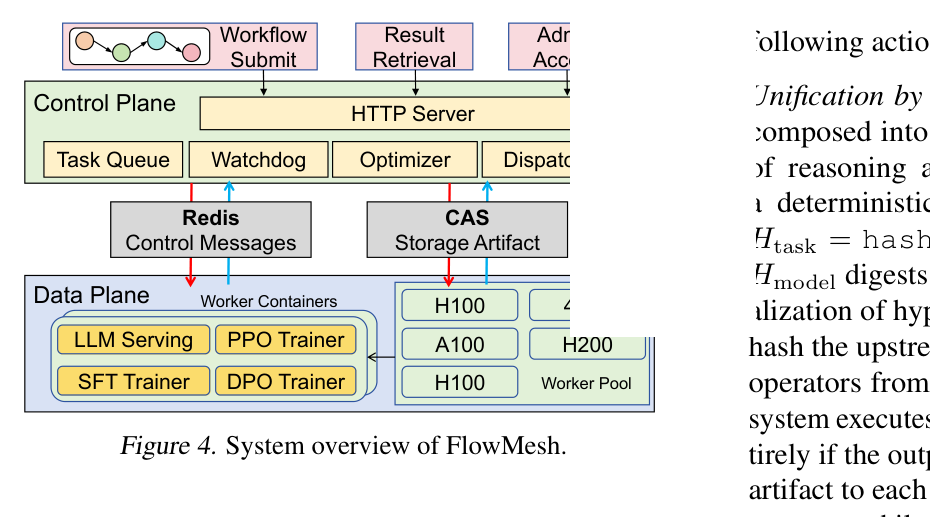
Paper's Figure 4, verbatim (caption: "System overview of FlowMesh.").
The dual-plane architecture: Control Plane (planner, router, scheduler) maintains a global view of all tenant DAGs and ready operators. Data Plane (elastic worker pool + CAS) executes scheduled work as stateless continuous-batching lanes. The control plane turns all tenant workflows into a single global stream of ready operators and continuously routes compatible requests into persistent executors.
Scheduling objective #
The control plane maximizes:
$$U(j,B) = w_t T_{\mathrm{eff}}(j,B) - w_c C(j) + w_\ell G_{\mathrm{loc}}(j,B)$$
where $T_{\mathrm{eff}}$ = predicted throughput on worker $j$ for batch $B$, $C(j)$ = normalized cost rate, $G_{\mathrm{loc}}$ = locality gain (model weights in GPU memory, adapters on disk, hot KV cache). Feasibility gated by VRAM/BW limits, architectural requirements, and tenant affinity rules.
Cross-DAG consolidation #
Two identity functions enable sharing without conflating provenance:
System scope #
Scheduler #
KV / Memory manager #
§4 作者证明 #
Notation table #
| Symbol | Meaning |
|---|---|
| $H_{\mathrm{task}}$ | Deterministic operator identity (includes input hashes) |
| $H_{\mathrm{exec}}$ | Execution signature (omits input hashes, adds resource class) |
| $U(j,B)$ | Scalar utility for worker $j$ serving batch $B$ |
| $T_{\mathrm{eff}}(j,B)$ | Predicted effective throughput (tokens/sec or samples/sec) |
| $C(j)$ | Normalized cost rate of worker $j$ |
| $G_{\mathrm{loc}}(j,B)$ | Locality gain (weights in memory, adapters on disk) |
| $(w_t, w_c, w_\ell)$ | Policy weights for throughput, cost, locality |
Equation physical meaning #
6 minimum checks #
§5 实验与数据 #
Setup: 6 GPU workers — H100 NVL (94 GB), RTX 4090 (48 GB), RTX 4090 (24 GB). Vast.ai Oct 2025 rates. Llama-3.1-8B, Llama-3.2-3B/1B. vLLM (inference) + HuggingFace TRL (RL training).
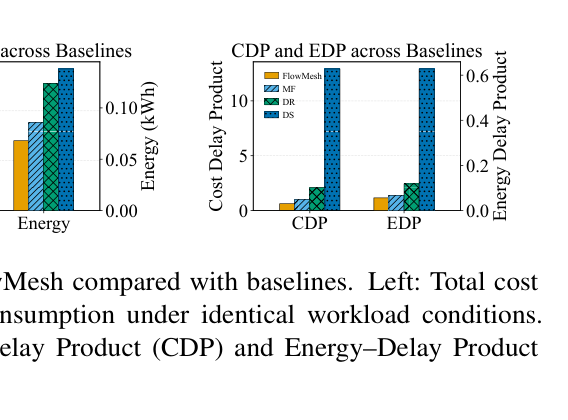
Paper's Figure 5, verbatim (caption: "FlowMesh compared with baselines. Left: Total cost and energy consumption. Right: Cost–Delay Product and Energy–Delay Product.").
FlowMesh delivers the lowest cost and energy across all baselines. DS (Decompose + Static) achieves slightly higher raw throughput by favoring H100 GPUs, but FlowMesh makes better use of smaller GPUs for superior cost/energy efficiency. The 2–10× CDP/EDP improvement is driven by the combination of deduplication, topology-aware placement, and elastic scaling.
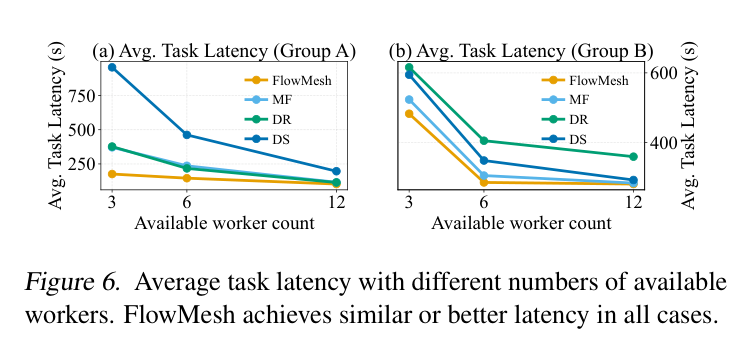
Paper's Figure 6, verbatim (caption: "Average task latency with different numbers of available workers. FlowMesh achieves similar or better latency in all cases.").
FlowMesh's latency advantage is most significant with fewer workers — where baselines queue for resources while FlowMesh consolidates common tasks across workflows, effectively skipping the queue.

Paper's Figure 7, verbatim (caption: "Complete tasks under different numbers of workers on a Kubernetes cluster.").
Sub-linear scaling: 17 → 32 tasks/min from 8 → 48 workers (6× workers for ~1.9× throughput). This suggests significant coordination overhead at scale, though queuing delay (not compute) dominates total latency.
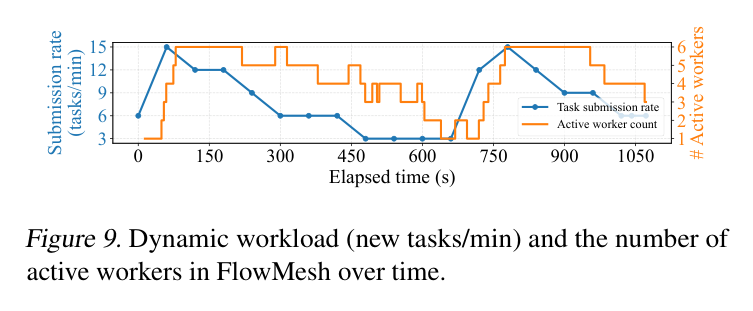
Paper's Figure 9, verbatim (caption: "Dynamic workload and the number of active workers in FlowMesh over time.").
The system effectively scales up and down tracking incoming workflow rate. The 30–60s lag is attributed to Vast.ai's instance bidding API — not fundamental to FlowMesh's design.
Where FlowMesh loses: DS achieves slightly higher raw throughput (favors H100s). Sub-linear scaling suggests diminishing returns. 30–60s Vast.ai provisioning lag could violate tight SLOs. Evaluation uses only 6 workers in the main experiment — gap to production scale is unaddressed.
Workload characterization #
| Workload regime | FlowMesh | Baseline | Why |
|---|---|---|---|
| Multi-tenant with shared sub-tasks | 1.8–3.8× cost reduction | Redundant computation | Cross-DAG dedup via $H_{\mathrm{task}}$ |
| Heterogeneous GPU cluster | Superior cost-efficiency | Wastes expensive GPUs on easy tasks | Utility-based placement matches task to GPU |
| Variable arrival rate | Elastic scaling | Static over/under-provisioning | Stateless workers + CAS enable instant scale |
| Tight latency SLOs | Moderate (30–60s Vast.ai lag) | Fixed allocation is predictable | Provisioning lag may violate strict SLOs |
§6 论证链 #
| Step | Claim | Evidence | Depends on |
|---|---|---|---|
| 1 | DAG workflows contain massive redundant compute across tenants | §2: RLHF/RLAIF anatomy shows identical SFT + reward inference across experiments | — |
| 2 | Deterministic operator identities enable safe cross-tenant deduplication and batching | §3: $H_{\mathrm{task}}$ for exact-match, $H_{\mathrm{exec}}$ for compatible-batch; lineage preserved per DAG edge | Step 1 |
| 3 | A single utility function unifies placement, batching, and routing | §3.1: $U(j,B)$ trades off throughput, cost, locality; feasibility-gated by VRAM/arch constraints | Step 2 |
| 4 | Stateless workers + CAS provide elastic fault-tolerance | §3.2–3.3: idempotent re-execution, speculative replicas, at-most-once publication via content identity | Step 3 |
| 5 | End-to-end cost/energy/latency improvements over baselines | §5.2: 1.8–3.8× cost, 1.3–2.0× energy, 2–10× CDP/EDP | Steps 2, 3, 4 |
§7 实现 cross-reference #
Implementation: Dual-backend — Kubernetes (custom controller + scheduler plugin in Go) and Vast.ai (Python CLI/SDK).
No public repository cited in the paper.
[实现未公开]
关键实现细节: