Opportunistic Expert Activation: Batch-Aware Expert Routing for Faster Decode Without Retraining
Opportunistic Expert Activation (OEA) — L2 #
1. TL;DR #
MoE decode is memory-bound at moderate batch sizes, so latency is linear in the number of unique activated experts $T$ (the union over the batch). OEA re-routes tokens at inference (no retraining): guarantee each token a top-$n_i$ baseline, then let tokens piggyback extra experts already loaded for others — cutting $T$ for free. 39% / 15% MoE decode speedup on Qwen3-30B / 235B, no significant accuracy loss.
2. Q1 / Q2 / Q3 #
Q1 — 痛点 (problem). During autoregressive decode the effective batch seen by an MoE layer equals the request batch size $B$ (one token/sequence/step), which is small. Because per-expert load grows only at rate $k/N$ (e.g. $1/16$ in Qwen3), the batch size needed to reach the compute-bound regime is in the thousands ($\approx 1.6\text{k}$ for Qwen3). So for moderate $B$ the MoE layer is memory-bound: latency is dominated by fetching each activated expert's weights HBM→SRAM, i.e. it scales with the number of unique activated experts. That union grows fast: at $N=128, k=8, B=16$, uniform routing activates $\approx 82$ experts — up to a $10\times$ increase over $B=1$.
Q2 — 方法 (method). Opportunistic Expert Activation (OEA), a two-phase batch-aware router applied only at decode, with no model change. Phase 1 gives every token an independent baseline of its top-$n_i$ experts ($n_i=\min(k_0, t_i)$, an adaptive top-$p$ capped at $k_0$), producing the union $S^{\text{base}}=\bigcup_i S^{\text{base}}_i$. Phase 2 lets each token piggyback additional experts, but only those already in $S^{\text{base}}$ — so $T=|S^{\text{base}}|$ is unchanged and the extra work is latency-free in the memory-bound regime. Kept router scores are renormalized.
The 核心技术壁垒 is the additive guarantee-then-piggyback asymmetry: OEA first fixes $T$ to a batch-independent per-token floor and then only augments within that fixed set. This is what separates it from Lynx's subtractive "activate-the-union-then-drop-unpopular" scheme, which can delete an expert that is unpopular batch-wide but critical to one token. Replicating the idea is easy; replicating the result requires trusting (and empirically validating) that adding out-of-policy experts strictly helps rather than hurts — the paper's most counterintuitive finding.
Q3 — 结果 (result). On Qwen3-30B (H100, bf16, $N=128, k=8$): simplified OEA at $k_0=3$ halves the activated-expert count (48.8→25.1 avg) and cuts MoE latency 39%; $k_0=5$ cuts 23%, all with no statistically significant benchmark loss (except GPQA for the pruned-only variant). On Qwen3-235B (TP=8): $k_0=5$ gives 15% MoE latency reduction (smaller, attributed to all-reduce overhead), holding accuracy on all benchmarks except LiveCodeBench (−2%). Latency-vs-$T$ linearity is confirmed at $R^2>0.99$.
3. 架构 / 方法图 #
The load-bearing empirical premise — MoE decode latency is (near-perfectly) linear in the number of activated experts — is Figure 1:
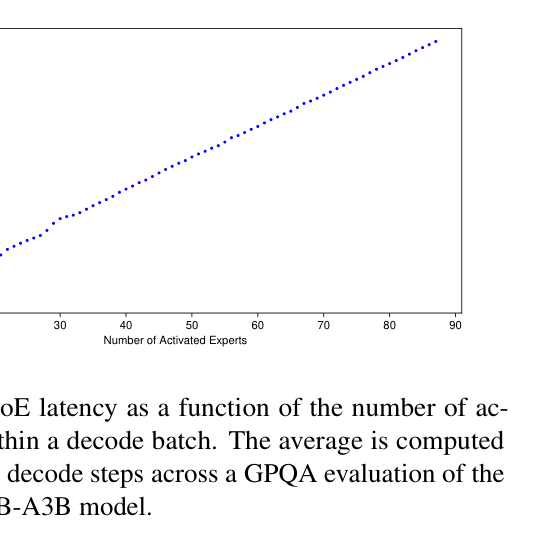
Paper's Figure 1, verbatim (caption: "Mean MoE latency as a function of the number of activated experts within a decode batch. The average is computed over all layers and decode steps across a GPQA evaluation of the vanilla Qwen3-30B-A3B model.").
Notice the regression fits at $R^2>0.99$ with standard errors $<2\cdot10^{-4}$: every additional distinct expert adds a nearly constant fetch cost, so minimizing the union of experts is the correct optimization target. This is the whole justification for OEA operating on $T$ rather than per-token compute.
The routing procedure itself has no paper figure, so a flowchart clarifies the two-phase control flow (Algorithm 1, general form):
t_i = min experts reaching cum-mass p
n_i = min(k0, t_i)
S_base_i = top-n_i experts"] B --> C["Union: S_base = ∪ S_base_i"] C --> D["Phase 2: per token i
S_i ← S_base_i
walk ranks j = n_i+1 .. maxP"] D --> E{"|S_i| > kmax?"} E -->|yes| G["stop for this token"] E -->|no| F{"e_ij ∈ S_base?"} F -->|yes| H["add e_ij to S_i (piggyback, free)"] F -->|no| I["skip"] H --> D I --> D G --> J["Renormalize kept scores, run MoE"]
The key structural point the raster cannot convey: Phase 2's if e_ij ∈ S_base gate is what makes the augmentation cost-free — no token can pull in an expert that isn't already being fetched for the batch.
4. 作者证明 #
This is an empirical paper built on one analytical latency model; there is 无形式化作者证明 — 仅实证 for the quality-preservation claim (that is validated by experiment, not theorem). The one formal object is the roofline latency decomposition, which the paper derives but does not prove as a bound.
Notation table
| Symbol | Meaning |
|---|---|
| $N$ | total experts (128 for Qwen3-30B/235B) |
| $k$ | experts activated per token by default router (8) |
| $B$ | decode batch size |
| $T$ | number of unique activated experts in the batch (the union size) |
| $\text{cnt}_i$ | tokens routed to expert $E_i$ |
| $a$ | per-token compute time in an expert |
| $b$ | weight-fetch cost HBM→SRAM (memory-bound term) |
| $e_{i,j}$ | token $i$'s $j$-th ranked expert |
| $n_i=\min(k_0,t_i)$ | baseline experts for token $i$ |
| $k_0, p, k^{\max}, \text{maxP}$ | the four OEA hyperparameters |
方程物理意义. The per-expert cost model is $f(0)=0$, $f(n)=an+b$ for $n>0$. Summing over experts:
$$\sum_{i=1}^N f(\text{cnt}_i)=\sum_{i=1}^N\left(b\cdot\mathbb{1}_{\text{cnt}_i>0}+a\cdot\text{cnt}_i\right)=b\cdot T + a\cdot Bk$$
The first term $b\cdot T$ is memory-bound (fixed per activated expert), the second $a\cdot Bk$ is compute-bound (each of $B$ tokens routes to $k$ experts, so total load is $Bk$). In the memory-bound regime $b\cdot T$ dominates, hence gains are near-proportional to the drop in $T$. The expected union under uniform routing is $\mathbb{E}[T]=N\left(1-(1-\tfrac{k}{N})^B\right)$, giving $\approx 82$ at $N=128, k=8, B=16$.
6 minimum checks:
- Assumption — memory-bound regime. Holds only when $\text{cnt}_i$ is small (moderate $B$); the paper explicitly bounds applicability, using OEA at decode only, not prefill. Breaks at large $B$ (thousands) where $a\cdot Bk$ dominates and reducing $T$ stops helping.
- Assumption — experts not executed in parallel. Eq. 2's "latency $\propto T$" assumes serial expert execution. Under expert parallelism the driver becomes the max per-machine expert count (acknowledged in §7 future work).
- $\text{cnt}_i\le B$ always (a token routes to an expert at most once); this bound survives any re-routing, so $T\le N$ and $\sum_i\text{cnt}_i=Bk$ hold exactly.
- Grouped-GEMM caveat. Optimized kernels batch expert compute but still must load all activated weights; the $b\cdot T$ constraint is unchanged. Confirmed empirically (Fig. 1), so the simplification does not invalidate the target.
- Uniform-routing idealization. $\mathbb{E}[T]$ and $\mathbb{E}[\text{cnt}_i]=Bk/N$ assume balanced routing (what load-balancing losses target). Real routing skews, but Fig. 1's tight fit shows the linear-in-$T$ relation survives regardless.
- Quality preservation is empirical, not guaranteed. Nothing proves piggybacked (out-of-policy) experts help; §4.1's $\text{maxP}=8$-hurts result is offered as evidence that they confer a strict advantage — a claim that would ideally be backed by a stability/robustness bound but is not.
- CUDA-Graph padding is not free for MoEs. Under default SGLang, a batch of size 7 padded up to a captured size 8 can be slower than a real batch of 8, because the padding token activates out-of-distribution experts, inflating $T$. The paper's fix is to capture CUDA Graphs up to size 16 (no padding); a proper fix is a padding mask that zeros padding tokens' expert choices. Miss this and latency measurements are non-monotonic and misleading.
- Piggybacking is redundant at $B=1$ and only benefits moderate batches — OEA must be gated to decode (not prefill) and to non-trivial batch sizes, otherwise it adds control-flow cost with no upside. The single knob $k_0$ controls both the quality floor and the $T$ reduction, so batch-size-dependent $k_0$ (larger, safer $k_0$ at small $B$) is the natural tuning axis.
5. 实验与数据 #
The central quality result is the piggybacking gain: OEA's Pareto frontier (cross-entropy delta vs activated-expert count) strictly dominates pruning-only (Phase-1) at $B=16$.
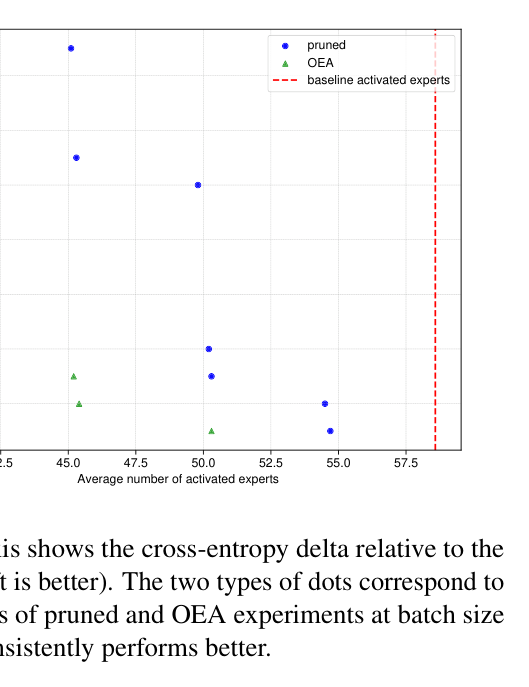
Paper's Figure 2, verbatim (caption: "The two types of dots correspond to the Pareto frontiers of pruned and OEA experiments at batch size B=16. OEA consistently performs better.").
Lower-left is better; OEA's frontier sits below pruning everywhere, so for the same activated-expert budget OEA loses less cross-entropy — the Phase-2 piggyback is doing real work, not just bookkeeping.
The simplified router (drop $p$, drop $\text{maxP}$, set $k^{\max}=k$, keep only $k_0$) matches the best hyperparameter choices, justifying the reduced sweep cost:
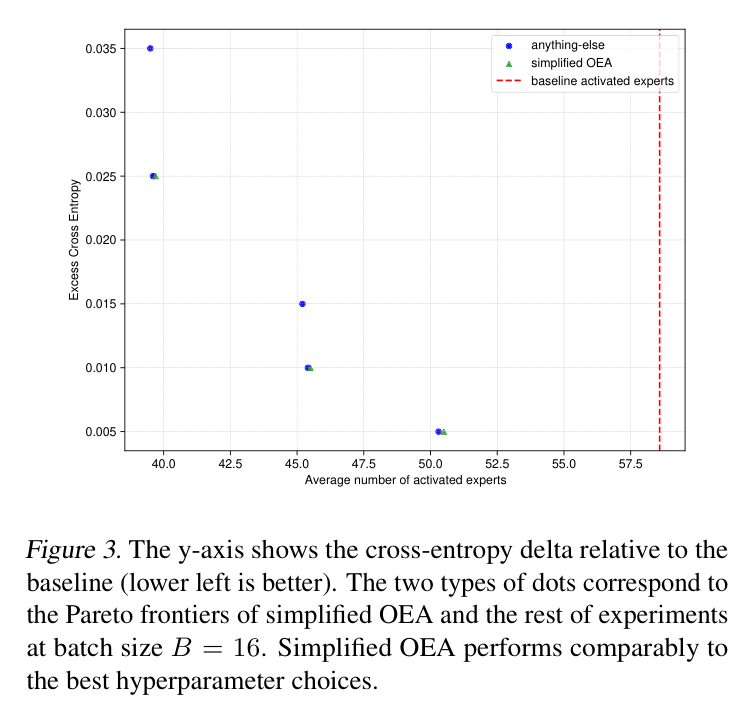
Paper's Figure 3, verbatim (caption: "The two types of dots correspond to the Pareto frontiers of simplified OEA and the rest of experiments at batch size B=16. Simplified OEA performs comparably to the best hyperparameter choices.").
The simplified frontier tracks the full-sweep frontier, meaning practitioners can deploy with a single knob $k_0$ — which simultaneously sets the quality floor and the expert-count reduction.
Downstream accuracy (Qwen3-30B, 4 runs, bold = SE-adjusted no-worse-than-vanilla):
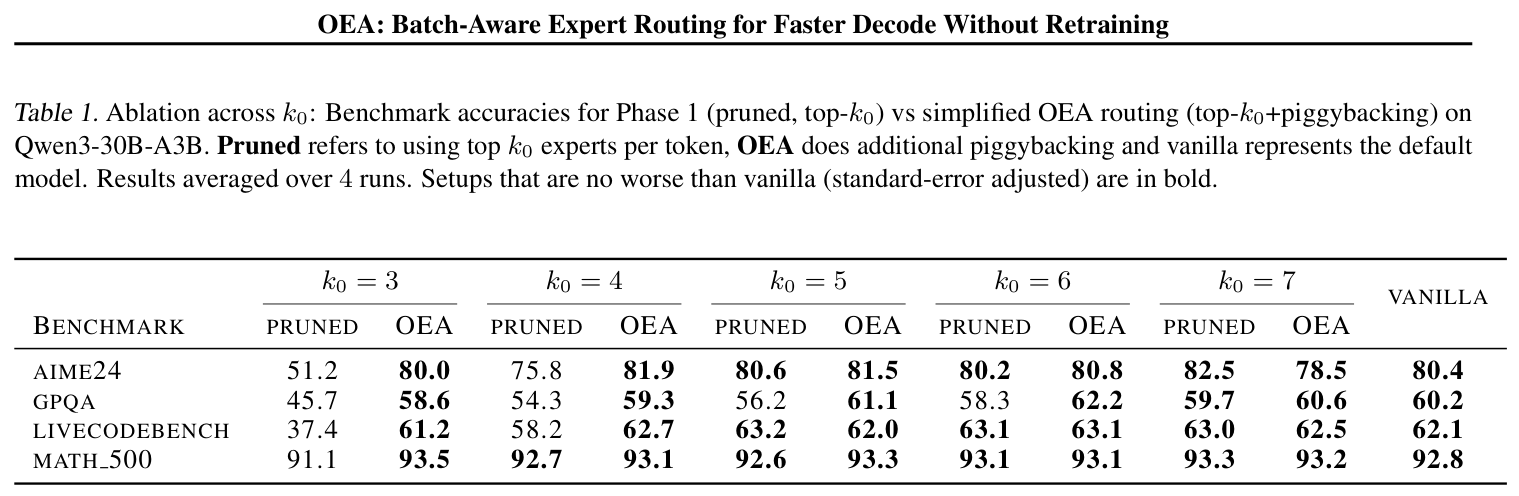
Paper's Table 1, verbatim (caption: "Benchmark accuracies for Phase 1 (pruned, top-k0) vs simplified OEA routing on Qwen3-30B-A3B ... Setups that are no worse than vanilla (standard-error adjusted) are in bold.").
The decisive contrast is the low-$k_0$ column: pruned at $k_0=3$ collapses (aime24 51.2, gpqa 45.7) while OEA at the same $k_0=3$ recovers to 80.0 / 58.6 — piggyback recovery from an otherwise-broken config, at zero extra latency.
The 235B case is even starker; pruning degrades catastrophically at low $k_0$ where OEA holds:
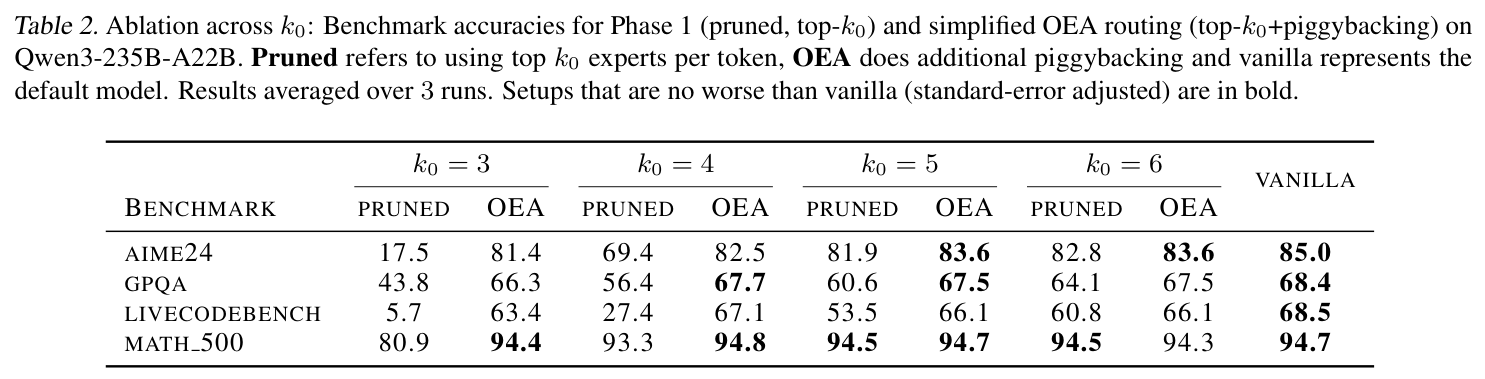
Paper's Table 2, verbatim (caption: "Benchmark accuracies for Phase 1 (pruned, top-k0) and simplified OEA routing on Qwen3-235B-A22B ... averaged over 3 runs.").
Pruned $k_0=3$ LiveCodeBench falls to 5.7 (vanilla 68.5); OEA at $k_0=3$ restores 63.4. This is the paper's strongest evidence that guarantee-then-piggyback beats union-then-drop.
Finally, the expert-count reduction translates directly to measured latency:
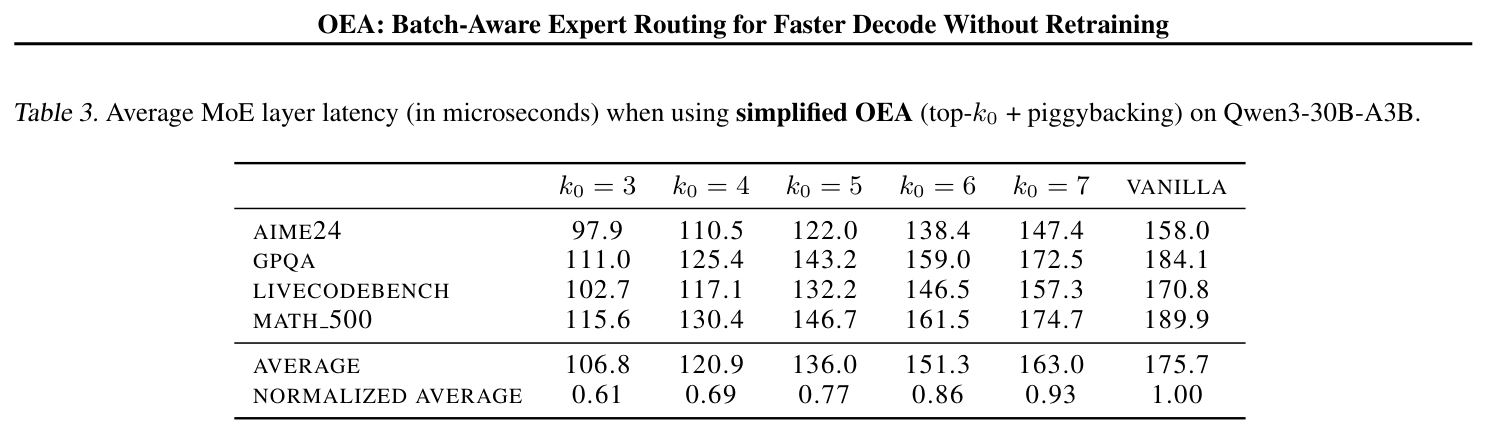
Paper's Table 3, verbatim (caption: "Average MoE layer latency (in microseconds) when using simplified OEA on Qwen3-30B-A3B.").
Normalized average drops to 0.61 at $k_0=3$ (the 39% headline) and 0.77 at $k_0=5$ (23%), matching the activated-expert reduction in Table 4 (0.51 / 0.72) — consistent with the near-proportional prediction of Eq. 2 in the memory-bound regime.
6. 论证链 #
| Step | Claim | Support (paper-internal) |
|---|---|---|
| 1 | MoE decode at moderate $B$ is memory-bound; latency $\approx b\cdot T + a\cdot Bk$ with $b\cdot T$ dominant | §3.1 Eq. 2 latency model; §2 per-expert-load $k/N$ argument |
| 2 | Therefore reducing the unique activated-expert count $T$ reduces latency near-proportionally | Eq. 2 first term; Fig. 1 empirical $R^2>0.99$ fit |
| 3 | A per-token top-$n_i$ baseline preserves each token's critical computation independent of batch | §3.2 Phase 1; adaptive top-$p$ capped at $k_0$; motivated by top-experts-are-critical |
| 4 | Adding only experts already in $S^{\text{base}}$ recovers quality while keeping $T=\lvert S^{\text{base}}\rvert$ fixed | §3.2 Phase 2; Fig. 2 OEA frontier dominates pruning |
| 5 | The full sweep collapses to a one-knob $k_0$ router with no loss | §4.1 findings ($p{<}1$, $\text{maxP}{<}N$, $k^{\max}{>}k$ don't help); Fig. 3 |
| 6 | Net effect: 39% / 15% MoE latency cut with no significant accuracy loss, no retraining | Tables 1–5; latency reductions from halved expert counts |
7. 实现 cross-reference #
The paper integrates the router into SGLang [zheng2024sglang] and runs decode-only re-routing; no author code release is indicated in L1, so the reference implementation status is [实现未公开]. The closest open surface is SGLang's MoE routing path, into which Phase-1 top-$n_i$ selection and the Phase-2 union-membership gate would be inserted before the expert dispatch.
核心技术壁垒 (dedicated paragraph). The single hardest-to-replicate insight is not the algorithm (it is a few dozen lines) but the empirical validity of the additive design under aggressive $k_0$. The subtractive Lynx-style scheme is the intuitive default; the non-obvious bet is that guaranteeing a small per-token floor and then piggybacking out-of-policy experts (ranks beyond the token's own top-$k$) strictly outperforms both smaller and larger active sets. The paper's $\text{maxP}=8$-strictly-hurts and $k^{\max}=9,10,11$-degrade results are the evidence, but they run against the prior that an unselected expert is useless to a token — anyone re-implementing must reproduce this or they will mis-tune the piggyback bounds and lose the free recovery.
关键实现细节 (easy-to-miss tricks):