Optimizing Agentic Language Model Inference via Speculative Tool Calls
Speculative Tool Calls — L2 #
§1 TL;DR #
用小模型提前投机预测 agent 的下一次 tool call 并异步执行,使工具执行与主模型推理重叠。提出 client-side(无需改引擎)和 engine-side(修改 vLLM 保持 KV-cache 驻留)两种方案,client-side 节省 6-21% 端到端时延,理论上界 < 2×;engine-side 额外节省 2-3%。
§2 Q1 · Q2 · Q3 #
Q1 痛点 #
LM agent 每次 tool call 都会打断推理:生成停止 → 序列从 batch 中驱逐 → 客户端运行工具 → 带工具输出重新调度 → 重新 prefill 不断增长的 prompt。这条严格的顺序依赖链引入三类开销:
- 工具等待时延:生成与工具执行完全串行,agent 在等待工具返回期间推理引擎空闲。
- 驱逐/重调度开销:序列被移出 active batch 后 KV-cache 可能被淘汰,重新进入时需重新 prefill(即使有 prefix caching 也要付出调度和 cache 管理成本)。
- 多租户竞争:多个 agent 共享推理引擎时,cache 淘汰更频繁,overhead 被放大。
- O1:投机执行工具,掩盖工具时延(与 client-side 同理)
- O2:检测到 tool call 开始时,从 cache 中取 draft tokens 做 speculative sampling 验证,跳过逐 token decode tool call 参数
- O3:检测到 tool call 结束且 cache 命中时,直接将 tool output 注入 KV-cache 继续 decode,避免序列驱逐和重调度
- Client-side:在 32 并发 gpt-oss-120b agent、xLAM-2-8B 投机模型的配置下,节省 6-21% 端到端时延(取决于工具时延与主模型生成时间的比值),吞吐量提升最高 +196.4 tok/s。
- Engine-side:在工具时延 < 主模型推理时间的场景下,相比 client-side 额外节省 2-3%(因为省去了驱逐/重调度开销)。
- 商业 API 验证:gpt-5 + gpt-5-nano 的 client-side speculation 中,1 次投机即可获得 ~9.5% 时间节省,额外成本仅 ~$0.025/100 turns(主模型成本的 ~4%)。
- 理论上界:client-side 投机的最大加速比严格 < 2×(Lemma 1 证明),因为只能掩盖生成和工具执行两个阶段中的一个。
- Success-rate model:Figure 5 展示 (model size, speculation count, cache hit rate) 的扫描矩阵。沿 model size 轴单调(8B > 3B > 1B),沿 speculation count 轴单调(更多 sample 提高 hit rate),沿 cache hit rate 轴吞吐量单调递增——与理论预测一致。
- Latency budget per turn:$G$ (主模型生成) + $T$ (工具执行) + overhead ($2o$)。论文声明"interactive latency"的条件是 $T < \delta R_i$(工具在 reasoning 期间完成),在 reasoning model 生成数秒 reasoning trace 的场景下合理。
- Failure mode classification:两类失败——(1) cache miss(投机模型预测错误的工具/参数),退化为 baseline 无额外开销;(2) stateful tool(无法安全投机),需人工标注工具为 stateless/stateful。论文方法主要解决 (1) 的效率问题。
- Tool cache keying 使用 canonicalized arguments:cache 键不使用原始文本,而是将 tool name + 参数进行规范化(canonicalize),以处理参数顺序不同但语义相同的情况。这是 cache hit rate 不被 trivial 格式差异降低的关键——容易被忽略但直接影响 $\alpha$。
- Tool proposer 的双阶段 cache lookup:engine-side 的 tool proposer 在 token 流中检测到 tool-call-start token 时,仅用部分键(tool name)查询 cache 以获取 draft tokens 做 early exit speculation;在检测到 tool-call-end token 时,用完整键(name + canonicalized args)做 exact match 以安全注入 tool output。这种分阶段策略平衡了投机的激进性(尽早开始)和正确性(完整匹配才注入结果)。
- 主模型:gpt-oss-120b(120B reasoning model),reasoning trace 持续数秒,为工具投机提供时间窗口。方法对主模型无特殊要求,仅需支持标准 tool calling format。
- 投机模型:xLAM 系列(1B/3B/8B,基于 Llama 的 tool-calling fine-tuning)。8B 模型在 BFCL 上达到 ~80% tool call 预测准确率。也验证了 gpt-5-nano 作为投机模型。
- backbone 敏感性:论文未做跨 backbone 家族的消融(未测试 Qwen/Claude),但方法在架构上对 backbone 无特殊假设。关键依赖是投机模型的 tool call 预测准确率 $\alpha$。
现有的缓解措施——并行 tool call(模型一次返回多个独立调用)和 prefix caching——只能部分缓解,无法消除顺序依赖本身。
Q2 方法 #
核心思路:将 speculative decoding 的"用小模型投机、大模型验证"范式从 token 级别推广到 tool call 级别。由于 tool call 的时延远大于几个 token 的 decode 时间(毫秒 vs 秒),传统 speculative decoding 只能 overlap 几个 token 的生成——收益微乎其微。本文的关键洞察是:tool 应该尽早投机、尽多投机,而非像 token-level speculation 那样只领先几步。
两个互补方案:
Client-side speculation(Algorithm 2):在发送 prompt 给主模型 $M$ 的同时,异步发送给 $\lambda$ 个更小更快的投机模型 $S$。$S$ 先返回时提取 tool call 并异步执行工具,结果缓存在 client 端的 tool cache 中。当 $M$ 返回需要同一个 tool call 时,直接从 cache 取结果,跳过等待。优势:完全不需要修改推理引擎或 API,纯 client 侧实现。
Engine-side speculation(Algorithm 5):在推理引擎内部维护 tool cache。客户端将投机工具执行结果通过 POST /cache-tool-output/{response_id} API 提交给引擎。引擎实现三重优化:
核心技术壁垒:engine-side 的 tool proposer 需要在 token 流中实时检测 tool-call 边界,并在两种 cache lookup 策略之间动态切换——tool-start 时用部分键(tool name)做 early exit speculation,tool-end 时用完整键(name + canonicalized args)做 exact match 注入。这要求深度改造推理引擎的 speculative decoding 基础设施(论文基于 vLLM 的自定义 fork 实现),是复现的主要技术障碍。
Q3 结果 #
§3 架构 / 方法图 #
Client-side 投机流程 #
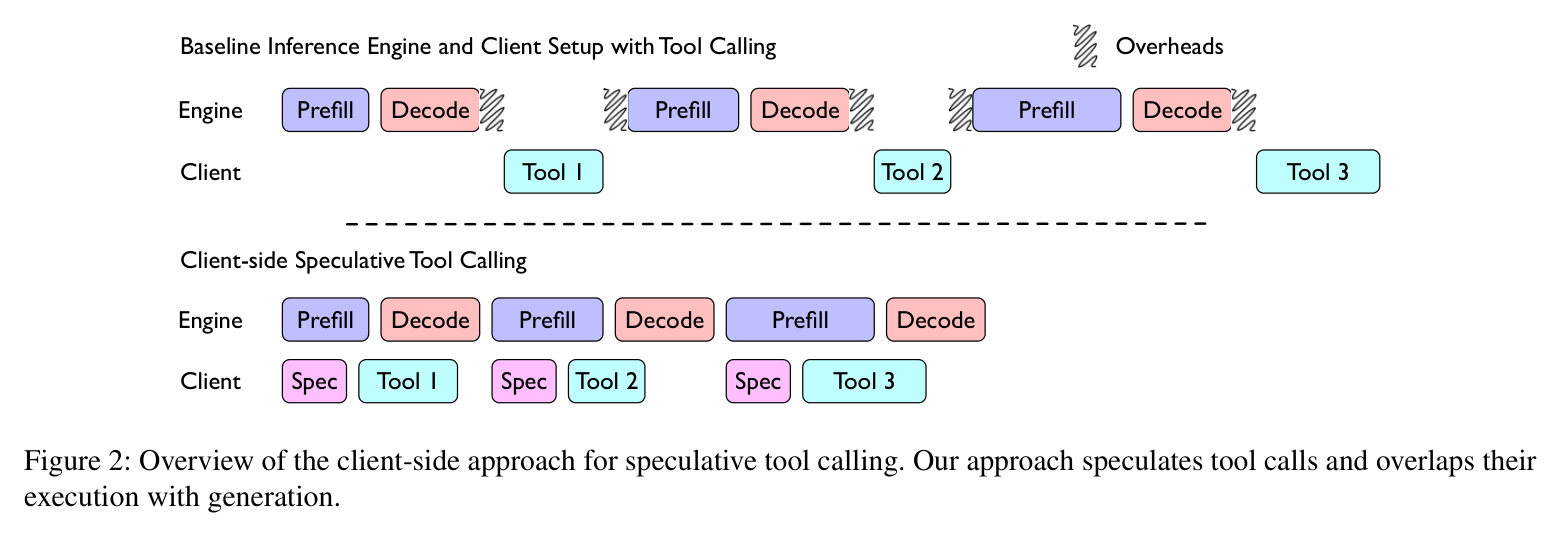
Paper Figure 2:Client-side speculative tool calling 的时序对比。上方为 baseline(Prefill→Decode→Tool 严格串行),下方为投机方案(投机模型与主模型并行运行,工具执行与主模型生成重叠)。
Client-side 方案的核心是时间重叠:投机模型 $S$ 比主模型 $M$ 更快返回 tool call 预测,工具在 $M$ 还在 decode 的过程中已经异步执行完成。当 $M$ 最终也需要同一个 tool call 时,结果已在 cache 中等待,跳过了工具等待时间。
Engine-side 投机流程 #

Paper Figure 4:Engine-side speculative tool calling 的架构。相比 client-side 增加了三重优化:(1) 保持序列驻留避免驱逐,(2) 通过 speculative sampling 缩短 tool call 参数的 decode,(3) 直接注入 tool output 继续生成。
Engine-side 方案的关键区别在于序列始终驻留在 batch 中——tool call 不再触发驱逐。投机的 tool output 通过 HTTP API 提交到引擎内部的 tool cache,引擎的 tool proposer 在检测到 tool-call boundary 时自动查询 cache 进行验证和注入。
Agent 循环状态机 #
Tool cache 约束 #
投机仅适用于无状态、低成本的工具(web search、file read、ls 等)。有副作用的工具(代码执行、文件写入、API 调用改变外部状态)无法安全投机,除非引入 undo/rollback 机制——本文不处理这一场景。
§4 作者证明 #
符号表 #
| Symbol | 含义 | 来源 |
|---|---|---|
| $M$ | 主模型(大模型) | §3 |
| $S$ | 投机模型(小模型) | §3 |
| $\lambda$ | 每轮投机采样数 | §3.1 |
| $G$ | 主模型平均生成时间 | §3.1.1 |
| $g$ | 投机模型平均生成时间 | §3.1.1 |
| $T$ | 平均工具执行时间 | §3.1.1 |
| $\alpha$ | 投机模型 acceptance rate | §3.1.1 |
| $\phi$ | prefill 速率 (s/tok) | §3.2.1 |
| $\delta$ | decode 速率 (s/tok) | §3.2.1 |
| $X_i$ | 第 $i$ 轮 prefill token 数 | §3.2.1 |
| $R_i$ | 第 $i$ 轮 reasoning token 数 | §3.2.1 |
| $t_i$ | 第 $i$ 轮 tool call token 数 | §3.2.1 |
| $T_i$ | 第 $i$ 轮工具执行时间 | §3.2.1 |
| $o$ | API 和驱逐 overhead | §3.2.1 |
| $K$ | agent 连续 turn 数 | §3.2.1 |
方程物理意义 #
Client-side 性能模型:$N$ 次请求的标准时间 $T_{\text{standard}} = N(G + T)$,投机时间 $T_{\text{spec}} = \alpha N \max\{G, g + T\} + (1 - \alpha)N(G + T)$。物理含义:投机成功(概率 $\alpha$)时,工具执行与主模型生成重叠,总时间取两者较大值;投机失败时退化为 baseline。
Lemma 1(加速比上界):$S_{\text{spec}}(\alpha) = \frac{G+T}{\alpha \max\{G, g+T\} + (1-\alpha)(G+T)}$。加速比关于 $\alpha$ 严格递增,最大值 $S_{\max} = \frac{G+T}{\max\{G, g+T\}} \leq 2 - \frac{2g}{G+g+T} < 2$。物理含义:client-side 只能掩盖生成和工具执行中的一个阶段,因此永远无法达到 2× 加速。当 $g \to 0^+$ 时趋近 2×。
Engine-side 性能模型:$T^*_{\text{spec}} = (1-\alpha)2Ko + \phi(X_1 + \sum(t_i + t_{o,i})) + \delta(\alpha K + \sum R_i + (1-\alpha)\sum t_i) + (1-\alpha)\sum T_i$。物理含义:当 $\alpha = 1$ 时,消除所有驱逐 overhead($2Ko$)、所有工具等待时间($\sum T_i$)、以及大部分 tool call decode 时间($\sum t_i - K$ 个 token),仅剩 prefill、reasoning decode 和每轮 1 个 verification token。
6 项检查 #
| # | 检查项 | 结果 |
|---|---|---|
| 1 | Lemma 1 证明逻辑完整性 | ✓ 令 $M := \max\{G, g+T\}$,$\Delta := M - (G+T) \leq 0$,分母关于 $\alpha$ 严格递减,加速比严格递增。用 $\max\{a,b\} \geq (a+b)/2$ 建立上界。证明完整。 |
| 2 | Equation (3) 边界条件 | ✓ $\alpha = 0 \Rightarrow S = 1$(无加速),$\alpha = 1, g \to 0 \Rightarrow S \to 2$(理论极限),符合物理直觉。 |
| 3 | Equation (6) 边界条件 | ✓ $\alpha = 0 \Rightarrow T^*_{\text{spec}} = T_{\text{cached}}$,$\alpha = 1$ 消除所有可投机的开销。 |
| 4 | 投机正确性(无输出变更) | ✓ Client-side:cache miss 时退化为 baseline,不影响输出。Engine-side:使用 speculative sampling 验证 draft tokens,拒绝时回退到正常 decode。数学等价性继承自 speculative decoding 的正确性证明。 |
| 5 | 约束条件合理性 | ✓ 仅投机无状态工具、$g < G$(投机模型比主模型快)、$\alpha > 0$(非零命中率)——三个约束都是实际部署中容易满足的。 |
| 6 | Speedup model vs 实验一致性 | ✓ 模型预测最佳 client-side 加速在 $T \approx G$ 时取得——Figure 6 中 tool latency 2.0-2.5s 时间节省最大(~21%),与 gpt-oss-120b 生成时间量级一致。 |
Agent-specific 检查 #
§5 实验与数据 #
主要结果:吞吐量提升 #
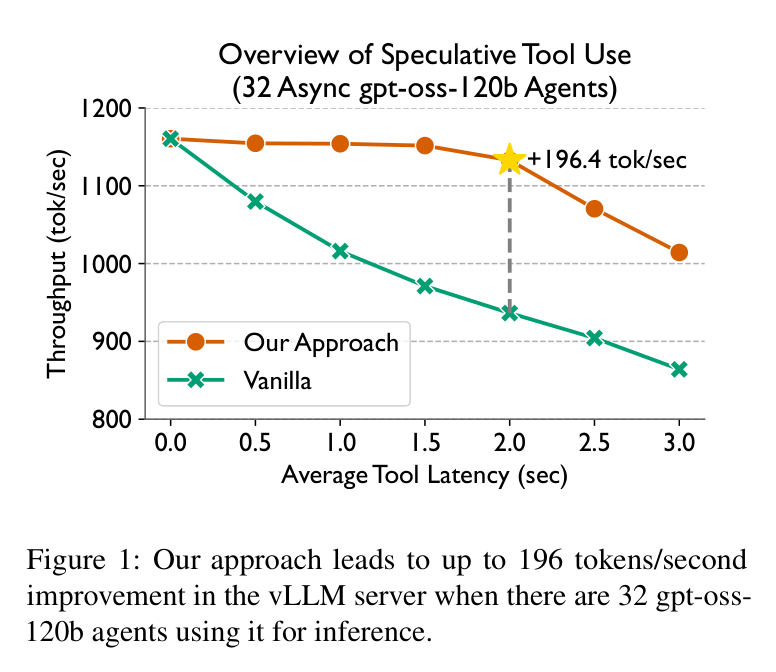
Paper Figure 1:32 个 gpt-oss-120b agent 使用 vLLM 推理时,投机方案 vs vanilla 的吞吐量对比。在工具时延 ~1.5s 时获得 +196.4 tok/s 的提升。
图中可见投机方案在所有工具时延下都优于 baseline。吞吐量差距随工具时延增大先增后减——符合理论预测的"$T \approx G$ 时最优"。
投机准确率与吞吐量关系 #
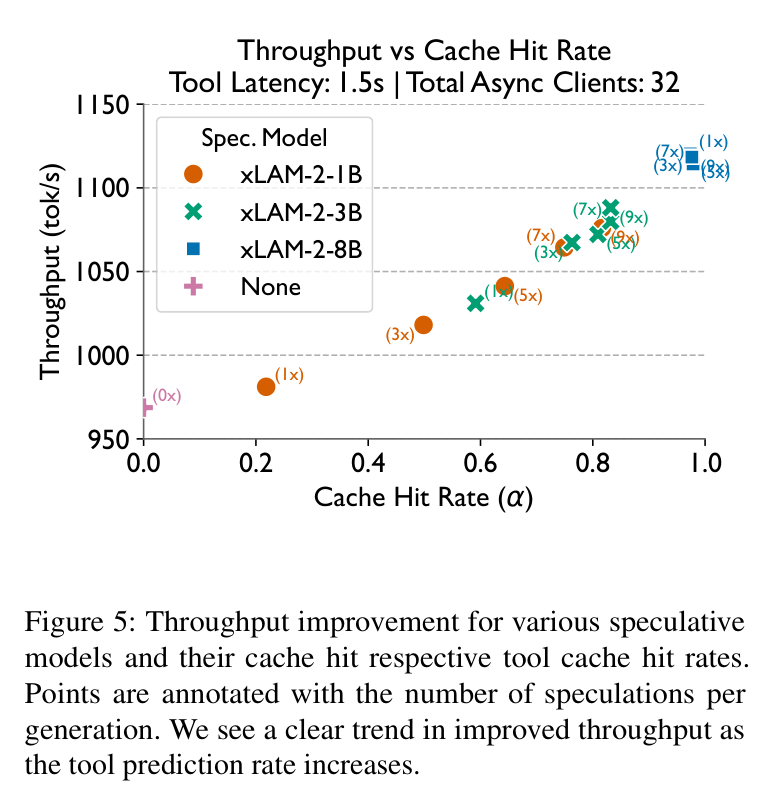
Paper Figure 5:不同投机模型的 cache hit rate 与吞吐量关系。xLAM-2-8B 在 1× speculation 时达到 ~80% 命中率;1B 模型通过 9× sampling 将命中率从 ~35% 提升到 ~55%。
关键观察:吞吐量与 $\alpha$ 近似线性正相关(与 Equation 3 一致)。更多投机 sample 对小模型帮助显著——xLAM-2-1B 的 9× 比 1× 命中率提升约 60%——但对 8B 模型提升有限,因为其 1× 准确率已经很高。
理论加速比分布 #
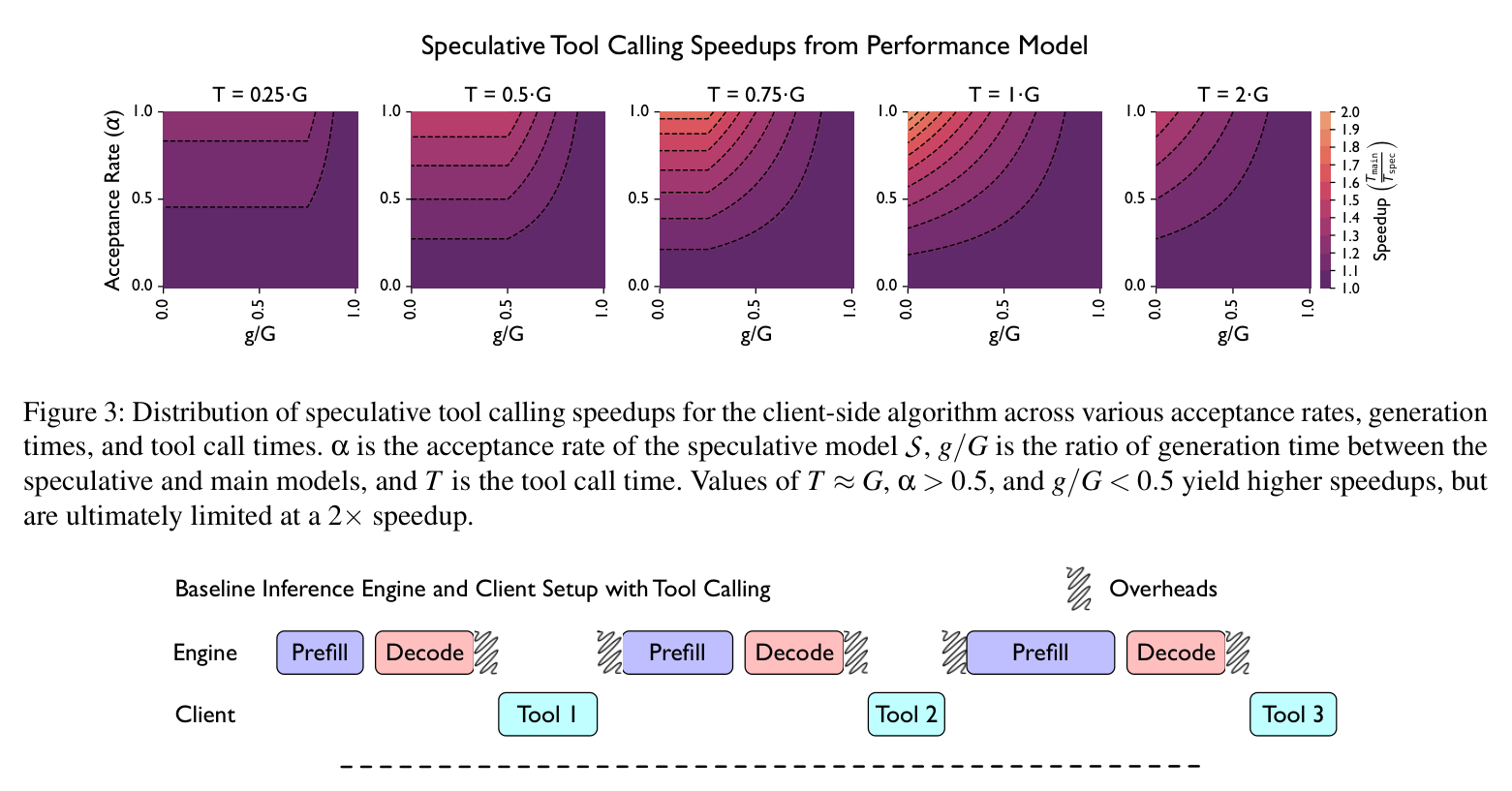
Paper Figure 3:Client-side 加速比的理论分布热力图,横轴 $g/G$,纵轴 acceptance rate $\alpha$,五个 panel 对应不同 $T/G$ 比值。
五个 panel 直观展示 Lemma 1 的含义:(1) 加速比随 $\alpha$ 增大、$g/G$ 减小而增大;(2) $T \approx G$ 时(中间 panel)获得最大加速空间;(3) 即使 $\alpha = 1, g/G \to 0$,加速比也被限制在 2× 以下。这是 client-side 方案的根本局限。
Client-side 时间节省 #
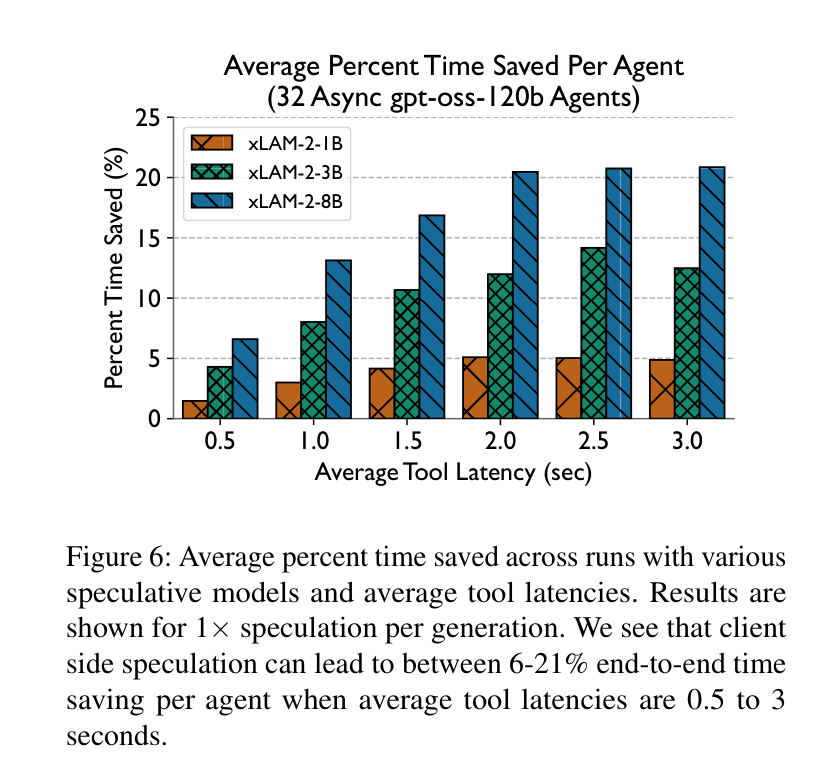
Paper Figure 6:32 个异步 gpt-oss-120b agent 在 1× speculation 下,不同工具时延的 percent time saved。xLAM-2-8B 在 2.0-2.5s 工具时延时节省最多(~21%),短工具(~0.5s)也能节省 ~6%。
该图验证了核心分析预测:最佳收益在 $T \approx G$ 附近(gpt-oss-120b 的 decode 时间约 2-3s)。工具时延过长时,工具执行主导总时间,投机节省的占比下降。
商业 API 成本效益 #
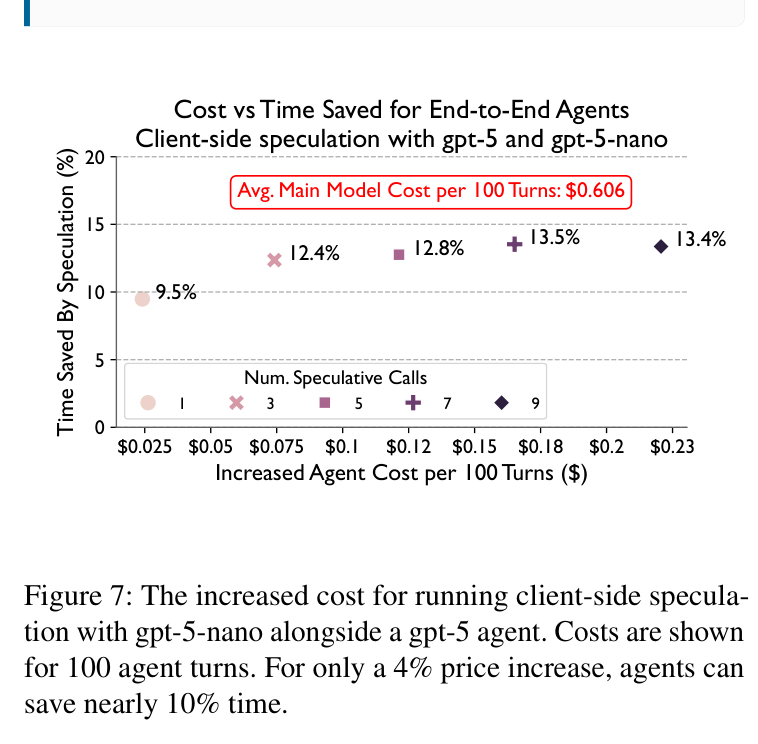
Paper Figure 7:使用 gpt-5-nano 为 gpt-5 投机的成本-收益分析。1 次投机节省 ~9.5% 时间,额外成本仅 ~$0.025/100 turns(主模型成本 $0.606/100 turns 的 ~4%)。
这是生产部署可行性的关键证据:投机模型的推理成本比主模型低一个数量级以上,成本效益比非常高。9× 投机虽然进一步提升时间节省至 ~13.5%,但成本增至 ~$0.23/100 turns(~38%),边际收益递减。
Engine-side vs Client-side 对比 #
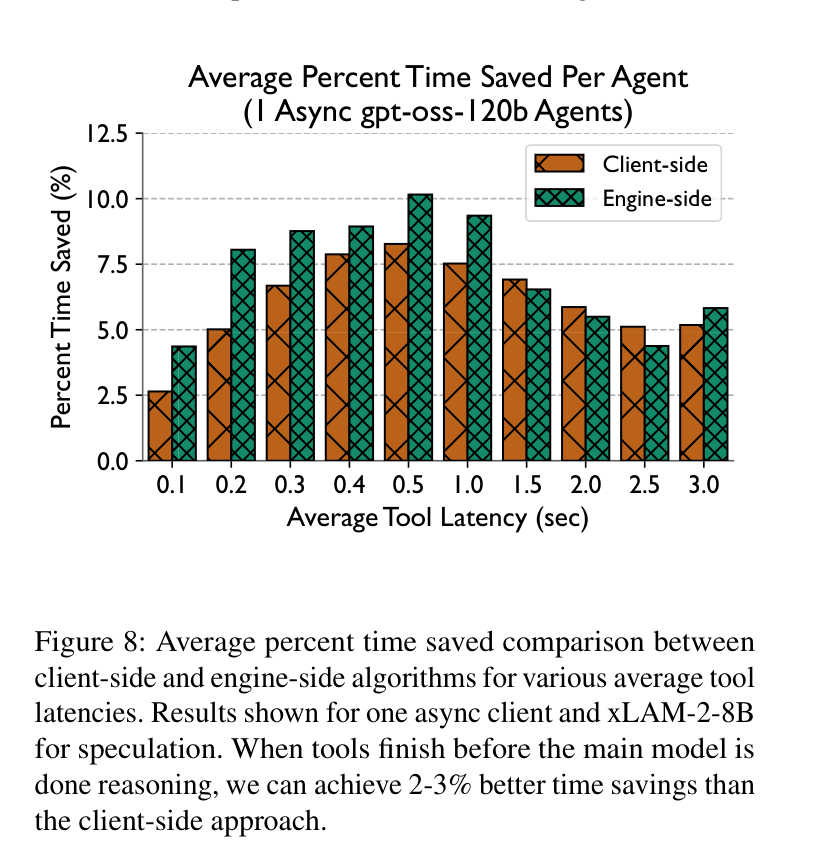
Paper Figure 8:1 个异步 agent、xLAM-2-8B 投机时,engine-side 与 client-side 的时间节省对比。工具时延 < 1s 时 engine-side 额外节省 2-3%;工具时延 > 1s 时两者趋同。
Engine-side 的额外收益来自 O2(省 decode tool call tokens)和 O3(省驱逐/重调度开销)。这两项收益的绝对值固定,在短工具场景下占比更大。当工具时延远超主模型生成时间时,工具等待主导总时间,engine-side 的 O2/O3 优势被稀释。注意该实验受限于 vLLM speculative decoding 在 batch > 1 时的高 overhead,仅展示单 agent 结果。
§6 论证链 #
| Step | 论点 | 支撑 | 评注 |
|---|---|---|---|
| 1 | Tool call 引入严格顺序依赖,是 agent 推理的性能瓶颈 | §1 问题分析 + §2.1 工具调用机制 | 行业共识,无争议 |
| 2 | 传统 speculative decoding 不适合 tool-level speculation:draft 仅领先 3-10 tokens,无法掩盖秒级工具时延 | §2.2 speculative decoding 背景 + §3 关键差异分析 | 正确区分了 token-level vs tool-level 的时间尺度差异 |
| 3 | Client-side speculation 可在不修改引擎的前提下,通过异步投机模型 + tool cache 实现工具执行与生成的时间重叠 | Algorithm 2 (§3.1) + Equations 1-3 (§3.1.1) | 方法简洁,工程可行性高 |
| 4 | Client-side 加速比有严格理论上界 < 2×,因为只能掩盖生成和工具执行中的一个阶段 | Lemma 1 证明 (§3.1.1) + Figure 3 热力图 | 证明完整,bound tight |
| 5 | Engine-side speculation 通过保持序列驻留 + speculative validation + tool output 注入,额外消除驱逐开销和部分 decode 开销 | Algorithm 5 (§3.2) + Equations 4-6 (§3.2.1) | 三重优化 O1/O2/O3 各有独立贡献 |
| 6 | 实验验证:client-side 节省 6-21%、engine-side 额外 2-3%、商业 API 仅 4% 成本增加 | Figures 1, 5-8 (§6) | 与分析模型预测一致;engine-side 受限于 vLLM 实现成熟度 |
§7 实现 cross-reference #
实现状态 #
论文基于 vLLM 的自定义 fork实现 engine-side 算法,client-side 使用 OpenAI async Python client + asyncio。截至论文发表(2025-12),代码未公开发布。
[实现未公开]