AI Meets Brain: Memory Systems from Cognitive Neuroscience to Autonomous Agents
AI Meets Brain: Memory Systems from Cognitive Neuroscience to Autonomous Agents #
§1 TL;DR #
综合认知神经科学与 AI agent 记忆系统的跨学科综述:提出 nature-based(episodic vs semantic)× scope-based(inside-trail vs cross-trail)双维分类体系,系统梳理记忆存储、管理生命周期、评测基准与安全攻防,覆盖 ~400 篇文献。
§2 痛点 / 方法 / 结果 #
Q1 痛点 #
LLM 本质无状态,每次推理独立,无法实现跨 session 持续记忆。现有 agent memory 研究受限于学科壁垒——认知神经科学与 AI 各自为政,agent 系统未能汲取人类记忆机制的精髓。具体瓶颈:
- 知识时滞:参数记忆在训练后冻结,无法实时更新
- 容量-成本矛盾:即使百万 token 上下文窗口也面临二次复杂度和 lost-in-the-middle 问题
- RAG 局限:传统 RAG 连接静态知识库,缺乏记录交互历史和动态反馈的能力
- Nature-based:episodic memory(交互轨迹、工具调用日志)vs semantic memory(事实、概念、规则)
- Scope-based:inside-trail memory(单轨迹内临时变量,episode 结束清除)vs cross-trail memory(跨轨迹泛化策略,持久化存储)
- 建立了覆盖 ~400 篇文献的最完整 agent memory 综述体系
- 提出首个明确区分 agent memory 与 RAG 的判据:RAG 连接静态知识,agent memory 嵌入动态交互过程
- 汇编 32+ semantic 评测基准和 12 episodic 评测基准
- 首次系统化 agent memory 安全攻防分类(extraction / poisoning / retrieval defense / response defense / privacy defense)
- 识别两个前沿方向:multimodal memory 和 modular agent skills
- Success-rate model: 综述未提供统一 success-rate sweep;各引用论文各自在单一维度(task difficulty 或 model size)上报告
- Latency budget: 未讨论单轮延迟分解
- Failure mode classification: §8 识别了 extraction-based attack 和 poisoning-based attack 两大失败类,但缺乏 agent 内部 memory 失败的系统分类(如 retrieval miss、stale memory、conflicting memory)
- 可被 bound 的指标: inside-trail memory 的最大有效 step 数(受 context window 物理约束);cross-trail memory 的 staleness half-life
- Agent memory ≠ RAG 的判据实现:区分在于是否维护 interaction feedback loop。实际系统中,这意味着 memory bank 需要写入端(记录 agent action + environment response),而非仅有读取端(RAG 只需检索)。忽略 write path 的"agent memory"实质退化为 RAG。
- Cross-trail memory 的 staleness 问题:论文引用的多个系统(SAGE、Ebbinghaus-inspired forgetting)暗示:持久化记忆需要主动遗忘机制,否则过时策略会在新任务中被检索并降低性能。实现中需要 decay signal(如时间戳 + retrieval frequency)来触发 eviction。
- 综述未限定最小 model size,但引用系统多基于 GPT-4 / Claude 级别模型
- 长上下文能力是 inside-trail memory 的硬性要求
- Tool-call 格式支持是 memory extraction 的前提
- 综述未进行 backbone sensitivity 消融
- Sandboxing: 未专门讨论
- Security: §8 系统化攻防但缺乏标准化防御协议
- Observability: 未讨论 trace logging 或 reproducibility
- Cost: 未提供 tokens/task 估算
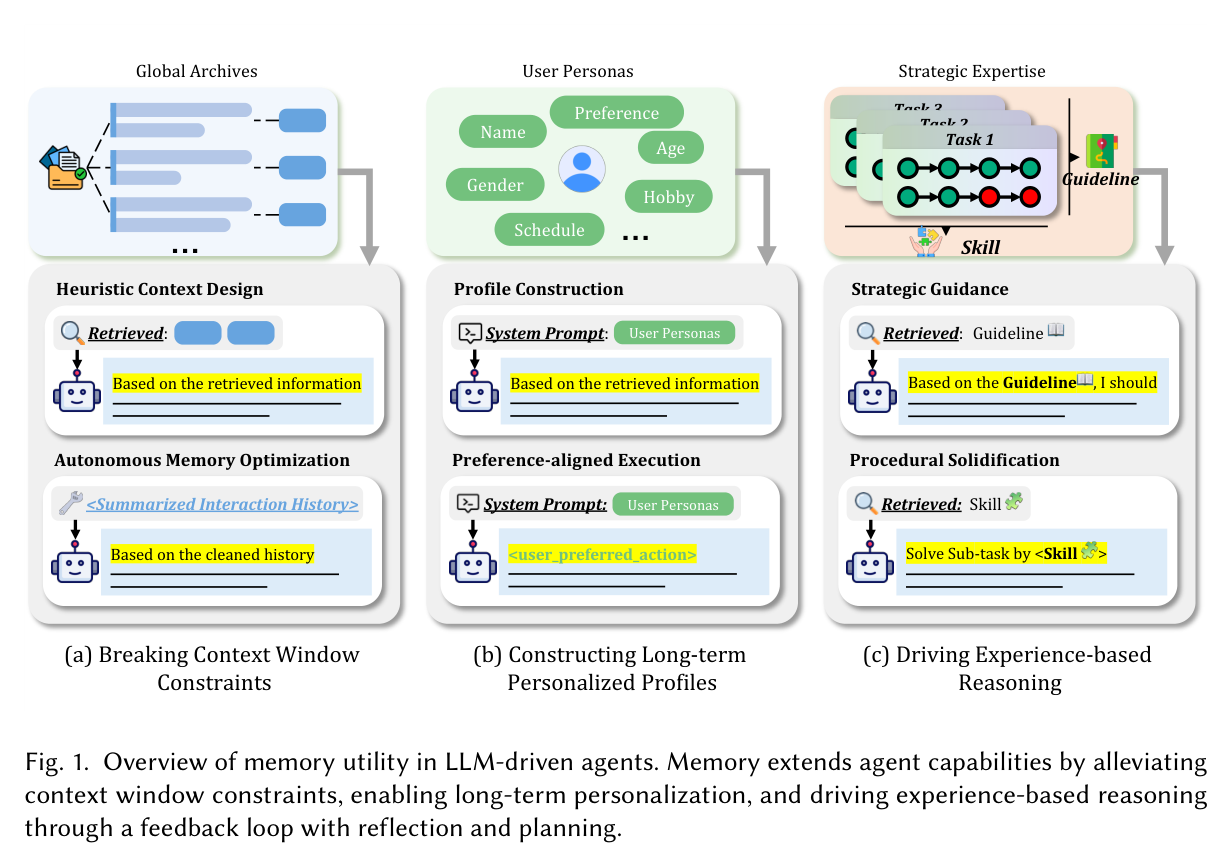
Paper's Figure 1, verbatim (caption: "Overview of memory utility in LLM-driven agents. Memory extends agent capabilities by alleviating context window constraints, enabling long-term personalization, and driving experience-based reasoning through a feedback loop with reflection and planning.").
Figure 1 展示了 agent memory 的三重功能价值:打破上下文窗口约束、构建长期个性化画像、以及驱动经验推理的闭环反馈。这是全文的核心动机图。
Q2 方法 #
跨学科系统综述框架:沿「定义 → 功能 → 分类 → 存储 → 管理 → 评测 → 安全 → 未来」八维度递进,将认知神经科学的记忆机制映射为 agent 系统设计原则。
核心贡献是双维分类体系:
核心技术壁垒:将认知神经科学的 hippocampal–neocortical coordination(海马体–新皮层协调)机制系统对应为 agent 的 context window(快速编码)+ memory bank(长期巩固)双存储架构,以及 extraction → updating → retrieval → utilization 的闭环管理。这一跨学科映射需要同时具备神经科学和系统设计的深度理解。
Q3 结果 #
§3 架构 / 方法图 #
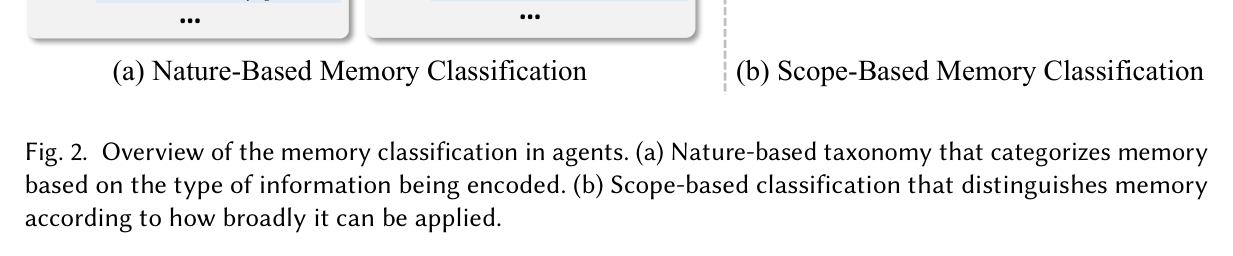
Paper's Figure 2, verbatim (caption: "Overview of the memory classification in agents. (a) Nature-based taxonomy that categorizes memory based on the type of information being encoded. (b) Scope-based classification that distinguishes memory according to how broadly it can be applied.").
Figure 2 是全文的分类学核心:左侧 nature-based 维度区分 episodic("how to do things")与 semantic("what things are")记忆;右侧 scope-based 维度区分 inside-trail(单轨迹临时,结束即清除)与 cross-trail(跨轨迹泛化,持久化)记忆。这一 2×2 矩阵为后续存储和管理讨论提供了统一框架。
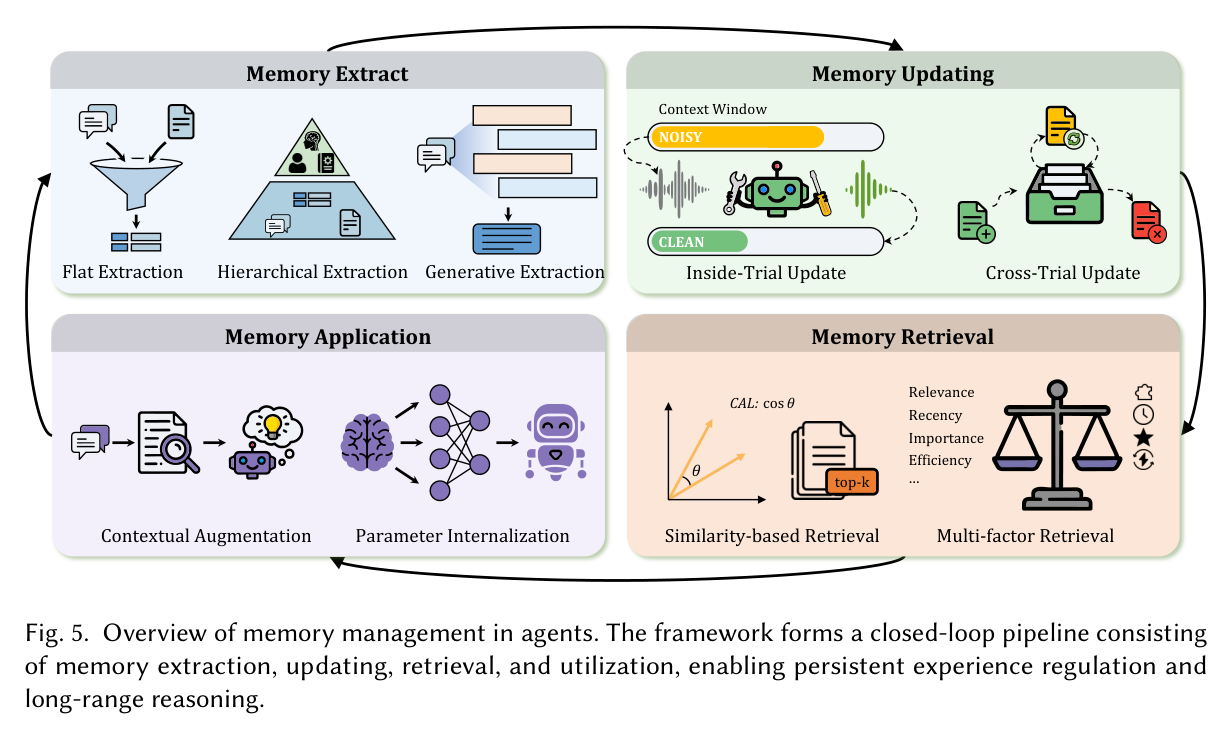
Paper's Figure 5, verbatim (caption: "Overview of memory management in agents. The framework forms a closed-loop pipeline consisting of memory extraction, updating, retrieval, and utilization, enabling persistent experience regulation and long-range reasoning.").
Figure 5 展示 agent 记忆管理的完整闭环:extraction(三种范式:flat / hierarchical / generative)→ updating(inside-trial 动态刷新 + cross-trial 外部知识库迭代)→ retrieval(similarity-based + multi-factor)→ utilization(contextual augmentation + parameter internalization)。这是综述的方法论主干。
Agent 记忆系统分层架构 #
| 层级 | 对应认知机制 | Agent 实现 | 时间尺度 |
|---|---|---|---|
| Working Memory | 短期记忆(前额叶) | Context window + KV cache | 单次推理 |
| Episodic Buffer | 海马体快速编码 | Inside-trail memory(轨迹日志) | 单 episode |
| Long-term Store | 新皮层巩固 | Cross-trail memory bank | 跨 session |
| Parametric Memory | 突触权重 | Model weights(预训练知识) | 永久(冻结) |
§4 作者证明 #
无形式化作者证明 — 仅实证
本文为综述性质,不包含原创数学模型或定理证明。无编号方程。
可量化但未被形式化的指标 #
| 指标 | 描述 | 潜在形式化路径 |
|---|---|---|
| Memory capacity bound | Agent 可有效利用的记忆条目数上限 | 可借鉴 working memory 4-9 items 约束建模 |
| Retrieval precision vs recall | 多因子检索的 trade-off 曲面 | 可用 information retrieval 理论量化 |
| Forgetting curve decay rate | Ebbinghaus 曲线参数化的遗忘速率 | $R = e^{-t/S}$ 但 agent 版本缺乏标定 |
| Memory update convergence | Cross-trial memory 迭代是否收敛 | 可类比 online learning regret bound |
| Attack success rate | Poisoning 攻击的 query-only 成功率 | 可用 adversarial robustness 框架量化 |
Agent-specific 验证 #
§5 实验与数据 #
本文为综述,无原创实验。以下从论文的 benchmark 梳理和跨学科对比中提取关键数据。
认知神经科学基础 #
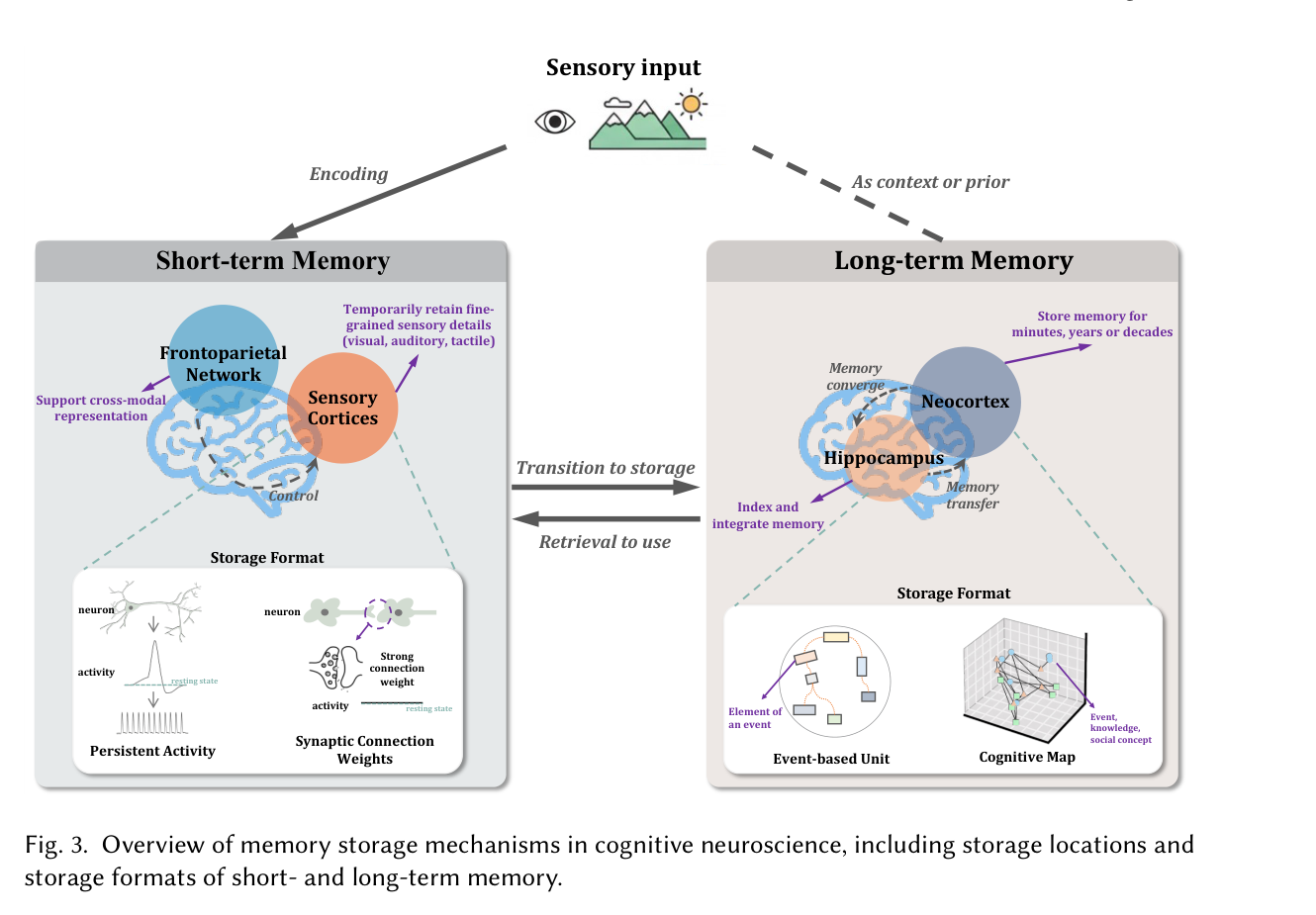
Paper's Figure 3, verbatim (caption: "Overview of memory storage mechanisms in cognitive neuroscience, including storage locations and storage formats of short- and long-term memory.").
Figure 3 展示了短期记忆(持续活动 vs 突触权重两种格式)和长期记忆(事件单元 vs 认知地图两种格式)的存储机制,以及海马体–新皮层的协调关系。这为理解 agent 记忆设计的生物学灵感提供了具象参照。
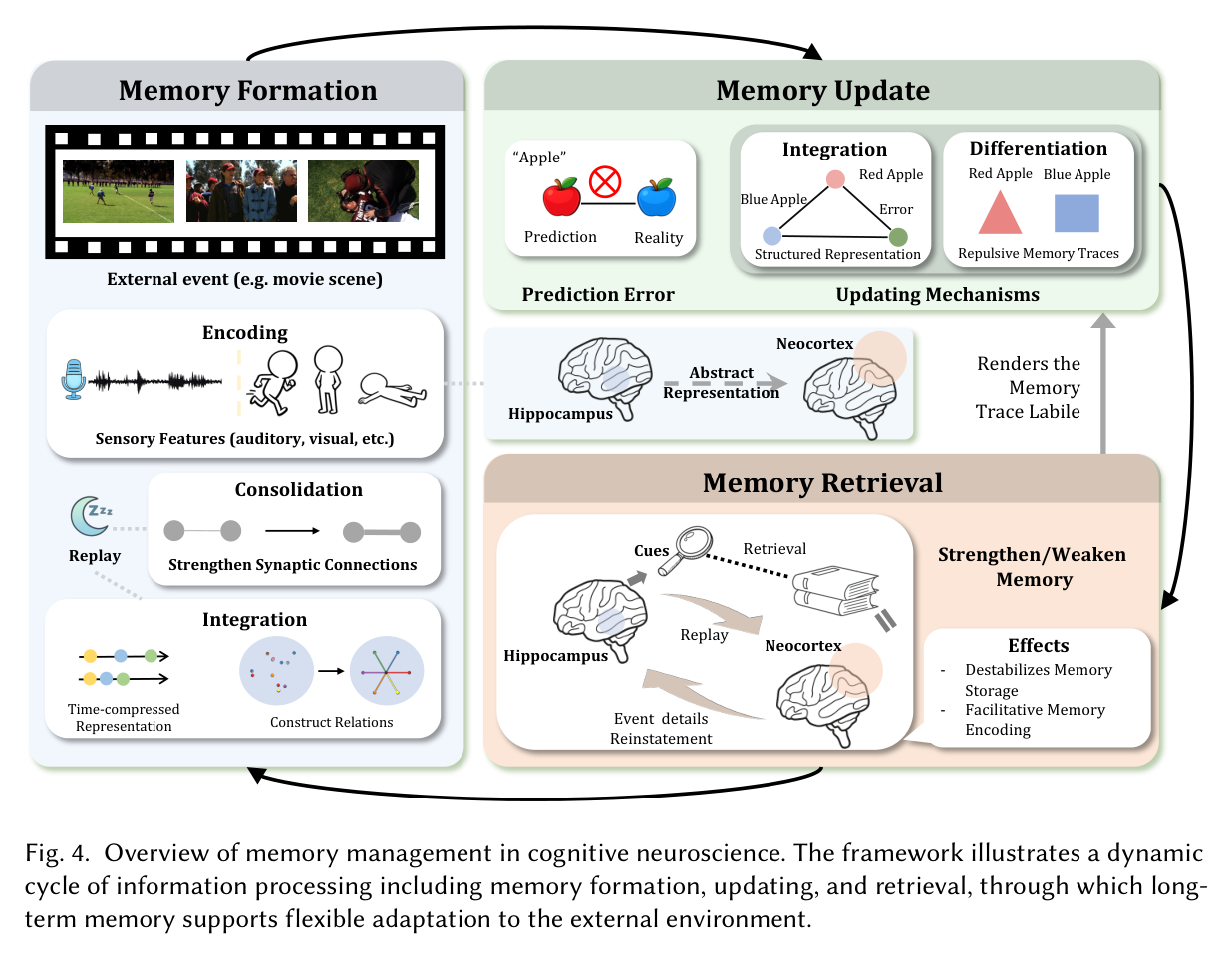
Paper's Figure 4, verbatim (caption: "Overview of memory management in cognitive neuroscience. The framework illustrates a dynamic cycle of information processing including memory formation, updating, and retrieval, through which long-term memory supports flexible adaptation to the external environment.").
Figure 4 阐释了生物记忆的完整管理循环:编码(Hebb 原则 + LTP/LTD)→ 巩固(离线重播 + 海马–新皮层同步)→ 整合(时间压缩 + 跨事件交联)→ 更新(预测误差驱动)→ 检索(模式完成 + 重巩固)。Agent 系统中的 extraction → updating → retrieval → utilization 直接对应这一循环。
Benchmark 数据汇总 #
| 类别 | 代表基准 | 数据规模 | 核心评测维度 |
|---|---|---|---|
| Semantic-Fidelity | LoCoMo, BABILong, RULER | 500–65K samples | 跨 session 推理、检索准确率 |
| Semantic-Dynamics | MemBench, LongMemEval | 500–65K samples | 过时信息识别与丢弃 |
| Semantic-Evolution | LifelongAgentBench, StreamBench | 1.4K–9.7K samples | 错误模式抽象、新场景迁移 |
| Episodic-Web | WebArena, WebChoreArena | 532–812 tasks | 动态网页导航与交互 |
| Episodic-Tool | ToolBench, GAIA | 466–143K calls | 工具 schema 检索与多模态上下文 |
| Episodic-Environment | ScienceWorld, BabyAI | 7.2K–100K+ | 状态追踪与样本效率 |
存储格式对比 #
| 格式 | 代表方法 | 优势 | 劣势 |
|---|---|---|---|
| Text | MemGPT, Playbook Memory | 可解释、灵活 | 冗余大、brevity bias |
| Graph | 三层图 (Zhang et al.)、知识图谱 | 结构化推理、关系显式 | 构建成本高、图遍历延迟 |
| Parameters | 模仿学习、RL 内化 | 推理零延迟 | 灾难性遗忘、不可解释 |
| Latent Representation | MemoryLLM, M+ | 高效压缩、端到端可训 | 语义对齐困难、调试不透明 |
§6 论证链 #
| Step | 论点 | 支撑 | 结论流向 |
|---|---|---|---|
| 1 | 人类记忆不是被动存储而是动态认知过程 | 认知神经科学文献:海马体编码–巩固–检索循环;重巩固理论证明检索本身改变记忆痕迹 | → Step 2: agent 应当模仿这种动态性 |
| 2 | 现有 agent memory 未能汲取人类记忆机制精髓 | 现有综述(54; 324; 399; 216; 332)局限于单一学科视角;RAG 缺乏交互反馈 | → Step 3: 需要跨学科统一框架 |
| 3 | 双维分类(nature × scope)为统一框架提供理论基础 | Episodic vs semantic 对应"how"vs"what";inside-trail vs cross-trail 对应短期/长期的功能区分 | → Step 4: 分类驱动存储和管理设计 |
| 4 | 存储格式(text/graph/params/latent)各有适用场景 | Text 可解释但冗余;graph 结构化但高成本;params 快但遗忘;latent 高效但不透明 | → Step 5: 管理机制需在格式间协调 |
| 5 | 闭环管理(extraction→updating→retrieval→utilization)是必要的 | Flat/hierarchical/generative extraction 解决信息进入;similarity+multi-factor retrieval 解决信息提取;contextual augmentation+parameter internalization 解决信息使用 | → Step 6: 系统需要安全保障 |
| 6 | Memory 是关键攻击面,需要多层防御 | Query-only 即可注入恶意记忆(Dong et al.);poisoning 不需要后端权限;extraction 可窃取隐私交互历史 | → 结论: 完整 agent memory 系统必须同时考虑功能与安全 |
§7 实现 cross-reference #
开源仓库:https://github.com/AgentMemory/Huaman-Agent-Memory
仓库包含论文的分类体系可视化和引用文献整理。作为综述论文,无原创算法实现。
关键实现细节 #
LLM backbone 要求 #
生产就绪度 #
[实现未公开] — 论文本身为综述,无完整系统实现供 cross-reference。仓库仅含文献整理。