Sutradhara: An Intelligent Orchestrator-Engine Co-design for Tool-based Agentic Inference
Sutradhara: An Intelligent Orchestrator-Engine Co-design for Tool-based Agentic Inference #
- Paper ID: 2601.12967
- Authors: Anish Biswas, Kanishk Goel, Jayashree Mohan, Alind Khare, Anjaly Parayil, Ramachandran Ramjee, Chetan Bansal
- Affiliations: Microsoft Research, M365 Research
- Published: 2026-01-19
- Categories: cs.DC
- URL: https://arxiv.org/abs/2601.12967
Phase 2: 综合分析 #
2a. 核心三问 #
Q1: 这篇论文试图解决什么核心痛点/问题?
Agentic LLM 应用(即 LLM 通过迭代式 tool 调用完成复杂任务)正在成为生产环境中部署 LLM 的主导范式。然而,现有系统存在三大关键瓶颈:
- Tool 执行延迟主导尾部 FTR(First Token Rendered):tool 调用占据 FTR 延迟的 30-80%,远非传统认知中"轻量 I/O 操作";
- 顺序编排浪费并行性:当前系统在 LLM decode → tool 执行 → 下一次 prefill 之间强制串行,60-80% 的下一轮 prefill 内容实际上不依赖 tool 输出;
- KV Cache 抖动(thrashing)破坏复用:workload-agnostic 的 LRU 驱逐策略在多个 agentic 请求并发时导致级联驱逐,摧毁大量可复用的 KV cache。
- Prompt Splitting + Tool 执行重叠:将 iteration $i+1$ 的 prompt 分为 tool-independent 和 tool-dependent 两部分。当 iteration $i$ 的 tool 在执行时,立即开始 prefill tool-independent 部分(
submit_partial_prefill()),tool 结果返回后通过extend_prefill()补全; - Streaming Tool Dispatch:通过
register_streaming_callback()实现 token 级回调,利用流式 JSON parser 在 decode 过程中识别完整的 tool call JSON 对象并立即分发执行,而非等待完整 decode 输出; - Workload-Aware KV Cache 管理:通过
tag_kv_blocks()和set_reuse_priority()给 KV 块打语义标签(SYSTEM_PROMPT / USER_QUERY / TOOL_OUTPUT / RESPONSE / PARTIAL_PREFILL),实现优先级驱逐策略,结合请求感知调度(按 agentic 请求到达时间排优先级)。 - 中位 FTR 延迟降低 15%,P99 FTR 降低 12.3%
- 端到端延迟降低 10%
- 无吞吐量损失
- Ablation 显示:Prompt Splitting 贡献 7.57% FTR 改进,Streaming Dispatch 额外贡献 4.2%
- 实现仅需 3500 行 Python 代码,基于 vLLM v0.11.0,无需修改模型架构或推理 kernel
- Orchestrator 知道:迭代边界、prompt 组成、tool 依赖关系、哪些 prompt 片段依赖 tool 输出
- LLM Engine 知道:调度、batching、KV cache 管理
- 两者互不通信——orchestrator 发送完整 prompt 等待完整回复,engine 把每次 LLM 调用视为独立请求
- 无法重叠:engine 不知道 prompt 的哪部分可以提前 prefill
- 无法提前分发 tool:engine 的 decode 输出只有完全结束后才到达 orchestrator
- 无法智能驱逐:engine 不知道哪些 KV block 即将被同一 agentic 请求的下一个 iteration 复用
- Pin partial prefill 产生的 KV blocks 防止被驱逐
- 在 extend 到达时正确 splice tool output 到已缓存的上下文中
- 处理 tool 执行失败时的资源释放
- Tool-independent prompt 比例假设:论文声称 50-80% 的 prompt 是 tool-independent,但这基于特定 orchestrator 的 prompt template 设计。不同 agentic 框架的 prompt 组织方式可能有很大差异;
- Tool 输出插入位置假设:假设 tool 输出总是在 prompt 的固定位置插入。如果 orchestrator 根据 tool 结果动态重组 prompt 结构(如改变 system prompt),则 partial prefill 的 KV cache 可能完全无用;
- Proportional tool latency scaling:用 LLM-to-tool 时间比例来模拟 tool 延迟,假设 tool 延迟与 LLM 延迟成比例——但实际 tool 延迟取决于外部服务状态,与 LLM 计算无关。
- 强制绑定 vLLM 架构:5 个新 API 深度嵌入 vLLM v1 scheduler,虽说"可移植到 TensorRT、DeepSpeed",但实际需要对目标 engine 的调度器做大量改动
- 强制绑定 JSON 格式 tool call:streaming dispatch 依赖 tool call 是结构化 JSON,如果 LLM 使用自然语言或其他格式输出 tool 调用,则无法工作
- 强制绑定 prompt template:partial prefill 需要 orchestrator 精确知道 prompt 的 split point,与 prompt template 紧密耦合
- 对 vLLM 的影响:基于 vLLM v0.11.0 实现,如果被 upstream 采纳,将为 vLLM 增加 agentic workload 原生支持能力
- 对 agentic 框架的影响:LangChain、AutoGen 等框架可以通过实现 co-design API 来获得延迟优化,但需要暴露 prompt structure 信息
- 对 KV cache 研究的影响:语义标签驱逐策略(semantic tagging + priority eviction)为 workload-aware cache management 开辟新方向
- 潜在限制:co-design 方案增加了 orchestrator-engine 的耦合度,可能与 disaggregated serving(P-D 分离)趋势产生张力
- Workload-Aware 驱逐优先级链:
- Trace 特征:中位 agentic 请求有 2 次 LLM 迭代(1 intermediate + 1 final),尾部最高 7 次;每次迭代中位 2 个 tool call,最高 20 个;中位 prompt 长度 ~20K tokens。
- Intermediate vs Final iteration 特征差异:intermediate iteration 的 decode token 数是 final 的 1/5,因此 intermediate iteration 是 prefill-bound,final iteration 是 decode-bound。
- 实现细节:基于 vLLM v0.11.0 的 v1 scheduler,使用 asyncio 事件驱动 orchestrator,PD colocation + chunk size 256。3500 行 Python 代码。
- Tool 执行占 FTR 延迟的 30-80%(尾部),变异系数超过 100%,使基于预测的优化方案不可行
- 50-80% 的下一轮 prompt 不依赖 tool 输出,为 prefill-tool overlap 提供了天然的并行化机会
- LRU KV cache 驱逐在 agentic 并发场景下导致级联 thrashing,语义优先级驱逐可有效缓解
- Prompt Splitting 贡献 7.57% FTR 改进,Streaming Dispatch 额外贡献 4.2%
- Co-design 方案仅需 3500 行代码改动,不修改模型架构或推理 kernel
- 仅在合成 trace(非真实生产 trace)上评估,虽声称与生产 workload 特征一致但无法直接验证
- 评估规模有限:单 A100 GPU,60 请求子集,仅 2 个模型(14B 和 12B 级别)
- Tool 延迟通过 proportional scaling 模拟,非真实 tool 执行
- Prompt splitting 效果取决于 prompt template 设计,不同 orchestrator 框架可能有不同的 tool-independent 比例
- 未评估 disaggregated PD 架构下的适用性
- 10-15% 的改进幅度在高 QPS 下会缩小(被 engine 排队时间主导)
- Primary goal: Serving — 优化 agentic LLM 推理的用户感知延迟(FTR)
- Scale: 单节点单 GPU(A100-80GB)
- Online/Offline: Online — 延迟敏感型
- Target workload: Tool-based agentic LLM inference(multi-iteration, multi-tool-call)
- KV Cache in HBM: 每次 iteration 的 ~20K token prompt 产生大量 KV cache;多个并发 agentic 请求的 KV cache 竞争 HBM 容量,是 thrashing 的根源。频率:每次 LLM 调用,阻塞式。
- Orchestrator ↔ Engine 通信: token-level streaming callback 需要 CPU-GPU 间的频繁小数据传输。频率:每个 decode token,可与计算重叠。
- Tool Network I/O: 外部 API 调用的网络延迟是不可压缩的瓶颈,变异系数 > 100%。频率:每次 tool 调用。
- 静态 DAG 不可行证明:iteration $i$ 的 decode 输出决定 iteration $i+1$ 的 tool 调用和 prompt 结构。即 $\text{DAG}_{i+1} = f(\text{decode}_i)$,不可预知。
- Tool 延迟预测不可行证明:Figure 4(b) 显示 top 7 tools 的延迟 CV > 100%,意味着标准差大于均值。即使使用历史分布预测,置信区间宽到无实用价值。
- Partial execution 不可行证明:如 web search tool,参数
{"query": "..."}中 query 必须完整才能执行。无法用半个 query 开始搜索。 - 在 continuous batching 循环中维护一个"半完成"请求状态(既不是 running 也不是 waiting)
- Pin 对应的 KV blocks 防止在 memory pressure 下被驱逐
- 处理 extend 请求到达时的上下文拼接——需要精确对齐 token 位置
- 超时/失败时的 graceful cleanup
- 绑定 prompt template 结构:orchestrator 必须精确知道 split point,与 prompt engineering 紧密耦合。如果 prompt format 变化,split logic 需要同步更新。
- 绑定 JSON tool call format:streaming dispatch 的 JSON parser 假设 tool calls 是标准 JSON array of objects。如果模型使用 XML、YAML 或自然语言格式,需要重写 parser。
- 绑定 PD colocation:evaluation 使用 PD colocation(prefill 和 decode 在同一 GPU)。在 disaggregated P-D serving(如 DistServe/Splitwise)架构下,partial prefill 的 KV cache 需要跨 GPU 传输,延迟特征完全不同。
- Batch formation: Continuous batching (inherited from vLLM), chunked prefill with chunk size 256
- Memory management: PagedAttention (inherited from vLLM) + semantic priority eviction
- GPU utilization: Partial prefill 利用 tool 等待期间的 GPU idle time
- Multi-tenancy: 通过 agentic request ID 区分不同请求,但无 SLO 隔离
- Priority scheduling: 按 agentic 请求到达时间排序,earlier = higher priority
- Baselines: (1) Standard vLLM (FCFS scheduling, LRU eviction) (2) vLLM + request-aware scheduling
- Fairness: 公平——相同硬件(A100-80GB)、相同模型(Qwen3-14B/Gemma-12B)、相同 trace
- Workload: 从 6000 请求的合成 trace 中抽取 60 请求,Poisson 到达
- Scale limitation: 仅单 GPU,60 请求——统计显著性有限
- Baseline 可能赢的场景: 高 QPS 时所有系统趋同(被排队时间主导)
- API compatibility: Custom 5-API extension on vLLM; 不兼容 OpenAI API(需要 orchestrator 显式调用 co-design API)
- Model support: 任何 vLLM 支持的模型
- Deployment: 需要 co-design orchestrator + 修改版 vLLM
- Configuration complexity: 中等——需要配置 prompt split point、KV tag policy、scheduling priority
- Open source: 论文未提及代码开源计划
- Production: 分析基于 Microsoft 内部生产平台的合成 workload
- Adoption barrier: 需要同时修改 orchestrator 和 engine,不是 drop-in replacement
- Downstream influence:
- vLLM 社区可能会采纳 semantic KV tagging 的概念
- Agentic framework(LangChain、AutoGen)可能会增加 engine hint API
- Request-aware scheduling 已是相对成熟的概念,可能被更快采纳
- Industry trend alignment: co-design 思想与近期 serving 系统"打破黑箱"的趋势一致(如 SGLang 的 RadixAttention 也是 engine 感知 prompt structure)
这三大问题的根源是架构性设计缺陷:orchestrator 和 LLM engine 作为解耦的黑箱运行,通过不透明的 request-response 接口通信,无法实现跨层优化。
Q2: 作者提出了什么新的"杀手锏"方法/架构?
提出 Sutradhara,一个 orchestrator-engine 协同设计(co-design)的 agentic 推理系统,通过 5 个新 API 实现 orchestrator 与 LLM engine 之间的语义信息传递:
Q3: 最终效果/结论如何?
在 A100-80GB GPU 上使用 Qwen3-14B 和 Gemma-12B 评估:
2b. 逻辑故事还原(约束推导型) #
时代定位 #
2024-2026 年,LLM 从单轮 query-response 范式快速演进到 agentic 架构,通过迭代式 tool 调用(ReAct、AutoGen、LangChain 等)完成复杂任务。然而,推理系统的优化一直聚焦在单次 LLM 调用的 TTFT 和 per-token 延迟上(PagedAttention、continuous batching、chunked prefill 等),对 agentic workload 的多迭代、多 tool 调用结构缺乏系统性认知。本文是首个大规模实证分析 agentic 推理性能的工作,揭示了 orchestrator-engine 解耦这一架构性设计缺陷。
背景:为何现有方法无法解决? #
现有系统的核心问题是层级隔离:
这导致三个 "不可能":
约束推导:替代方案为何失败? #
| 替代方案 | 为何不可行 |
|---|---|
| 静态 DAG 编排 (Parrot, Murakkab) | Tool-based agentic 应用的 DAG 结构事先未知,工具调用取决于 LLM 实时推理结果 |
| 非透视调度 (Autellix) | 仅优化吞吐量,不解决 intra-request 的 tool 延迟问题 |
| 预测 tool 执行时间 (Continuum) | tool 执行时间变异系数超过 100%(如 web search),使预测变得不切实际 |
| Partial tool execution (Conveyor) | 生产环境中多数 tool 无法在参数不完整时执行 |
| 纯 KV cache 共享 (KVFlow, DroidSpeak) | 未考虑 tool 调用对延迟的显著贡献(30-80% FTR),仅优化 cache 层面 |
破局:Aha Moment #
关键洞察是 prompt 的 tool-independent 部分占 50-80%——system instructions、conversation history、templates 不依赖 tool 输出。这意味着 orchestrator 可以在 tool 执行期间就开始下一轮的 prefill 计算,只要 engine 提供 partial prefill + extend 的接口。第二个洞察是 LLM 生成 tool call 是流式 JSON,一个完整的 tool call object(到 } 闭合时)就可以立即分发,无需等待整个 JSON array。
核心技术壁垒 #
Partial Prefill 的 KV Cache 生命周期管理是最难复现的技术。当 partial prefill 提交后,tool 可能执行数百毫秒甚至数秒。在此期间,engine 必须:
这需要 engine scheduler 深度修改以支持 "半完成" 状态的请求,且必须在 continuous batching 框架下正确管理 GPU 内存。
质疑假设 #
设计绑定批判 #
拆解:从输入到输出 #
[User Request] → Orchestrator
    → Iteration 1:
        → 构建完整 prompt (system + user query)
        → submit to engine → Prefill P1 → Decode D1 (生成 tool calls JSON)
        → register_streaming_callback: 流式 JSON parser
            → 第一个 tool call JSON object 闭合 → 立即分发 Tool T1_1
            → 第二个 tool call JSON object 闭合 → 立即分发 Tool T1_2
            (与 decode 重叠)
    → Iteration 2:
        → Orchestrator 识别 split point
        → submit_partial_prefill(tool-independent prefix P2a)
            (与 T1_1, T1_2 执行并行)
        → Tools 完成 → extend_prefill(tool-dependent suffix P2b)
        → Decode D2 → 如果是 final iteration → 输出给用户
        → 如果还有 tool calls → 继续迭代
[Final Response] ← User
实践上下文 #
本文直接面向大规模 LLM agentic 应用的生产部署,如 Microsoft 的企业 AI 助手(M365 Copilot 类产品),workload 包含 document retrieval、summarization、web search 等 tool。Sutradhara 解决的是用户感知延迟(FTR)问题,在企业用户对响应速度敏感的场景中有直接价值。
生态影响追踪 #
2c. 关键图表分析 #
Figure 1: Sutradhara 整体效果预览 #

展示内容:Sutradhara 通过系统性地解锁 intra-request 并行性来降低 FTR 和 e2e 延迟。展示了 (a) 并行执行原理图 (b) 延迟增益 (c) FTR breakdown。
重要性:这是论文的"灵魂图",一图展示了核心思想——将 agentic 请求中原本串行的 prefill/decode/tool 执行三阶段重叠起来,在两个随机请求上实现 18-35% 的 FTR 降低。
Figure 4: Tool 调用执行动态 #
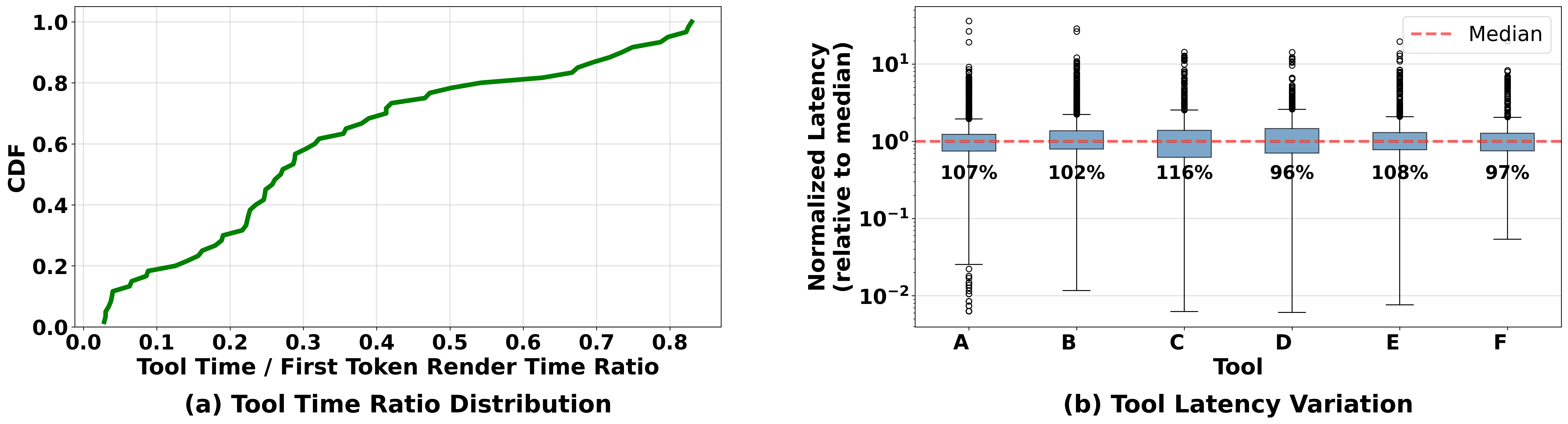
展示内容:(a) Tool 执行时间占 FTR 延迟比例的 CDF——中位 27%,P90 68%,P99 83%。(b) 7 种 tool 的归一化延迟分布,变异系数超过 100%。
重要性:这是论文最核心的实证发现,直接挑战了"tool call 是轻量 I/O"的传统认知,为 orchestrator-engine co-design 提供了动机。
Figure 5: Prompt 中 tool-independent 内容的比例 #
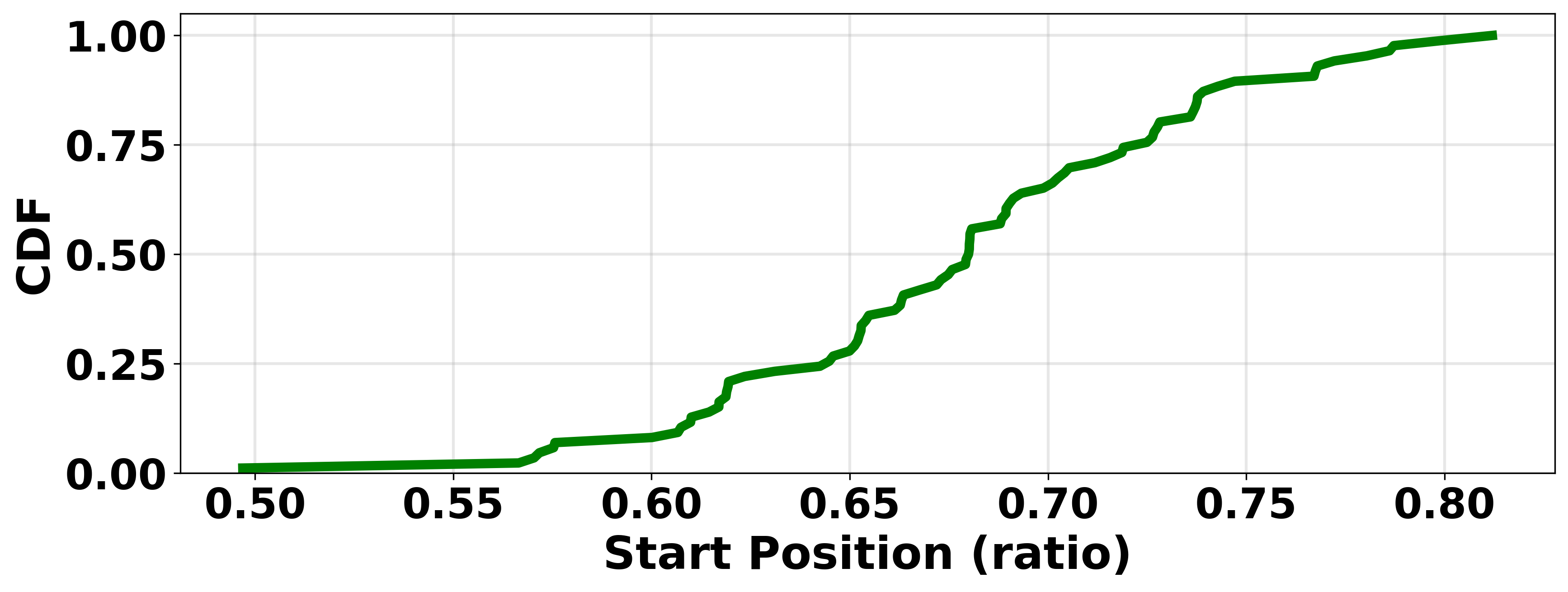
展示内容:跨迭代的 prompt 中 tool-independent vs tool-dependent 内容的比例分析。50-80% 的 iteration $i+1$ prompt 在 iteration $i$ decode 完成时就已可用。
重要性:直接证明了 prompt splitting 的可行性——大部分 prefill 计算可以与 tool 执行并行。
Figure 6: KV Cache Thrashing 示意 #
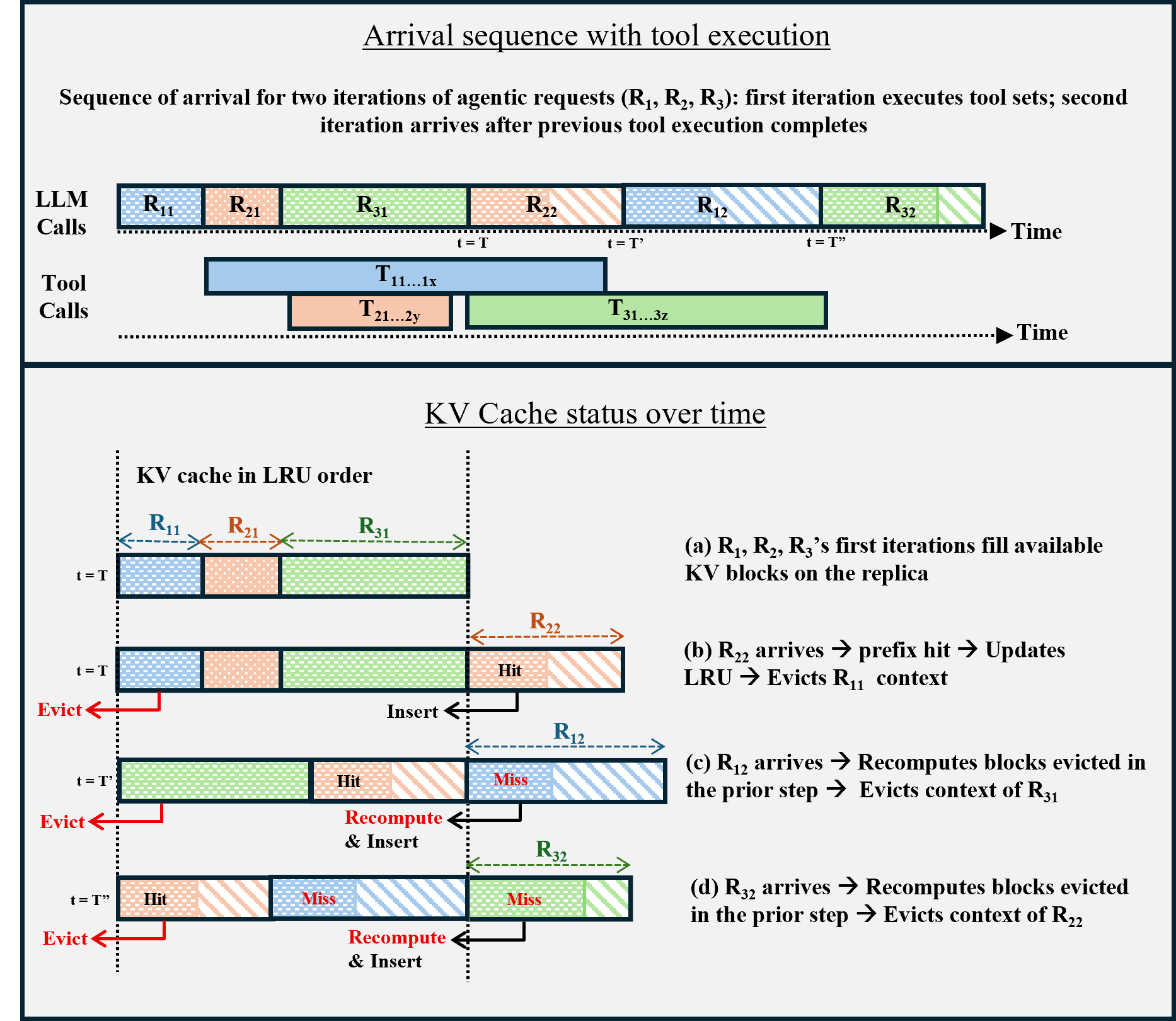
展示内容:三个并发 agentic 请求 $R_1, R_2, R_3$ 在 LRU 驱逐策略下的级联驱逐过程。$R_2$ 的第二次迭代导致 $R_1$ 被驱逐,$R_1$ 的第二次迭代又导致 $R_3$ 被驱逐,形成恶性循环。
重要性:直观展示了 workload-agnostic LRU 在 agentic workload 下的根本缺陷。
Figure 7: Sutradhara 并行执行设计 #
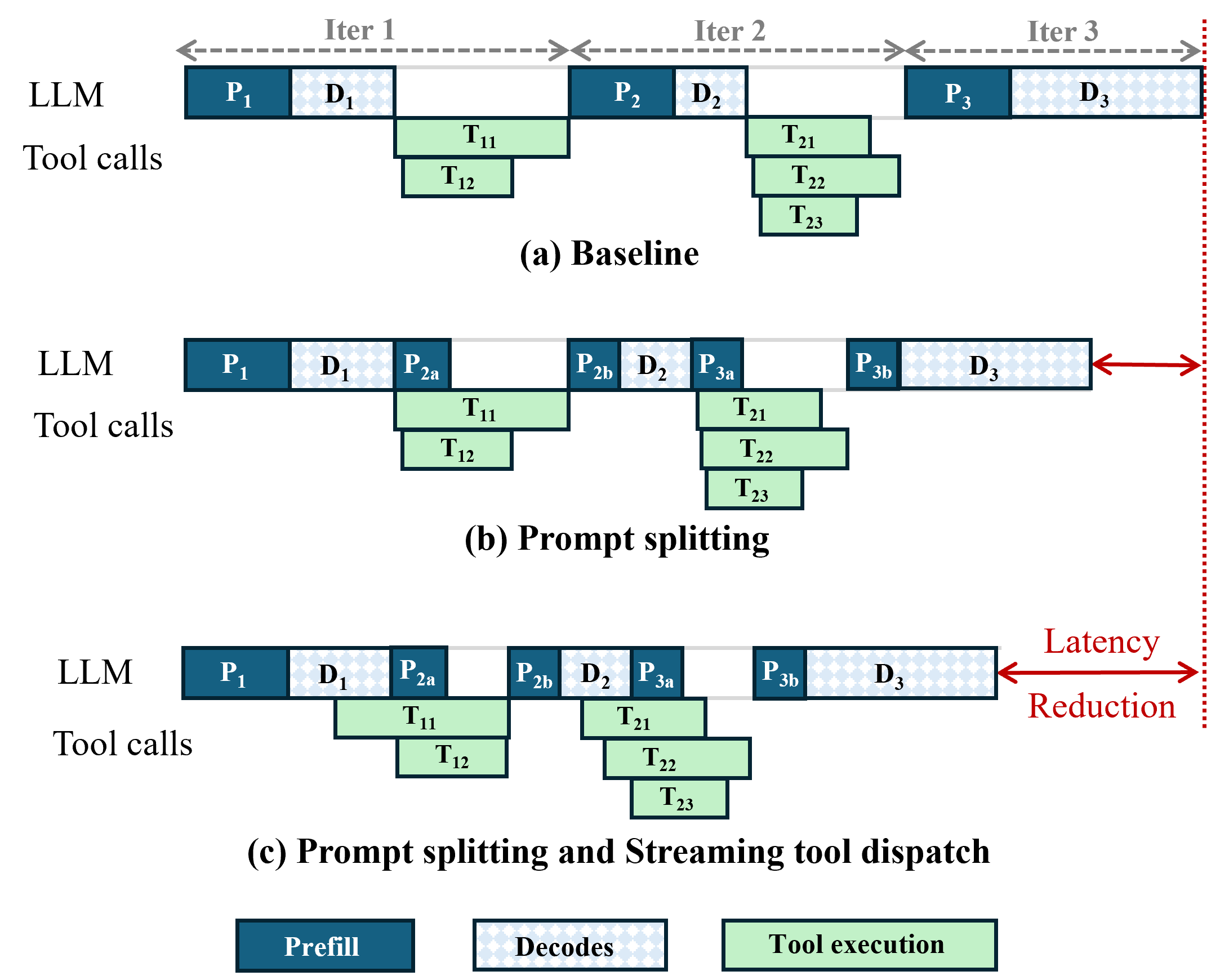
展示内容:(a) Baseline 串行执行 (b) Prompt splitting 实现 prefill-tool overlap (c) Streaming tool dispatch 实现 decode-tool overlap。三步递进展示完整优化方案。
重要性:论文的核心设计图,展示了三种优化如何逐步叠加消除串行瓶颈。
Table 1: Co-design API #
| API Call | Purpose | Enables Optimization |
|---|---|---|
submit_partial_prefill() | 提交 tool-independent prompt 片段 | 并行执行:engine 在 tool 执行期间开始 prefill |
extend_prefill() | 追加 tool 输出到已 pin 的 partial prefill 上下文 | 并行执行:tool 结果到达后无需重新计算前缀 |
register_streaming_callback() | 逐 token 接收 partial decode 输出 | Streaming dispatch:orchestrator 在 decode 进行时就解析并分发 tool |
tag_kv_blocks() | 给 cached KV blocks 打语义标签 | Cache 管理:启用 workload-aware 驱逐策略 |
set_reuse_priority() | 设置 KV block 优先级用于 pinning | Cache 管理:防止即将被复用的上下文被驱逐 |
关键要点:5 个 API 构成了 orchestrator-engine 之间的"薄接口层",最小化侵入性的同时实现三大优化。
Table 2: Ablation 结果 #
| Technique | FTR (s) | E2E (s) | FTR % | E2E % |
|---|---|---|---|---|
| KV (baseline) | 51.5 | 84.2 | - | - |
| KV + PS | 47.6 | 80.38 | 7.57% | 4.54% |
| KV + PS + DS | 45.44 | 77.99 | 11.77% | 7.37% |
关键要点:Prompt Splitting 是主要贡献者(7.57% FTR),Streaming Dispatch 额外贡献 4.2%。E2E 改进小于 FTR(final iteration 的 decode 无法被加速)。
2d. 技术细节补充与一句话总结 #
技术细节补充 #
$$\text{RESPONSE} \longrightarrow \text{TOOL\_OUTPUT} \longrightarrow \text{USER\_QUERY} \longrightarrow \text{SYSTEM\_PROMPT} \longrightarrow \text{PARTIAL\_PREFILL}$$
(从先驱逐到后驱逐)
一句话总结 #
Sutradhara 通过打破 orchestrator-engine 的黑箱隔离,在 agentic 推理中实现 prompt 分裂并行、streaming tool 分发和语义 KV cache 管理三大优化,将 FTR 延迟降低 15%。
2e. 结构化提取 #
Core Contribution: Sutradhara 提出 orchestrator-engine co-design 架构,通过 5 个 thin API 实现 prompt splitting(prefill-tool overlap)、streaming tool dispatch(decode-tool overlap)和 workload-aware KV cache management,在不修改模型架构的前提下将 agentic 推理的 FTR 延迟降低 15%。
Summary: Agentic LLM 应用通过迭代式 tool 调用完成复杂任务,但现有推理系统将 orchestrator 和 LLM engine 视为解耦的黑箱,导致三大性能瓶颈:tool 执行占据 30-80% FTR 延迟、串行编排浪费可利用的并行性、以及 LRU KV cache 驱逐在多请求并发时引发级联 thrashing。
Sutradhara 提出协同设计方案,通过 5 个新 API(submit_partial_prefill, extend_prefill, register_streaming_callback, tag_kv_blocks, set_reuse_priority)使 orchestrator 向 engine 传递语义信息。三大优化包括:(1) 将 prompt 分为 tool-independent 和 tool-dependent 两部分实现 prefill-tool 并行;(2) 通过流式 JSON parser 在 decode 过程中增量分发 tool 调用;(3) 基于语义标签的优先级驱逐策略 + 请求到达时间优先调度。
基于 vLLM v0.11.0 实现(3500 行代码),在 A100-80GB 上使用 Qwen3-14B 和 Gemma-12B 评估,tool-heavy 和 iteration-heavy 两种 trace 下一致性地降低 FTR(10-15%)和 e2e 延迟(6-10%),且不损失吞吐量。
Key Findings:
Limitations:
Phase 3: 分类 #
Primary Category: framework
Secondary Tags: agent, kv-cache, scheduling, serving, latency-optimization
Infrastructure Impact:
| Category | Impact |
|---|---|
| algorithm | N/A — 不涉及算法层面创新 |
| kernel | 无需自定义 kernel;所有优化在 scheduler 和 orchestrator 层面 |
| llm | 模型无关设计,适用于任何 tool-calling LLM(已验证 Qwen3-14B、Gemma-12B) |
| agent | 高影响 — 直接优化 agentic workload 的 FTR 延迟,为 LangChain/AutoGen 等框架提供 co-design 接口范式 |
| cluster | 单 GPU 评估,未涉及分布式场景;co-design API 概念可扩展到多节点 |
| hardware | 仅在 A100 上评估,设计不绑定特定硬件 |
Phase 5: Deep Read — Framework 深度分析 #
1. System Scope #
2. Architecture & Data Flow #
2a. End-to-End Data Flow #
[User Request] → [Orchestrator: Prompt Construction] → [Engine: Prefill] → [Engine: Decode]
                    ↓ prompt tokens (20K median)         ↓ KV cache           ↓ tool call JSON
                    ↓ CPU                                ↓ GPU HBM            ↓ GPU → CPU
                    ↓ ~0ms                               ↓ ~variable          ↓ ~variable

→ [Orchestrator: Streaming JSON Parse] → [Tool Execution Layer: API calls]
   ↓ partial JSON objects                  ↓ external I/O
   ↓ CPU                                  ↓ network/CPU
   ↓ per-token callback                   ↓ ms to seconds (high variance)

→ [Orchestrator: Partial Prefill Submission] → [Engine: Extend Prefill] → [Engine: Decode]
   ↓ tool-independent prompt slice            ↓ KV cache extension        ↓ final response / next tool calls
   ↓ CPU                                     ↓ GPU HBM                   ↓ GPU → CPU → User
| Stage | Input → Output | Location | Latency | Data format & size |
|---|---|---|---|---|
| Prompt Construction | user query + history → token IDs | CPU | ~0ms | List[int], ~20K tokens median |
| Prefill (partial) | tool-independent tokens → KV cache | GPU HBM | variable | [layers, heads, seq, dim] |
| Decode | KV cache → tool call JSON tokens | GPU HBM | variable, ~5x fewer tokens for intermediate | JSON string |
| Tool Execution | tool call spec → tool result | External API/CPU | ms-seconds, CV > 100% | string/structured data |
| Extend Prefill | tool output tokens → KV cache extension | GPU HBM | variable | appended KV blocks |
| Final Decode | KV cache → response tokens | GPU HBM | variable, ~5x more tokens | text stream |
2b. Data Movement Hotspots #
3. Design Space & Constraint Analysis #
3a. Alternative Approaches #
| 替代方案 | 可行性 | 原因 |
|---|---|---|
| 静态 DAG 优化 (Parrot/Murakkab) | ❌ 不可行 | Tool-based agent 的执行图是动态的,取决于 LLM 实时推理 |
| Tool 延迟预测 + 调度 (Continuum) | ❌ 不实用 | Tool 延迟 CV > 100%,无法可靠预测 |
| Tool partial execution (Conveyor) | ❌ 受限 | 大多数生产 tool 需要完整参数才能执行 |
| 纯 orchestrator 优化(不修改 engine) | ⚠️ 部分可行 | 可实现 streaming dispatch,但无法实现 partial prefill 和 cache 管理 |
| 纯 engine 优化(不修改 orchestrator) | ⚠️ 部分可行 | 可改进 cache 策略,但缺乏 prompt structure 信息 |
| Orchestrator-Engine Co-design | ✅ 可行 | 最小化接口暴露同时实现三大优化 |
3b. Constraint Derivation #
3c. Assumption Audit #
| 假设 | 成立条件 | 可能失效场景 |
|---|---|---|
| 50-80% prompt 是 tool-independent | Orchestrator 使用固定 template(system prompt + user query + tool output 拼接) | 如果 orchestrator 根据 tool 结果动态重写 system prompt |
| Tool call 输出为结构化 JSON | LLM 按要求格式输出 | LLM hallucinate 非 JSON 输出、或使用 function calling 以外的格式 |
| Tool 延迟与 LLM 延迟比例稳定 | 模拟环境 | 真实生产环境中 tool 延迟受外部因素影响,与 LLM 无关 |
| 单 GPU 足以处理 workload | 模型 ≤14B 参数 | 更大模型需要多 GPU TP/PP,co-design API 需扩展 |
3d. Core Technical Barrier #
Partial prefill 的状态管理是核心技术壁垒。当 submit_partial_prefill() 提交后,engine 必须:
这不是一个简单的 API 封装,而是对 vLLM v1 scheduler state machine 的深度修改。
3e. Design Binding Critique #
4. Key Innovations #
| Innovation | Mechanism | Benefit | Cost/Tradeoff |
|---|---|---|---|
| Prompt Splitting | 将 prompt 分为 tool-independent/dependent 两部分,提前 prefill 前者 | 7.57% FTR 改进 | 需要 orchestrator 暴露 prompt structure,增加耦合 |
| Streaming Tool Dispatch | Token-level callback + streaming JSON parser,decode 过程中增量分发 tool | 4.2% 额外 FTR 改进 | Per-token callback 开销;JSON parser 需维护 |
| Semantic KV Tagging | 5 种语义标签 + 优先级驱逐 | 消除级联 thrashing | 标签需要 orchestrator 提供,增加 API 复杂度 |
| Request-Aware Scheduling | 按 agentic 请求到达时间排优先级 | 减少 in-flight 请求的等待时间 | 可能增加新请求的排队延迟 |
| 5-API Co-design Interface | Thin API layer between orchestrator and engine | 最小化侵入性的跨层优化 | 增加 orchestrator-engine 耦合 |
5. Scheduling & Resource Management #
6. Target Scenarios #
| Scenario | Workload Pattern | SLO/Goal | Why existing systems fail |
|---|---|---|---|
| Enterprise AI Assistant (M365 Copilot) | Multi-tool, 2-7 iterations, 20K token context | FTR < 数秒 | Sequential orchestration + KV thrashing |
| Tool-heavy workload | High tool fanout (median 2, max 20) per iteration | Min FTR | Tool latency dominates, no overlap |
| Iteration-heavy workload | Deep iteration chains (7+), lower fanout | Min e2e | Sequential pipeline bottleneck |
Primary bottleneck: Scheduling-bound (sequential orchestration + KV thrashing) > Memory-bound (KV cache pressure) > Compute-bound (prefill compute)
7. Performance Evaluation #
7a. Metrics #
| Metric | Definition | Unit | Direction |
|---|---|---|---|
| FTR | 从用户请求到 final response 第一个 token 的时间 | seconds | Lower |
| E2E | 从用户请求到完整 response 生成的时间 | seconds | Lower |
| Median/P99 FTR | FTR 的分位数 | seconds | Lower |
7b. Before-After Comparison #
| Optimization | Metric | Baseline | After | Improvement | Conditions |
|---|---|---|---|---|---|
| Full Sutradhara | Median FTR | 51.5s | ~43.3s | 15.83% | Qwen3-14B, A100-80G, tool-heavy trace |
| Full Sutradhara | P99 FTR | - | - | 12.3% | Same |
| Full Sutradhara | Median E2E | 84.2s | ~73.8s | ~10% | Same |
| KV + PS | Median FTR | 51.5s | 47.6s | 7.57% | Same |
| KV + PS + DS | Median FTR | 51.5s | 45.44s | 11.77% | Same |
| Gemma-12B | Median FTR | - | - | 10.74% | Tool-heavy trace |
| Gemma-12B | Median E2E | - | - | 6.39% | Tool-heavy trace |
| Iteration-heavy | Tail FTR | - | - | 4% | Qwen3-14B |
| Iteration-heavy | E2E | - | - | 8% | Qwen3-14B |
7c. Bottleneck Shift Analysis #
Before: scheduling-bound (sequential orchestration, tool wait blocking next prefill)
→ After PS: still partially scheduling-bound (decode-tool still sequential)
→ After PS+DS: memory-bound (KV cache pressure becomes more visible)
→ After PS+DS+KV: engine capacity-bound (at high QPS, queueing dominates)
残留瓶颈:高 QPS 下所有系统都被 engine 排队时间主导,co-design 优化的边际效益递减。
7d. Baselines & Fairness #
8. API & Usability #
9. Infrastructure Impact #
| Layer | Impact |
|---|---|
| Algorithm | 不直接影响算法,但 prompt splitting 概念可扩展到 speculative decoding 场景 |
| Kernel | 不需要自定义 kernel,所有优化在 Python scheduler 层 |
| LLM | 模型无关,但 tool calling 格式(JSON)需要模型支持 |
| Agent | 核心影响层:为 agentic framework 提供 co-design 接口范式 |
| Ops | 提供 semantic metadata tagging,有潜力扩展为 observability/monitoring 信号 |
10. Comparison Matrix #
| Feature | Sutradhara | vLLM | SGLang | Autellix | Conveyor |
|---|---|---|---|---|---|
| Continuous batching | ✅ (inherited) | ✅ | ✅ | ✅ | ✅ |
| PagedAttention | ✅ (inherited) | ✅ | ✅ | ✅ | ✅ |
| Prefix caching | ✅ (enhanced) | ✅ | ✅ | ✅ | ✅ |
| Agentic workload awareness | ✅ | ❌ | ❌ | partial | partial |
| Prefill-tool overlap | ✅ | ❌ | ❌ | ❌ | ❌ |
| Streaming tool dispatch | ✅ | ❌ | ❌ | ❌ | ❌ |
| Semantic KV eviction | ✅ | ❌ | ❌ | ❌ | ❌ |
| Orchestrator co-design | ✅ | ❌ | ❌ | ❌ | partial |
| Dynamic DAG support | ✅ | N/A | N/A | ❌ (static DAG) | N/A |
| Multi-GPU | ❌ (untested) | ✅ | ✅ | ✅ | ❓ |