AgentSM: Semantic Memory for Agentic Text-to-SQL
AgentSM: Semantic Memory for Agentic Text-to-SQL — L2 #
1. TL;DR #
AgentSM makes a Text-to-SQL agent reuse structured prior exploration traces (built offline from synthetic questions) and merges frequently co-occurring tool calls into composite tools. This cuts trajectory length ~25% and lifts accuracy to a SOTA 44.8% on Spider 2.0 Lite — without a heavy reasoning model.
2. Q1 / Q2 / Q3 #
Q1 — 痛点 (what breaks). Agentic Text-to-SQL scales badly on enterprise schemas (deep nesting, multi-dialect, thousands of columns). Three concrete failures, each grounded in observed agent behavior:
- Repeated exploration: agents re-run near-identical schema-probing on the same DB every query; prior work reports <10–20% of trajectories are distinct.
- Rigid strategy: a single fixed pipeline (e.g. always vector-search) is suboptimal — Fig 2 shows vector search is actually chosen only ~33% of the time.
- Variance: trivial intermediate errors derail reasoning; temperature-0 does not enforce determinism and would kill useful exploration anyway.
The formal objective is to find the trajectory maximizing accuracy: $\tau^{} = \arg\max_{\tau \in \mathcal{T}(q, D, \mathcal{U})} \text{Acc}(\tau)$ — i.e. optimize the whole tool-use + reasoning sequence*, not just the final single-shot SQL.
Q2 — 方法 (the mechanism). Two tightly-coupled ReAct coding agents (planner + schema-linking) sit over a structured semantic memory = a Trajectory Store. Offline, synthetic questions (Algorithm 1) are executed to harvest dense exploration traces; each trace is regex-classified into phases (explore / execute / validate), rewritten into markdown with LLM-generated headers, and stored per-phase. At inference, the store is filtered to the same database then the most semantically similar question's trajectory is loaded (Eqs. 1–3). Separately, composite tools merge tool subsequences that co-occur above a support threshold $\theta$ into one action (e.g. get_ext + get_ddl ⇒ local_exploration).
核心技术壁垒: the insight that *data exploration is reusable across questions on the same DB — and that this reuse can be manufactured offline via synthetic questions rather than waiting for real traffic*. This decouples memory quality from query volume and is what lets a mid-tier model beat reasoning-model systems.
Q3 — 结果 (outcome). 44.8% overall EX on Spider 2.0 Lite (claude-4-sonnet), +14.1 pts over SpiderAgent, >20 pts over a same-framework CodingAgent, and would rank No. 1 on the leaderboard at submission — achieved without Qwen3/o3. Trajectory length drops (median 20→16 steps); the exploration:execution split flips from 65:35 to 44:56. Gold-tables oracle reaches 57.6% (Table 2), exposing schema linking as the dominant remaining bottleneck.
3. 架构 / 方法图 #

Paper's Figure 3 ("An overview of the AgentSM architecture that leverages trajectories in structured semantic memory"). The planner agent owns the reasoning loop and generates/executes SQL in-line (deliberately not delegated to a sub-agent, to avoid context loss and inter-agent latency). It calls the schema-linking agent — a bounded (≈5-step) worker with the vector-search tool — only for deep table probing. The Trajectory Store on the left is populated from raw + synthetic questions, then step-classified and semantically annotated, feeding "Trajectory Reuse" back into the planner. Notice the reuse arrow ("Retrieve most similar question") is what closes the loop: prior exploration is injected as context instead of being re-derived.
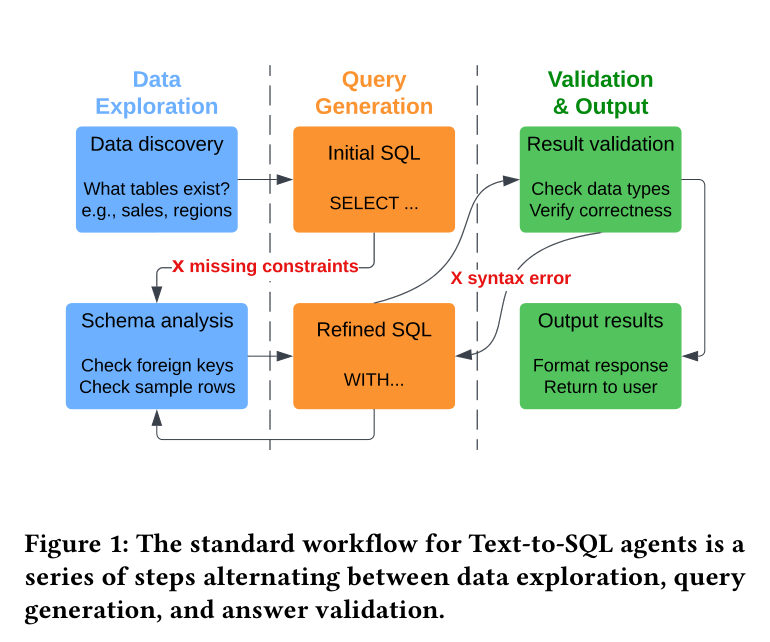
Paper's Figure 1 — the baseline workflow AgentSM optimizes: Data Exploration → Query Generation → Validation & Output, with back-edges on "missing constraints" / "syntax error". This figure is load-bearing for the method because the three phases become the regex step-classification labels; reuse is grounded per-phase (exploration steps generalize across questions, execution steps are DB-specific).
The Mermaid adds the retrieval→reuse control flow that Fig 3's raster crowds together: filter, rank, load, then plan with composite tools.
4. 作者证明 #
无形式化作者证明 — 仅实证. AgentSM has no convergence theorem, variance bound, or loss decomposition; it is an empirical systems/algorithm paper. Its "guarantees" are heuristic constructions with definitional equations rather than proved statements. A desirable formal result would be a bound on exploration-step savings as a function of trajectory-store coverage, or a variance-reduction guarantee from composite-tool determinism — neither is provided.
Notation table:
| Symbol | Meaning |
|---|---|
| $q$, $D$, $\mathcal{U}$ | incoming query, database, tool set |
| $\mathcal{T}(q,D,\mathcal{U})$ | space of executable reasoning trajectories |
| $\tau^{*}$ | accuracy-maximizing trajectory (objective) |
| $Q_{syn}$ | offline synthetic question set (Algorithm 1) |
| $\mathcal{C}$ | same-DB candidate trajectories (Eq. 1) |
| $q^{*}$ | most-similar stored question (Eq. 2) |
| $\text{sim}(\cdot,\cdot)$ | MiniLM-L6-v2 embedding similarity (FAISS) |
| $c=\langle t_1..t_k\rangle$ | composite tool; formed if $\text{freq}\ge\theta$ |
方程物理意义:
- Objective $\tau^{*}=\arg\max_{\tau}\text{Acc}(\tau)$: optimize the sequence, motivating memory + tool composition over single-shot decoding.
- $\mathcal{C} = \{ q' \in Q_{syn} \mid \text{db}(q') = \text{db}(q) \}$ (Eq. 1): exploration only transfers within a schema, so retrieval is DB-scoped.
- $q^{*} = \arg\max_{q' \in \mathcal{C}} \text{sim}(q', q)$ (Eq. 2): semantically similar questions probe the same tables during initial exploration.
- $\tau = \text{traj}(q^{*})$ (Eq. 3): load that trajectory verbatim as reusable context.
- $c = \langle t_1,\ldots,t_k \rangle \ \text{if}\ \text{freq}(t_1,\ldots,t_k) \geq \theta$: merge a frequent, phase-coherent tool subsequence into one action.
Minimum checks (6):
- Objective well-posed? Yes — argmax over a finite (per-run bounded) trajectory space; but $\text{Acc}(\tau)$ is only observable post-execution, so it is optimized greedily/heuristically, never solved exactly.
- Eq. 1 soundness: DB-scoping is safe but can miss cross-DB-transferable generic exploration (e.g. reading a DDL file) — a recall cost the authors accept.
- Eq. 2 single-pick risk: choosing only the top-1 $q^{*}$ is brittle if similarity is noisy; authors flag finer-grained (schema/plan-level) retrieval as future work, admitting top-1 is a heuristic.
- Composite-tool threshold $\theta$: no value disclosed; construction depends on it plus three heuristics (same-phase only, exclude cross-phase tools, cap size). Sensitivity untested.
- Step-classification via regex: claimed comparable accuracy to LLM classification at lower cost — asserted from "a sample," not quantified beyond Table 1's 20-question probe.
- Internal consistency: several headline numbers disagree across sections (see §6) — the formalism is clean but the reported deltas are not fully reconciled.
- Synthetic-question generation prompts (Algorithm 1): https://tinyurl.com/xcey6h33
- Step-classification regex + trajectory-structure generation: https://tinyurl.com/492ymhcn
- Step classification is regex/tool-pattern based, not positional — because agents re-enter the exploration phase mid-trajectory on errors (e.g.
WITH ...⇒ execution, file-read ⇒ exploration). LLM classification was tried and dropped for cost/latency at "comparable accuracy." - Per-phase segmented storage means the agent selectively loads only the phase-relevant trajectory segment (e.g. exploration segment during exploration), which is what avoids the lost-in-the-middle penalty of dumping a whole raw trace.
5. 实验与数据 #
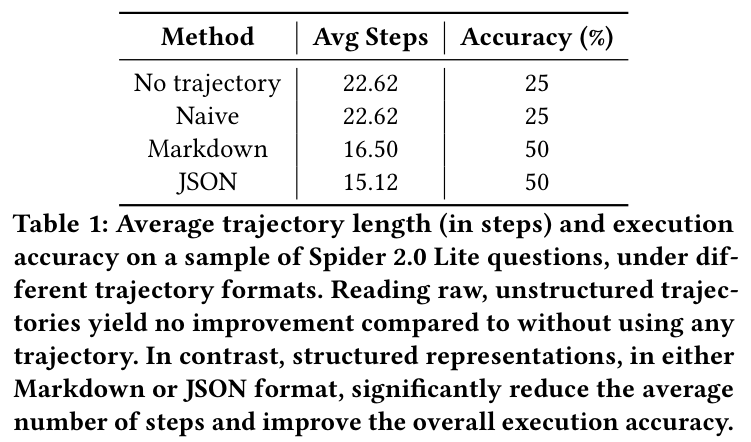
Trajectory format ablation (Table 1, 20 questions). Structuring the trajectory is the load-bearing move — raw/naive logs give zero benefit over no trajectory (25% acc, 22.62 steps), while markdown/JSON roughly double accuracy (50%) and cut ~6 steps. Markdown is chosen for consistency with external-knowledge files and readability.
| Format | Avg Steps | Accuracy (%) |
|---|---|---|
| No trajectory | 22.62 | 25 |
| Naive (raw) | 22.62 | 25 |
| Markdown | 16.50 | 50 |
| JSON | 15.12 | 50 |
Paper's Table 2 (main results). AgentSM (claude-4) hits 52.2 BigQuery / 35.0 Snowflake / 51.9 SQLite / 44.8 overall at 16.4 avg steps and 247s latency, vs SpiderAgent 28.7 overall and CodingAgent 24.7. Note the honest cost: AgentSM uses more input tokens (~300K vs 200K) — the win is in steps and latency, not raw token count. The gold-tables row (57.6%) is the schema-linking oracle ceiling.
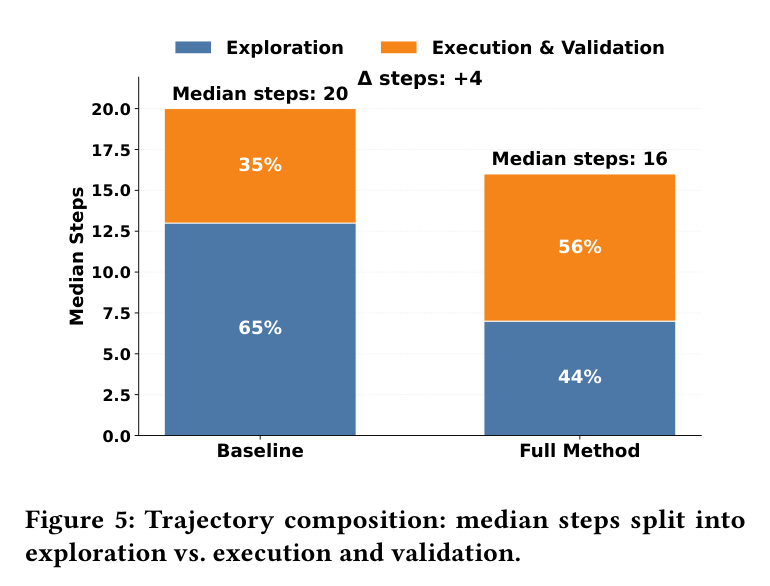
Paper's Figure 5 ("median steps split into exploration vs. execution and validation"). This is the mechanism made visible: the baseline spends 65% of median-20 steps exploring; AgentSM spends only 44% of median-16, transitioning to execution far earlier. The reader should notice the +4-step gap is entirely absorbed exploration.
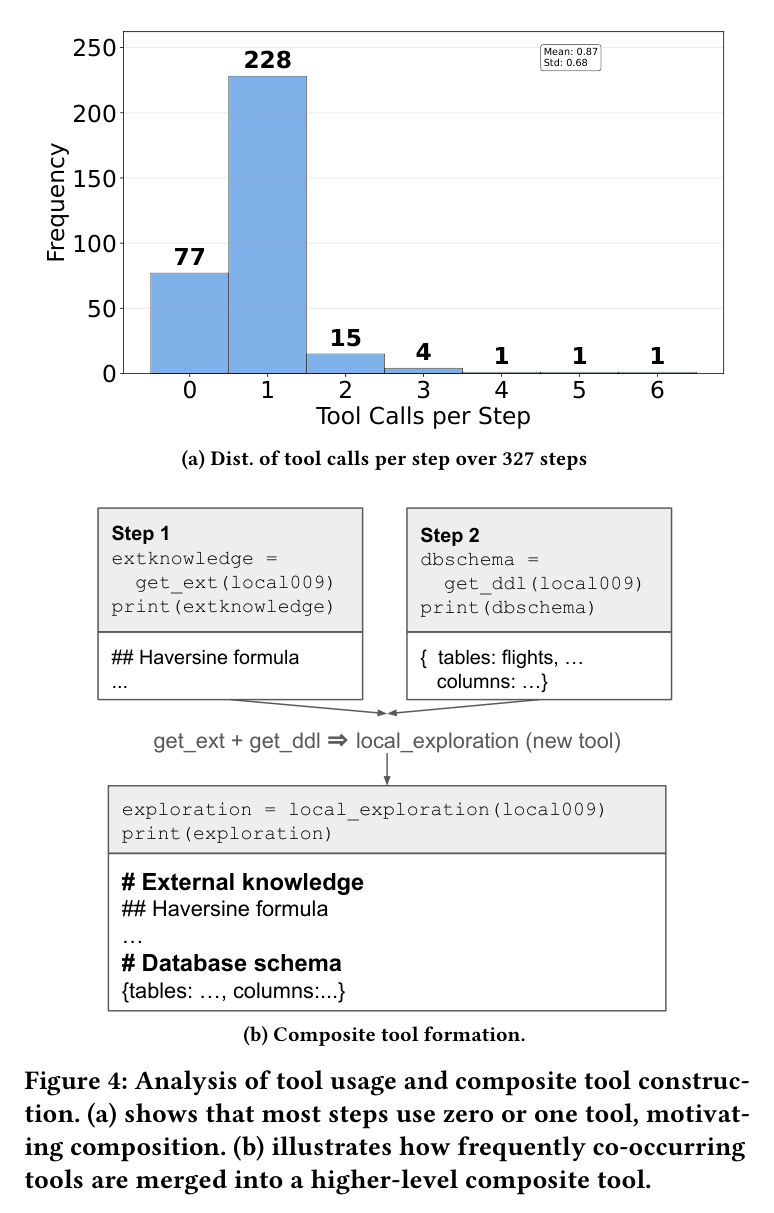
Paper's Figure 4. (a) Over 327 steps the mean tool calls/step is 0.87 (mostly 0 or 1) — agents almost never chain tools within a step, wasting whole steps on deterministic routines. (b) Shows the concrete merge get_ext + get_ddl ⇒ local_exploration. Together they justify composition: if the agent won't chain tools itself, pre-chain them.
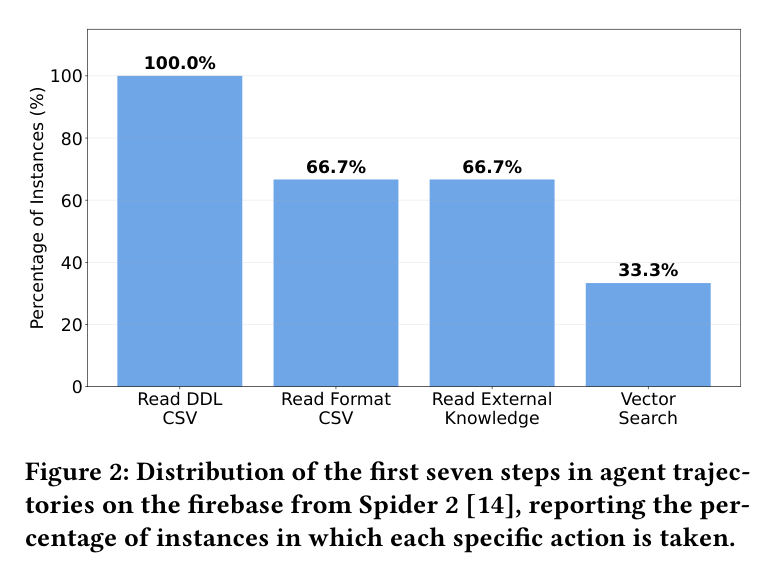
Paper's Figure 2. Read DDL CSV = 100%, Format CSV = 66.7%, External Knowledge = 66.7%, Vector Search = 33.3%. The near-universal early actions are exactly what synthetic-trajectory reuse eliminates; the low vector-search rate motivates not hard-coding it (Opportunity 2).
Component ablation (Table 3, 75 questions). Removing either component is catastrophic: no-trajectory-reading drops EX to 17.3 (−34.7) and adds +4.37 steps; no-composite-tools drops to 16.2 (−35.8), adds +4.77 steps and +46K input tokens / +271s latency. The full method: 52.0 EX, 15.99 steps.
| Method | EX (%) | ΔEX | Avg Steps | ΔSteps | ΔInput | ΔTime (s) |
|---|---|---|---|---|---|---|
| No trajectory reading | 17.3 | −34.7 | 20.36 | +4.37 | +8K | +96.2 |
| No composite tools | 16.2 | −35.8 | 20.76 | +4.77 | +46K | +271.3 |
| Full method | 52.0 | — | 15.99 | — | — | — |
Error analysis. Of 245 errors: 44% Snowflake (worst), 34% BigQuery, 22% SQLite. Within Snowflake, 30% are schema-linking (nested schemas), 5% step-budget, rest logic/dialect. Memory helps schema-linking most; it does not help complex-math / intricate-CTE reasoning. Per-domain accuracy ranges 60–78% (city/weather/census) down to 14–40% (github_repos/idc).
6. 论证链 #
| # | Step | Support (paper-internal) |
|---|---|---|
| 1 | Agent exploration on a given DB is highly repetitive and thus reusable. | Fig 2 (100% read-DDL etc.); ref [17] <10–20% distinct trajectories. |
| 2 | Reuse is only effective if traces are structured, not raw. | Table 1: raw = no gain (25%); markdown/JSON = 50%. |
| 3 | Reusable traces can be manufactured offline via synthetic questions, decoupling memory from real query volume. | Algorithm 1 + §3.2 synthetic-question exploration. |
| 4 | Retrieve by same-DB filter then max-similarity to inject the right prior trace. | Eqs. 1–3; §3.2 "similar questions probe the same tables." |
| 5 | Agents under-chain tools (mean 0.87/step), so pre-merging frequent subsequences saves steps. | Fig 4a distribution; Eq. composite rule with $\theta$. |
| 6 | Together these shift steps from exploration to execution, raising accuracy under step/latency budgets. | Fig 5 (65:35→44:56); Table 3 (both components each ~+35 pts EX). |
| 7 | Net effect: SOTA 44.8% without a reasoning model; residual errors are schema-linking-bound. | Table 2 (44.8 vs 57.6 gold); §4.4 Snowflake 30% schema-linking errors. |
7. 实现 cross-reference #
Implementation is not in the paper body; core artifacts are deferred to the authors' repository via footnotes:
Reproducible stack from §4.1: smolagents (agent framework, [8]), MiniLM-L6-v2 embeddings ([23]) + FAISS ([10]) for $\text{sim}$, vLLM on 8×A100-80GB for the served 7B, Claude Haiku 4.5 as the lightweight header-generator, backends BigQuery/Snowflake/SQLite. [实现未公开] for the composite-tool support threshold $\theta$, the exact synthetic-question budget $N$, and the regex ruleset (only described, values not in paper).
核心技术壁垒 (dedicated). The hardest-to-replicate insight is offline synthetic-question trajectory manufacturing: rather than passively logging real traffic (cold-start problem, coverage skew), AgentSM proactively generates questions per-DB (budget-allocated toward large/complex schemas, Algorithm 1 Lines 6–11), runs an exploration-only agent on them, and banks the resulting dense traces. Replicating the format (markdown + regex classification + FAISS retrieval) is easy; replicating the quality and coverage of the synthetic distribution — which is what actually eliminates redundant exploration on unseen real queries — depends on unpublished prompt engineering and budget-allocation tuning.
关键实现细节 (easy-to-miss).