Understanding Bottlenecks for Efficiently Serving LLM Inference With KV Offloading
Understanding Bottlenecks for Efficiently Serving LLM Inference With KV Offloading — L2 #
§1 TL;DR #
推导 $\kappa_{\text{crit}} = \kappa_M \times \kappa_{HW}$ 分析框架,将 KV offloading 下 prefill 从 compute-bound 转 memory-bound 的临界点分解为模型因子和硬件因子;实证表明真实工作负载超过该阈值 1–2 个数量级,GPU 仅消耗 22–28% TDP,99% 延迟花在 PCIe 传输上。
§2 Q1 / Q2 / Q3 #
Q1 — 痛点 #
KV cache offloading 通过将 KV 存入 CPU DRAM 解锁长上下文推理,但 PCIe 带宽(实测仅 15 GB/s,峰值的 23%)远低于 HBM(TB/s 级),导致 prefill 从 compute-bound 退化为 memory-bound。现有调度器(vLLM iteration-level scheduling)和架构(prefill-decode disaggregation)的设计假设——prefill 是 compute-intensive——被彻底打破。MoE 模型因计算量减少但 KV 不减而更加脆弱。
Q2 — 方法 #
提出 $\kappa_{\text{crit}}$ 分析框架,将瓶颈临界点分解为两个独立因子:
$$\kappa_{\text{crit}} = \underbrace{\frac{F_{\text{pf}}}{B_{\text{kv}}}}_{\kappa_M \text{ (model)}} \times \underbrace{\frac{\text{BW}_{\text{PCIe}}}{C_{\text{eff}}}}_{\kappa_{HW} \text{ (hardware)}}$$
当工作负载的 $\kappa_{\text{ratio}} = K/T > \kappa_{\text{crit}}$ 时,prefill 进入 memory-bound 区域。框架将模型架构(GQA vs MLA, Dense vs MoE)和硬件规格(PCIe gen, GPU 算力)解耦,并进一步推导 VRAM-constrained 调度模型(Eq. 9–10)来量化 scheduler 效率损失。
核心技术壁垒: 将 roofline model 扩展到 KV offloading 场景的洞察——arithmetic intensity 不再由 model FLOPs/param 决定,而是由 $T/K$ 的 workload ratio 决定。这使得同一硬件上同一模型在不同 workload 下跨越 compute/memory bound 分界线,且该分界线随 GPU 迭代恶化(计算增速快于互联带宽)。
Q3 — 结果 #
- $\kappa_{\text{crit}}$ 实测值仅 1–2(远低于理论 7.8–14.3),因 PCIe 有效带宽仅峰值 23%
- ShareGPT median $\kappa_{\text{ratio}} = 100$,NarrativeQA = 5000,FinQA = 10000——全面超过阈值
- Qwen3-235B 在 $K=65$K, $T=64$ 时 $P_{OH}=86$(99% 时间在传输)
- GPU 平均功耗仅 TDP 的 22–28%
- NVLink C2C (900 GB/s) 将 $\kappa_{\text{crit}}$ 提升 5.3×,统一 HBM 提升 48×,但 document Q&A 仍超阈值
§3 架构 / 方法图 #
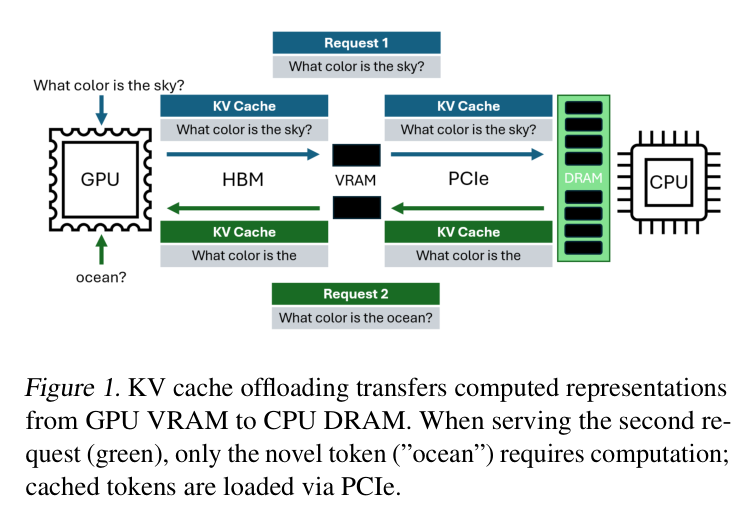
Paper's Figure 1, verbatim (caption: "KV cache offloading transfers computed representations from GPU VRAM to CPU DRAM. When serving the second request (green), only the novel token ('ocean') requires computation; cached tokens are loaded via PCIe.").
Figure 1 展示了 KV offloading 的核心数据流:第一次请求的 KV 被 offload 到 CPU DRAM,后续请求只需计算 novel tokens 的 KV 并从 CPU DRAM 加载已缓存部分。PCIe 成为瓶颈的根本原因——大量 cached tokens 需要跨越带宽瓶颈回到 GPU。
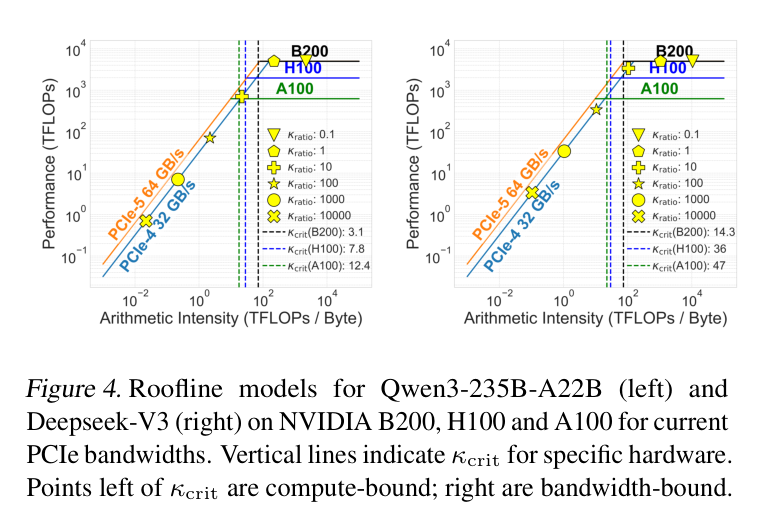
Paper's Figure 4, verbatim (caption: "Roofline models for Qwen3-235B-A22B (left) and Deepseek-V3 (right) on NVIDIA B200, H100 and A100 for current PCIe bandwidths. Vertical lines indicate κ_crit for specific hardware.").
Roofline 图直观展示了随 $\kappa_{\text{ratio}}$ 增大,操作点从 compute ceiling 滑入 bandwidth ceiling 的过程。DeepSeek-V3 的 MLA 将 compute-bound 区域延伸到 $\kappa_{\text{ratio}} \approx 40$,但两个模型在 $\kappa_{\text{ratio}} > 100$ 时均进入 bandwidth-limited 区域。
(token budget) participant VRAM as GPU VRAM
(KV slots) participant DRAM as CPU DRAM
(offloaded KV) participant GPU as GPU Compute Client->>Scheduler: Request (K cached, T new tokens) Scheduler->>VRAM: Check: (K+T)·B_kv ≤ V_eff? Note over VRAM: VRAM exhausts before
token budget saturates Scheduler->>DRAM: Initiate KV load (K·B_kv bytes) DRAM-->>VRAM: PCIe transfer (t_PCIe = K·B_kv / BW_PCIe) Note over DRAM,VRAM: 99% of TTFT here VRAM->>GPU: Prefill T new tokens GPU-->>Client: First output token (TTFT)
§4 作者证明 #
符号表 #
| Symbol | Definition | Typical Value |
|---|---|---|
| $K$ | Cached (offloaded) tokens | 65K (doc QA) |
| $T$ | New prefill tokens | 32–133 |
| $\kappa_{\text{ratio}}$ | $K/T$ — workload memory-compute balance | 100–10000 |
| $\kappa_{\text{crit}}$ | Critical ratio for compute→memory-bound transition | 1–76 |
| $\kappa_M$ | Model factor: $F_{\text{pf}}/B_{\text{kv}}$ | 0.07–1.42 |
| $\kappa_{HW}$ | Hardware factor: $\text{BW}_{\text{PCIe}}/C_{\text{eff}}$ | 6.7–107.5 KB/GFLOP |
| $F_{\text{pf}}$ | FLOPs per prefill token ($\approx 2N$ for $N$ active params) | 6.6G–810G |
| $B_{\text{kv}}$ | Bytes per token for KV cache | 70–516 KB |
| $\text{BW}_{\text{PCIe}}$ | Sustained host-to-device bandwidth | 15 GB/s (measured) |
| $C_{\text{eff}}$ | Effective GPU compute throughput | 312T–4500T FLOP/s |
| $U$ | GPU utilization fraction: $t_{\text{GPU}} / \text{TTFT}$ | 0.01–0.5 |
| $P_{OH}$ | PCIe overhead ratio: $t_{\text{PCIe}}/t_{\text{GPU}}$ | 1–86 |
| $N_{\text{max}}$ | Max concurrent requests (VRAM-limited) | 1–2 (doc QA) |
| $V_{\text{eff}}$ | Available VRAM for KV caches | 60–92 GB |
方程物理意义 #
Eq. 3 (TTFT decomposition): $\text{TTFT} = \frac{K \cdot B_{\text{kv}}}{\text{BW}_{\text{PCIe}}} + \frac{T \cdot F_{\text{pf}}}{C_{\text{eff}}}$
两项之和:PCIe 传输大量 cached KV 的时间 + GPU 计算少量 new tokens 的时间。假设无法完全 overlap(实测 $t_{\text{PCIe}} \gg t_{\text{GPU}}$ 时 overlap 收益可忽略)。
Eq. 6 ($\kappa_{\text{crit}}$ factorization): $\kappa_{\text{crit}} = \frac{F_{\text{pf}}}{B_{\text{kv}}} \cdot \frac{\text{BW}_{\text{PCIe}}}{C_{\text{eff}}}$
将 roofline 的 compute-bandwidth 交叉点($AI = C/BW$)在 KV offloading 场景下重新表达为 $K/T$ 的临界值。乘法结构使模型优化(增大 $\kappa_M$)和硬件优化(增大 $\kappa_{HW}$)可独立推进。
Eq. 10 (Scheduled tokens): $T_{\text{sched}} = N_{\text{max}} \cdot T \approx \frac{V_{\text{eff}}}{\kappa_{\text{ratio}} \cdot B_{\text{kv}}}$
VRAM 容量(而非 token budget)决定每 iteration 实际可调度的 prefill tokens 数量,且与 $\kappa_{\text{ratio}}$ 成反比。这解释了为什么 NarrativeQA 仅调度 532 tokens(4K budget 的 13%)。
单调性 / 凸性分析 #
$\kappa_{\text{crit}}$ 关于 $\text{BW}_{\text{PCIe}}$ 单调递增,关于 $C_{\text{eff}}$ 单调递减——更快的 GPU 使问题恶化,更快的互联使问题缓解。$U$ 关于 $\kappa_{\text{ratio}}$ 单调递减($U = 1/(1 + P_{OH})$, $P_{OH} \propto \kappa_{\text{ratio}}$),无内部极值点,边界行为为 $\kappa_{\text{ratio}} \to \infty$ 时 $U \to 0$。
6 Minimum Checks #
- Dimensional consistency: $\kappa_{\text{crit}}$ is dimensionless — $[F_{\text{pf}}]/[B_{\text{kv}}]$ = FLOP/byte, $[\text{BW}]/[C]$ = byte/FLOP, product is pure ratio ✓
- Boundary: $K=0$: no offloading → $\kappa_{\text{ratio}} = 0 < \kappa_{\text{crit}}$ → compute-bound, consistent with standard prefill ✓
- Boundary: $T \to 0$: $\kappa_{\text{ratio}} \to \infty$, always memory-bound → pathological (single-token prefill of huge cached context) ✓
- Case study LLaMA-405B on H100: $F_{\text{pf}} = 810$ GFLOP, $B_{\text{kv}} = 516$ KB, $\text{BW} = 64$ GB/s, $C = 2000$ TFLOP/s. $\kappa_M = 810G/(516K) = 1.57M$ FLOP/byte ≈ 1.42 (units: GFLOP/KB → 1.42 in normalized units). $\kappa_{HW} = 64G/2000T = 3.2 \times 10^{-5}$ byte/FLOP. Product ≈ 45–50 → matches paper's ~50 ✓
- Measured bandwidth correction: using 15 GB/s instead of 64 GB/s → $\kappa_{\text{crit}}$ drops by 64/15 ≈ 4.3×, from ~50 to ~12, matches paper's "sustained ~12" ✓
- Eq. 10 NarrativeQA: $V_{\text{eff}} = 92$ GB, $K=57000$, $T=12$, $B_{\text{kv}} = 328$ KB → $N_{\text{max}} = 92G/(57000 \times 328K) \approx 5$, $T_{\text{sched}} = 5 \times 12 = 60$... paper reports 532 for mixed workload (some requests have larger T) — directionally consistent with VRAM-limited regime ✓
- Stage coverage: Prefill only (decode excluded by design: output limited to 1 token)
- Serving mode: Continuous batching via vLLM v0.10.1 + LMCache v0.3.5
- Parallelism: TP (8× H100 SXM5), no EP/PP/SP analysis
- Deployment: Single-node, 8-GPU
- vLLM iteration-level scheduler with token budget: vllm/core/scheduler.py (v0.10.1) — budget-based admission, VRAM tracking
- LMCache KV offloading integration: LMCache/lmcache (v0.3.5) — CPU DRAM KV store with PCIe transfer
- Sustained PCIe bandwidth = 23% of peak: 任何基于 $\kappa_{\text{crit}}$ 的调度决策必须使用实测带宽(15 GB/s on H100),而非 spec sheet 的 64 GB/s。NUMA effects、CPU memory copy overhead、transfer granularity 是三个主因。
- VRAM-budget decoupling: 当前 vLLM scheduler 将 offloaded requests 的 prefill token 数计入 budget 但不追踪其 VRAM demand($(K+T) \cdot B_{\text{kv}}$),导致 VRAM OOM 先于 budget exhaustion。修复需要在 admission control 中引入 VRAM-aware accounting。
- User-facing API: 标准 vLLM OpenAI-compatible API(无额外配置暴露给用户)
- Config surface: LMCache 配置 offloading 策略(CPU DRAM path),vLLM 配置 token budget size
- Migration cost: 已使用 vLLM 的部署只需添加 LMCache 集成(已有上游支持)
- Upstream status: 分析框架本身未合并到任何 serving system;LMCache 已是 vLLM 生态的组件
- Production deployment: 未声明
- Downstream forcing: 提出的 utilization-aware scheduling 需修改 vLLM scheduler 的 admission control 逻辑;硬件建议(NVLink C2C, unified HBM)指向 NVIDIA Grace Blackwell/Grace Hopper 平台
- Serving stage: Prefill only(paper explicitly scopes to prefill; decode 不受此分析影响因为 decode 已是 memory-bound)
- Concurrency regime: Low concurrency (1–5 requests) due to VRAM exhaustion; high $\kappa_{\text{ratio}}$ workloads cannot co-schedule more than 1–2 concurrent requests on 80 GB GPU
- Hardware affinity: A100 (PCIe 4) 反而比 B200 (PCIe 5) 更不容易进入 memory-bound($\kappa_{HW}$ 更高),但绝对性能更低。Grace Hopper/Blackwell (NVLink C2C) 获益最大。
- Ecosystem integration: 分析适用于任何使用 KV offloading 的 serving system(vLLM, SGLang, TRT-LLM + LMCache/CacheGen)
- Migration path: 无代码变更需要;paper 提供的是分析工具和设计原则,帮助判断是否值得部署 offloading、选择什么硬件
- Unified HBM: 消除 CPU-GPU 互联瓶颈,将 KV cache 置于共享 HBM 中。需要解决热管理、die area、coherency 协议挑战。$\kappa_{\text{crit}}$ 可达 370–1700,使多数 workload 回到 compute-bound。
- NVLink C2C 泛化: 当前仅 Grace Hopper/Blackwell 支持 900 GB/s C2C;paper implicitly argues 所有 inference GPU 都应提供高带宽 CPU-GPU 互联(而非仅依赖 PCIe)。
- ISA/cache implication: 更快的 GPU(B200+)在 KV offloading 场景下反而更受限,暗示未来 inference-optimized GPU 可能需要牺牲 peak FLOP/s 来换取更平衡的 bandwidth/compute ratio,或者在芯片内部集成更大容量的低延迟 KV buffer。
§5 实验与数据 #
System scope #
Workload $\kappa_{\text{ratio}}$ distributions #
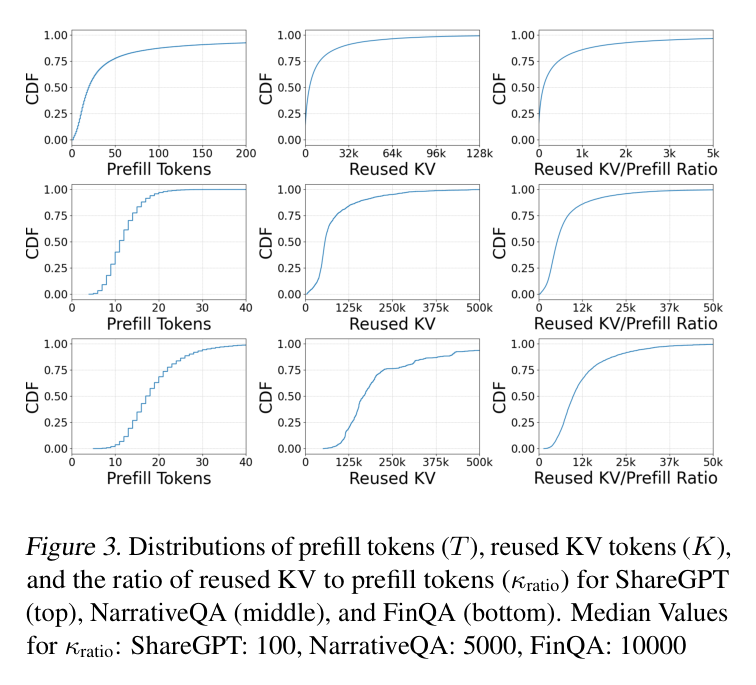
Paper's Figure 3, verbatim (caption: "Distributions of prefill tokens (T), reused KV tokens (K), and the ratio κ_ratio for ShareGPT (top), NarrativeQA (middle), and FinQA (bottom). Median κ_ratio: ShareGPT 100, NarrativeQA 5000, FinQA 10000").
三个数据集展示了逐级恶化的 $\kappa_{\text{ratio}}$:multi-turn conversation(ShareGPT)中 KV 增长缓慢,document QA 中整个文档被缓存而 query 极短,$\kappa_{\text{ratio}}$ 高达 10000。这些分布证明了 $\kappa_{\text{crit}}$ 被系统性超越。
PCIe overhead 实测 #
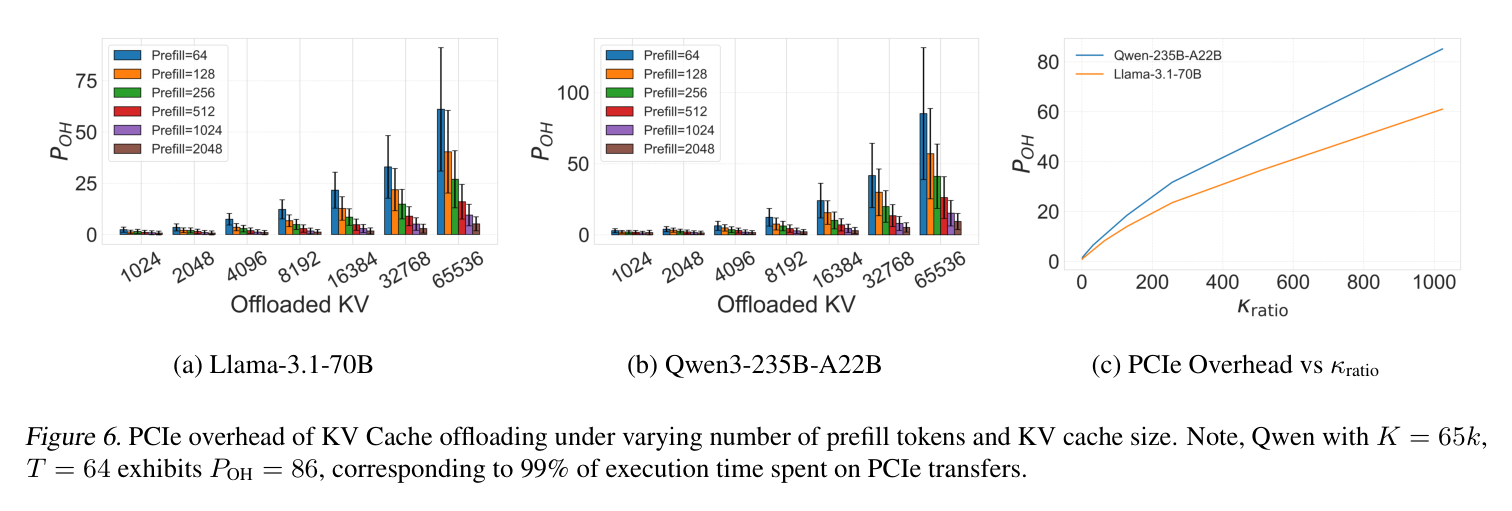
Paper's Figure 6, verbatim (caption: "PCIe overhead of KV Cache offloading under varying number of prefill tokens and KV cache size. Qwen with K=65k, T=64 exhibits P_OH=86, corresponding to 99% of execution time spent on PCIe transfers.").
热力图清晰展示了 $P_{OH}$ 随 $K$ 增大 / $T$ 减小而指数级增长。MoE 模型(Qwen3)在所有配置下 overhead 均高于 Dense 模型(Llama),验证了 §5.2 的分析预测。
Framework validation #
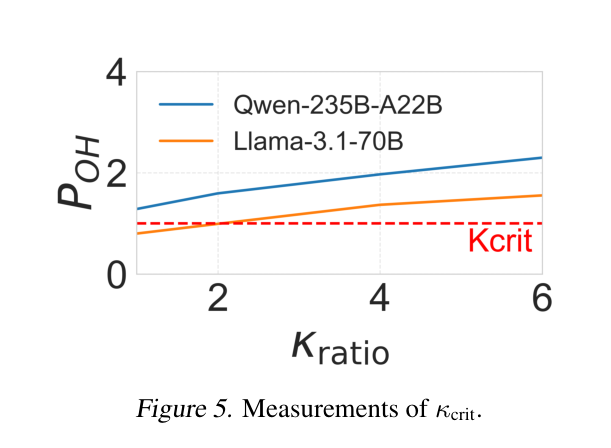
Paper's Figure 5, verbatim (caption: "Measurements of κ_crit.").
实测 $\kappa_{\text{crit}}$(Llama=2, Qwen=1)远低于峰值带宽假设下的理论值(14.3, 7.8),但使用实测 15 GB/s 带宽修正后(3.3, 1.8)与实测吻合。这验证了框架的正确性并突显了使用实测带宽的重要性。
Scheduler & power underutilization #
| Metric | ShareGPT (70 RPS) | NarrativeQA (70 RPS) |
|---|---|---|
| $T_{\text{sched}}$ (tokens/iter) | 4064 | 532 |
| Budget utilization | ~100% | ~13% |
| Avg GPU power (W) | 196 | 152 |
| % of TDP | 28% | 22% |
NarrativeQA 的极端 $\kappa_{\text{ratio}}$ 导致 VRAM 在 token budget 饱和前耗尽,scheduler 被迫闲置 87% 的预算。GPU 功耗仅达 TDP 的 22%,意味着数据中心电力/散热基础设施大量过剩。
硬件/模型优化效果 #
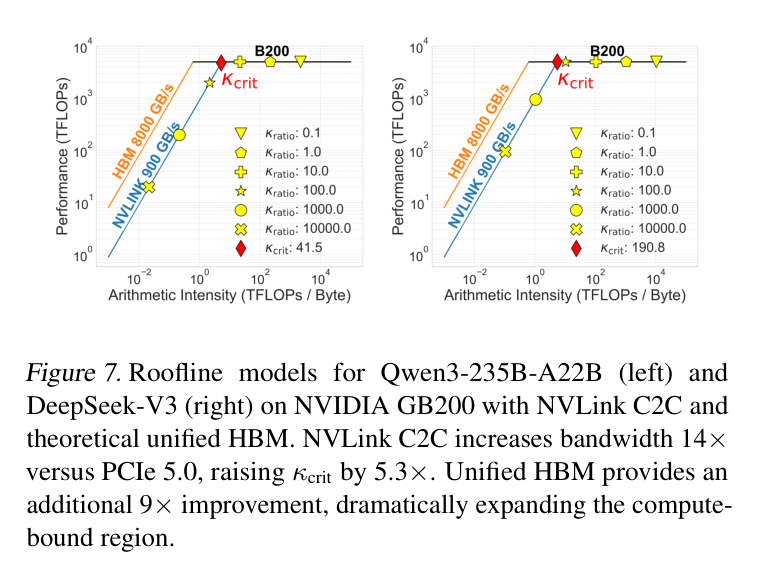
Paper's Figure 7, verbatim (caption: "Roofline models for Qwen3-235B-A22B (left) and DeepSeek-V3 (right) on NVIDIA GB200 with NVLink C2C and theoretical unified HBM. NVLink C2C increases bandwidth 14× versus PCIe 5.0, raising κ_crit by 5.3×. Unified HBM provides an additional 9× improvement.").
NVLink C2C 将 Qwen3 的 $\kappa_{\text{crit}}$ 从 3.1 提升到 41.5,但 document QA($\kappa_{\text{ratio}}=5000$)仍超出 120×。只有统一 HBM($\kappa_{\text{crit}}=370$ for Qwen, 1700 for DeepSeek-V3)才能让 MLA 模型的 document QA 接近 compute-bound。
Scheduling optimization direction #
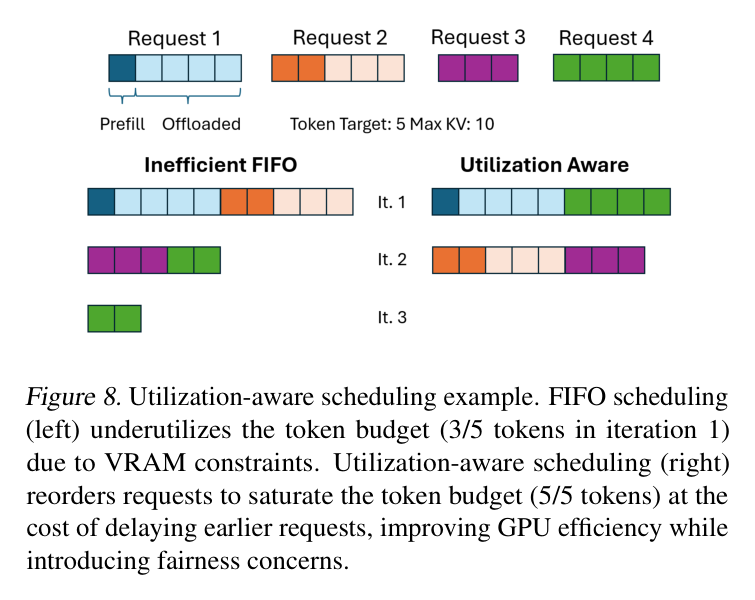
Paper's Figure 8, verbatim (caption: "Utilization-aware scheduling example. FIFO scheduling (left) underutilizes the token budget due to VRAM constraints. Utilization-aware scheduling (right) reorders requests to saturate the token budget, improving GPU efficiency while introducing fairness concerns.").
FIFO 调度在 VRAM 约束下仅利用 3/5 token budget,而 utilization-aware 调度通过重排请求(优先调度低 $\kappa_{\text{ratio}}$ 请求)将利用率提升到 5/5,但引入公平性问题。
§5-ext Scheduling & Resource Management #
Scheduling decisions #
| Aspect | Paper's approach |
|---|---|
| Granularity | Request-level (iteration-level scheduling, per-request token budget) |
| Preemption | Not explored; vLLM baseline supports preemption but paper focuses on admission |
| Admission control | VRAM-capacity-gated: requests deferred until KV fits in VRAM |
| Fairness | Identified as open problem; proposed aging credits + weighted fair queueing |
Memory management #
| Aspect | Current (vLLM + LMCache) | Problem |
|---|---|---|
| KV allocation unit | PagedAttention blocks (vLLM) | Budget accounts tokens, not bytes |
| Fragmentation | Paged → low internal fragmentation | VRAM exhausted by large $K$ before budget saturates |
| Eviction | LRU in LMCache (CPU DRAM) | CPU DRAM abundant; VRAM is the binding constraint |
| Swap | CPU DRAM → GPU VRAM on demand | PCIe bandwidth is the bottleneck |
核心问题:scheduler 的 token budget 与 VRAM consumption 解耦——一个 $K=65$K, $T=32$ 的请求仅消耗 32 token budget 但需要 33 GB VRAM。
§5-ext Workload Characterization #
| Workload regime | Offloading system | Baseline (no offloading) | Why |
|---|---|---|---|
| Short prompt, low $\kappa_{\text{ratio}}$ (<2) | Compute-bound, behaves like standard prefill | Same | $t_{\text{PCIe}} < t_{\text{GPU}}$ |
| Multi-turn conversation (median $\kappa_{\text{ratio}}$=100) | Memory-bound; 88% time on PCIe | N/A (KV doesn't fit VRAM for all users) | $\kappa_{\text{ratio}} \gg \kappa_{\text{crit}}$ |
| Document QA (median $\kappa_{\text{ratio}}$=5000) | Severely memory-bound; 99% time on PCIe, 13% budget utilization | Cannot serve (OOM) | Extreme $K/T$ mismatch |
| MoE + high $\kappa_{\text{ratio}}$ | Worse than Dense (lower $\kappa_M$) | N/A | MoE reduces $F_{\text{pf}}$ faster than $B_{\text{kv}}$ |
| MLA model (DeepSeek-V3) | Better; $\kappa_{\text{crit}}$ 4.6× higher than GQA MoE | N/A | $B_{\text{kv}}$ reduced 2.7× by low-rank compression |
Paper wins: analytical prediction; loses: cannot demonstrate real MLA benefits (DeepSeek-V2 implementation issues) and does not propose a working scheduler implementation.
§6 论证链 #
| Step | Claim | Evidence | Depends on |
|---|---|---|---|
| 1 | TTFT = $t_{\text{PCIe}} + t_{\text{GPU}}$ (sequential, overlap negligible when $t_{\text{PCIe}} \gg t_{\text{GPU}}$) | Eq. 3–4; measured overlap impact <1% for typical workloads | Physical constraint: GPU needs KV in VRAM before computing attention |
| 2 | $\kappa_{\text{crit}} = \kappa_M \times \kappa_{HW}$ factorizes transition point into model × hardware | Algebraic rearrangement of $t_{\text{PCIe}} > t_{\text{GPU}}$ (Eq. 5→6) | Step 1 |
| 3 | Real $\kappa_{\text{crit}}$ is 1–2 (not 7–76) because sustained PCIe is 23% of peak | Fig. 5: measured $P_{OH}=1$ at $\kappa_{\text{ratio}} \approx 1$–2; recalculated with 15 GB/s matches | Step 2 + empirical bandwidth measurement |
| 4 | Real workloads' $\kappa_{\text{ratio}}$ (100–10000) exceed $\kappa_{\text{crit}}$ by 50–5000× | Fig. 3: ShareGPT/NarrativeQA/FinQA CDFs | Step 3 + dataset analysis |
| 5 | Scheduler under-utilizes token budget because VRAM (not budget) is binding | Table 4: NarrativeQA schedules 532/4000 tokens; Eq. 10 predicts correctly | Step 4 + Eq. 9–10 |
| 6 | GPU power drops to 22–28% TDP → infrastructure overprovisioned | Table 5: 152–196W measured vs ~700W TDP | Step 5 (low utilization → low power) |
| 7 | NVLink C2C raises $\kappa_{\text{crit}}$ 5.3×, unified HBM 48×, but only HBM + MLA approaches sufficiency | Fig. 7: roofline extension shows extended compute-bound region | Step 2 (scale $\kappa_{HW}$ with new bandwidth) |
§7 实现 cross-reference #
Baseline implementation: vLLM v0.10.1 + LMCache v0.3.5 (open-source).
[实现未公开] — The paper proposes utilization-aware scheduling and $\kappa$-based routing as design implications but does not release an implementation. The $\kappa_{\text{crit}}$ framework itself is purely analytical (no code artifact).
核心技术壁垒 (§7 dedicated paragraph): 本文的核心 insight 是将 KV offloading 场景下的 prefill 性能问题重新框定为 roofline 问题,其中 arithmetic intensity 不由模型本身决定,而由 workload 的 $K/T$ 比例动态决定。这意味着:(1) 同一模型同一硬件的性能可因 workload 变化差异 100×;(2) GPU 越快问题越严重($\kappa_{HW}$ 随 $C_{\text{eff}}$ 增大而减小);(3) scheduler 的 token budget 会被 VRAM 约束架空。这个洞察不需要复杂实现,但需要对 serving system 设计理念的根本性转变。
关键实现细节:
§8 API & Usability #
Paper 不提供新的 serving system,而是分析现有系统(vLLM + LMCache)的瓶颈并提出设计方向。
§9 Adoption & Ecosystem #
§10 Deployment Context (实践上下文) #
§12 Software → Hardware Reverse Implication #
Triggered: paper 直接讨论了 hardware-proximal 优化(interconnect bandwidth, unified HBM architecture, chiplet topology implications)。
Paper argues for: