Not All Prefills Are Equal: PPD Disaggregation for Multi-turn LLM Serving
Not All Prefills Are Equal: PPD Disaggregation for Multi-turn LLM Serving #
Zongze Li, Jingyu Liu, Zhen Xu, Yineng Zhang, Tahseen Rabbani, Ce Zhang | 2025-03 | https://arxiv.org/abs/2603.13358 Category: framework | Tags: serving, disaggregation, multi-turn, scheduling, KV-cache Read: 2026-05-25
§1 TL;DR #
Multi-turn PD disaggregation wastes 99% of prefill compute re-processing cached history. PPD observes append-prefill causes only 2% TPOT degradation (vs. 48% for full prefill) and dynamically routes Turn 2+ requests to decode nodes via an offline-profiled scoring function, cutting Turn 2+ TTFT by 48–73% while maintaining TPOT.
§2 核心三问 #
Q1 痛点: 多轮对话下PD分离架构的根本低效
标准PD disaggregation的单向KV传输协议(P→D, 无反向通道)导致多轮对话每一轮都必须:(1) 在P节点重新计算整个历史KV cache(含上轮response),占multi-turn prefill成本的99%;(2) 重复将KV cache通过网络传回D节点,饱和带宽引发高延迟甚至服务降级。在2P_2D配置下,传统PD在12个QPS中有9个出现服务崩溃。
Q2 方法: PPD — 基于干扰差异的动态路由
核心洞察:append-prefill(仅处理新增$m$个token,复用已缓存KV)与full prefill的decode干扰相差一个数量级(2% vs. 48% TPOT degradation at batch 200)。PPD将routing decision形式化为优化问题:
$$S(\psi;\,\pi,\mathbf{w}) = w_{\text{ttft}}\,\Delta_{\text{ttft}} - w_{\text{tpot}}\,\Delta_{\text{tpot}}$$
$S > 0$ 时Turn 2+请求在D节点本地执行append-prefill,否则走传统PD路径。算法分两阶段:Phase 1离线对工作负载网格逐点profiling建表;Phase 2在线将请求映射到最近网格点,<1ms返回decision。传统PD是PPD的特例($x \equiv 0$)。
核心技术壁垒:将"append-prefill干扰极低"这一微架构观察与"无静态策略全面占优"的系统级发现连接成一个可操作的per-request routing decision——通过offline profiling将高维工作负载空间离散化为lookup table,以零运行时开销实现动态最优。
Q3 结果
- Turn 2+ TTFT降低48–73%(合成负载),15–25%平均查询延迟降低(真实数据集)
- 将不稳定配置(2P_2D, 3P_1D)从频繁服务崩溃恢复为100%成功率
- 网络越慢优势越大:TTFT改善从64%(NVLink)增长至70%(100GbE)
- Per-metric winner counts(27测试点): PPD在TPOT胜12次、TTFT胜14次、SR=100%,唯一全面竞争性策略
§3 架构 / 方法图 #
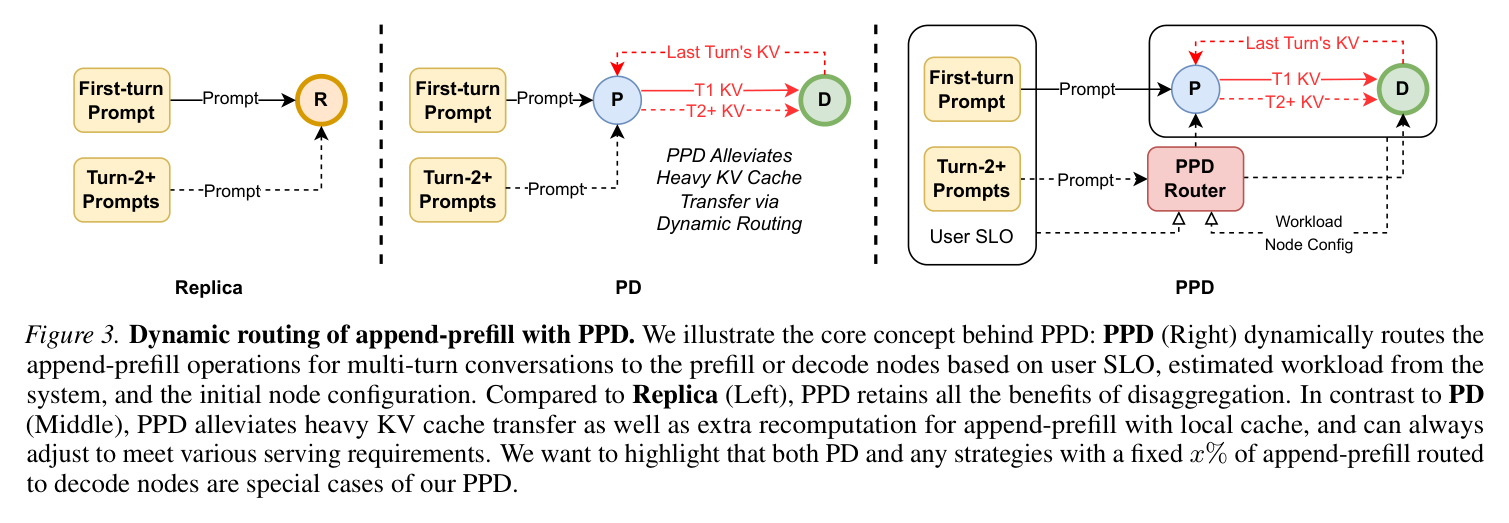
Paper's Figure 3, verbatim (caption: "Dynamic routing of append-prefill with PPD").
PPD架构的关键在于引入了PPD Router模块。Turn 1请求仍走传统PD路径(P节点处理full prefill → KV transfer → D节点decode),但Turn 2+请求由Router基于当前workload估计、user SLO权重、node配置三因素决策:路由到P(走PD path)或在D节点本地执行append-prefill(复用已缓存KV)。PD和Replica均为PPD的特例。
System Scope #
- Stage coverage: prefill + decode; fuses append-prefill into decode nodes when routing locally
- Serving mode: continuous batching; disaggregated prefill-decode as baseline
- Parallelism: does not own TP/PP/EP — operates at request-routing layer above parallelism dimensions
- Deployment: multi-node disaggregated (P nodes + D nodes); single-node also supported as replica fallback
§4 作者证明 #
Notation Table #
| Symbol | Meaning |
|---|---|
| $x$ | fraction of Turn 2+ AP routed to decode (hardware-level) or per-request binary decision |
| $\pi$ | node assignment (e.g., 1P_3D = 1 prefill + 3 decode GPUs) |
| $\phi$ | user-defined SLO distribution |
| $\psi$ | workload descriptor (QPS, input/output lengths, turns) |
| $\mathbf{w} = (w_{\text{ttft}}, w_{\text{tpot}})$ | operator-specified SLO weights |
| $\Delta_{\text{ttft}}$ | relative TTFT improvement of local vs. PD path |
| $\Delta_{\text{tpot}}$ | relative TPOT degradation of local vs. PD path |
| $S(\psi;\pi,\mathbf{w})$ | benefit score; positive → route locally |
| $\mathcal{J}(x;\pi,\phi)$ | expected SLO under routing fraction $x$ |
方程物理意义 #
Objective function:
$$\mathcal{J}(x;\pi,\phi) := \mathbb{E}_{\psi, \text{SLO} \sim \phi}[\text{SLO}(P_\pi(1-x), D_\pi(x), \psi)]$$
物理意义:在node assignment $\pi$下,routing fraction $x$的期望SLO表现。$P_\pi(1-x)$表示prefill节点处理$(1-x)$比例的AP,$D_\pi(x)$表示decode节点处理$x$比例。PPD求解 $\arg\max_x \mathcal{J}$。
Scoring function (Eq. 1):
$$S(\psi;\,\pi,\mathbf{w}) = w_{\text{ttft}}\,\Delta_{\text{ttft}} - w_{\text{tpot}}\,\Delta_{\text{tpot}}$$
物理意义:正值意味着local处理的TTFT增益(乘以operator权重)超过TPOT损失。减号反映两者的trade-off方向:TTFT改善是增益,TPOT劣化是代价。$w_{\text{tpot}}$越大对TPOT越敏感,更倾向走PD path。
6项检查 #
- Monotonicity: $\Delta_{\text{ttft}}$在P-scarce配置下单调增加(P节点越少TTFT越大),$\Delta_{\text{tpot}}$在decode-heavy负载下增加。$S$不单调——这正是需要per-request decision的原因。
- 边界行为: $x=0$ 退化为PD; $x=1$ 退化为Full AP-to-D。PPD的optimum在内部时取决于workload profile。
- First-order verification: Table 1中1P_3D高QPS下TTFT改善-73.3%,与§6.2报告的"48–73%"一致。
- Convexity: 隐含为非凸(no single static dominates),故exhaustive grid search而非gradient-based。
- Dimensional consistency: $S$无量纲(两个相对变化量的加权差);$\mathcal{J}$量纲取决于SLO metric(ms for latency, tok/s for throughput)。
- Sensitivity: 权重$(w_{\text{ttft}}, w_{\text{tpot}})$直接控制Pareto frontier上的operating point,Figure 6验证了从0%到95% D-local的单调滑动。
- KV transfer protocol(P→D cache传输)
- Prefix cache(用于识别cached KV entries)
- Session management(确保Turn 2+请求路由到持有KV cache的同一D节点)
- Discretization thresholds: lookup table沿三轴离散化——accumulated context length ($n_{\text{ctx}}$), input/output ratio ($n_{\text{in}}/n_{\text{out}}$), system QPS ($q$)。网格粒度未明确,但decision time <1ms暗示table规模适中。
- Session affinity: Turn 2+请求必须路由到持有上轮KV cache的那个特定D节点,而非任意D节点。这要求scheduler维护session→node映射表。如果该D节点故障或过载,fallback回PD path($x=0$)。
- 分配单元:未具体说明(继承vLLM的paged allocation)
- 碎片化:D节点持有multi-turn KV cache增长问题由vLLM page table管理
- Eviction:未讨论。长会话可能导致D节点KV memory耗尽,此时应fallback到PD path
- Swap:未提及CPU/disk offload
- vLLM disaggregated serving(standard PD, $x=0$)
- Replica mode (4R)
- Static $x=1$ (Full AP-to-D)
- Hybrid R+P/D configurations (7 configs, generally underperform)
- TTFT: time-to-first-token (Turn 2+ specifically)
- TPOT: time-per-output-token (average)
- TPS: tokens-per-second (output throughput)
- SR: success rate (≥95% completing without timeout)
- Query latency: end-to-end per-conversation
- 需要vLLM disaggregated serving基础设施
- 添加PPD routing module(scheduler integration)
- 运行一次offline profiling生成lookup table
- 配置operator权重
- 无model修改、无custom ops、无kernel变更
- Upstream status: 未合并到vLLM/SGLang主线。论文为学术工作,prototype基于vLLM。
- Production deployment: 未声明production use。
- Downstream requirements: 需要disaggregated serving mode(vLLM已支持)+ prefix cache + session affinity。不引入新的parallelism constraint。
- Concurrent work: AMPD(He et al., 2026)使用online queue-delay estimation而非offline table。
- Serving stage: both prefill and decode; routing decision at request admission layer
- Concurrency regime: 全范围有效;低QPS时PPD≈$x=1$,高QPS时PPD动态调整保护TPOT
- Hardware affinity: 在H100验证。HBM bandwidth越大→KV transfer越快→PD的缺点减弱→PPD优势缩小;反之网络越慢(跨节点部署)PPD优势越大
- Ecosystem integration: 基于vLLM disaggregated serving。Integration是scheduler-level patch(routing module),非fork
- Migration path: vLLM用户启用disaggregated serving → 添加PPD router → 运行offline profiling → 设置SLO weights → 上线
§5 实验与数据 #
干扰分析:Full Prefill vs. Append Prefill #
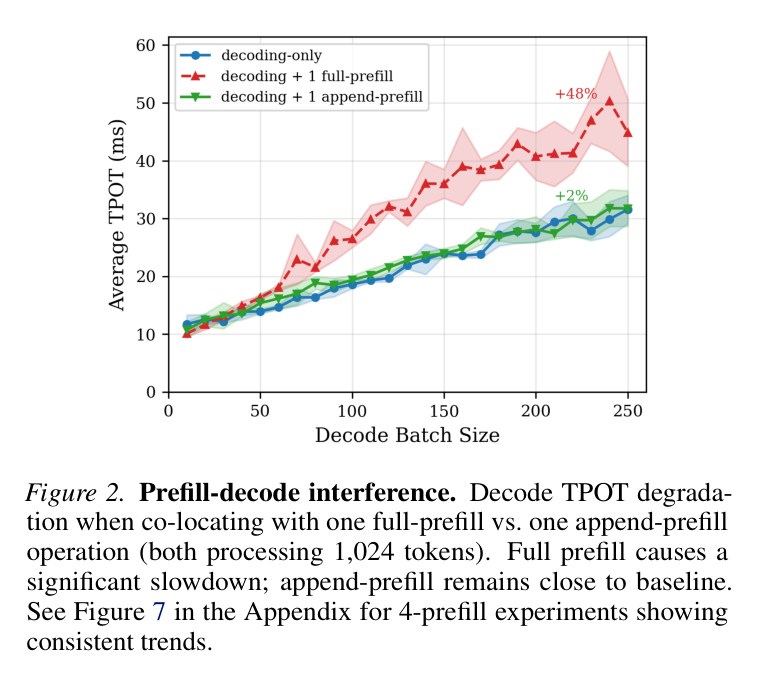
Paper's Figure 2, verbatim (caption: "Prefill-decode interference. Decode TPOT degradation when co-locating with one full-prefill vs. one append-prefill operation (both processing 1,024 tokens)").
这是PPD的基础性实证。在H100上Llama-3.1-8B,full prefill在batch 200处造成+48% TPOT degradation,而append-prefill仅+2%——量级差距验证了"decode节点可安全处理Turn 2+ AP"的核心假设。绿色线(append-prefill)几乎与蓝色基线(decode-only)重合。
Pareto Frontiers #
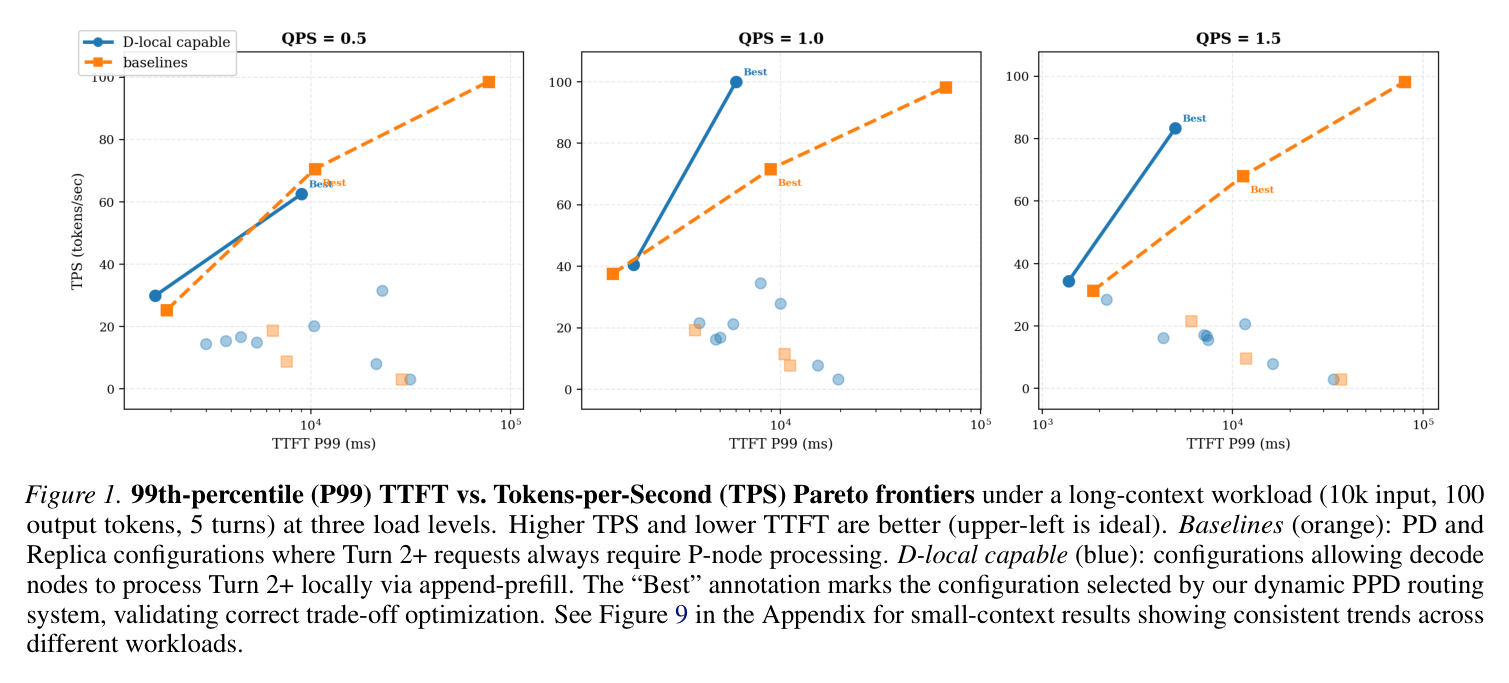
Paper's Figure 1, verbatim (caption: "99th-percentile (P99) TTFT vs. Tokens-per-Second (TPS) Pareto frontiers under a long-context workload (10k input, 100 output tokens, 5 turns) at three load levels").
三个QPS面板清晰展示:D-local capable配置(蓝色)始终dominate orange baselines(PD/Replica),PPD "Best"标注点精准落在Pareto frontier最优区域。随QPS升高,baselines的TTFT爆炸式增长(log scale X轴),而D-local capable维持稳定。
稳定性与延迟 #
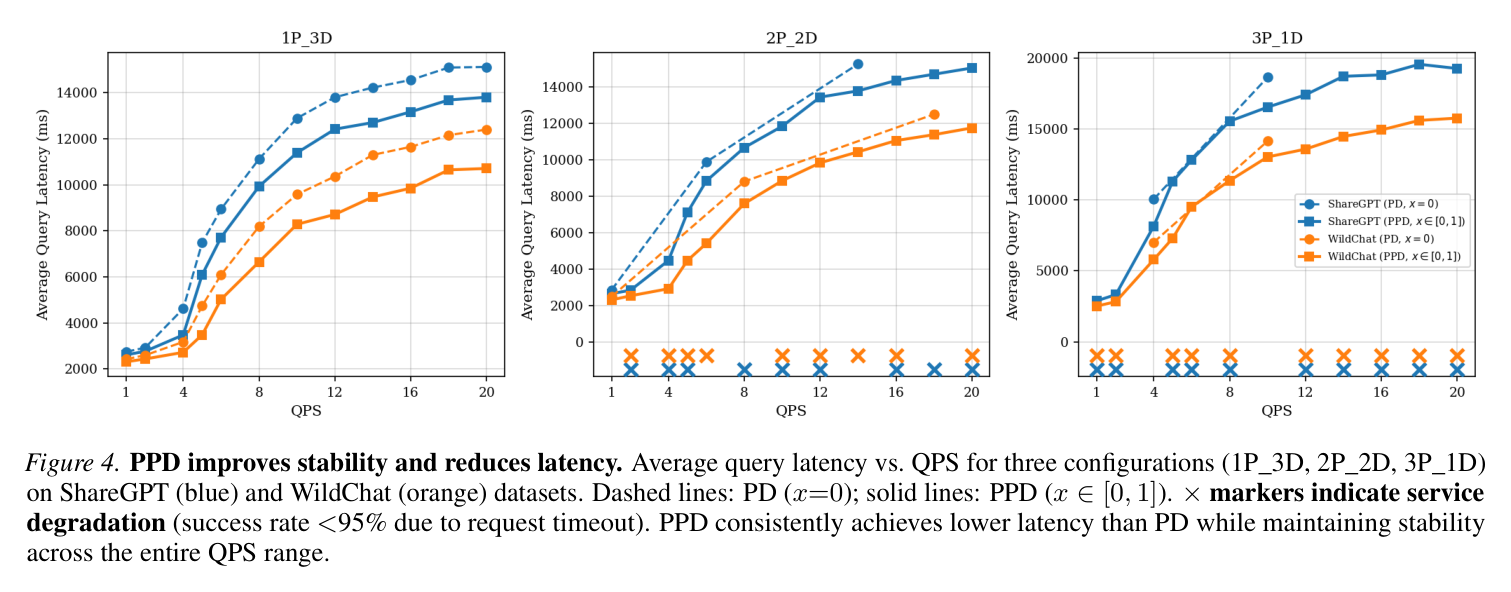
Paper's Figure 4, verbatim (caption: "PPD improves stability and reduces latency. Average query latency vs. QPS for three configurations on ShareGPT and WildChat datasets").
最striking的发现:传统PD下2P_2D和3P_1D大量× markers(服务崩溃),而PPD的solid lines始终稳定。1P_3D配置中PPD减少15–25%平均延迟。这证明PPD不仅优化性能,更重要的是将"不可用"配置变为"可用"。
网络鲁棒性 #
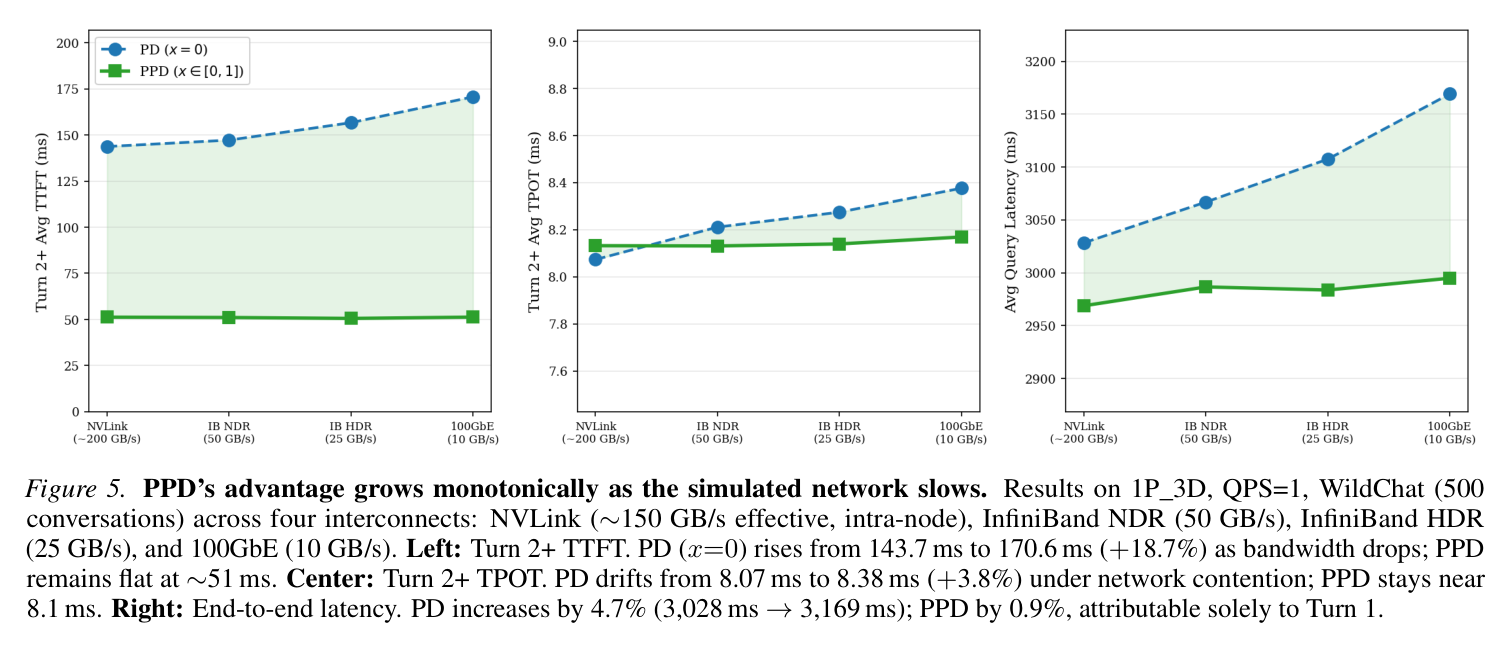
Paper's Figure 5, verbatim (caption: "PPD's advantage grows monotonically as the simulated network slows").
Left panel: PD的TTFT随网络变慢从143.7ms增至170.6ms (+18.7%),PPD保持flat ~51ms——因为local execution零网络依赖。Right panel: end-to-end latency差距从NVLink的3028→2968ms扩大到100GbE的3169→2983ms。
TTFT-TPOT Trade-off Frontier #
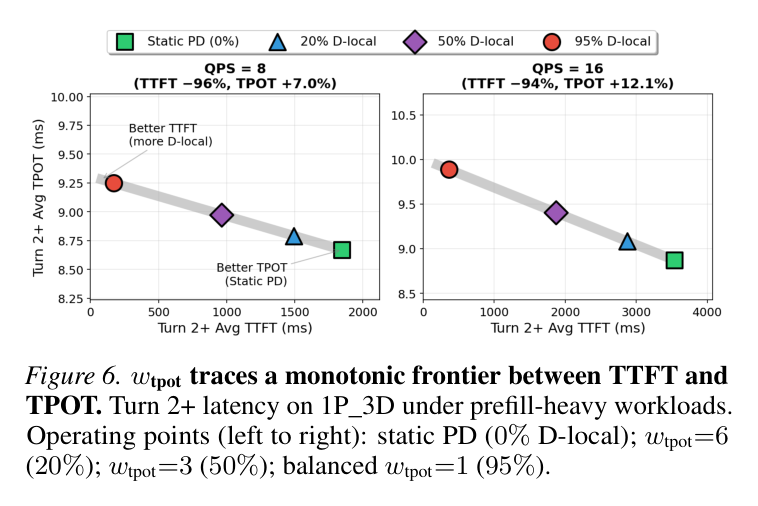
Paper's Figure 6, verbatim (caption: "w_tpot traces a monotonic frontier between TTFT and TPOT. Turn 2+ latency on 1P_3D under prefill-heavy workloads").
Operator通过$w_{\text{tpot}}$控制在frontier上的position:$w_{\text{tpot}}=1$(balanced)路由95% locally获得-96% TTFT / +7% TPOT;$w_{\text{tpot}}=6$路由20% locally获得-40% TTFT / +2% TPOT。灰色band是achievable region,验证了连续可控性。
Key Tables #
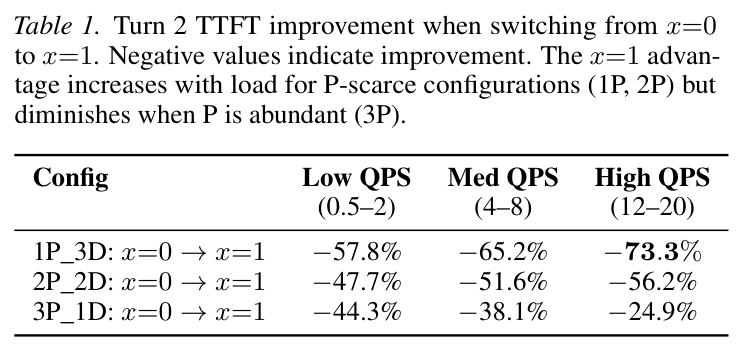
Paper's Table 1: TTFT improvement grows with load for P-scarce configs (1P: -57.8% to -73.3%) and diminishes when P is abundant (3P: -24.9% to -44.3%).
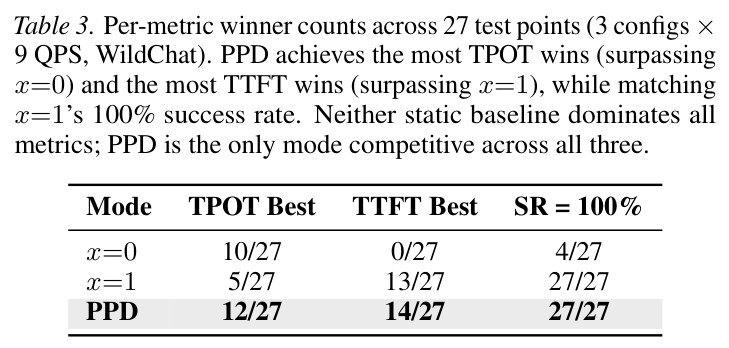
Paper's Table 3: PPD是唯一同时在TPOT(12/27)、TTFT(14/27)、SR(27/27)三维竞争的策略。$x=0$赢TPOT 10/27但TTFT 0/27且SR仅4/27;$x=1$赢TTFT 13/27但TPOT仅5/27。
§6 论证链 #
| Step | Claim | Evidence | Mechanism |
|---|---|---|---|
| 1 | Full prefill与append-prefill的decode干扰差距一个数量级 | Figure 2: 48% vs. 2% at batch 200 | Append-prefill复杂度$O(m(n+m))$ vs. full的$O(n^2)$;当$m \ll n$时计算量差$n/m$倍 |
| 2 | 无单一静态$x$在所有SLO/workload组合中占优 | Table 2: Replica赢TTFT 63.3%场景,$x=0$赢TPOT 38.3%,$x=1$赢throughput 27% | 不同workload profile的prefill/decode比例不同,最优routing fraction随之变化 |
| 3 | Per-request dynamic routing可以逼近Pareto frontier | Figure 1: "Best" markers落在D-local capable frontier最优点 | Offline profiling覆盖workload grid,online lookup在<1ms内选择最优$x$ |
| 4 | PPD将不稳定配置变为100%成功率 | Figure 4: 2P_2D从9/12崩溃→0崩溃 | 减少~75% KV transfer volume(3.1平均turns → 仅Turn 1需要传输),解除网络瓶颈 |
| 5 | PPD优势与网络无关且随网络变慢单调增长 | Figure 5: TTFT advantage从64%→70% | Local execution无网络组件;PD的TTFT中KV transfer延迟占比随带宽降低增加 |
§7 实现 cross-reference #
PPD原型实现在vLLM disaggregated serving infrastructure之上,复用vLLM的:
具体实现细节在Appendix B描述但未提供源码或commit hash。
[实现未公开] — 论文未开源代码,无file:line引用。
关键实现细节 #
§8 Scheduling & Resource Management #
Routing granularity: per-request(非per-token或per-layer)。每个Turn 2+请求作为原子单元决策一次routing。
Preemption: 未提及。一旦请求被路由到D节点local执行或送往P节点,无cancel/restart机制。
Admission control: 通过scoring function隐式实现。当系统过载时$\Delta_{\text{tpot}}$增大,$S$趋负,更多请求走PD path——自适应降级。极端过载时PPD退化为标准PD($x=0$)。
Fairness: 无per-tenant保证。所有Turn 2+请求使用相同scoring function和权重。
KV cache management:
§9 Workload Characterization #
| Workload regime | PPD | PD ($x=0$) | Why |
|---|---|---|---|
| Short prompts, long output (decode-heavy) | TTFT↓68%, TPOT≈ | TPOT slightly better | AP很短→local执行几乎零干扰;但decode-heavy使D节点batch大,AP额外负载可感知 |
| Long prompts, short output (prefill-heavy) | TTFT↓96%, TPOT↑7–12% | TPOT better | AP处理长new-prompt仍有计算成本,但TTFT gains巨大因避免了10K+ token KV transfer |
| Balanced I/O, high concurrency | TTFT↓65%, stability↑ | Service degradation | KV transfer饱和网络导致PD崩溃;PPD消除~75%传输量 |
| Turn 1 dominant (few multi-turn) | ≈PD | ≈PPD | Turn 1两者行为一致;PPD退化为PD无额外收益也无损失 |
| Slow network (100GbE) | TTFT advantage grows to 70% | TTFT degrades +18.7% | PPD local path零网络依赖;PD的KV transfer成为瓶颈 |
PPD loses on: prefill-heavy workloads where TPOT matters more than TTFT(operator需要调高$w_{\text{tpot}}$来保护decode quality)。
§10 Evaluation #
Baselines:
Baseline fairness: 所有configurations使用相同硬件(4×H100),相同model(Llama-3.1-8B),相同vLLM codebase。未提及specific commit hash。
Metric definitions:
Datasets: ShareGPT (user-shared ChatGPT conversations), WildChat (in-the-wild conversations with varied patterns)
§11 API & Usability #
User-facing API: 继承vLLM的OpenAI-compatible API。PPD对用户完全透明——无需修改client代码。
Config surface: 两个核心参数:$w_{\text{ttft}}$和$w_{\text{tpot}}$(operator权重)。Node assignment $\pi$是部署时决定。Offline profiling phase需要workload grid benchmark(one-time cost)。
Migration cost (vLLM → PPD):
§12 Adoption & Ecosystem #
§13 Deployment Context #
§12 Software → Hardware reverse implication: 不触发。PPD是纯软件request-routing策略,不涉及persistent megakernel、chiplet affinity、cache-scope control等硬件亲和设计。