Fast-WAM: Do World Action Models Need Test-time Future Imagination?
Fast-WAM: Do World Action Models Need Test-time Future Imagination? #
1. TL;DR #
World Action Models entangle two things: a video-prediction training objective and test-time future video synthesis. Fast-WAM keeps video co-training but replaces future denoising with a single-pass world encoder for actions. Result: on-par accuracy, 190 ms latency (>4× faster), and the training objective — not test-time imagination — is shown to be the real source of the gain.
2. Q1 / Q2 / Q3 #
Q1 — 痛点 (problem) #
The imagine-then-execute paradigm dominant in WAMs first generates future frames by iterative video denoising, then predicts actions conditioned on them. This is expensive at test time (the paper measures 810 ms for its own IDM variant). More fundamentally, the field has confounded two candidate sources of WAM benefit: (i) the video-prediction objective during training, and (ii) explicit future generation during inference. Because existing systems always do both, nobody has isolated which one carries the accuracy. The objective being optimized is the standard visuomotor conditional $p(a_{1:H}\mid o,l)$, but imagine-then-execute rewrites it as $p(a_{1:H}\mid o,l)=\int p(v_{1:T}\mid o,l)\,p(a_{1:H}\mid o,l,v_{1:T})\,dv_{1:T}$, paying for the marginalization over $v_{1:T}$ at runtime.
Q2 — 方法 (method) #
Decouple the two factors. During training Fast-WAM co-trains a video branch (flow-matching on future latents) alongside an action branch; at inference it deletes the future-video branch entirely and reads actions off the world representation $z(o,l)$ produced by a single forward pass of the video backbone: $p_\theta(a_{1:H}\mid o,l)=p_\theta(a_{1:H}\mid z(o,l))$. The architecture is a Mixture-of-Transformer (video DiT from Wan2.2-5B + a 1B action expert DiT) with shared attention and a structured mask.
核心技术壁垒: the structured attention mask is what makes the decoupling sound. It lets future-video tokens shape the shared backbone during training (grounding it in physical dynamics) while forbidding action tokens from ever attending to future-video tokens — so the action branch never learns to depend on the imagined future. This is precisely what permits deleting the future branch at test time with no distribution shift for the action expert (detailed in §7).
Q3 — 结果 (results) #
Without any embodied pretraining: RoboTwin 91.8% (beats all no-PT baselines, near best pretrained), LIBERO 97.6% avg. Controlled ablation: dropping video co-training costs 8 pts on RoboTwin (→83.8%), 4 pts on LIBERO (→93.5%), and collapses real-world towel-folding to 10% success — whereas swapping between direct/joint/IDM inference moves accuracy by ≤1–2 pts. Latency 190 ms vs 810 ms (IDM).
3. 架构 / 方法图 #

Paper's Figure 1, verbatim (caption: "Three representative WAM paradigms. (A) Joint-modeling WAMs denoise future video and action tokens together. (B) Causal WAMs first generate future observations and then condition action prediction on the generated future representation. (C) Fast-WAM retains video co-training during training but removes explicit future generation at inference time...").
This teaser frames the whole contribution as a design-space triangle. (A) and (B) both keep future-video tokens in the inference-time attention graph; (C) is the ablation of that edge. Reading (C) against (A)/(B) is what makes the experimental "controlled variants" legible — Fast-WAM-Joint and Fast-WAM-IDM are literally re-instantiations of (A) and (B) inside the same codebase.
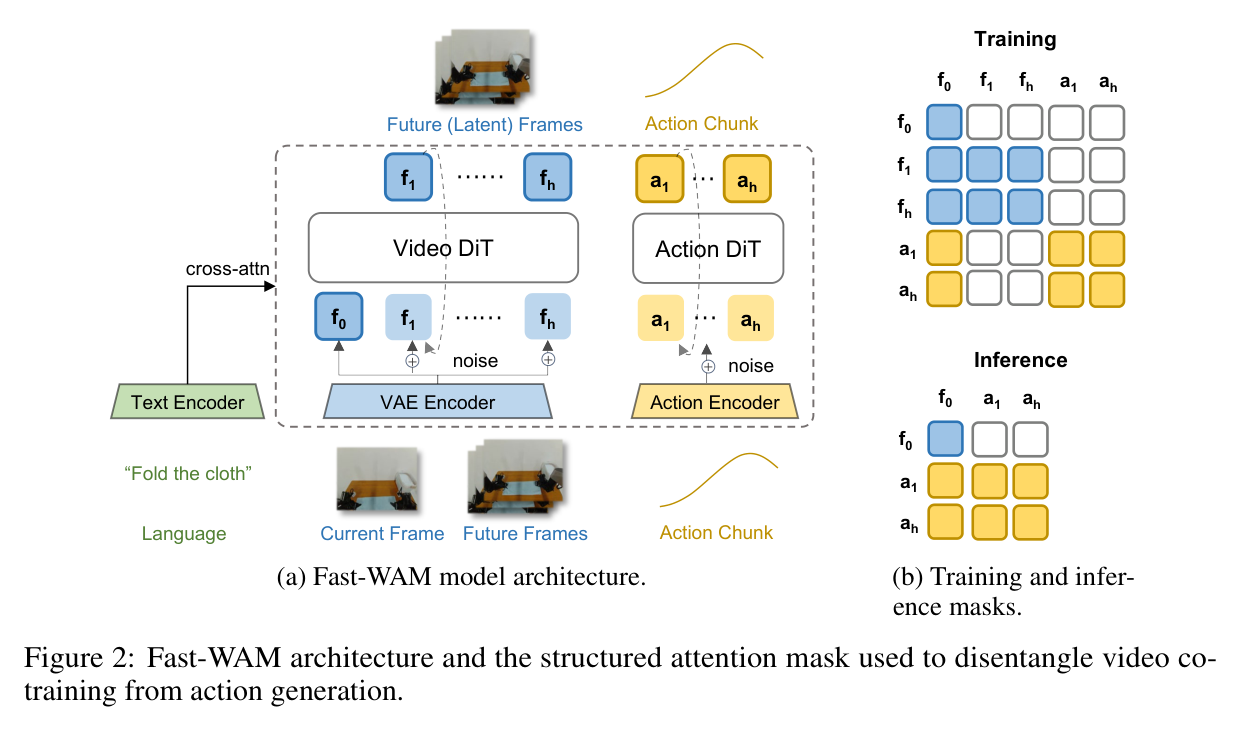
Paper's Figure 2, verbatim (caption: "Fast-WAM architecture and the structured attention mask used to disentangle video co-training from action generation." Subfig (a): MoT model architecture; subfig (b): training and inference masks).
Subfig (a) shows the MoT: a video DiT branch and an action expert DiT branch with shared attention; T5 language enters every token via cross-attention; the pretrained VAE maps observations to latent video tokens. Subfig (b) is the load-bearing detail — three token groups (clean first-frame anchor / future noisy video / action) and the mask that (during training) lets both video and action tokens read the clean anchor but blocks action→future-video, and (at inference) simply drops the future-video rows/columns so only the anchor feeds the action expert.
The information-flow contract between the three token groups is worth stating as a diagram, since the mask is easy to misread from the raster:
At inference the V node disappears; C → A (plus language cross-attention) is the entire path, executed in one forward pass.
4. 作者证明 #
无形式化作者证明 — 仅实证. The paper offers no convergence theorem, variance bound, or sample-complexity result; its claims are empirical (controlled variants). What would have been desirable is a statement that the action-marginal $p_\theta(a_{1:H}\mid z(o,l))$ recovered by single-pass encoding is close (in some divergence) to the imagine-then-execute marginal $\int p(v_{1:T}\mid o,l)\,p_\theta(a_{1:H}\mid o,l,v_{1:T})\,dv_{1:T}$ under the shared-mask training — that would formally justify deleting the future branch. Below are the 6 minimum checks against the equations the paper does state.
Notation table
| Symbol | Meaning |
|---|---|
| $o,\;l$ | current observation; task instruction |
| $a_{1:H}$ | action chunk, horizon $H$ (paper uses $h=32$) |
| $v_{1:T},\;z_{1:T}$ | future frames; their VAE latents, horizon $T$ (9 frames after 4× downsample) |
| $z(o,l)$ | latent world representation from a single backbone forward pass |
| $y,\;y_t,\;\epsilon,\;t$ | flow-matching target / interpolant / noise / time |
| $f_\theta$ | velocity-field predictor |
| $\lambda$ | weight balancing action loss vs video co-training loss |
方程物理意义 & checks
- Dimensional / type consistency. Eq. (2) integrates over $v_{1:T}$ (a distribution), Eq. (4) replaces it with a deterministic encoding $z(o,l)$. The type change (marginalize vs encode) is exactly the paper's claim; consistent. ✔
- Reduction to baseline. Eq. (3) $p_\theta(a_{1:H}\mid o,l)$ is the plain VLA conditional Eq. (1); Fast-WAM's interface degenerates to a VLA at test time. ✔
- Limit behavior of the objective. In Eq. (9) $\mathcal{L}=\mathcal{L}_{\mathrm{act}}+\lambda\mathcal{L}_{\mathrm{vid}}$, setting $\lambda=0$ exactly yields the "no video co-training" control variant. The ablation is a clean knob, not a confounded reconfiguration. ✔
- Flow-matching target sign. Eq. (6) regresses $f_\theta(y_t,t,o,l)$ onto $(\epsilon-y)$ with interpolant $y_t=(1-t)y+t\epsilon$ (Eq. 5), so $\partial y_t/\partial t=\epsilon-y$; the network learns the correct velocity of the linear path from data to noise. ✔
- Objective instantiation. Eqs. (7)–(8) are the same $\mathcal{L}_{\mathrm{FM}}$ applied to $y=a_{1:H}$ and $y=z_{1:T}$ — a single shared loss form across branches, which is what justifies "controlled" comparison. ✔
- Where the guarantee is missing. Nothing in Eqs. (1)–(9) proves that the mask-trained $z(o,l)$ retains the foresight that explicit $v_{1:T}$ would provide; the equivalence is asserted and then tested, not derived. Flagged as the gap. ✔
- CFG scale = 1.0 with 10 steps (§4.1) — i.e. no guidance amplification; the model relies on conditioning strength, not CFG, keeping the 190 ms budget. Copying a "standard" diffusion CFG>1 would inflate latency and possibly hurt.
- IDM variant needs ground-truth-video noise augmentation at $p=0.5$ (§4.1, following LingBot-VA) — the video-then-action control only trains stably with this; omitting it would make the baseline artificially weak and invalidate the controlled comparison.
- Multi-camera images are concatenated into one image before the VAE, and future video is temporally downsampled 4× to 9 frames — cheap tokenization choices that keep the shared-attention sequence short.
5. 实验与数据 #
Setup: Wan2.2-5B backbone (video DiT + T5 + VAE), 1B action expert (hidden $d_a=1024$), 6B total; $h=32$; 10 denoising steps, CFG=1.0; AdamW lr $1\times10^{-4}$, wd 0.01, cosine; latency on a single RTX 5090D V2 32GB. LIBERO 20k steps (500 demos × 10 tasks × 4 suites, 2000 trials); RoboTwin 2.0 30k steps (2.5k clean + 25k randomized demos, >50 tasks); real-world 60 h teleop on Galaxea R1 Lite, 30k steps.
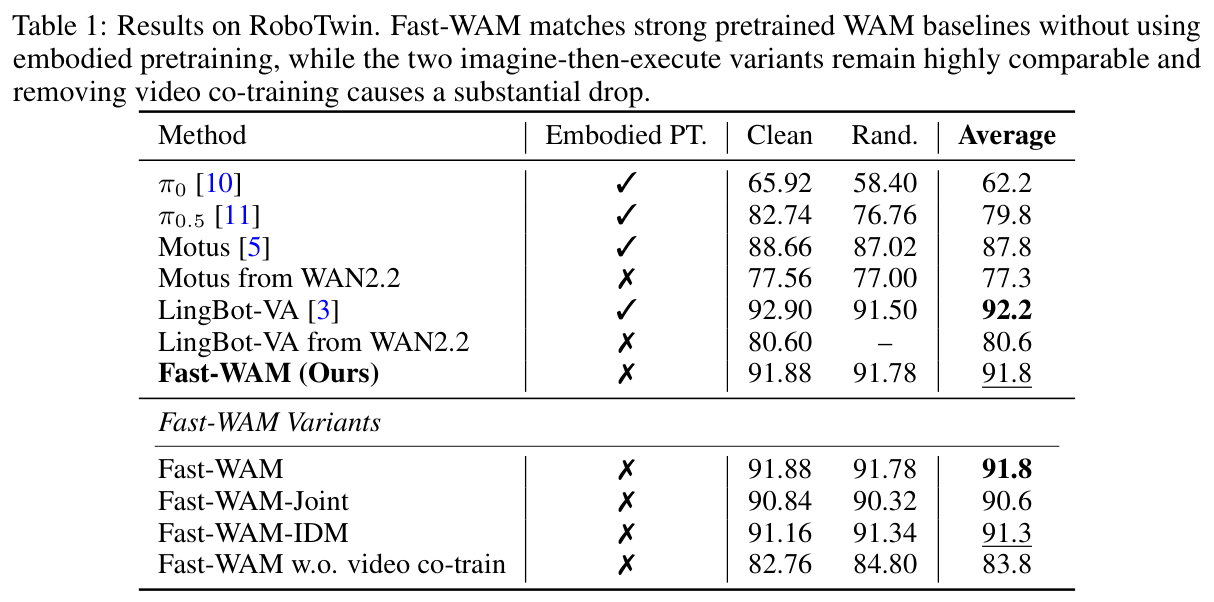
Paper's Table 1 (caption: "Results on RoboTwin. Fast-WAM matches strong pretrained WAM baselines without using embodied pretraining..."). Fast-WAM 91.8% (no PT) beats Motus-no-PT (77.3%) and LingBot-VA-no-PT (80.6%) and is within 0.4 pt of pretrained LingBot-VA (92.2%). The three co-trained variants cluster at 90.6–91.8%; the no-co-train variant sits at 83.8% — the gap that carries the thesis.
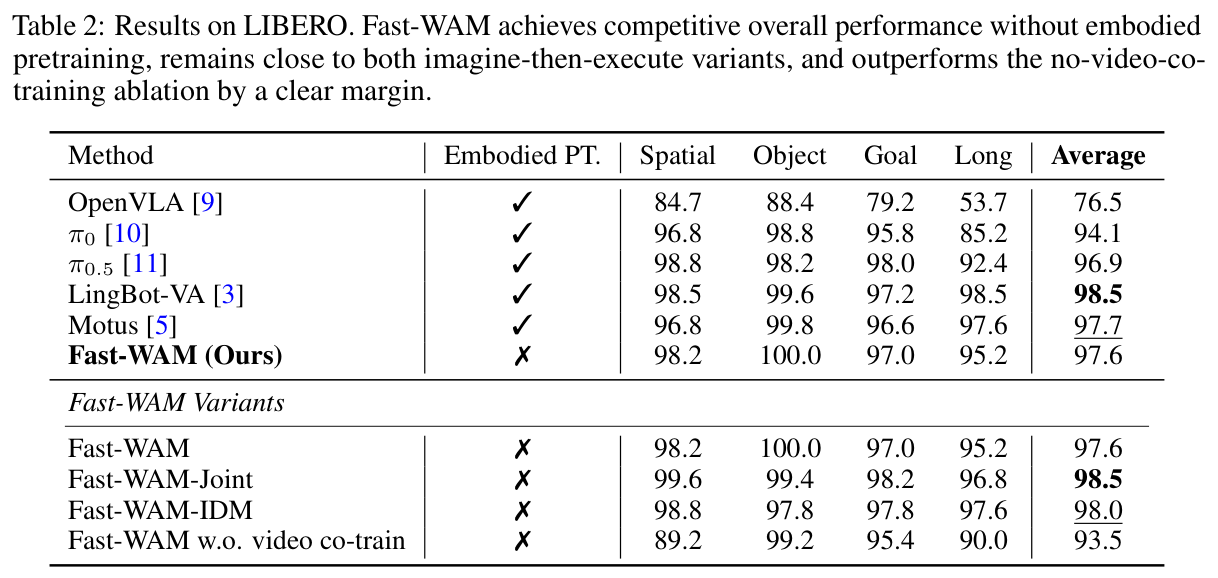
Paper's Table 2 (caption: "Results on LIBERO. Fast-WAM achieves competitive overall performance without embodied pretraining..."). Fast-WAM 97.6% avg beats $\pi_{0.5}$ (96.9%), essentially ties pretrained WAMs (98.5% / 97.7%). Removing co-training drops to 93.5% with the damage concentrated on Spatial (98.2→89.2) and Long (95.2→90.0) — the suites needing spatial/temporal world structure, which is exactly what the video objective should supply.

Paper's Figure 4 (caption: "Real-world results on the long-horizon towel-folding task. Left: success rate vs average completion time (upper-left better). Right: inference latency. Fast-WAM achieves strong real-world performance with substantially lower latency..."). Left panel: all co-trained Fast-WAM variants beat $\pi_{0.5}$-no-PT and cluster upper-left, while no-co-train collapses to the lower-right corner (10% success, longest time). Right panel: 190 ms for Fast-WAM vs 810 ms for IDM — the efficiency headline. Note pretrained $\pi_{0.5}$ still wins the absolute upper-left; the claim is relative/efficiency, not absolute SOTA.
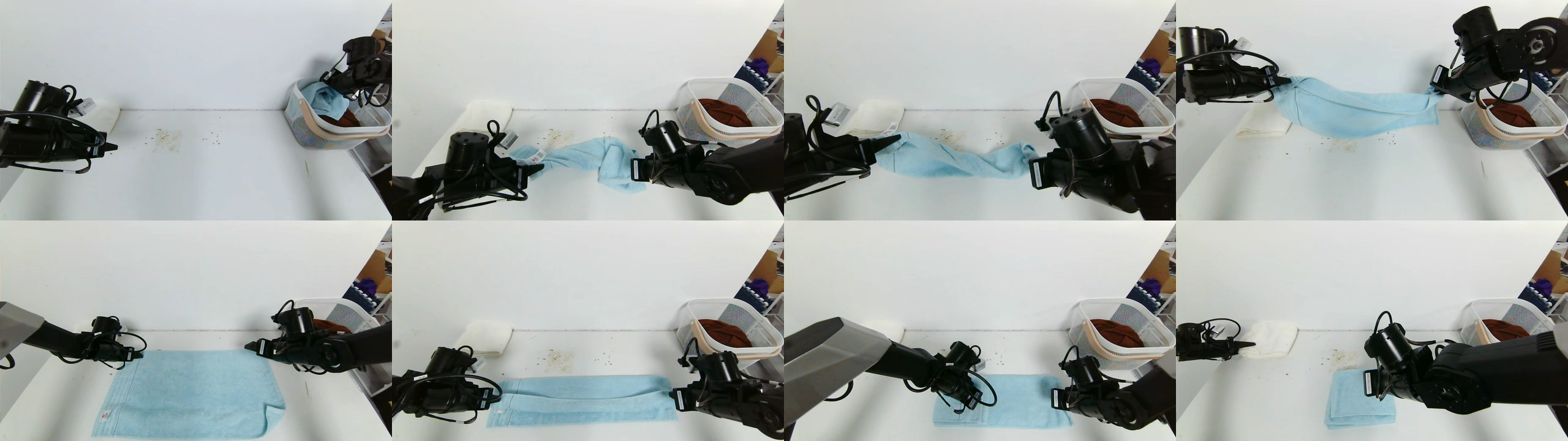
Paper's Figure 3 (caption: "Real-world towel-folding task on the Galaxea R1 Lite platform. Folding a deformable object requires long-horizon planning and precise closed-loop manipulation..."). This qualifies why the real-world result is the sharpest test: deformable-object folding needs learned dynamics, and it is exactly here that removing the video objective is catastrophic (10%), far worse than the modest simulation gaps — evidence that the objective's value grows with task physical complexity.
Per-task RoboTwin detail (Table 3, tab3.png) shows the aggregate hides fragility: Fast-WAM-Joint scores only 3%/14% on Open Microwave, and the no-co-train variant occasionally ties or beats the full model on individual tasks (e.g. Open Laptop, Handover Mic) despite its aggregate/real-world collapse.
6. 论证链 #
| # | Step | Support (paper-internal) |
|---|---|---|
| 1 | WAM benefit could come from the training objective OR from test-time imagination; prior work entangles them. | §1 para 2; Eq. (2) factorization |
| 2 | Build one framework where the only differences are (a) inference structure (direct / joint / IDM) and (b) presence of $\mathcal{L}_{\mathrm{vid}}$ ($\lambda>0$ vs $\lambda=0$). | §3.3; Eq. (9); shared backbone/tokenizer/recipe |
| 3 | Varying inference structure (Fast-WAM vs Joint vs IDM) moves accuracy ≤1–2 pts on both sims. | Table 1 (91.8/90.6/91.3), Table 2 (97.6/98.5/98.0) |
| 4 | Removing $\mathcal{L}_{\mathrm{vid}}$ moves accuracy 4–8 pts (sim) and ~80 pts (real world). | Tables 1–2 (→83.8 / →93.5); Fig 4 (→10%) |
| 5 | Therefore the training objective, not test-time imagination, is the dominant factor; the direct-policy interface is safe to adopt. | §4.3.2–4.3.3 conclusion; Fig 4 latency 190 ms |
7. 实现 cross-reference #
[实现未公开] — no code repository is referenced in the L1 source; reproduction rests on the described recipe.
核心技术壁垒 (elaborated). The single hardest thing to replicate is the training-time attention mask that lets the shared video DiT be shaped by the future-video objective without the action expert ever consuming future-video tokens. Concretely (§3.2): future noisy video tokens attend bidirectionally within the video branch and read the clean first-frame anchor; action tokens attend bidirectionally within the action branch and read the same anchor; action tokens are forbidden from attending to future-video tokens; the clean anchor has no incoming edges. Because the action expert is trained to read only the anchor-conditioned representation, deleting the future branch at inference introduces no input-distribution shift for it — that is why single-pass encoding matches imagine-then-execute accuracy. Get this mask wrong (e.g. allow action→future-video during training) and the action expert becomes dependent on imagined frames, so dropping them at test time would break it.
关键实现细节 (easy-to-miss).