From Hallucination to Structure Snowballing: The Alignment Tax of Constrained Decoding in LLM Reflection
From Hallucination to Structure Snowballing: The Alignment Tax of Constrained Decoding in LLM Reflection — L2 #
1. TL;DR #
Forcing an 8B model (Qwen3-8B) to do structured self-reflection via Outlines FSM-constrained decoding does not improve self-correction — accuracy drops 50.0%→38.0% and 96/100 diagnoses collapse to FORMATTING_MISMATCH, trapping 58 samples in death loops. This "structure snowballing" is the alignment tax of constrained decoding.
2. Q1 / Q2 / Q3 #
Q1 — 痛点 (the problem) #
Intrinsic LLM self-correction fails on open-ended reasoning because of hallucination snowballing: during free-text reflection a model generates self-consistent but false justifications for an early error, consolidating the mistake instead of fixing it. Prior fixes (REFINER-style structured feedback) work but require an externally trained critic or symbolic tools, which destroys agent autonomy. The open question: can structured reflection be enforced purely at the decoding layer (grammar constraints, no extra training) and still disrupt error propagation? The paper's three RQs ask whether grammar-constrained reflection (RQ1) improves success, (RQ2) changes the error-propagation mechanism, and (RQ3) exposes a tension between model capacity and constraint granularity.
Q2 — 方法 (the approach) #
A ternary Reflexion-style loop — Actor $M_a$ (policy $\pi_\Theta$), Evaluator $M_e$ (binary reward vs ground truth), Reflector $M_r$ (root-cause diagnosis) — where on failure the Reflector is forced through an Outlines-compiled finite-state machine (FSM) derived from a Pydantic schema: a 5-class Error Type enum plus a string Correction_Rule. The FSM applies a per-step boolean logit mask that zeroes any token violating JSON syntax or the taxonomy enum, mathematically guaranteeing 100% schema adherence. Two design decisions ride on top: a 4+1 error taxonomy (RETRIEVAL_FOCUS, BRIDGE_FAILURE, HALLUCINATION, INFERENCE_ERROR + FORMATTING_MISMATCH) capped at 5 to avoid overloading a small model, and an upstream-first attribution strategy (diagnose only the first fatal error) to interrupt snowballing.
核心技术壁垒: The hard-to-replicate insight is not an engineering artifact — it is the causal identification that a hard logit-level constraint, intended to remove cognitive load, actually redirects the small model's finite attention budget away from semantic reasoning toward syntactic compliance. The barrier is the controlled Control-vs-Treatment isolation (same model, same retrieval, same verifier; only the decoding constraint differs) that lets the token-count surge (2,850→4,005.5) be read as a capacity signal rather than a prompt artifact. See §7.
Q3 — 结果 (the results) #
Constrained decoding is a net negative at 8B scale: accuracy 50.0%→38.0% (McNemar's $p\approx0.059$), 23 correct→wrong flips vs only 11 wrong→correct recoveries. The diagnostic taxonomy degenerates — 96/100 first-round diagnoses are FORMATTING_MISMATCH, 58 samples enter death loops. The degraded (TF) group burns 4,005.5 tokens on average vs 2,850 for the stable (TT) group: quantified "alignment tax." Yet the mechanism works precisely when the true error is superficial (the "Three"→"Three centuries" case), making constrained decoding "a highly effective syntactic aligner but a poor semantic depth-probe."
3. 架构 / 方法图 #
The paper ships no architecture figure (its 3 figures are all result plots), so the ternary loop and the FSM logit-masking mechanism are redrawn below.
The loop is standard Reflexion; the paper's contribution lives entirely inside Reflector M_r, where the free-text reflection is replaced by an FSM-constrained emission:
The upstream-first attribution constrains which error the Reflector labels: only the first fatal error in the trajectory, mirroring the BIG-Bench Mistake annotation principle, so downstream symptoms are ignored.
4. 作者证明 #
无形式化作者证明 — 仅实证. The paper contains no numbered display equations and no theorem/proof; its only formal object is the Actor policy sampling statement. Since it is an empirical study (not a model release), the model-release asks (scaling-law fit, per-module parameter breakdown, capacity budget) are N/A — this is a constrained-decoding behavior study on an off-the-shelf Qwen3-8B, not a new architecture.
Notation table (the minimal formalism, §3.3):
| Symbol | Meaning |
|---|---|
| $M_a$ | Actor model — policy function generating the reasoning trajectory |
| $M_e$ | Evaluator model — binary reward vs ground truth (here Qwen3-8B as judge) |
| $M_r$ | Reflector model — root-cause diagnosis under FSM constraint |
| $M$ | Episodic Memory — stores accumulated JSON correction rules |
| $\pi_\Theta$ | Actor policy parameterized by $\Theta$ |
| $y, x$ | generated trajectory; input context |
Physical meaning: the Actor samples a full trajectory $\mathrm{Trajectory} \sim \pi_\Theta(y|x)$; on failure $M_r$ writes one structured correction rule into $M$, which conditions the next trial. The FSM's per-step mask sets $P(\text{token}) = 0$ for any token outside the schema support, so the emission is a hard-constrained resampling of the next-token distribution.
Six load-bearing consistency checks against the reported numbers:
- Status flips sum to 100: 27 (C→C) + 23 (C→W) + 11 (W→C) + 39 (W→W) = 100. ✓ (Table A.2)
- Baseline accuracy = 50%: correct-in-baseline = C→C + C→W = 27 + 23 = 50 of 100 → 0.50. ✓
- Constrained accuracy = 38%: correct-under-constraints = C→C + W→C = 27 + 11 = 38 of 100 → 0.38. ✓ (matches Table A.1)
- Net penalty = −12 pts: 23 degradations − 11 recoveries = −12 → 50%→38%. ✓
- Error distribution near-degenerate: 96 FORMATTING_MISMATCH + 4 RETRIEVAL_FOCUS = 100 first-round diagnoses; the other 3 taxonomy classes never fire → "4+1" effectively "1+1". ✓ (Table A.3 vs §3.1)
- Significance caveat: McNemar's $p\approx0.059 > 0.05$ — the headline penalty is only marginally significant; conclusions rest on the mechanism (token surge, error collapse), not on the accuracy delta alone.
- Pairing error type ↔ correction format is what makes constraints occasionally succeed. The schema forces the Reflector to emit a deterministic, copy-paste correction rule tied to the labeled error type (
FORMATTING_MISMATCH→ "use exact formatFinish[Three centuries]"). This executable rigidity — not the diagnosis quality — is what overwrites the Actor's generation inertia in the recovered samples. Note the failure inverse: in the appendix Lawson case the Trial-3RETRIEVAL_FOCUSrule gives factually wrong advice yet the Actor still succeeds, showing the correction rule's format matters more than its content. - Same model for Actor, Evaluator, and Judge (Qwen3-8B) is a deliberate variance-control choice (avoids capability mismatch / cross-model scoring bias) but silently caps the study: the evaluator cannot exceed the actor's semantic ceiling, so "deep" errors can go undetected by construction — a confound the death-loop result partly reflects.
- Scale saturation/inversion: at what parameter scale (the paper speculates 70B-class) does a rigid taxonomy stop being a syntactic aligner and start enabling deep logical debugging? The alignment tax is hypothesized to shrink with capacity but is untested here.
- Metric confound: because HotpotQA uses static exact-match, the residual error pool is dominated by string-matching brittleness (survivor bias), which structurally favors FORMATTING_MISMATCH. Would execution-based benchmarks (definitive logical failures) reverse the conclusion?
- Transfer: does the "constraint redirects finite attention" effect hold for non-QA modalities, or is it specific to the discrete-answer HotpotQA format where formatting is the last-mile failure?
- Taxonomy design: the 4+1 taxonomy collapsed to effectively 1 class at 8B — is the cap of 5 too coarse, or is the model simply incapable of populating the reasoning-error classes regardless of taxonomy?
5. 实验与数据 #
Setup: HotpotQA distractor (2 gold + 8 distractor paragraphs), Qwen3-8B for Actor+Evaluator, temperature 0.1, max 1024 tokens/gen, LLM-as-a-judge for semantic-equivalence filtering. A 1,000-sample pilot (631 correct first-try) was cleaned to a hard 100-sample set split into Pool A (55 baseline-solved in trials 2–5, metric = Average Trajectories) and Pool B (45 baseline-failed, metric = Success Rate). Control = free-text Reflexion; Treatment = FSM-constrained Logic-Guided Reflexion.
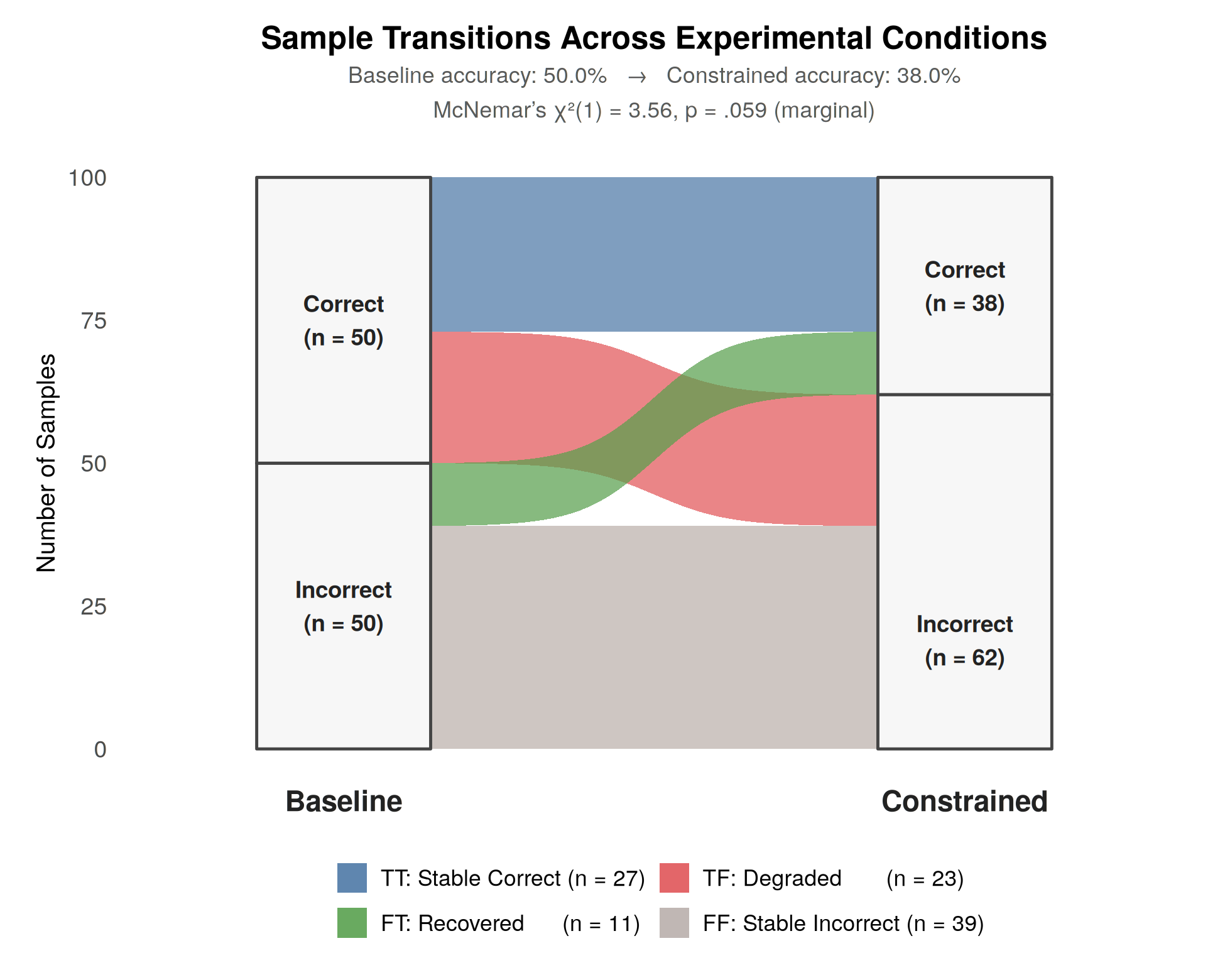
Paper's Figure 1 (fig:result_alluvial; caption empty in source). The alluvial diagram visualizes the four status-flip flows behind Table A.2: 23 correct→wrong degradations (the TF group) dominate the 11 wrong→correct recoveries (FT group), so the net accuracy movement is downward. The reader should notice the thick correct→wrong band — this is the visual signature of the alignment tax hurting more samples than it saves.
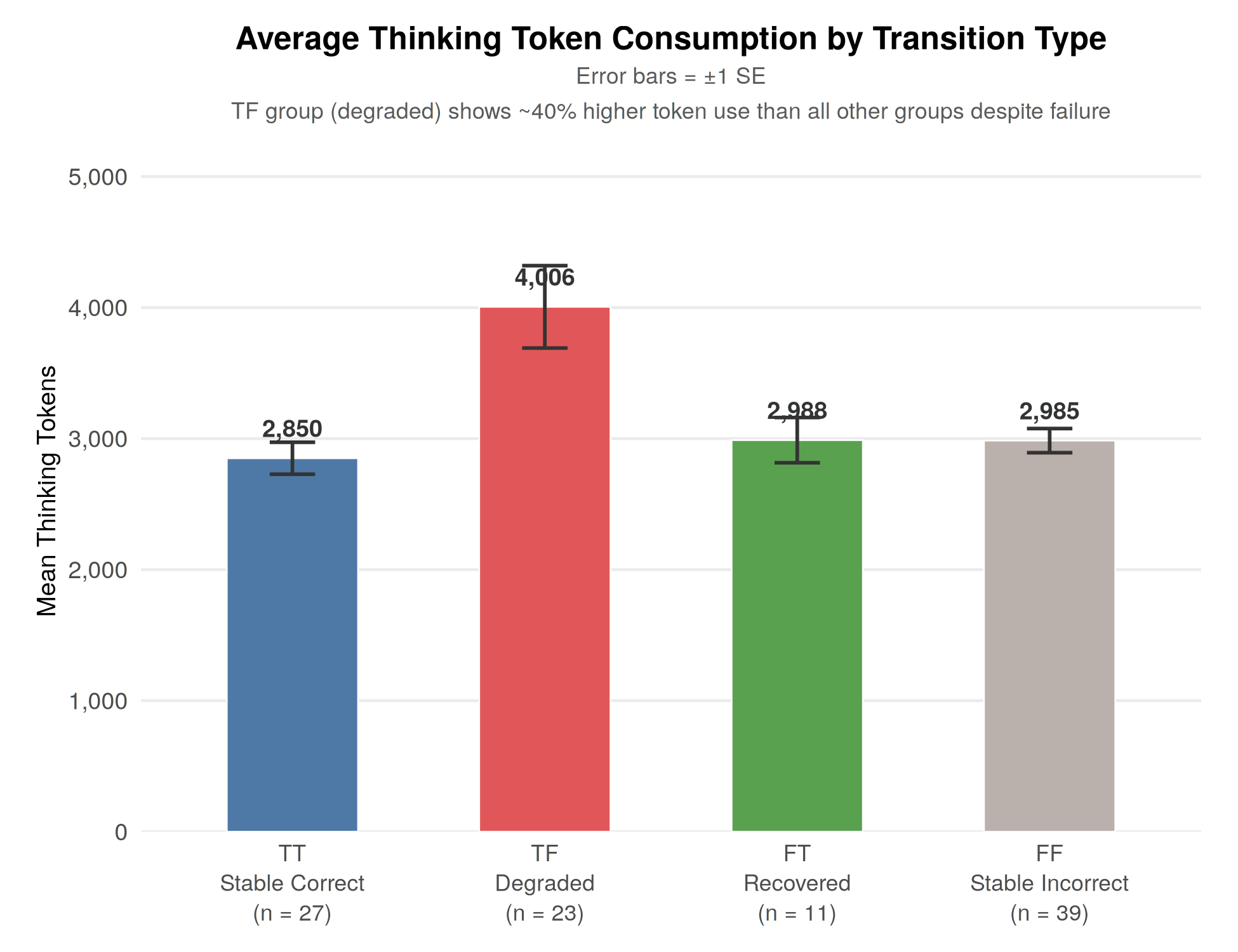
Paper's Figure 2 (fig:token_count; caption empty in source). The bar chart contrasts token consumption across outcome groups: the stable TT group averages 2,850 thinking tokens while the degraded TF group surges to 4,005.5 before failing. This ~40% token inflation is the paper's core quantitative evidence for the alignment tax — the model spends more compute yet fails, indicating the extra tokens go to syntactic thrashing rather than useful reasoning.
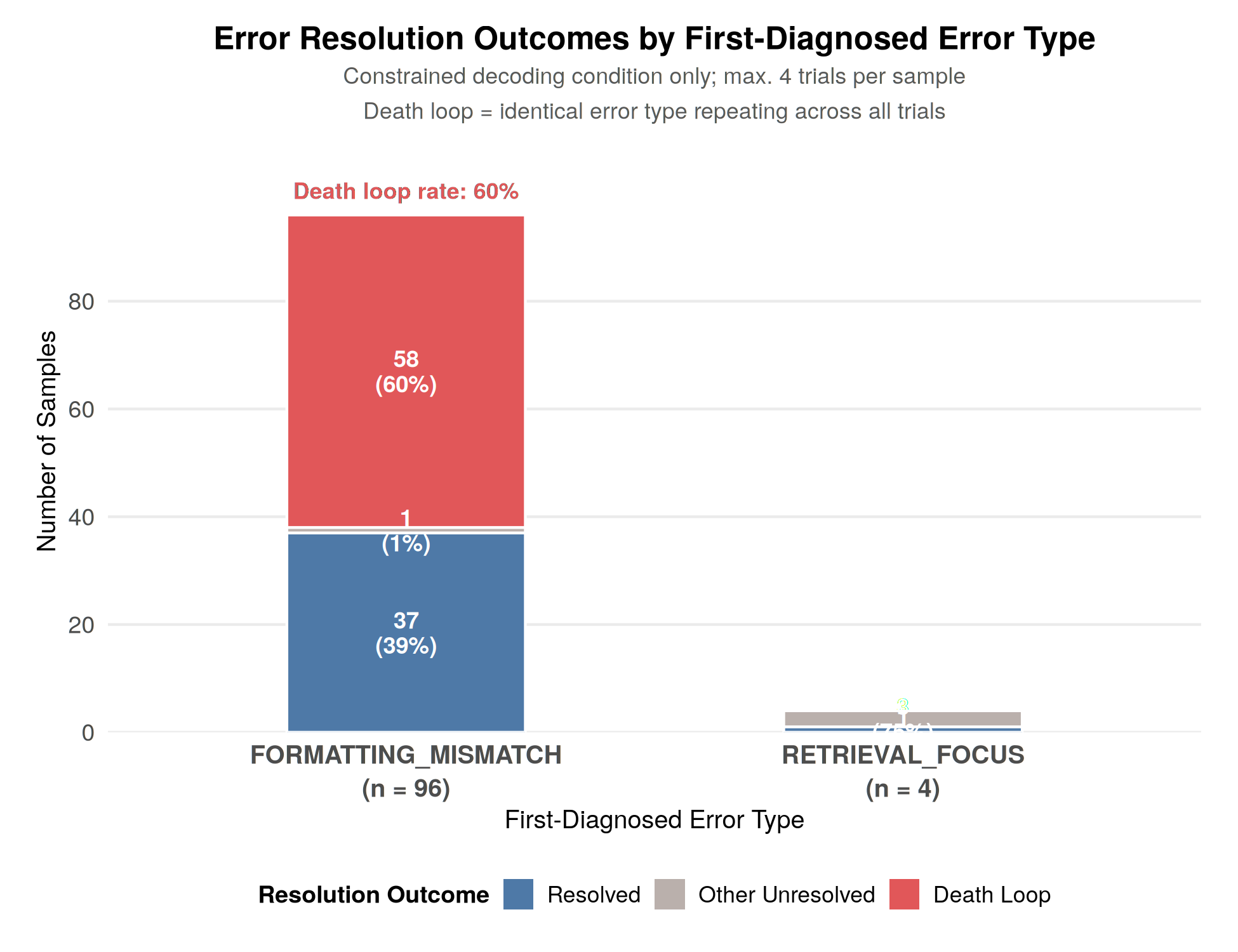
Paper's Figure 3 (fig:error_reso; caption empty in source). The chart shows how each diagnosed error type resolves; FORMATTING_MISMATCH (96/100 first-round diagnoses) leads far more often to death loops than to successful saves (~60% → death loop per source). This is the "formatting trap" made visible: the dominant diagnosis is also the least productive one, confirming that structured feedback failed to route the model toward the real (retrieval/inference) fallacies.
Supporting quantitative tables (appendix):
| Method | Accuracy | Avg Trials | Success@1 | Success@≤2 |
|---|---|---|---|---|
| Baseline | 0.50 | 0.63 | -- | -- |
| Constrained | 0.38 | 0.41 | 0.00 | 0.80 |
| Error Type | Count | % |
|---|---|---|
| Formatting Mismatch | 96 | 96% |
| Retrieval Focus | 4 | 4% |
The "dwelling place of the dead" case study (§5.4) is the dialectical counter-example: free-text reflection produces an accurate semantic self-diagnosis yet the Actor stubbornly repeats Finish[Three]; the constrained Reflector instead emits an executable Correction_Rule: Use the exact format: Action: Finish[Three centuries] that overwrites generation inertia and succeeds — proving constrained decoding wins exactly when the true error is superficial string-matching.
6. 论证链 #
| # | Step | Paper-internal support |
|---|---|---|
| 1 | Free-text reflection fails via hallucination snowballing; existing structured fixes need trained critics/tools, breaking autonomy. | §1–§2 (Reflexion, Huang, REFINER) |
| 2 | Therefore enforce structure purely at decode via Outlines FSM (5-class taxonomy + upstream-first attribution), guaranteeing 100% schema adherence with no training. | §3.1–§3.3 |
| 3 | Under identical Control/Treatment isolation, constrained decoding lowers accuracy 50.0%→38.0% (23 degradations vs 11 recoveries). | §5.1, Fig 1, Table A.1–A.2 |
| 4 | The mechanism is a token/compute surge (TT 2,850 vs TF 4,005.5): the model redirects attention to syntactic compliance ("alignment tax"). | §5.2, Fig 2 |
| 5 | Diagnoses collapse to FORMATTING_MISMATCH (96/100), trapping 58 samples in death loops ("structure snowballing"). | §5.3, Fig 3, Table A.3 |
| 6 | But when the true error is superficial, the constrained rule executes a deterministic fix (case study), so constrained decoding = good syntactic aligner, poor semantic depth-probe. | §5.4 |
7. 实现 cross-reference #
Official code exists — github.com/hongxuzhou/agentic_llm_structured_self_critique (per abstract) — but no specific file paths are cited in the paper, so architecture-level claims map to the L1-recorded design rather than to file:line: [实现未公开 — repo存在但论文未给出文件行号锚点].
核心技术壁垒 (elaborated): The single hardest thing to replicate is not the Outlines FSM (that is off-the-shelf) but the interpretation apparatus that turns a token-count difference into a capacity claim. Reproducing the finding requires: (a) filtering a saturated benchmark down to genuinely hard samples so the residual failures are reasoning failures, not shortcuts (the 1,000→100 cleaning with LLM-as-judge); (b) holding retrieval + verifier fixed so the only varying factor is the decode constraint; and (c) separating Pool A (efficiency, AT) from Pool B (capability ceiling, SR) so the alignment tax is measured on the population where it can actually manifest. Without this design the token surge would be dismissible as prompt noise.
关键实现细节 (easy-to-miss tricks):
8. Serving / deployment considerations #
Not a serving-oriented paper, but two deployment takeaways: (1) hard grammar constraints are cheap per token (Outlines adds minimal overhead) yet expensive per task on small models because they inflate trial count and token budget (avg 3,183 tokens, max 8,976 per Table A.4) — a throughput trap for agent loops. (2) The proposed mitigation is a dynamic fallback: if an agent repeats a constrained correction without environmental success, temporarily lift the decoding constraint (return to free-text or roll back a reasoning node, ToT-style), which is a schedulable serving-layer policy rather than a model change.
9. Open questions #
Appendix: 模型架构图 #
N/A — 该论文不是模型发布 (model release),未引入新架构;被评估对象为现成的 Qwen3-8B,论文贡献在解码层约束与自我纠错行为分析,因此代码驱动的 A1–A6 逐块架构图不适用。核心机制图 (ternary loop + FSM logit-mask) 已在 §3 给出。