Qualixar OS: A Universal Operating System for AI Agent Orchestration
Qualixar OS: A Universal Operating System for AI Agent Orchestration — L2 #
§1 TL;DR #
Qualixar OS 是首个应用层级的 AI agent 编排操作系统,通过 12 种 multi-agent 执行拓扑、LLM 驱动的自动团队设计(Forge)、三层 meta-learning 模型路由、8 模块质量保障流水线(含 Goodhart 检测与 JSD 漂移监控),以及 Claw Bridge 框架兼容层,统一了 10 个 LLM provider 和 8+ agent 框架的编排。20 任务定制评测 100% 准确率、\$0.000039/task;但自改进循环未达统计显著($p=0.578$)。
§2 痛点 / 方法 / 结果 #
Q1 痛点 #
当前 AI agent 生态碎片化严重:AutoGen、CrewAI、MetaGPT、LangGraph 等框架互不兼容,开发者在一个框架中构建的 agent 无法在另一个中运行,且缺乏统一的成本追踪、质量保障和管理界面。AIOS 提出了 kernel-level agent OS 概念,但聚焦资源调度而非编排关注点(拓扑、团队设计、成本优化、用户体验)。
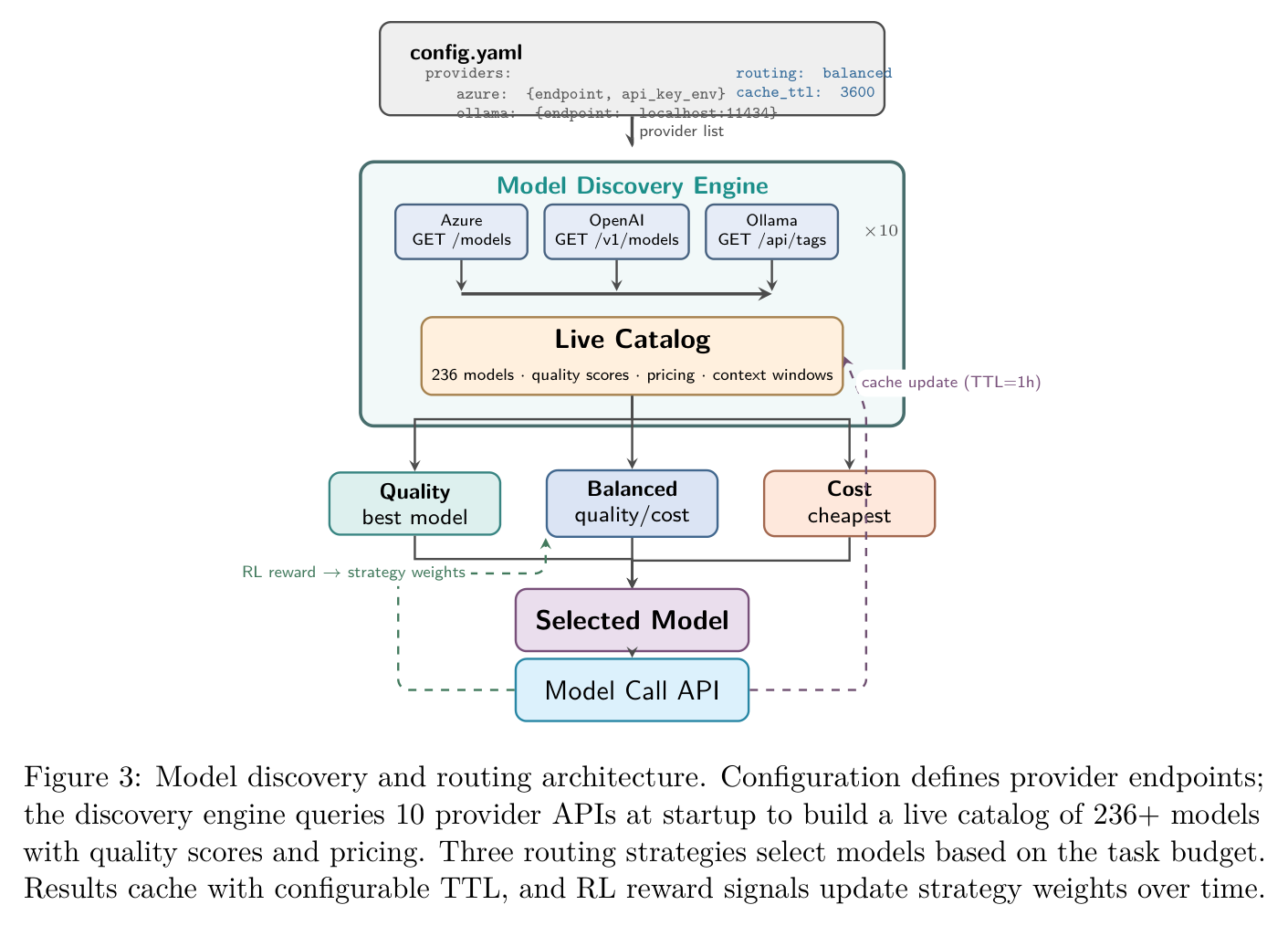
Paper's Figure 3, verbatim (caption: "Model discovery and routing architecture. Configuration defines provider endpoints; the discovery engine queries 10 provider APIs at startup to build a live catalog of 236+ models with quality scores and pricing. Three routing strategies select models based on the task budget.").
图 3 展示了碎片化问题的一个具体维度:10 个 provider 各有不同的 catalog API 和认证方式,模型发现和统一路由本身就是一个非平凡的工程问题。
Q2 方法 #
Qualixar OS 在应用层提供完整的 agent 编排运行时,核心设计包含六层架构:
- 12 种执行拓扑——涵盖 sequential、parallel、hierarchical、DAG、mixture、debate、mesh、star、circular、grid、forest、maker,每种有形式化终止条件和消息传递语义。其中 grid(2D 细胞自动机式邻居精炼)、forest(多树并行层级合成)、maker(民主投票制)为新颖拓扑。
- Forge 自动团队设计——LLM 驱动的 meta-cognitive 设计引擎,接受自然语言任务描述和预算约束,输出 $(\\mathcal{A}, \\tau, \\mathcal{T}, \\mathcal{M})$(角色、拓扑、工具映射、模型映射),带历史策略记忆和渐进升级(refinement → radical redesign → human escalation)。
- 三层模型路由——meta-layer($\epsilon$-greedy contextual bandit 选策略)→ strategy layer(cascade / cheapest / quality / balanced / POMDP)→ belief layer(Bayesian POMDP 在 low/medium/high quality 隐状态上维护信念分布)。
- 8 模块质量保障流水线——consensus judge pipeline(三种共识算法 + Shannon 熵分歧度量)、Goodhart 检测(cross-model entropy + calibration delta + score inflation + diversity collapse)、JSD 漂移监控($\Theta=0.877$)、self-evolution trilemma 导航(4 escape hatches)、Design-by-Contract 行为契约、Forge 记忆防护。
- 四层内容归因——可见署名、HMAC-SHA256 签名、零宽字符隐写水印、OpenTimestamps 区块链时间戳。
- 通用兼容——Claw Bridge 导入 OpenClaw / NemoClaw / DeerFlow / GitAgent 四种格式;双向 MCP 和 A2A v0.3 协议支持。
- 20 任务定制评测 100% 准确率(7 L1 + 7 L2 + 6 L3),均价 \$0.000039/task,均耗 3,996ms
- 2,821 测试用例覆盖 217 种事件类型和 8 个质量模块
- 自改进循环基准:3 轮迭代分数从 0.564 → 0.519,$p=0.578$,未达统计显著;作者坦承为 "negative preliminary result"
- 模型发现验证:Azure AI Foundry 返回 236 个模型,GPT-5.4-mini 端到端调用成功
- Goodhart medium-risk 时轮换 judge 模型而非仅告警——检测到 medium risk 后直接 rotate judge model,high risk 时丢弃当前评估轮次并用全新 judge panel 重跑,而非简单降级或标记。
- Forge memory guard 的最小多样性约束——
forge_designs表在 rolling window eviction 前检查每种拓扑类型至少有 ≥2 个存活设计,防止系统 "遗忘" 某种拓扑的使用方式(catastrophic forgetting prevention at the strategy level)。
核心技术壁垒:8 模块质量保障流水线中 Goodhart 检测与 JSD 漂移监控的集成。Cross-model entropy 需要 ≥50 次评估窗口才能产生可靠信号,JSD 阈值 $\Theta=0.877$ 来自 AgentAssert 的 18K session 标定——这意味着复现者不仅需要实现检测逻辑,还需要足够的评估规模来标定阈值,且需处理参考分布 $P_0$ 假设平稳性的限制。将 Goodhart 检测、漂移监控与 trilemma 导航统一在一个 Forge → Judge → RL 反馈循环中并保持架构防火墙,是系统层面最难复现的设计。
Q3 结果 #
关键 caveat:100% 准确率仅限定制评测(无 web browsing / file manipulation / multi-tool orchestration),未在 SWE-Bench、HumanEval、MINT 等标准基准上评估。
§3 架构 / 方法图 #
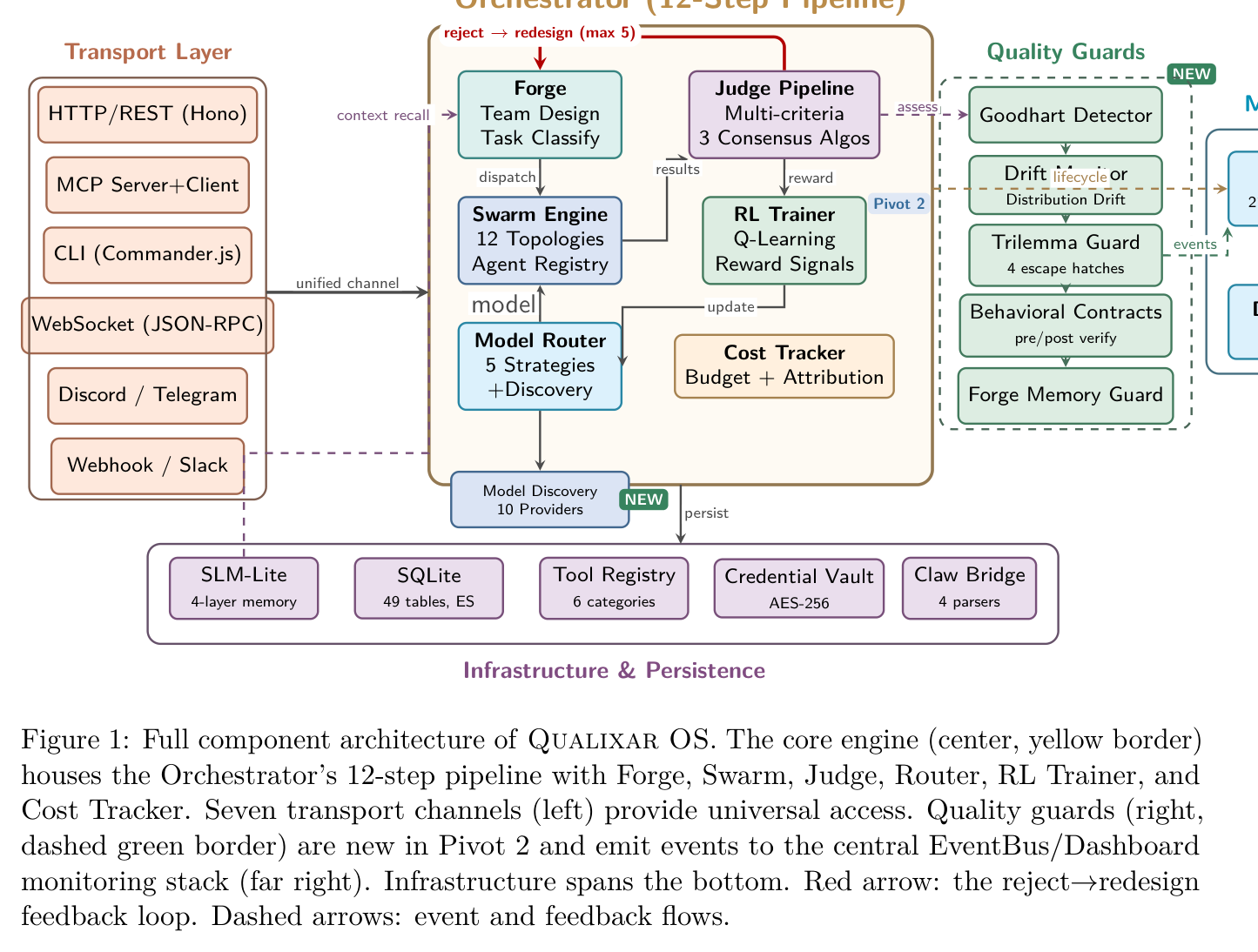
Paper's Figure 1, verbatim (caption: "Full component architecture of Qualixar OS. The core engine (center, yellow border) houses the Orchestrator's 12-step pipeline with Forge, Swarm, Judge, Router, RL Trainer, and Cost Tracker. Seven transport channels (left) provide universal access. Quality guards (right, dashed green border) are new in Pivot 2 and emit events to the central EventBus/Dashboard monitoring stack (far right). Infrastructure spans the bottom. Red arrow: the reject → redesign feedback loop. Dashed arrows: event and feedback flows.").
系统分六层:Presentation(24-tab React dashboard + Glassmorphism 2.0 + Zustand 1,077 行)→ Transport(7 通道:HTTP/REST、MCP 双向、CLI、Discord、Telegram、Webhook、Slack)→ Orchestration(12-step pipeline)→ Execution(SwarmEngine + 5-state agent lifecycle: $\text{idle} \rightarrow \text{working} \rightarrow \text{paused/error/terminated}$)→ Infrastructure(SLM-Lite 认知记忆、tool registry、MCP consumer、AES-256 credential vault、Claw Bridge)→ Persistence(SQLite 49 表 + FTS5 + 30+ 索引 + event sourcing)。
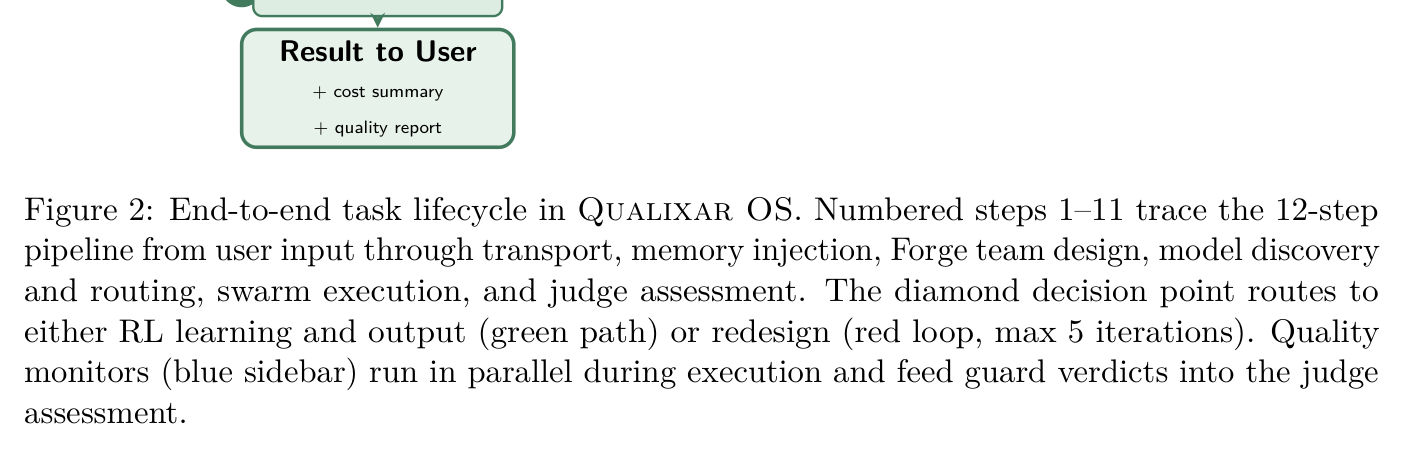
Paper's Figure 2, verbatim (caption: "End-to-end task lifecycle in Qualixar OS. Numbered steps 1–11 trace the 12-step pipeline from user input through transport, memory injection, Forge team design, model discovery and routing, swarm execution, and judge assessment. The diamond decision point routes to either RL learning and output (green path) or redesign (red loop, max 5 iterations).").
12-step orchestrator pipeline(orchestrator.ts 923 行)是系统的主干:Initialize → Memory Injection → Forge Design → Simulation(仅 Power mode)→ Security Validation → Swarm Execution → Judge Assessment → Redesign Loop(reject 时回到 step 3,最多 5 轮,$3\times$ 预算上限)→ RL Learning → Behavior Capture → Output Formatting → Finalize。Steering 在每个 major step 之间检查暂停/重定向/取消状态(paused 时 100ms 轮询,1 小时超时)。
12 Topologies] H --> I[Judge Assessment
Consensus Pipeline] I --> J{Approved?} J -->|Yes| K[RL Learning] J -->|No, count<5| D J -->|No, count=5 or 3×B| L[Human Escalation] K --> M[Output + Attribution]
§4 作者证明 #
符号表 #
| 符号 | 含义 | 首次出现 |
|---|---|---|
| $P_0$ | 参考评分分布(judge 初始标定) | §7.3 |
| $P_t$ | 时刻 $t$ 的当前评分分布 | §7.3 |
| $M$ | 混合分布 $(P_0 + P_t)/2$ | §7.3 |
| $D_{\text{KL}}$ | Kullback–Leibler 散度 | §7.3 |
| $\Theta$ | JSD 漂移阈值(= 0.877) | §7.3 |
| $H$ | Shannon 熵(共识分歧度量) | §7.1.2 |
| $T$ | 记忆信任分数 | §8.1 |
| $C, R, D, V$ | 来源可信度、矛盾分数、时间衰减、交叉验证 | §8.1 |
| $\mathcal{A}, \tau, \mathcal{T}, \mathcal{M}$ | Forge 输出:角色集、拓扑、工具映射、模型映射 | §4.1 |
| $B$ | 预算约束 | §4.1 |
| $\epsilon$ | Bandit 探索率 | §6.1 |
方程物理意义 #
Eq. 1 — JSD 漂移检测(§7.3):
$$\text{JSD}(P_0 \| P_t) = \frac{1}{2} D_{\text{KL}}(P_0 \| M) + \frac{1}{2} D_{\text{KL}}(P_t \| M), \quad M = \frac{P_0 + P_t}{2}$$
JSD 是对称、有界(0–1)的分布差异度量。相比原始 KL 散度,JSD 始终有限且对称,适合在线监控场景。当 $\text{JSD} > \Theta = 0.877$ 时触发 judge 暂停和分布快照记录。物理意义:衡量 judge 评分分布相对于初始标定的偏移程度,>0.877 表示分布已发生实质性漂移。
Shannon 熵(§7.1.2):
$$H = -\sum p_i \log p_i$$
用作三种共识算法(weighted majority、BFT-inspired、Raft-inspired)的分歧度量。$H$ 低表示 judges 高度一致,$H$ 高表示分歧大。
信任分数(§8.1):
$$T = C \cdot (1 - R) \cdot D \cdot V$$
乘法结构意味着任一因子归零则信任为零——高矛盾($R \to 1$)直接摧毁信任,无论来源可信度多高。
6 项检查 #
| # | 检查内容 | 结果 |
|---|---|---|
| 1 | JSD 对称性与有界性 | ✓ — JSD 定义保证 $0 \leq \text{JSD} \leq 1$,论文正确使用对称形式 |
| 2 | $\Theta=0.877$ 来源 | ⚠ — 来自 AgentAssert [3] 的 18K session 标定,未在 Qualixar OS 的 judge 分布上独立验证;迁移性未讨论 |
| 3 | 信任分数零点行为 | ✓ — 乘法结构确保单因子归零即全零,符合设计意图 |
| 4 | POMDP 信念分布归一化 | ✓ — 论文描述信念 floor/ceiling guards 防止退化分布 |
| 5 | 行为契约终止保证 | ✓ — Redesign loop 有硬上限(5 轮或 $3\times$ 预算),pre-stage 违约 fail-fast |
| 6 | Goodhart 检测最小窗口 | ⚠ — 需 ≥50 次评估才能产生可靠信号,低频任务场景下检测窗口过大(论文 §12 自认限制) |
§5 实验与数据 #
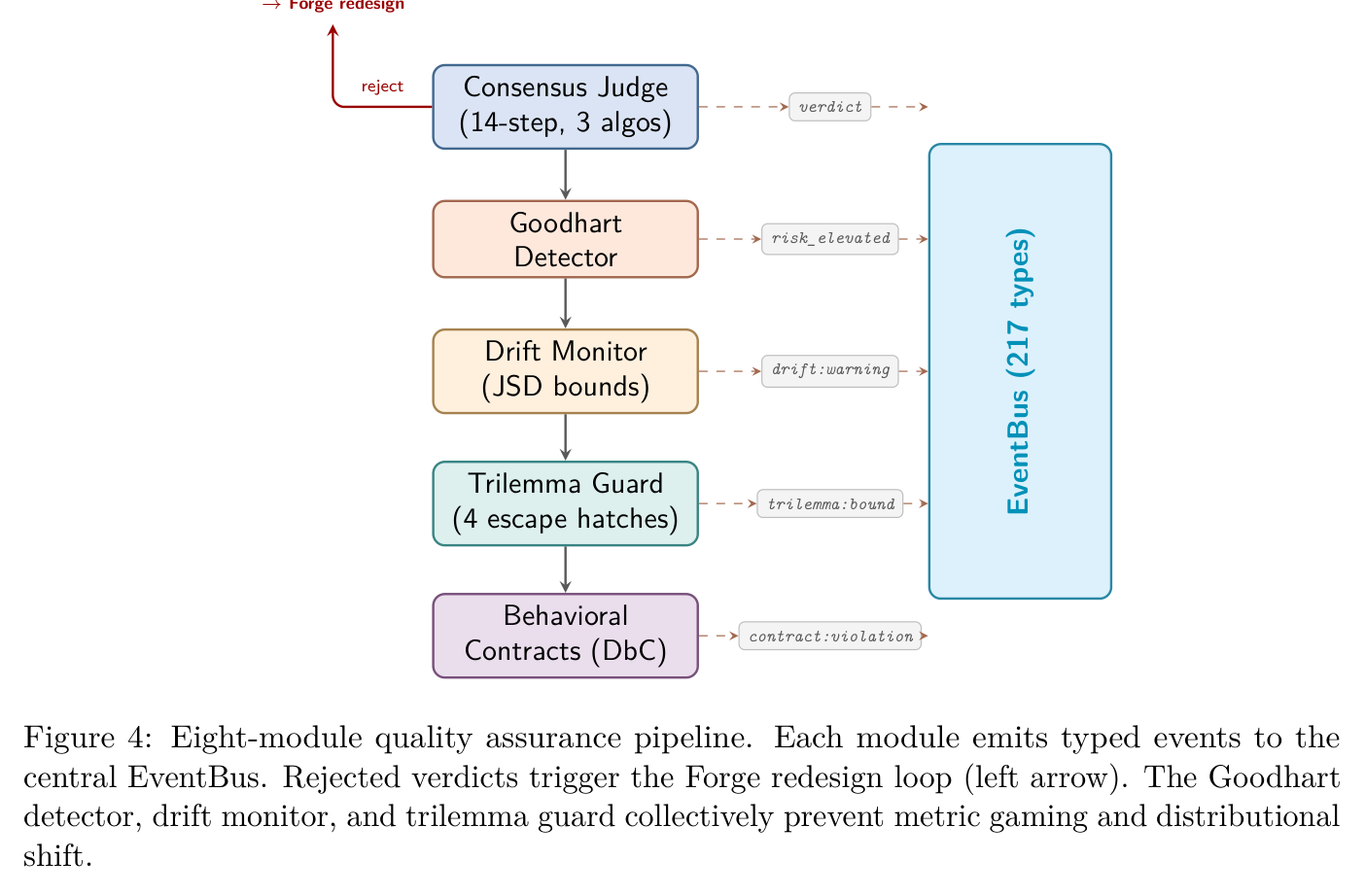
Paper's Figure 4, verbatim (caption: "Eight-module quality assurance pipeline. Each module emits typed events to the central EventBus. Rejected verdicts trigger the Forge redesign loop (left arrow). The Goodhart detector, drift monitor, and trilemma guard collectively prevent metric gaming and distributional shift.").
质量保障流水线是系统最独特的组件。8 个模块(consensus judge、Goodhart detector、drift monitor、trilemma guard、behavioral contracts、memory guard + anti-fabrication + drift pre-check)并行运行于 swarm 执行期间,通过 EventBus 发射事件。reject verdict 触发 Forge redesign loop,形成闭环。
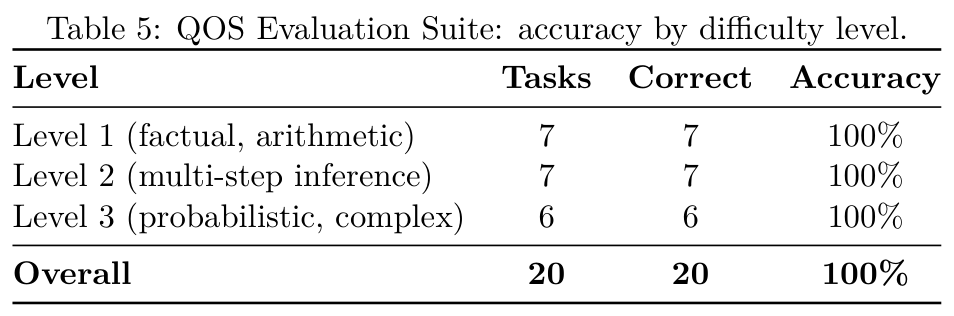
Paper's Table 5, verbatim.
20 任务评测(GPT-5.4-mini on Azure AI Foundry)结果:全部 3 个难度级别 100% 准确率,均价 \$0.000039/task。但论文自身 caveat 明确指出这些任务不包含 web browsing、file manipulation 或 multi-tool orchestration——恰恰是 "OS" 框架应当编排的能力。19/20 精确匹配,1 个模糊匹配(G18, "About 50%")。
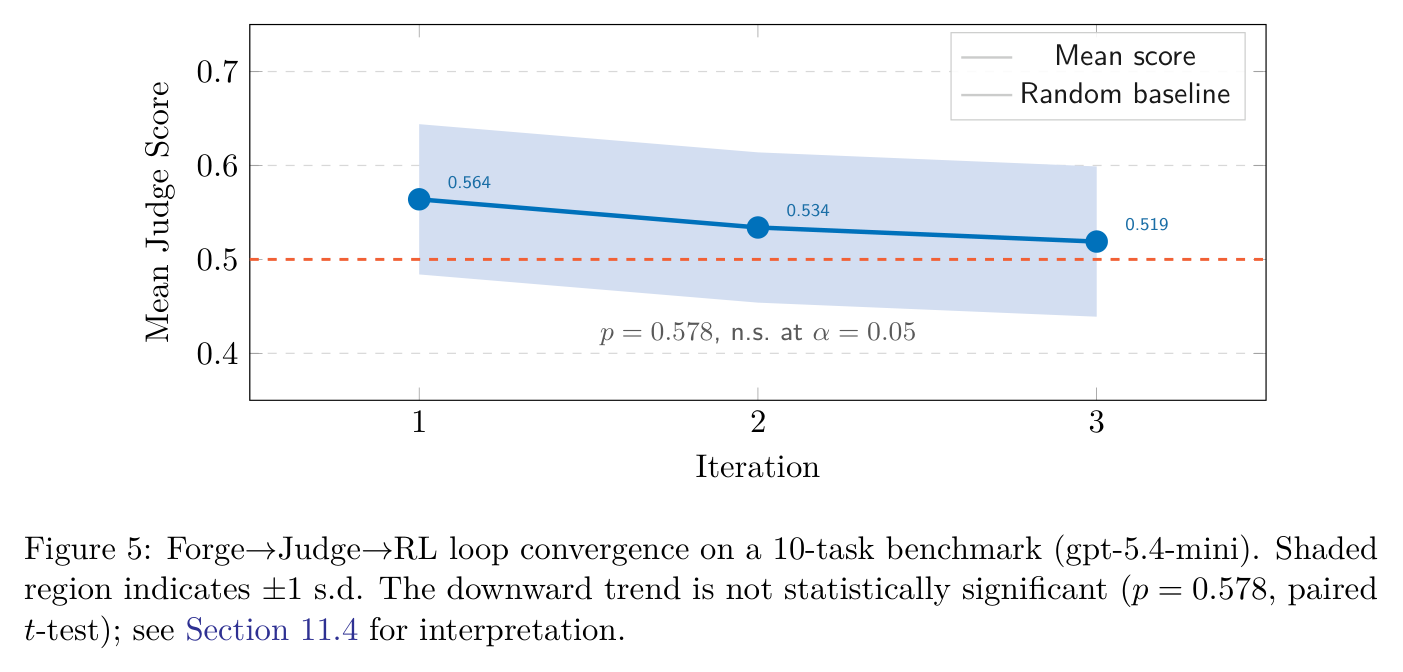
Paper's Figure 5, verbatim (caption: "Forge → Judge → RL loop convergence on a 10-task benchmark (gpt-5.4-mini). Shaded region indicates ±1 s.d. The downward trend is not statistically significant (p=0.578, paired t-test).").
自改进循环是论文最诚实的结果:3 轮迭代分数从 0.564 降至 0.519,$p=0.578$,远未达显著。作者将其归因于简化的 simulation harness 而非根本性限制。值得注意的是,6/10 任务报告为 "converged (score ≥ 0.8)"——但这些可能是初始分数已高于 0.8 的任务,而非通过迭代改进达到的。
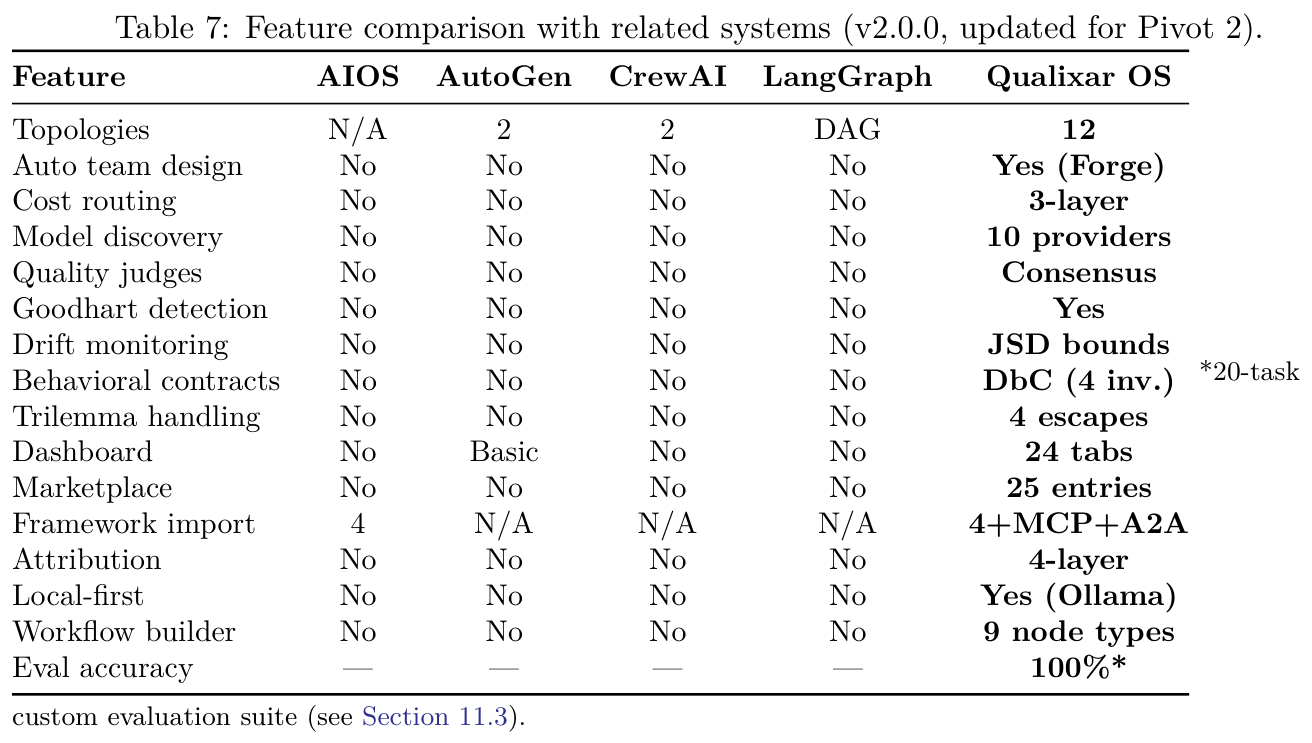
Paper's Table 7, verbatim.
特征对比表在 15 个维度上对所有竞品标注 "No" 或 "N/A",未给出部分功能重叠的 partial credit(如 AIOS 的 memory management 与 SLM-Lite 的比较)。该表的信息价值在于功能清单,而非严格的定量对比。
§6 论证链 #
| 步骤 | 论点 | 支撑 | 方向 |
|---|---|---|---|
| 1 | Agent 框架碎片化是生产部署的核心障碍 | §1: AutoGen/CrewAI/MetaGPT/LangGraph 互不兼容,无统一成本追踪或质量保障;84% 组织使用 AI 但仅 33% 信任输出 | 前提 → 2 |
| 2 | 需要应用层 OS(而非 kernel-level)来统一编排 | §1–2: AIOS 聚焦资源调度;Qualixar OS 聚焦编排关注点(拓扑、团队设计、成本、质量、UX);二者互补 | 2 → 3 |
| 3 | 12 种拓扑 + Forge 自动团队设计覆盖多样执行模式 | §4–5: Algorithm 1 的 library lookup + LLM adapt/generate 分支;12 种拓扑含形式化终止条件;grid/forest/maker 为新颖贡献 | 3 → 4 |
| 4 | 三层模型路由实现成本-质量-延迟多目标优化 | §6: $\epsilon$-greedy bandit → 5 策略 → POMDP 信念更新;扩展 FrugalGPT 单目标级联和 RouteLLM 二元路由 | 4 → 5 |
| 5 | 8 模块质量流水线防止自改进循环中的 metric gaming | §7: Goodhart 检测 + JSD 漂移 ($\Theta=0.877$) + trilemma 4 escape hatches + DbC 行为契约;但自改进循环 empirical 验证未达显著($p=0.578$) | 5 → 结论 |
论证链弱点:步骤 5 的 empirical 支撑不足——质量流水线的理论设计完备,但自改进循环(Forge → Judge → RL)在实际基准上分数下降而非上升,论文承认需 full-pipeline validation。
§7 实现 cross-reference #
论文提供了详尽的文件级代码引用:
| 组件 | 文件 | 行数 |
|---|---|---|
| Orchestrator pipeline | orchestrator.ts | 923 |
| Forge team design | forge.ts | 528 |
| Consensus judge | judge-pipeline.ts | 507 |
| Consensus algorithms | consensus.ts | 259 |
| Q-learning router | q-learning-router.ts | 375 |
| Model router (5 strategies) | model-router.ts | 457 |
| POMDP belief layer | pomdp.ts | 218 |
| Model call (10 providers) | model-call.ts | 1,122 |
| Model discovery | model-discovery.ts | 380 |
| Goodhart detector | goodhart-detector.ts | 290 |
| Drift bounds | drift-bounds.ts | 250 |
| Forge memory guard | forge-guard.ts | 180 |
| Belief graph | belief-graph.ts | 487 |
| Mode engine | mode-engine.ts | 200 |
| Workflow converter | workflow-converter.ts | 314 |
| Loop benchmark | loop-benchmark.ts | 250 |
| Zustand state management | dashboard (React 19) | 1,077 |
| SLM-Lite memory | src/memory/ (11 files) | ~2,100 |
| Compatibility bridge | src/compatibility/ | 2,604 (test lines) |
代码开源于 https://github.com/qualixar/qualixar-os(Elastic License 2.0,非 OSI 批准的开源许可证——限制将软件作为托管服务提供)。
核心技术壁垒(实现层面):Goodhart 检测的 4 信号(cross-model entropy、calibration delta、score inflation、diversity collapse)与 JSD 漂移监控的集成需要:(1) 足够的评估量(≥50 次)用于熵信号标定;(2) 可靠的参考分布 $P_0$(假设初始标定无异常);(3) 检测 → judge 轮换 → 重评的闭环控制逻辑。论文给出了 goodhart-detector.ts 290 行和 drift-bounds.ts 250 行的具体实现。
关键实现细节: