From Agent Loops to Structured Graphs: A Scheduler-Theoretic Framework for LLM Agent Execution
From Agent Loops to Structured Graphs: A Scheduler-Theoretic Framework for LLM Agent Execution #
Hu Wei | 2026-04 | https://arxiv.org/abs/2604.11378 Category: agent | Tags: framework, scheduling, dag, position-paper, agent-runtime Read: 2026-04-18
Core Contribution #
将 LLM agent 的执行系统统一为一个 scheduler 模型 $\mathcal{E}=(\mathcal{S},\mathcal{U},\mathcal{P},\mathcal{O},\Delta)$,用 ready-set 基数 $|\mathcal{U}|$ 把 Agent Loop 和 graph-based executor 放到同一条连续谱上,并据此提出一个牺牲表达力换可控性的静态 DAG 执行框架 Structured Graph Harness (SGH)。
Summary #
Motivation:主流 LLM agent 采用 Agent Loop——单个 LLM 不断读取增长中的 context window 决定下一步。作者指出这个范式有三个结构性缺陷:(1) 步骤依赖是隐式的、不可验证的;(2) 失败恢复没有边界语义,LLM 可以无限 replan;(3) 执行计划可被 LLM 静默重写,事后无法构造忠实的 audit trail。作者在 70 个开源 agent 项目中观察到 60% 都是 Agent Loop 变体,问题不是个例。
Method:作者把所有 agent 执行系统形式化为 $(\mathcal{S},\mathcal{U},\mathcal{P},\mathcal{O},\Delta)$ 五元组,关键观察是:Agent Loop 是 $|\mathcal{U}|\le1$ 的 single-ready-unit scheduler,$\mathcal{P}$ 是 LLM 推理这个 "不可检查的非确定策略";而 graph executor 则可以达到 $|\mathcal{U}|\ge 1$。基于这个视角,作者提出 SGH——把控制流从 context 里 "拉" 到一个显式静态 DAG 里,并做三个设计承诺:(1) plan 在单个 version 内不可变;(2) planning / execution / recovery 三层严格分离;(3) recovery 遵守三级严格升级协议 local_retry → local_patch → request_replan,跳级禁止。同时形式化了节点状态机(10 个状态,证明了有界终止和 conditional soundness),以及 all_of / any_of join 语义(显式排除 first_of 竞争性并行)。
Results:这是一篇 position paper + design proposal,没有实现也没有实验数据。主要 "结果" 是:(1) 一个可比较 Agent Loop / LangGraph / Airflow / TDP 等 70 个系统的统一框架;(2) 四条设计原则和明确的牺牲/收益表;(3) 状态机的 termination 和 soundness 证明;(4) 一个七组对照的实验 protocol (G0–G6),把总增益分解为 $G_{\text{plan}}, G_{\text{scaffold}}, G_{\text{graph}}, G_{\text{patch}}, G_{\text{replan}}$ 五个可归因分量。
Key Findings #
- Agent Loop 的本质局限不是 "提示不够好",而是 $|\mathcal{U}|=1$ 的 scheduler 结构——加 planner、加 reflection 都改不了这一点,只有显式 DAG 才能让 $|\mathcal{U}|\ge 1$。
- OpenAI parallel tool calls / 异步操作虽然有 $|\mathcal{U}|>1$,但策略仍然非确定(LLM 决定哪些并行),不构成 "结构性并行"。
- 70 个项目调研中 graph/flow 系统的 failure-loop 行为明显更常见(4 个里有 3 个),state-machine 系统几乎没有;作者把这个归因于 unbounded recovery 而非 graph 本身。
- Soundness 不是绝对的。Contract validation 的正确率 $p_v$ 对 syntactic check 接近 1,对 LLM-based semantic check 可能远低于 1,因此 $\Pr[\text{all correct}]\ge \prod_v p_v$ 的 validation gap 不可消除,只能通过 side-effect 分类 + human-in-the-loop 缓解。
- 明确排除
first_of竞争性并行、递归子图展开、parent-chain rollback、动态拓扑修改——这些能力每一个都对应 violate 某条设计原则,不是疏忽。 - 自嘲式坦白:如果 planner 生成的是一条线性链(无 parallel branch),SGH 就退化为 single-ready-unit scheduler,多出来的价值只剩 bounded recovery + 审计 + context 隔离。作者估计 60-70% 任务其实是线性的。
Limitations #
- 纯理论文章,无 prototype,无 benchmark 结果。所有 "graph gain > 0" 都是 theoretical prediction。
- 静态 DAG 假设对 exploratory / creative / 未知 root-cause 的调试任务天然不成立。
- 多就绪单元并行会放大 planner 的错误:一旦 DAG 错了(漏依赖 / 伪依赖 / 粒度错),会在多个并行分支上同时浪费 token。
- Cold start:没有可复用 DAG 模板的新任务里,planner 要从零构造 DAG,其收益可能被摊销不掉。
- 实现复杂度高:粗估 3300–6500 行生产级代码,是 Agent Loop 的 10 倍。
- 调研方法论本身不严格(70 个项目是主观挑选、人工分类、κ=0.84 的两人评审),论文多处自承 "qualitative evidence"。
Infrastructure Impact #
- Algorithm: 不直接影响模型训练,但给 agent 训练数据合成提供一个结构化视角——节点级 trace + plan version 可作为高质量 SFT / RL 数据格式。
- Kernel: N/A——论文不涉及 GPU kernel。间接影响:多就绪单元并行会提高对多请求并发推理吞吐的需求,偏好 continuous batching + prefix cache 友好的 serving。
- Framework: 这是 framework 层的核心工作。对 vLLM/SGLang 的启示是:agent serving 需要把每个 node 看成独立 request,对 plan-level 的 KV / prefix cache 复用要有显式接口,同时支持多 ready node 并发调度。
- LLM: 不要求模型改动,但对 LLM 的 output contract / structured output / function calling 稳定性提出更高要求——contract validation 失败直接触发 recovery。
- Agent: 本论文的主战场。提供了一个把 LangGraph / CrewAI / Claude Code / OpenAI Codex agent 放在同一坐标系里量化比较的语言,把 "是否可审计 / 是否有界 / 是否可并行" 变成可测量的设计轴。
- Cluster: N/A。
- Hardware: N/A。
- Code: 提出了一个可实现的 3300-6500 行参考架构,对想写结构化 agent runtime 的工程团队是一个蓝图。
Deep Analysis (agent) #
时代定位 (Era Positioning) #
2025-2026 年 agent 领域正在经历从 "Agent Loop 野蛮生长" 到 "Graph orchestration 沉淀" 的拐点:LangGraph / AutoGen / CrewAI / AFlow / TDP / DynTaskMAS 都在往 graph 结构靠,但各家都只解决局部问题(LangGraph 要灵活,TDP 要 context 隔离,DynTaskMAS 要并行)。此时缺一个 能把这些系统放在同一尺度上比较的理论框架——这就是本文的时机位。它不是一个新系统,而是一个 命名和坐标系,相当于把 "为什么 Agent Loop 不够用" 从工程直觉升格为 $|\mathcal{U}|\le1$ 的形式化命题。
约束推导 (Constraint Derivation) #
作者实质上在做一个 "为什么不可 X" 的穷举:
- 为何不可继续用 Agent Loop? $|\mathcal{U}|\le 1$,无法表达并行、无法保证 dependency、recovery 由 LLM 自由决定导致 failure loop(survey 中 Agent Loop 项目普遍无 recovery 上限)。
- 为何不可用 LangGraph/AFlow 这种动态图? 动态图允许 runtime add_node/add_edge,plan mid-execution 就被改写,audit trail 变成移动目标。survey 观察到 versioned-history 系统调试成功率显著更高,即使作者承认 κ 低。
- 为何不可支持
first_of竞争性并行? 两个原因:(a) loser cancellation 需要 compensation protocol 回滚副作用,引入新失败模式;(b) commit-point 歧义——A 先成功但 B 可能质量更高,语义不明确。 - 为何不可递归子图展开? $|V|$ 无界,ready set 不可预测,违反 bounded termination。
- 为何不可 parent-chain rollback? 违反 plan invariant(immutable within version)。
这些约束最终 "挤" 出了 SGH 的设计空间:静态 DAG + all_of/any_of + 三级 recovery + plan versioning。每个排除都映射到某条原则,不是任意选择。
可行性矩阵(简化版,基于论文 Table 6/7):
| Approach | Multi-ready | Deterministic $\mathcal{P}$ | Bounded recovery | Immutable plan | LLM-aware |
|---|---|---|---|---|---|
| Agent Loop | ✗ | ✗ | ✗ | ✗ | ✗ (隐式) |
| Plan-and-Act | ✗ | ✗ | ✗ | 部分 | 部分 |
| TDP | ✗ | ✗ | ✗ | mutable | 部分 |
| LangGraph | ✓ | semi | ✗ | mutable | 部分 |
| Airflow/Luigi/Prefect | ✓ | ✓ | ✓ | ✓ | ✗ |
| SGH | ✓ | ✓ | ✓ | ✓ | ✓ |
SGH 是唯一同时满足五列的位置。
破局 (Insight) #
"Agent Loop 不是一种特别的架构,它就是 $|\mathcal{U}|=1$ 的一种 scheduler"——这个 reframing 是全文的 aha moment。一旦换上 scheduler 视角,经典 DAG scheduling 半个世纪的积累(list scheduling、Kahn 拓扑、HEFT、critical path、2-1/m 近似比)立刻可以被复用到 agent 执行上。类比:相当于有人指出 "你们讨论的并不是'agent怎么思考',而是'下一个该执行哪个单元'——这本质是一个 OS scheduler 问题,而你们把它交给了一个 opaque 的 LLM。"
核心技术壁垒 (Core Technical Barrier) #
全文最硬核的一块不是 DAG 本身(这是 1960 年代的东西),而是 "在非确定 LLM 节点 + contract 验证不可靠"这两个约束下,如何仍然证明 bounded termination 和 conditional soundness。Theorem 6.2 的证明思路是:每个节点有 $\tau_v$ 超时 + $b_v$ 重试预算 + terminal state 绝对不可逆,把无限循环的可能性结构化地关进了 $\sum_v \tau_v\cdot(b_v+1) + \sum T_{\text{human}}$ 这个上界。Theorem 6.3 的 validation gap $\Pr\ge \prod p_v$ 则诚实地把 "contract 验证错误" 这个通常被业界忽略的失败模式显式写进了正确性 bound 里。这个 "bounded termination 可证 + validation gap 公开" 的组合,是把 SGH 和那些只在 README 写 "we handle retries" 的 graph 框架区分开的核心壁垒。
质疑假设 (Challenge Assumptions) #
- 假设 1:planner 能识别任务的并行结构。作者自己在 §9.3 坦白 30-40% 任务才有 "natural parallelism",其余 60-70% 是线性链。这意味着 $G_{\text{graph}}$ 在一般 workload 上可能远小于作者暗示的水平。笔者也不是十分确定 作者估计 30-40% 这个数字本身——这基于 70 个仓库的人工看(κ=0.84),仓库集合本身有选择偏差(偏向 coding agent)。
- 假设 2:plan-version immutable 是可审计性的必要条件。实际上 event sourcing + append-only log 也能做到 "mutable plan + full audit",只是需要额外存储。作者排除 mutable plan 更像是工程取舍而非理论必然。
- 假设 3:
all_of/any_of足以覆盖工程任务。作者在 §9.9 自己承认 report 节点的 all_of 过度序列化;实际上 LLM agent 面对的很多场景天然是 streaming / incremental 的,DAG 粒度无法轻易表达。 - 假设 4:contract validation 可独立做好。syntactic 验证 $p_v\approx 1$ 没问题,但 semantic 验证其实也是 LLM 在做——用一个 LLM 验证另一个 LLM 的输出,independence 假设可能不成立。
设计绑定批判 (Design Binding Critique) #
SGH 强制绑定了以下前提:
- 任务依赖可在规划时完全枚举——violates 则必须走 Level 3 replan,成本极高。
- 存在可靠的 contract 语言(JSON schema + semantic checker)——没有 schema 的任务(如 "写一段有趣的故事")无法被 SGH 保护。
- 副作用可分类——Principle 4 依赖 side-effect level,但现实中 tool 的副作用往往模糊(一个
run_shell可以 read-only 也可以 rm -rf)。 - 存在一个比 executor 更强的 planner——planner 必须强到能识别并行,否则 SGH 退化。这和 "用弱模型做 executor + 强模型做 planner" 的成本优化思路冲突。
- Planner Layer 接收 task intent,生成静态 DAG $\Pi=(\text{id}, \text{version}, V, E, \sigma, \kappa)$,附带每节点 config(action、retry policy、side-effect level)和 plan-level output contract。
- DAG Validation:检查 acyclicity (Kahn)、reachability、join consistency (
any_of必须有 $\ge 2$ 候选)、contract well-formedness、side-effect consistency。 - Runtime Layer 开始迭代:计算 $\mathcal{U}(\mathcal{S})=\{v\mid s_v=\text{ready}\land \forall(u,v)\in E: s_u=\text{executed}\}$。
- 用确定性策略 $\mathcal{P}$(默认拓扑顺序)并发分发所有 ready 节点,每节点
pending → ready → running。 - 节点执行完毕,contract validation $\kappa_v$ 通过则
running → executed,否则running → failed_retryable或failed。 - Recovery Layer 收到 failure report:先查
recovery_state[v];pristine时只允许attempt_retry,retried后才能attempt_patch,patched后才能request_replan——跳级在 API 边界被直接拒绝。 - 所有节点 terminal 后,plan version 完成。若触发 replan,生成 new plan version $v+1$,旧状态保留在 $\mathcal{C}_{\text{diag}}$ 里。
- 最适合:software engineering agent(bug fix、feature impl、code review)、data analysis pipeline(query → transform → report)、ops 场景(incident response)。这些任务的依赖可以 upfront 讲清楚。
- 不适合:deep research agent(结构是 emergent 的)、creative writing、open-ended 探索、根据中间 observation 才能决定下一步的调试。
- 服务栈位置:SGH 是 agent runtime 层,下面套 vLLM/SGLang/TRT-LLM 这种 LLM serving,上面可以是 AutoGen/LangChain 这种 app framework。它替代的是 AgentExecutor / LangGraph 这层。
- 硬件偏好:多 ready 单元并发执行意味着 serving 侧要吃 prefix cache(节点间共享 system prompt)、continuous batching、function calling 结构化输出。不对 GPU 架构有特殊要求。
- Agent type: single agent runtime,但 planner / executor / recovery 是三个独立 "component layer"(不是多 agent,只是责任分层)。
- Core loop: 不是 ReAct 也不是 plan-then-execute,是 plan-commit-then-dispatch——生成 immutable DAG → 拓扑调度 → 失败按三级升级。
- Memory mechanism: 严格的 $\mathcal{C}_{\text{exec}} \cap \mathcal{C}_{\text{diag}}=\emptyset$ 分区。执行 context 只含输入、可见 artifact、runtime state、budget;diagnostic context 只给 recovery 层,含失败历史、planner annotation、旧 plan version。论文的洞察是:用失败历史做下一步输入是 agent 失败的根源,因为它把 recovery 决策和 execution 逻辑耦合了。
- Tool use protocol: 每个节点包一个 tool call(LLM inference、function call、code exec),节点 output 必须满足 contract $\kappa_v$。Contract 默认是 JSON schema + field 存在 + 类型 check 这种 syntactic;semantic check 建议用 test suite 或另一次 LLM call。
- When to use tools: 不由 LLM 决定——由 DAG 结构决定。节点被规划时就绑定了 action,runtime 不允许偏离。这是和 ReAct 最本质的区别。
- Planning granularity: 节点级 DAG。作者承认 granularity 本身是 "the planner 必须平衡的设计决策"——粒度太粗丢失并行(under-decomposition),太细引入 serialization overhead(over-decomposition)。
- Backtrack / revise: 显式禁止 mid-execution plan modification。任何结构变化必须走 Level 3 replan 生成 plan version $v+1$,旧 version 的 trace 完整保留。
- Reasoning approach: 论文不规定 planner 内部用什么;建议可以是 LLM、template、hybrid。重点是 planner 输出要通过 DAG validation(acyclicity + reachability + join consistency + contract well-formedness + side-effect consistency)。
- Ambiguity handling: 不处理。SGH 假设 task 的 dependency 可 upfront 枚举;若不能,作者明确让用户选 LangGraph 这种 dynamic system(§9.7)。
- Plan quality evaluation: 通过 $G_{\text{plan}}=\text{Perf}(\text{G2})-\text{Perf}(\text{G1})$ 间接度量——把 "有 planner 无 graph" 和 "无 planner" 对比。但论文无实验数据。
- Tools: paper-agnostic,任意 tool。每 node 通过 NodeConfig 绑定一个 action。
- Tool description format: NodeConfig + 输出 contract $\kappa_v$。Contract 建议 JSON schema + validation rule。
- Error handling: 三级升级协议,见下面 Figure 4。
- Environment: 静态 DAG 内部。tool 是否幂等由 node 的 side-effect level 标记,高副作用不能 speculative 并行。
- Sandboxing: 靠
side_effect_level和waiting_human状态。高副作用节点可要求人工审批,超时 $T_{\text{human}}$ 自动 cancel。 - Base model: 不规定,G0 baseline 建议 GPT-4 / Claude 3.5 级别。planner 对 "能识别并行" 有较高要求——作者估计 WorfBench 显示 sequence-vs-graph planning gap 15% (§2.5),所以 planner model 要强。
- Fine-tuning: 不需要特殊 SFT/RL。Contract validation 对 structured output 的稳定性要求高,所以 function calling / JSON mode 必须可靠。
- Prompt format: planner 的 prompt 决定了 DAG 质量,但论文不提供具体 template。
- Context window: 显著短于 Agent Loop,因为每个节点只看 $\mathcal{C}_{\text{exec}}$(inputs + visible artifacts),失败历史被隔离在 $\mathcal{C}_{\text{diag}}$ 里不进入 prompt。这是对长 context 消耗的直接优化——TDP 报告过 82% token 削减(§2.2),SGH 继承这个思路。
- Latency: 多 ready 单元并发 → 在相同 wall-clock 内调用更多 LLM 请求 → 对 serving 侧的并发能力要求高。
- Benchmarks: 无。论文是 position paper,只设计了 7 组对照 protocol,未执行。
- Metrics(protocol 里定义的): Success rate、wall-clock time、token cost、node count、recovery action count、plan version count。
- Baseline comparisons(protocol 里定义的):
- G0: SOTA Loop(Claude Code / Codex agent mode)
- G1: Naive Loop(单步 LLM、无 planner)
- G2: Planner Loop
- G3: Structured Loop(scaffold, $|\mathcal{U}|=1$)
- G4: GH-Core($|\mathcal{U}|\ge 1$, 无 recovery)
- G5: GH+Patch(Level 1+2 recovery)
- G6: GH+Replan(Level 1+2+3 recovery)
- Failure analysis: 论文 §3.7 列了 planning 失败的 5 种模式:missing dep / spurious dep / incorrect branch selection / over-decomp / under-decomp。前两种 runtime 能捕获(contract violation),后三种只能靠 replan。
- Human evaluation: 不涉及。
- Reliability: 论文无数据。理论上 bounded termination(Theorem 6.2)保证 $\le\sum_v \tau_v(b_v+1)$ 时间终止;failure-loop 被 Level 3 replan 上限阻断。
- Safety: Principle 4 强制 side-effect classification;high side-effect node 不能 speculative 并行,可走
waiting_human状态做审批。 - Observability: plan version + append-only WAL + diagnostic context 三件套。作者宣称这是 Graph Harness 相对 LangGraph 的最大实用优势——"failure attribution via plan-version-audited traces"(Table 2)。
- Scalability: §9.10 列了具体实现路径——incremental ready-set 更新 O(|E_new|)、token-bucket rate limiting、WAL 持久化、Raft/Paxos leader election。作者估算生产级实现 3300-6500 LOC,是 Airflow (50K+) 的 1/10。
- 长期 stateful 会话:SGH 把 agent execution 变成一个 plan-version-scoped 的长会话,对 serving 层来说意味着要支持 plan-level KV cache 复用 + 多 node 并发调度。普通 LLM serving 假设 request 独立,SGH 打破了这个假设。
- 对模型能力的推动:planner 的质量直接决定 $G_{\text{graph}}$,所以会推动 "planning-specialized" 模型(类似 o1-preview / DeepSeek-R1 的 reasoning traces)被用作 planner layer。
- 对 serving 的新要求:不仅要高吞吐,还要支持 heterogeneous concurrency(同一 plan 内不同 node 可能跑不同 model / tool),这和现在按 model-id 分 serving pool 的做法需要抽象统一。
- 基础设施蓝图:论文 §9.10 给出的清单(incremental scheduler + WAL + Raft + rate limiter)其实就是一个 "agent runtime OS" 的雏形,未来可能会形成类似 Airflow / Temporal 但 LLM-native 的独立 category。
- Recovery API 是 SGH 可控性的"机械护栏": recovery layer 只暴露
attempt_retry(v)/attempt_patch(v, cfg)/request_replan(reason)三个入口。每个入口在 API 边界 checkrecovery_state[v]——跳级调用会被直接拒绝。作者对比 Rust 的unsafe块:只要实现尊重 API 边界,invariant 就不可能被违反。 any_ofjoin 的"loser skip"语义很微妙: 当某个候选成功后,剩余pending/ready/running/failed_retryable的 sibling 会被强制转skipped;已经 terminal 的保留原状态。这避免了做真正的 mid-execution cancellation(会触发 compensation 问题),但代价是 loser 继续跑到自然结束。- Validation gap 的实用影响: 如果用 LLM 做 semantic validation 且每个节点 $p_v=0.95$,10 个节点链的 $\Pr[\text{all correct}]\ge 0.95^{10}\approx 0.6$——即使所有节点都"通过",仍有 40% 的隐性错误概率。这解释了为什么 SGH 把 human-in-the-loop (
waiting_human) 设计成第一等公民,而不是边缘 feature。
如果任务是长期 open-ended(比如 autonomous research),上面任何一条都不成立,SGH 不适用。
拆解 (Deconstruction) #
一个任务在 SGH 下的完整生命周期:
实践上下文 (Deployment Context) #
生态影响追踪 (Ecosystem Influence) #
这篇是 2026-04 的 position paper,暂无下游采用记录。它的潜在影响路径有两条:(1) 作为学术语言被后续 graph agent 论文引用,把 "scheduler continuum" 变成标准坐标;(2) 作为工程参考,被 Claude Code / Codex / Devin 这些需要可审计性的 coding agent 借鉴 "plan versioning + three-level recovery"。值得关注的是作者自己指出的 companion paper(Evolutionary Graph Architecture),如果出来会是真正的实验验证。
1. Agent Architecture #
Figure 1: Motivating example — bug-fix DAG #
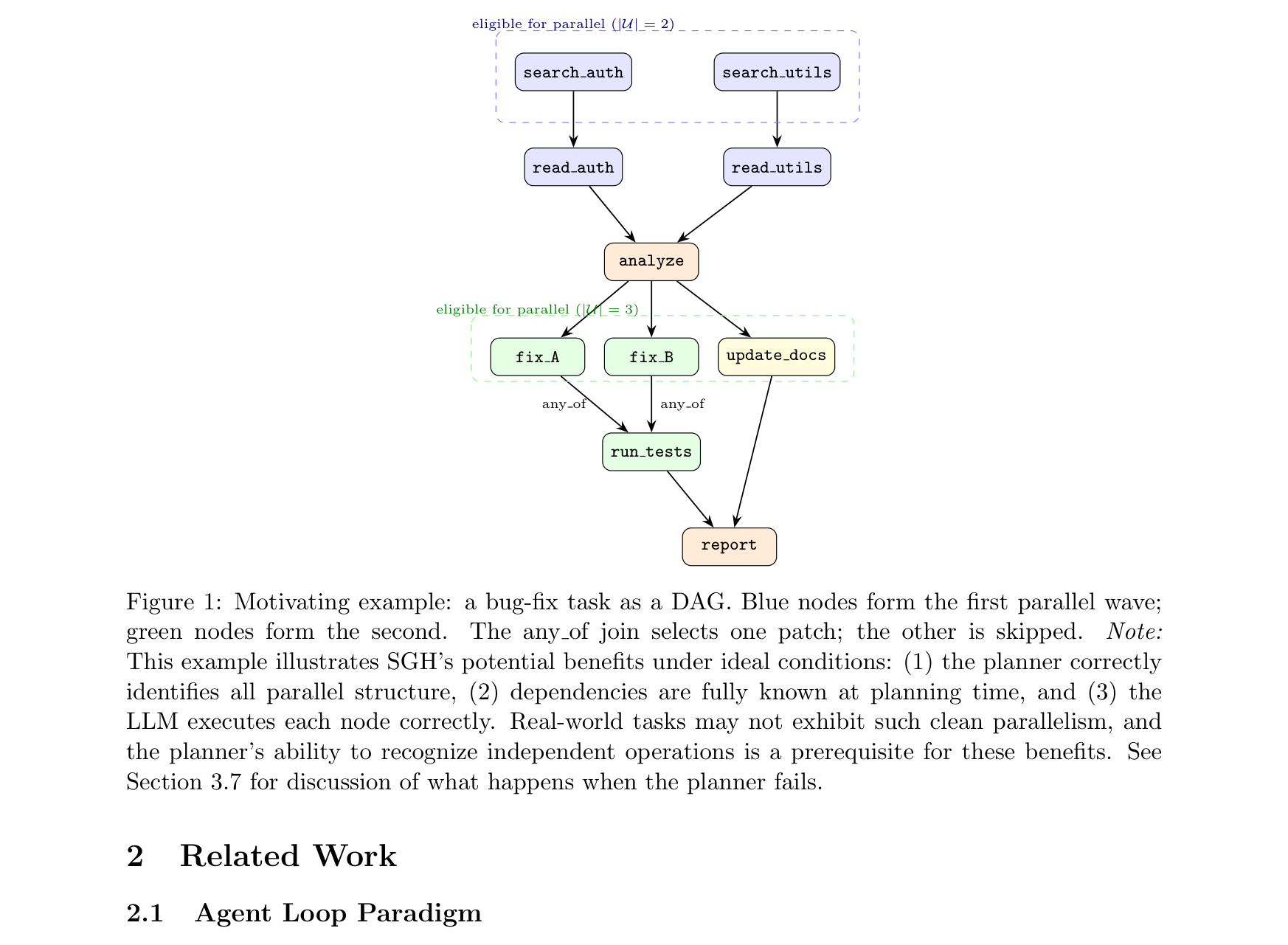
What it shows: 一个 Python bug fix 任务被分解为 10 个节点的 DAG:search_auth / search_utils 并行(蓝色 wave 1),各自触发 read_auth / read_utils 并行(绿色),汇合到 analyze,再扇出到 fix_A / fix_B / update_docs 三路并行,fix_A / fix_B 用 any_of join 接到 run_tests,最后 run_tests 和 update_docs 用 all_of 接到 report。
Why it matters: 这是全文唯一的 "soul diagram"。它同时展示了三个 SGH 核心能力——structural parallelism(搜/读两波并行,$|\mathcal{U}|=2$ / $3$)、alternative paths(any_of 让 fix_A/fix_B 任一成功即可,不用无脑重试)、explicit all_of dependency(analyze 必须等两个 read 都完成)。作者把同一任务在 Agent Loop 下跑成 11 轮串行,在 SGH 下跑成 6 个 scheduling round,直接把 "graph gain" 可视化出来。
Detailed description: 两个入口节点 search_auth / search_utils 无 predecessor。它们分别连接到 read_auth / read_utils,形成两条独立链。两条链在 analyze 用 all_of 合流。analyze 扇出到 fix_A / fix_B(都标 any_of——论文意思是它们是 run_tests 的 any_of candidates,不是 analyze 的子节点语义),同时扇出到 update_docs。fix_A / fix_B 的 any_of 边汇合到 run_tests,run_tests 和 update_docs 的 all_of 汇合到 report。论文标注了两次 $|\mathcal{U}|$ 扩张:第一波 searches 并行 ($|\mathcal{U}|=2$),第二波 fix+docs 并行 ($|\mathcal{U}|=3$)。
2. Planning & Reasoning #
3. Tool & Environment Interface #
4. LLM Backbone Requirements #
5. Evaluation #
Figure 2: The scheduler continuum #
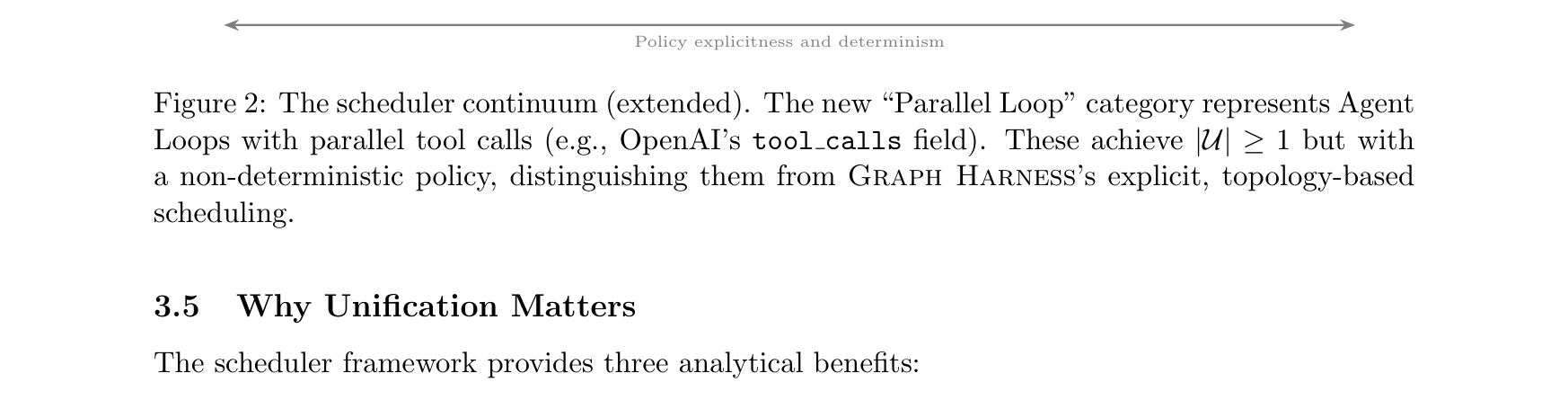
What it shows: 从左到右排列 5 种 agent 执行范式——Naive Loop → Parallel Loop → Planner Loop → Structured Loop → Graph Harness。每种标注 $|\mathcal{U}|$ 和 policy 类型。
Why it matters: 这张图是 "scheduler continuum" 理论的视觉载体,也是作者最想传播的概念图。它把 Agent Loop(1-ready,non-det)、parallel tool calls($\ge 1$-ready 但 non-det)、加 planner / scaffold 的系统(仍然 1-ready)、和真正的 SGH($\ge 1$-ready + det)放在同一条轴上,让读者一眼看出:加 planner、加 scaffold 只在 policy 轴上前进,只有真正的 graph 才能跨进多 ready 单元的象限。这直接支撑了 §3.4 的核心论点。
Detailed description: 图中 5 个方块横向排列,下方标注 "Policy explicitness and determinism" 方向。左起:Naive Loop($|\mathcal{U}|=1$, Non-det, Sequential)、Parallel Loop($|\mathcal{U}|\ge 1$, Non-det, Parallel calls)、Planner Loop($|\mathcal{U}|=1$, Non-det, Planner)、Structured Loop($|\mathcal{U}|=1$, Semi-det, Scaffold)、Graph Harness($|\mathcal{U}|\ge 1$, Det, Graph)。注意 Parallel Loop(OpenAI tool_calls)被单列出来,强调它虽然并行但策略仍不显式。
6. Multi-Agent #
N/A — SGH 是 single-agent runtime 架构,只是把 planner / executor / recovery 三个 role 分层而已。论文 §2.3 讨论过 AutoGen / CrewAI 的 multi-agent,但作者归类它们为 $|\mathcal{U}|=1$ 或 semi,并认为 multi-agent 本质上仍可以被 scheduler 框架描述——"agent count" 不是 SGH 关心的轴。
7. Infrastructure Impact #
| Layer | 影响 |
|---|---|
| Algorithm | 不直接涉及训练。间接:plan-version trace 可作为高质量 agent SFT/RL 数据格式。 |
| Kernel | 不涉及。多 ready 并发对 serving 侧意味着要吃 prefix cache(节点间共享 system prompt)、continuous batching。 |
| Framework | 核心影响层。serving 需要把每个 node 看成独立 request,且支持 plan-level 共享 prefix;agent framework 需要提供 DAG validator、state machine 实现、recovery 升级状态机、append-only WAL、token-bucket rate limiter。 |
| LLM | 对 function calling / JSON mode / structured output 的稳定性要求高,因为 contract validation 直接决定 retry 行为。模型规模上 planner ≫ executor 是自然的分层。 |
| Cost | 相比 Agent Loop:token 消耗因 context 隔离而降低(参照 TDP 82% 削减),但节点数多 + 并发 LLM 调用 → peak QPS 更高、总 tokens 不一定少。对 task-level 成本的影响是任务依赖的。 |
8. Production Readiness #
Figure 3: Three-layer separation #
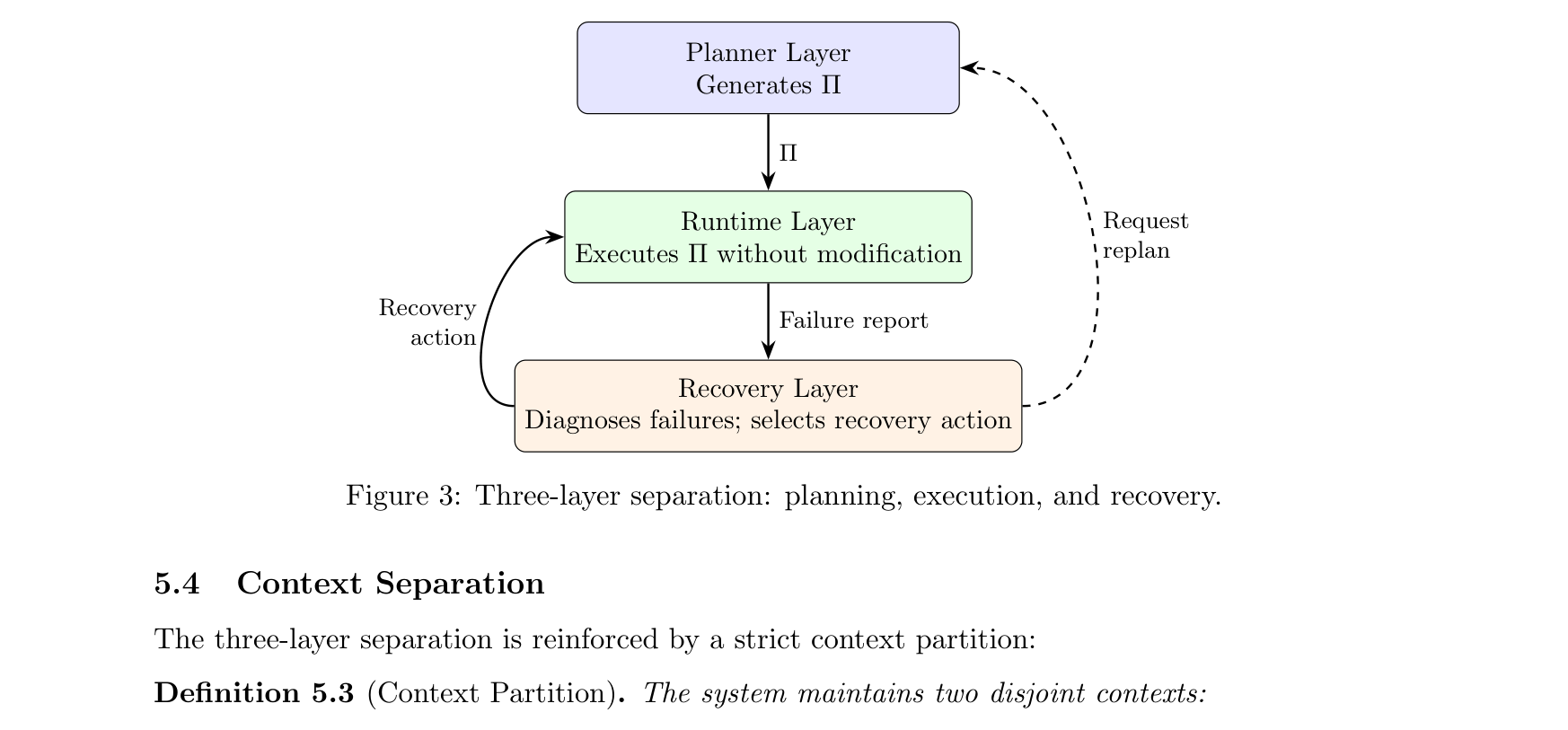
What it shows: planner / runtime / recovery 三层的接口关系:planner 产出 $\Pi$ 给 runtime,runtime 执行不改 $\Pi$,failure 往上报到 recovery,recovery 决定 recovery action 或 request_replan 回到 planner。
Why it matters: 这张图把 Principle 2(stable commitment)变成一张架构图。读者能立刻看出:runtime 不接触 plan 结构,只消费;recovery 不接触 runtime 内部,只看 failure report 和 diagnostic context;planner 不接触 runtime 实时状态。这是 SGH 相对 LangGraph(runtime 可改图)、TDP(planner 可动态加 task)的本质区别。
Detailed description: 三个矩形垂直排列——顶部 Planner Layer(generates $\Pi$)、中部 Runtime Layer(executes $\Pi$ without modification)、底部 Recovery Layer(diagnoses failures, selects recovery action)。三条有向边:Planner → Runtime 传 $\Pi$;Runtime → Recovery 传 failure report;Recovery → Planner 传 "request replan" 请求(仅在 Level 3 时触发)。关键是 Runtime → Planner 没有直接边——runtime 不能把中间结果 push 回 planner 做动态 replan。
9. Impact on AI Infra #
Figure 4: Node state machine #
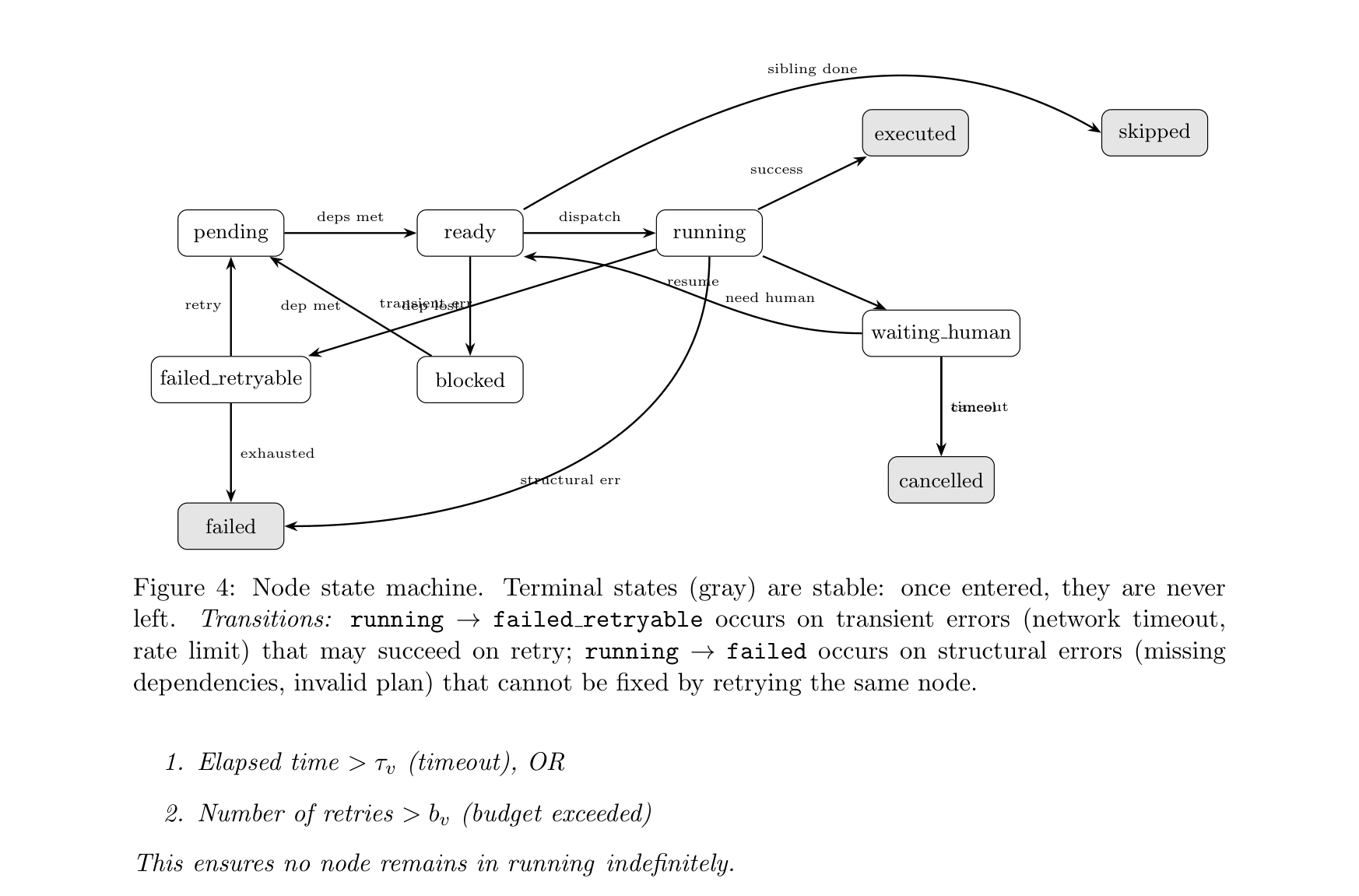
What it shows: 10 个状态的节点状态机,4 个 terminal 态 {executed, failed, cancelled, skipped} 用灰色标注;转移边标注 trigger 条件(deps met / dispatch / success / timeout / retry / exhausted / dep lost / sibling done / transient err / structural err)。
Why it matters: 这是 SGH termination 证明的基石。Theorem 6.2 的证明完全基于这张图的结构——terminal state 无出边(absorbing)+ 每个非 terminal 态必有一条通往 terminal 的路径 + $\tau_v$/$b_v$ 有限。如果这张图里任何一个 terminal 态加了出边,bounded termination 就破。论文把这张图当作 "formal object" 来证明,而不仅仅作图示。
Detailed description: 节点初始 pending → 条件 deps met → ready → 条件 dispatch(被 $\mathcal{P}$ 选中)→ running。running 有 4 条出边:success → executed(terminal,但被 contract validation 守护);transient err → failed_retryable(budget>0 可回到 pending 走新一轮,exhausted 则 → failed);structural err → failed(terminal);need human → waiting_human(resume → ready 或 timeout → cancelled)。ready 有 2 条额外出边:dep lost → blocked(→ pending 当 dep 恢复);sibling done(any_of join)→ skipped(terminal)。failed_retryable 也可因 any_of sibling 完成而 → skipped。
关键细节 #
一句话总结 #
Scheduler 视角下,Agent Loop 和 LangGraph 只是 $|\mathcal{U}|$ 轴上的不同点;SGH 用"静态 DAG + 三级 recovery + plan versioning"把 agent 执行从一个 non-det, unbounded, unauditable 的 loop 改造成一个 det, bounded, auditable 的 scheduler,代价是放弃竞争性并行和动态拓扑。