Escaping the Context Bottleneck: Active Context Curation for LLM Agents via Reinforcement Learning
Escaping the Context Bottleneck: Active Context Curation for LLM Agents via RL — L2 #
1. TL;DR #
Decouples memory-management from reasoning: a small RL-trained ContextCurator (Qwen2.5-7B) rewrites working memory each turn for a frozen frontier TaskExecutor. On WebArena, Gemini-3.0-flash goes 36.4%→41.2% SR with −8.8% tokens; on DeepSearch, ~8× fewer tokens at higher SR. A 7B curator ≈ GPT-4o.
2. Q1 / Q2 / Q3 #
Q1 — 痛点 (the problem). Long-horizon LLM agents fail not from insufficient context capacity but from a collapsing signal-to-noise ratio. Raw observations are extreme-entropy: web DOM trees are >90% structural noise (ads, styling, nav), search results flood context with distractor paragraphs. Feeding this raw stream into the transformer triggers "Lost-in-the-Middle" attention dilution, and early noise compounds into cascading hallucinated actions. Existing fixes fall short in two ways: passive memory (Mem0, MemGPT, LangMem) treats recall as semantic retrieval and misses causally-essential "reasoning anchors" that are textually dissimilar to the query (retrieval bias); monolithic learned memory (Mem1, MemAgent) folds memory ops into the same task model, creating a capacity split (small models can't reason deeply; frontier models are too costly/opaque to fine-tune on-policy) plus "lazy agent" gradient interference.
Q2 — 方法 (the method). ActiveContext splits the monolithic policy $\pi_\theta(a_t, m_t)$ into two specialized entities: a trainable ContextCurator $\pi_\phi$ that autoregressively rewrites working memory, and a frozen TaskExecutor $\pi_{\text{exec}}$ (e.g. Gemini-3.0-flash / GPT-4o) that acts. Each turn: (1) curator generates $\mathcal{M}_{t+1}=m_t\sim\pi_{\text{ctx}}(\cdot\mid\mathcal{M}_t,o_t,a_{t-1})$; (2) executor picks $a_t\sim\pi_{\text{exec}}(\cdot\mid m_t,o_t)$ — it never sees raw history. The curator is trained by Multi-Turn GRPO against a distal binary task-success reward.
核心技术壁垒 (the single hardest-to-replicate insight): cross-model alignment via environment absorption. Because the executor is a black-box, closed-source model that cannot be back-propped through, ActiveContext absorbs the frozen TaskExecutor into the environment's transition dynamics. This collapses a two-agent problem into a tractable single-agent RL problem: any variance in terminal reward $R(\tau)$ is attributable solely to the curator's $m_t$, so the sparse distal reward becomes a valid learning signal for $\phi$. Reproducing the paper requires getting this credit-assignment framing right — not the GRPO math, which is standard.
Q3 — 结果 (the outcome). A new Pareto frontier: higher SR and fewer tokens simultaneously. WebArena (Gemini-3.0-flash) 36.4%→41.2% SR, 47.4K→43.3K tokens. DeepSearch (Gemini-3.0-flash) 53.9%→57.1% SR, 46.7K→6.6K tokens (~8×; up to ~85% reduction). The RL-trained 7B curator (21.8% WebArena / 34.9% DeepSearch) matches GPT-4o-as-curator (21.2% / 35.0%) at a fraction of the token cost.
3. 架构 / 方法图 — the agent loop #
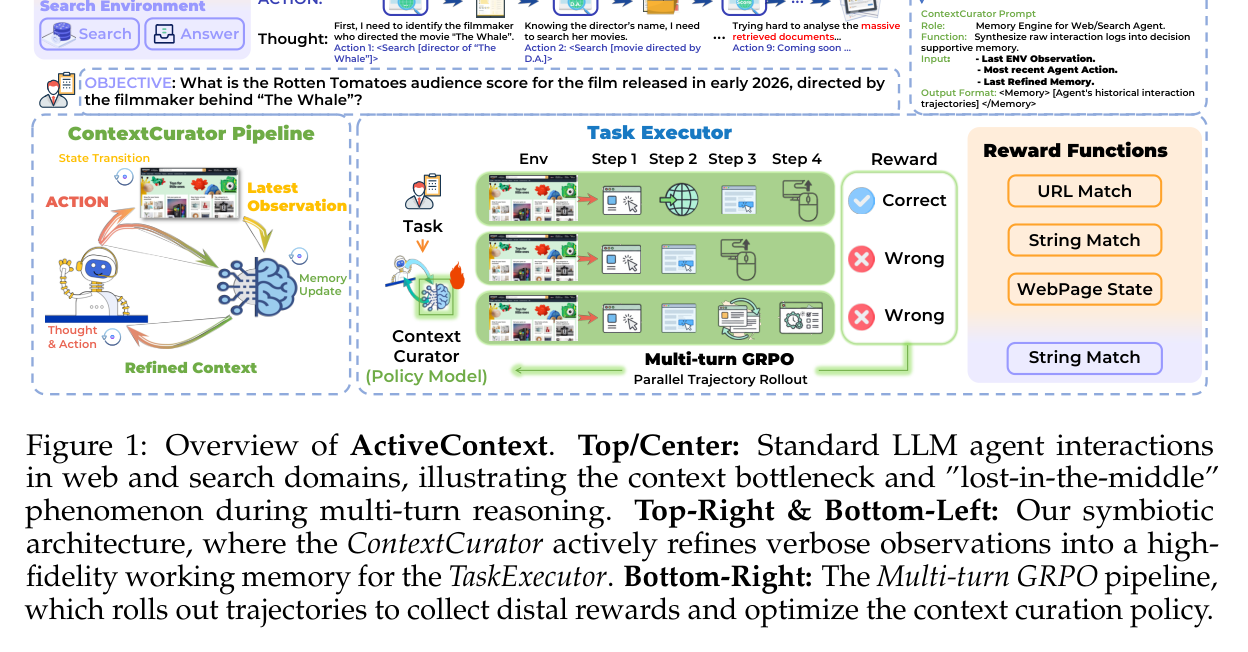
Paper's Figure 1, verbatim (caption: "Overview of ActiveContext. Top/Center: Standard LLM agent interactions in web and search domains, illustrating the context bottleneck and 'lost-in-the-middle' phenomenon during multi-turn reasoning. Top-Right & Bottom-Left: Our symbiotic architecture, where the ContextCurator actively refines verbose observations into a high-fidelity working memory for the TaskExecutor. Bottom-Right: The Multi-turn GRPO pipeline, which rolls out trajectories to collect distal rewards and optimize the context curation policy.")
The figure contrasts the failing baseline (raw observations accumulate into a bloated, noisy context that dilutes attention) against the two-model loop. The reader should notice that the executor's input is bounded — it consumes only the curated memory plus the current observation — while the GRPO panel shows the reward flowing back only to the curator, never to the frozen executor.
The per-turn state machine below makes the memory-model and error-recovery explicit. Memory model: short-term working memory is the single rewritten $\mathcal{M}_t$ text blob (no vector DB, no episodic log — the curator is the memory system). Tool invocation: the executor emits WebArena/DeepSearch actions (click, type, search query, stop). Error recovery: there is no explicit rollback/backtracking action — the curator instead learns to retain past erroneous deductions in $\mathcal{M}_t$ (see Appendix B, where the search memory explicitly logs "past erroneous deductions"), so recovery is soft and policy-learned rather than a discrete state transition.
Planning & reasoning. The executor uses a ReAct-style think-then-act step ("Let's think step-by-step... the next action I will perform is..."). Decomposition is emergent, not a fixed workflow: there is no explicit task tree or tree-search — the curator's rewritten memory is the only planning scaffold. Budget: interaction rounds capped at 15; max context 16,000 tokens; max new tokens 512. Backtracking: none as a discrete action; the agent moves forward and relies on memory fidelity.
The key architectural departure from Mem1/MemoryR1 is that context curation is modeled as direct generation of the next memory state (autoregressive rewrite), not selection from a discrete op-set (navigate / scroll / rollback). This lets the curator compress, delete, and synthesize in one generative step.
4. 作者证明 #
无形式化作者证明 — 仅实证. The paper offers no convergence or success-rate guarantee; all support is empirical. The one analytical argument is a credit-assignment justification (§3.3): freezing the executor makes reward variance attributable to $m_t$, licensing distal-reward RL. What could have been bounded but was not: a formal statement that expected return is non-decreasing under the decoupling vs. the monolithic policy, or a bound on information loss in the rewrite.
Notation table.
| Symbol | Meaning |
|---|---|
| $\mathcal{M}=(\mathcal{S},\mathcal{A},\mathcal{O},\mathcal{T},\mathcal{R})$ | POMDP tuple |
| $o_t, a_t, R(\tau)\in\{0,1\}$ | observation, action, sparse terminal reward |
| $z_t, k_t$ | environmental noise vs. task-critical anchors, $\lvert z_t\rvert\gg\lvert k_t\rvert$ |
| $\pi_\phi$ / $\pi_{\text{ctx}}$ | trainable ContextCurator |
| $\pi_{\text{exec}}$ | frozen TaskExecutor |
| $c_t=(\mathcal{M}_t,o_t,a_{t-1})$ | curator's local context |
| $A_i$ | group-relative advantage |
| $\rho_t(\phi)$ | importance-sampling ratio |
| $\beta, \epsilon$ | KL coeff (0.001), clip ratio (0.2) |
方程物理意义 (load-bearing equations). The credit-assignment chain
$$m_t\sim\pi_\phi(\cdot|c_t)\ \longrightarrow\ a_t\sim\pi_{\text{exec}}(\cdot|m_t,o_t)\ \longrightarrow\ R(\tau)$$
says a curator decision drives a frozen executor action which drives the distal outcome. The advantage
$$A_i=\frac{R(\tau_i)-\text{mean}(\{R(\tau_1),\dots,R(\tau_G)\})}{\text{std}(\{R(\tau_1),\dots,R(\tau_G)\})+\epsilon}$$
is the critic-free GRPO baseline. The objective
$$\mathcal{J}_{\text{GRPO}}(\phi)=\mathbb{E}_{\tau\sim\pi_{\phi_{\text{old}}}}\left[\frac{1}{L}\sum_{t=1}^{L}\left(\mathcal{O}_{t}^{\text{clip}}(\phi)-\beta\mathbb{D}_{\text{KL}}\big(\pi_{\phi}||\pi_{\text{ref}}\big)_{t}\right)\right]$$
averages a per-step clipped PPO surrogate over the trajectory, with gradients applied only to curator tokens $m_t$ (cutting training memory vs monolithic). Token accounting (Appendix A) shows the mechanism: Full-Context grows linearly, $C_{t}^{\text{FullContext}}=\text{len}(S)+\text{len}(O_{t})+\sum_{k}\text{len}(P)+\text{len}(U)+\sum_{k}\text{len}(Re_k,A_k)$, whereas ActiveContext replaces the growing sum with a bounded memory term, $C_{t}^{\text{Active}}=\text{len}(S)+\text{len}(O_{t})+\text{len}(U)+\text{len}(\mathcal{M}_t)$ — halting linear growth.
6 minimum checks.
- Success-rate sweep matrix — the paper sweeps
(benchmark × backbone model × curation method): 2 benchmarks, 4 executors (Gemini-3.0/2.5-flash, GPT-4o, GPT-4o-mini), ~6 curation strategies. Monotonicity holds along "curation quality" (RL curator ≥ zero-shot curator ≥ retrieval ≥ full-context) for token cost, but SR monotonicity is imperfect (see §5 losses). - Latency budget per turn — not reported; the paper never claims interactive latency. Per turn = curator inference (7B) + executor inference (frontier API) + no separate memory read (memory is inline text). Cannot verify wall-clock from the sweep.
- Failure-mode classification — two named classes: attention dilution ("Lost-in-the-Middle") and cascading failures from compounded noise. The method targets the dominant one (noise accumulation) via entropy reduction.
- Anchor-preservation test — Map domain (needs spatial coordinates) is the stress case: No-Memory 6.7% → ActiveContext 33.3% SR (Gemini-3.0-flash), evidencing the curator retains textually-dissimilar anchors that retrieval misses.
- Scale sensitivity — gains are larger for weaker backbones: GPT-4o-mini +72% relative (12.7%→21.8%) vs GPT-4o +11% (WebArena), confirming smaller executors depend more on curation.
- Curator-substitution parity — 7B RL curator ≈ GPT-4o zero-shot curator (21.8 vs 21.2 WebArena; 34.9 vs 35.0 DeepSearch), the central "specialization" claim.
- Gradient masking to curator tokens only — the backward pass updates only the tokens the curator generated ($m_t$), which is what makes 7B on-policy RL feasible on one node; a naive implementation that back-props over the full transcript would blow up memory.
- Memory logs errors, not just facts — the search memory explicitly retains "past erroneous deductions" (Appendix A.3, Appendix B), functioning as soft backtracking without a discrete rollback action; dropping this would remove the only error-recovery mechanism.
5. 实验与数据 #
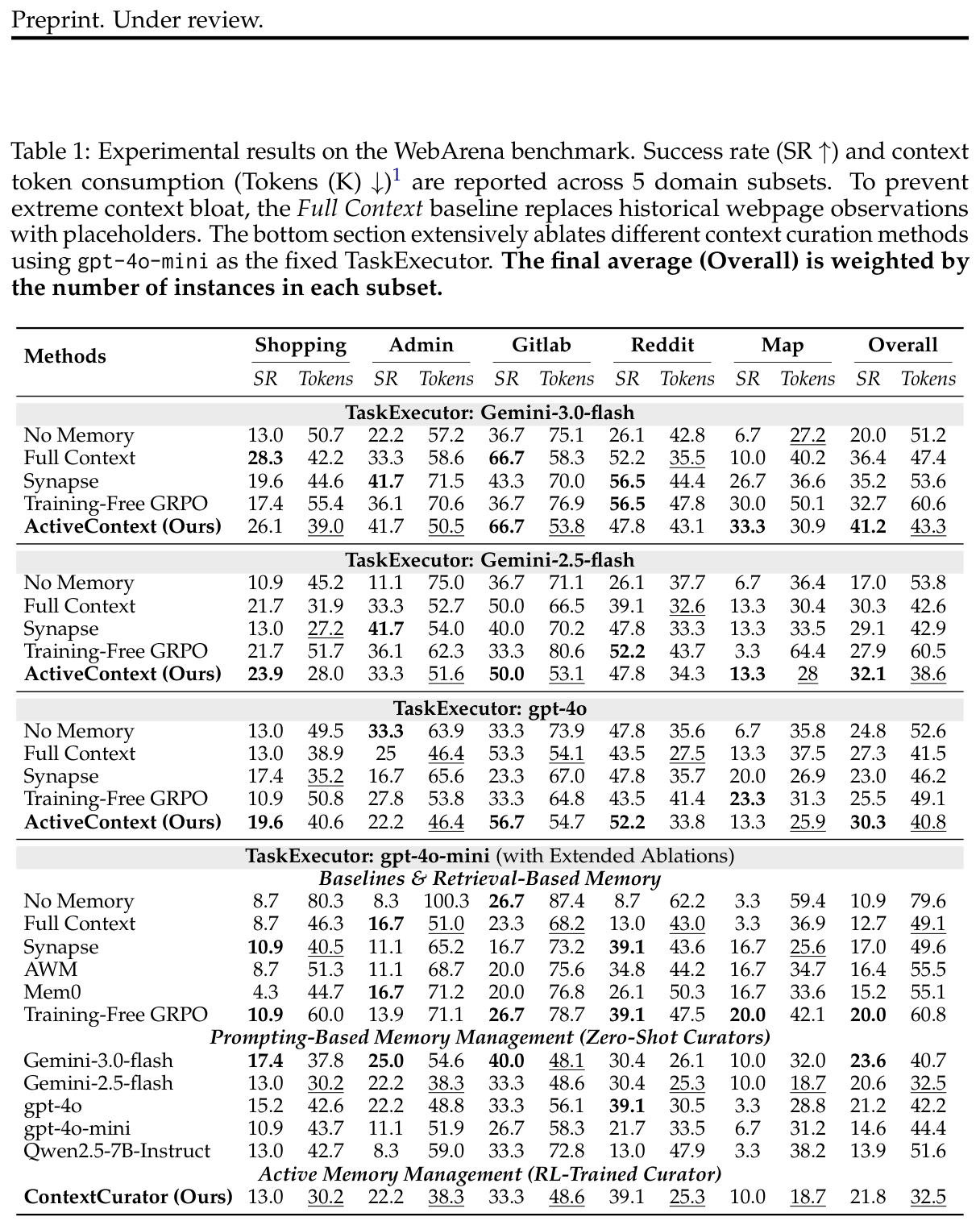
Paper's Table 1 (caption: "Experimental results on the WebArena benchmark. Success rate (SR ↑) and context token consumption (Tokens (K) ↓) across 5 domain subsets ... bottom section ablates context curation methods using gpt-4o-mini as the fixed TaskExecutor."). The load-bearing rows: Gemini-3.0-flash Full-Context 36.4%/47.4K vs ActiveContext 41.2%/43.3K — the Pareto win. In the gpt-4o-mini ablation block, the RL curator (21.8%/32.5K) beats the gpt-4o-mini zero-shot curator (14.6%/44.4K) and matches gpt-4o (21.2%). Note the honest losses: on Reddit, ActiveContext 47.8% trails Full-Context 52.2% and Synapse 56.5%.
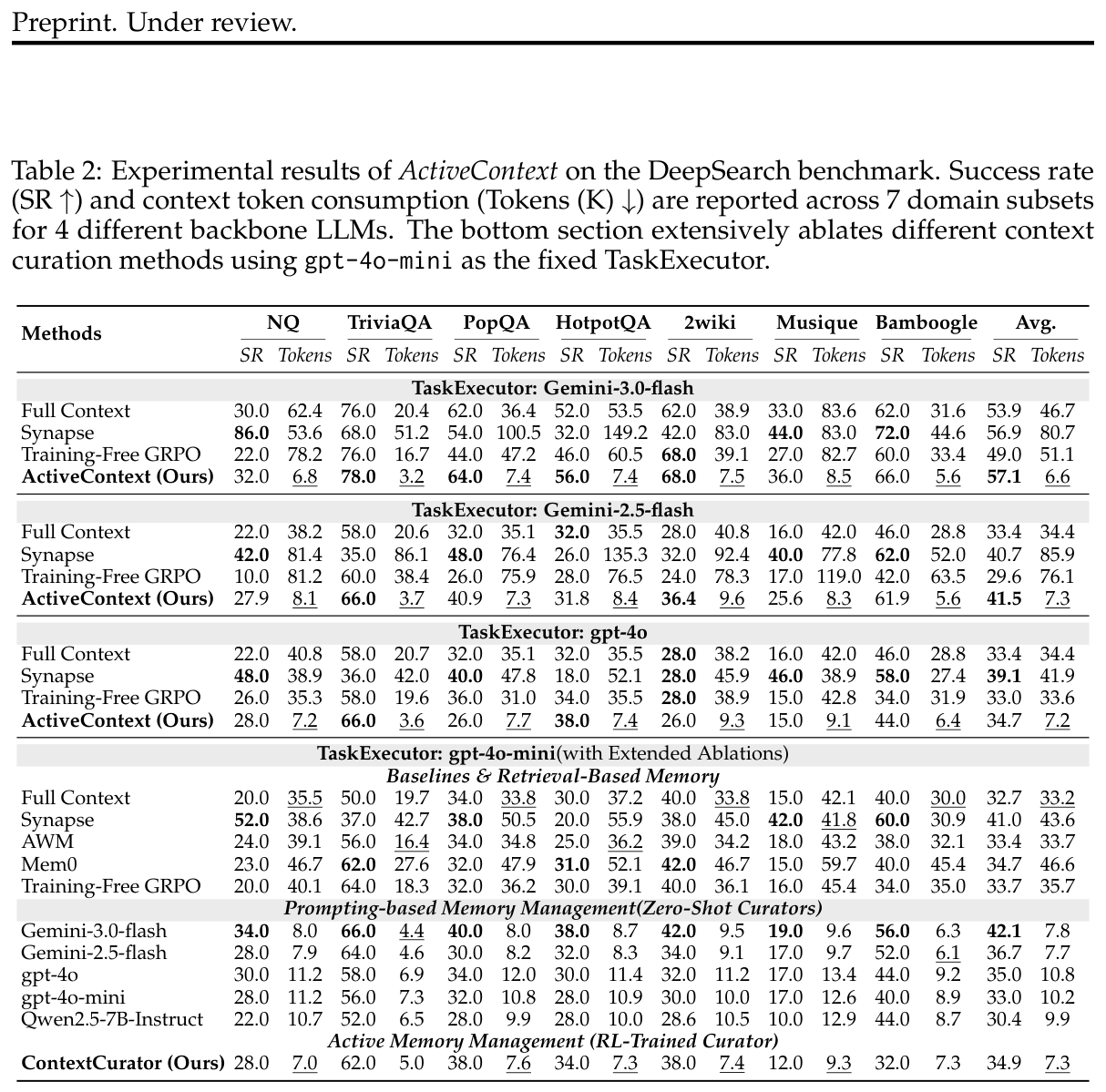
Paper's Table 2 (caption: "Experimental results of ActiveContext on the DeepSearch benchmark. Success rate (SR ↑) and context token consumption (Tokens (K) ↓) across 7 domain subsets for 4 backbone LLMs."). The efficiency story is starkest here: Gemini-3.0-flash 53.9%/46.7K → 57.1%/6.6K (~8× token cut). Multi-hop tasks benefit most (2Wiki 62→68, HotpotQA 52→56); single-hop NQ gains little (30→32), supporting the "curation matters when the reasoning chain is fragile" claim. Caveat: Synapse reaches comparable Avg SR (56.9%) but at ~12× the tokens (80.7K) — ActiveContext's advantage is efficiency, not raw ceiling.
A worked trajectory (Appendix B, WebArena "count downvoted comments" task, Turns 7–8) shows the curator condensing a verbose DOM accessibility tree into a few sentences of state ("navigated to Comments; one old comment with a single downvote; ..."), letting gpt-4o-mini correctly answer "0" and stop. This is the qualitative face of the token numbers.
6. 论证链 #
| # | Step | Support (paper-internal) |
|---|---|---|
| 1 | Long-horizon failure is an SNR problem, not a capacity problem (raw obs is >90% noise). | §1 Para 2; §3.1 noise/anchor decomposition $\lvert z_t\rvert\gg\lvert k_t\rvert$. |
| 2 | Both passive retrieval (misses non-similar anchors) and monolithic RL (gradient interference, capacity split) fail to fix SNR. | §1 Para 3; §2 Para 2. |
| 3 | Therefore decouple: trainable curator rewrites memory; frozen frontier executor reasons. | §3.1 Para 6; §3.2 two-stage loop. |
| 4 | Freezing the executor lets it be absorbed into env dynamics → reward variance is attributable to $m_t$ → distal-reward RL is valid. | §3.1 Para 7; §3.3 Eq (1). |
| 5 | Train the curator with MT-GRPO on sparse task reward, updating only curator tokens. | §3.3 Eqs (2)–(4). |
| 6 | Result: higher SR + fewer tokens (Pareto), and a 7B curator matches GPT-4o-as-curator. | §4.2 Table 1; §4.3 Table 2. |
7. 实现 cross-reference #
[实现未公开] — no code repository is cited in the paper. Reproduction hinges on config values stated in §4.1: ContextCurator initialized from Qwen-2.5-7B-Instruct, full-parameter fine-tune on 8× A100-80GB; MT-GRPO with lr $1\text{e-}6$, batch 8, rollout group $G=4$ (WebArena-Lite) / $G=8$ (DeepSearch), max 15 interaction rounds, $\beta=0.001$, clip $\epsilon=0.2$, max context 16,000, max new tokens 512; rollouts via vLLM (TP=1, GPU-mem-util 0.6), sampling temperature = top-$p$ = 1.0.
核心技术壁垒 (dedicated paragraph). The genuinely hard-to-replicate piece is not the GRPO objective — it is making the black-box executor a stable part of the environment. Because closed-source frontier models are non-deterministic and cannot be trained, the curator must learn a policy robust to executor stochasticity from an extremely sparse binary reward, with all credit routed through a single generative rewrite. Getting this to converge (hence the noted need for "maximal stability" of the frozen models) is the load-bearing engineering, and the paper gives no ablation on how sensitive training is to executor drift.
关键实现细节 (easy-to-miss tricks).