Experience Compression Spectrum: Unifying Memory, Skills, and Rules in LLM Agents
Experience Compression Spectrum: Unifying Memory, Skills, and Rules in LLM Agents #
§1 TL;DR #
提出 Experience Compression Spectrum,将 agent memory / skill / rule 统一为经验压缩轴上的三个点($L_1$ 5–20×, $L_2$ 50–500×, $L_3$ 1000×+)。映射 20+ 系统后发现全部固定在单一压缩层级,无系统支持自适应跨层级压缩("missing diagonal"),且 memory 与 skill 社区互引率 <1%。
§2 痛点 / 方法 / 结果 #
Q1 痛点 #
持久化 LLM agent 每天产生数千条交互轨迹,原始 trace 迅速淹没 context window 和 retrieval budget。当前 agent memory 社区($L_1$ 级结构化记忆)和 agent skill 社区($L_2$ 级行为模式提取)解决同一个问题——从交互经验中提取可复用知识——却几乎完全隔离:对 22 篇核心论文的 1,136 条引用分析显示跨社区互引率不到 1%(memory 引 skill 0.7%,skill 引 memory 1.2%)。没有统一框架,两个社区重复造轮子。
Q2 方法 #
核心框架:定义 Experience Compression Function $C_L: \mathcal{T} \rightarrow \mathcal{K}_L$,将交互轨迹 $\mathcal{T} = \{(s_t, a_t, o_t, f_t)\}_{t=1}^N$ 映射为四个压缩层级的知识工件:
| Level | 名称 | 压缩比 | 格式 | 可复用性 |
|---|---|---|---|---|
| $L_0$ | Raw Trace | 1:1 | 完整日志 | 最低 |
| $L_1$ | Episodic Memory | 5–20× | KV 对、时间戳事件摘要 | 低–中 |
| $L_2$ | Procedural Skill | 50–500× | 结构化流程、代码模板 | 高 |
| $L_3$ | Declarative Rule | 1000×+ | 自然语言原则、约束 | 最高(但缺特异性) |
Missing Diagonal:将 20+ 系统映射至该谱后发现三个缺失能力:(1) 自适应选择压缩层级 $L^*$;(2) 向上推动知识($L \to L'$, $L' > L$);(3) 向下回退知识(高层工件在新 context 失败时降级回 $L_1$)。
核心技术壁垒:需要一个 meta-controller 在无标注信号的情况下判断"这段经验应该压缩到哪个层级"。现有 MemSkill 的 RL routing、EvoSkill 的 Pareto selection、AutoSkill 的 versioning 是潜在 building blocks,但尚无系统组合它们实现全谱自适应压缩。
Q3 结果 #
- 映射 20+ 系统证实全部操作在预定义单一层级(Table 2),无系统支持 adaptive cross-level compression
- $L_2$ 对 $L_1$ 的经验性优势:SkillRL +68.5pp (ALFWorld),Trace2Skill +21.5pp (SpreadsheetBench)
- 压缩质量 ≥ 压缩层级:SkillsBench 上 curated $L_2$ +16.2pp vs. LLM 自生成 $L_2$ +0.0pp
- $L_3$ 实证:RuleShaping 负约束 +7–14pp vs 正指令反而损害(coding agents)
- 19 系统中仅 AutoSkill 具备完整 lifecycle 管理
§3 架构 / 方法图 #
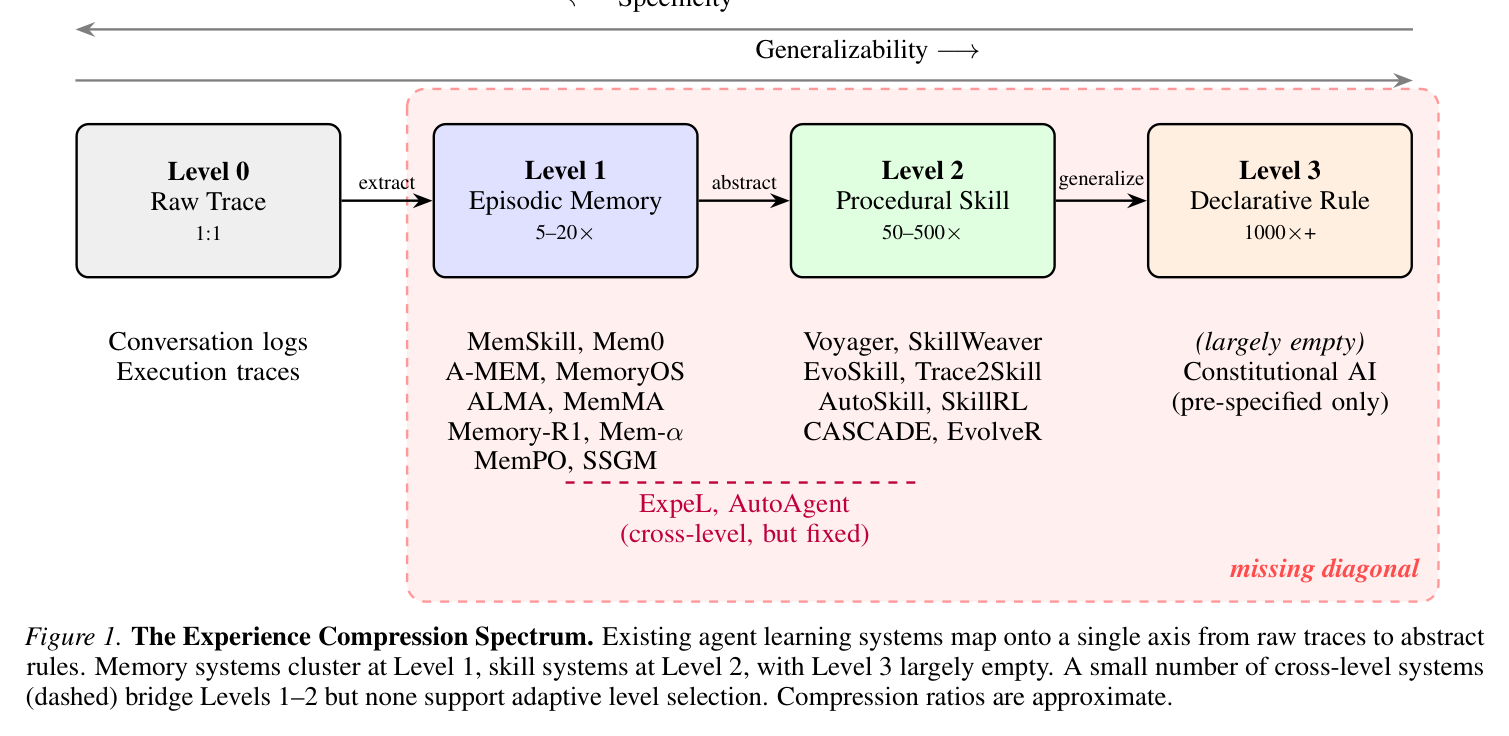
Paper Figure 1, verbatim (caption: "The Experience Compression Spectrum. Existing agent learning systems map onto a single axis from raw traces to abstract rules. Memory systems cluster at Level 1, skill systems at Level 2, with Level 3 largely empty.").
Figure 1 是本文的核心贡献可视化。横轴为压缩层级($L_0 \to L_3$),系统按其输出知识粒度聚集——10 个 memory 系统密集分布于 $L_1$,8 个 skill 系统分布于 $L_2$,ExpeL 和 AutoAgent 以虚线跨越 $L_1$–$L_2$,而 $L_3$ 几乎空白。对角箭头标注 "missing diagonal" 是作者识别的关键 gap。底部标注 Generalizability → / ← Specificity 的权衡方向。
该状态图补充 Figure 1 的静态映射,展示作者设想的 "diagonal system" 运行时行为:meta-controller 路由 trace 到合适层级,promotion engine 在证据累积时上推,lifecycle manager 维护知识工件。当前无系统实现此完整循环。
§4 作者证明 #
无形式化作者证明 — 仅实证
本文是 survey + framework paper,不含 convergence 证明或 regret bounds。证据形式为:
| 检查项 | 状态 | 说明 |
|---|---|---|
| 引用统计可复现性 | ✓ | 1,136 references / 22 papers, cross-citation <1% — 方法论明确可复现 |
| 压缩比量化 | ✓ | Mem0 26K→1.8K tokens (~15×), Trace2Skill 128 sub-agents → skill dir (~100-500×) |
| 系统映射完备性 | ✓ | 20+ 系统 × 4 维度(level, mechanism, lifecycle)— 见 Table 2 |
| Cross-level performance | ✓ | 7 rows in Table 1 从不同发表中聚合,方向一致 |
| $L_3$ 缺口识别 | ✓ | 遍历所有 surveyed systems,仅 Constitutional AI 有预设规则 |
| Lifecycle coverage | ✓ | Table 2 明确标注 ✓/partial/× |
可能可以 bound 但未 bound 的指标:给定 trace 分布下各压缩层级的 information loss rate($\mathcal{T} \to \mathcal{K}_L$ 的信息保真度)、adaptive routing 策略的 regret。
Success-rate model(agent-specific):本文不含 agent 系统实现,但聚合了 backbone 对性能的影响证据——SkillsBench 显示 LLM self-gen 在 multi-task 上 +0.0pp,暗示 backbone 生成质量是 $L_2$ 成功的必要条件。
Failure mode classification:作者识别 4 类 barrier 阻碍 $L_3$ 自动化:(1) 因果 vs 偶然正则难区分;(2) 无 $L_2$ grounding 的规则太抽象;(3) 规则质量评估的 infinite regress;(4) LLM-as-Judge 的虚假安全感。
§5 实验与数据 #
本文无原创实验,但 Table 1 和 Table 2 是核心实证支撑。

Paper Table 1 (caption: "Cross-level performance evidence aggregated from published benchmarks. Each row compares a higher-compression representation against a lower-compression baseline within the same study.").
Table 1 的关键发现:方向一致性——所有 $L_2$ vs $L_1$ 对比都显示高压缩优于低压缩(+5.3% 到 +68.5pp),但 SkillsBench 的 self-gen +0.0pp 是关键反例,证明压缩层级只是必要条件,压缩保真度才是充分条件。RuleShaping 的 $L_3$ negative constraints +7–14pp 是目前唯一的自动化 $L_3$ 实证。
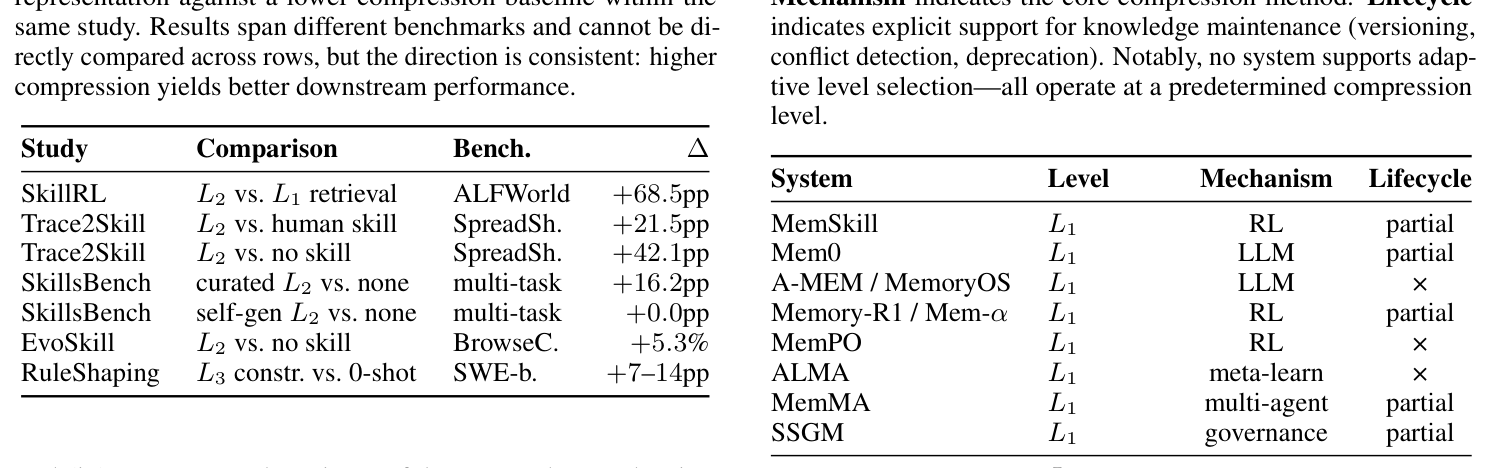
Paper Table 2 (caption: "Representative systems mapped onto the Experience Compression Spectrum. Level indicates primary output granularity. Mechanism indicates the core compression method. Lifecycle indicates explicit support for knowledge maintenance.").
Table 2 的关键观察:
- Mechanism diversity within levels:$L_1$ 系统使用 RL (MemSkill, Memory-R1, Mem-α, MemPO)、LLM (Mem0, A-MEM)、meta-learn (ALMA)、multi-agent (MemMA)、governance (SSGM) 等不同方法但收敛于同一输出格式
- Lifecycle gap:19 系统中仅 AutoSkill 标记 ✓(完整 lifecycle),8 个 partial,10 个 ×
- Cross-level 仅 2 系统:ExpeL 和 AutoAgent 都是 predetermined two-speed,不是 adaptive
- Meta-controller routing:作者指出 MemSkill (Zhang et al., 2026b) 的 RL controller 可作为 building block——该系统用 RL 学习何时触发 memory 操作,但仅在 $L_1$ 内部路由,未扩展到跨层级
- Promotion engine:EvoSkill (Alzubi et al., 2026) 的 Pareto selection 可选择哪些 skill 值得保留/进化,但不跨越 $L_1 \to L_2$ 边界
- Lifecycle manager:AutoSkill (Yang et al., 2026b) 是唯一实现完整生命周期管理的系统(Table 2 中唯一 ✓),但同样不跨层级
- Idle-time consolidation 未被任何系统实现——CLS theory 暗示应在 agent 空闲时执行上向压缩(hippocampus → neocortex 类比),这是一个 deployment-level 的工程缺口
- $L_3$ 负约束 vs 正指令的非对称性(RuleShaping +7–14pp vs hurt)意味着未来 $L_3$ 自动化系统应优先提取 "don't do X" 而非 "do Y"——这是一个可直接指导实现的设计约束
Overhead 量化(§2.2):$L_1$-only agent 以 1,000 episodes × 500 tokens = 500K-token store 面临每次决策的检索开销。压缩至 $L_2$ 减为 ~5K tokens,至 $L_3$ 减为 ~500 tokens——100–1000× 检索开销下降,在每日数千决策下 compound。
§6 论证链 #
| Step | 论据 | 支撑 | 推出 |
|---|---|---|---|
| 1 | 持久 LLM agent 每天产生大量 trace,overwhelm context window | §1 para 1: 规模化部署挑战 | 需要 experience management |
| 2 | Memory 社区和 Skill 社区分别提出解决方案但互引 <1% | §1 para 2: 1,136 refs / 22 papers 引用分析 | 缺乏统一视角 |
| 3 | 两者本质上是同一操作(压缩交互经验)的不同粒度实例 | §2.1: Def 2.1 (trace) + Def 2.2 (compression function) | 可统一为 compression spectrum |
| 4 | 系统映射证实 clustering at $L_1$/$L_2$, empty $L_3$ | §2.3: 20+ systems, Figure 1, Table 2 | missing diagonal 存在 |
| 5 | Cross-level evidence 方向一致:高压缩 → 高性能 | Table 1: 7 rows 正向 Δ | 填补 missing diagonal 有价值 |
| 6 | 但压缩质量制约收益 (self-gen +0.0pp) | SkillsBench: curated +16.2pp vs self-gen +0.0pp | adaptive + high-fidelity compression 才是完整解 |
| 7 | $L_3$ 自动化面临 4 barriers,lifecycle 被忽视 | §2.3 barriers, Table 2 lifecycle column | open problems 驱动未来研究方向 |
§7 实现 cross-reference #
[实现未公开]
本文为 survey/framework paper,不包含系统实现代码。
核心技术壁垒落地分析:
关键实现细节: