A Comprehensive Survey on Agent Skills: Taxonomy, Techniques, and Applications
A Comprehensive Survey on Agent Skills: Taxonomy, Techniques, and Applications #
§1 TL;DR #
Survey formalizes agent skills as reusable procedural artifacts $S = (M, \mathcal{R}, \mathcal{C})$ bridging the "procedural gap" between tool access and reliable execution. Organizes 122 papers around a four-stage lifecycle (representation → acquisition → retrieval/selection → evolution), identifying that the most capable skill libraries will emerge from combining human-, experience-, task-, and corpus-derived acquisition routes.
§2 痛点 / 方法 / 结果 #
Q1 痛点 #
LLM-based agents can access external tools via APIs, plugins, and protocols like MCP, but access alone does not yield reliable behavior. Tools expose atomic capabilities (what can be done) without encoding when to act, how to sequence operations, what failure modes to anticipate, or how to judge completion. This creates a "procedural gap": as task complexity grows, the orchestration burden falls back on LLM inference-time reasoning, producing brittleness, redundancy, and poor maintainability.
The gap is empirically validated: SkillsBench shows curated skills can have negative utility on some tasks when retrieval/selection is poor, and PoisonedSkills demonstrates that third-party skill documentation can hide malicious logic exploiting implicit trust in the skill ecosystem.
Q2 方法 #
The paper proposes a skill-centric view of agent systems, defining agent skills as:
$$S = (M, \; \mathcal{R}, \; \mathcal{C})$$
where $M$ = root instruction document, $\mathcal{R} = \{r_1, \ldots, r_K\}$ = auxiliary resources (references, templates, scripts), and $\mathcal{C}$ = applicability conditions. Skills externalize situated procedural knowledge (triggers, sequencing, fallbacks, validation criteria) into bounded, reusable artifacts.
The lifecycle taxonomy structures all operational concerns into four stages:
- Representation: text-backed / code-backed / hybrid-resource configurations of $\mathcal{R}$
- Acquisition: four families — human-derived, experience-derived, task-derived, corpus-derived
- Retrieval & Selection: dense/sparse/generative/structure-aware retrieval → context-aware/composition/cost-utility/feedback-driven selection
- Evolution: revision → validation → policy coupling → repository evolution → runtime governance
- Ecosystem scale: SkillsMP hosts 700k+ skills; SkillNet 300k+; SkillHub 80k+ (Table I) — demonstrating rapid ecosystem maturation since 2023
- Field growth: cumulative representative papers show exponential growth from April 2023 to April 2026 (Fig. 2)
- Negative utility warning: SkillsBench demonstrates skills can degrade performance when retrieval/selection fails — skills are not universally beneficial
- Security surface: PoisonedSkills shows exploitable trust in skill ecosystems
- Coverage: 122 papers organized across 8 application domains (software engineering, web/GUI, chatbot, robotics, finance, healthcare, games, social simulation)
- No latency budget analysis (survey-level)
- No backbone sensitivity sweep (survey-level)
- Dominant failure class identified: "procedural gap" at the skills-absent baseline; within skill-equipped systems, the dominant class is retrieval/selection failure leading to negative utility
- Voyager: executable code skills enable open-ended embodied exploration without human intervention
- SkillRL: recursive skill evolution during RL training improves over static skill banks
- SkillsBench: demonstrates non-monotonic relationship between skill availability and task success
- AWM: workflow memory reuse achieves consistent improvement across web navigation benchmarks (WebArena, Mind2Web)
- Trigger condition $\mathcal{C}$ is underspecified: The formal definition allows $\mathcal{C}$ to be "metadata, NL descriptions, or embeddings" — but no concrete schema or standard format is proposed. This means interoperability across skill platforms (SkillsMP, SkillNet, etc.) remains unsolved at the representation level, despite being identified as a future direction (§VIII-1).
- Degenerate skill boundary: Since $\mathcal{R}$ can be empty, the minimum viable skill is a single markdown file ($M$) plus trigger metadata ($\mathcal{C}$). This deliberately loose lower bound risks conflating skills with system prompts — practical implementations must establish admission criteria beyond the formal definition to prevent repository pollution (acknowledged in §VII-A: "admission quality at scale").
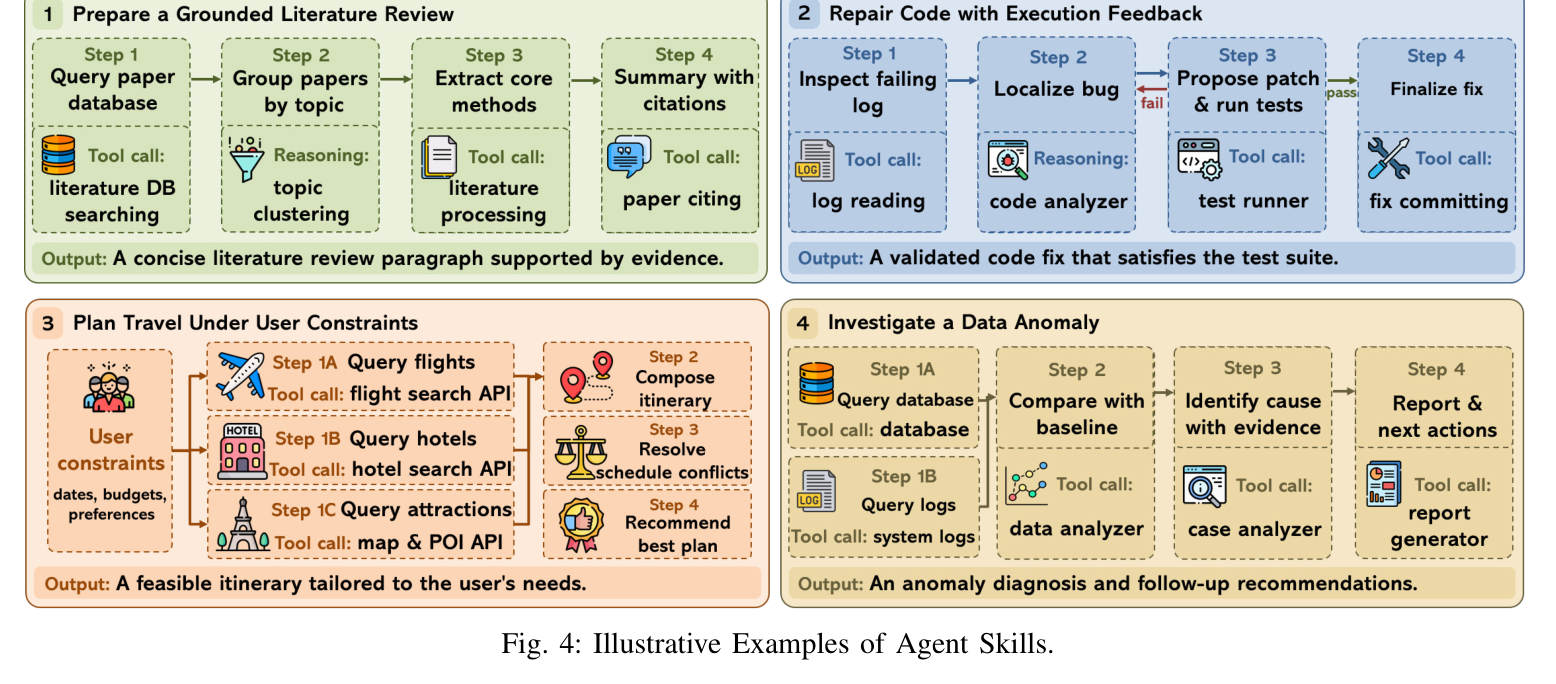
Paper's Figure 4, verbatim (caption: "Illustrative Examples of Agent Skills.").
The four examples — literature review, code repair, travel planning, and anomaly investigation — demonstrate how skills coordinate parallel tool calls, satisfy domain constraints, compare evidence, and generate actionable outputs beyond what a single tool invocation can achieve.
核心技术壁垒: The formalization itself — treating skills as first-class inspectable objects with explicit trigger conditions $\mathcal{C}$, separating the instruction document $M$ from resources $\mathcal{R}$ — enables independent evolution/validation of each component. Without this separation, "skills" collapse into monolithic prompts that cannot be versioned, composed, or governed. The lifecycle framing reveals that acquisition, retrieval, and evolution are tightly coupled through feedback loops (execution outcomes → revision → re-validation → updated retrieval indexes), and that breaking any link degrades the entire system.
Q3 结果 #
As a survey paper, there are no novel experimental results. Key empirical findings synthesized:
§3 架构 / 方法图 #
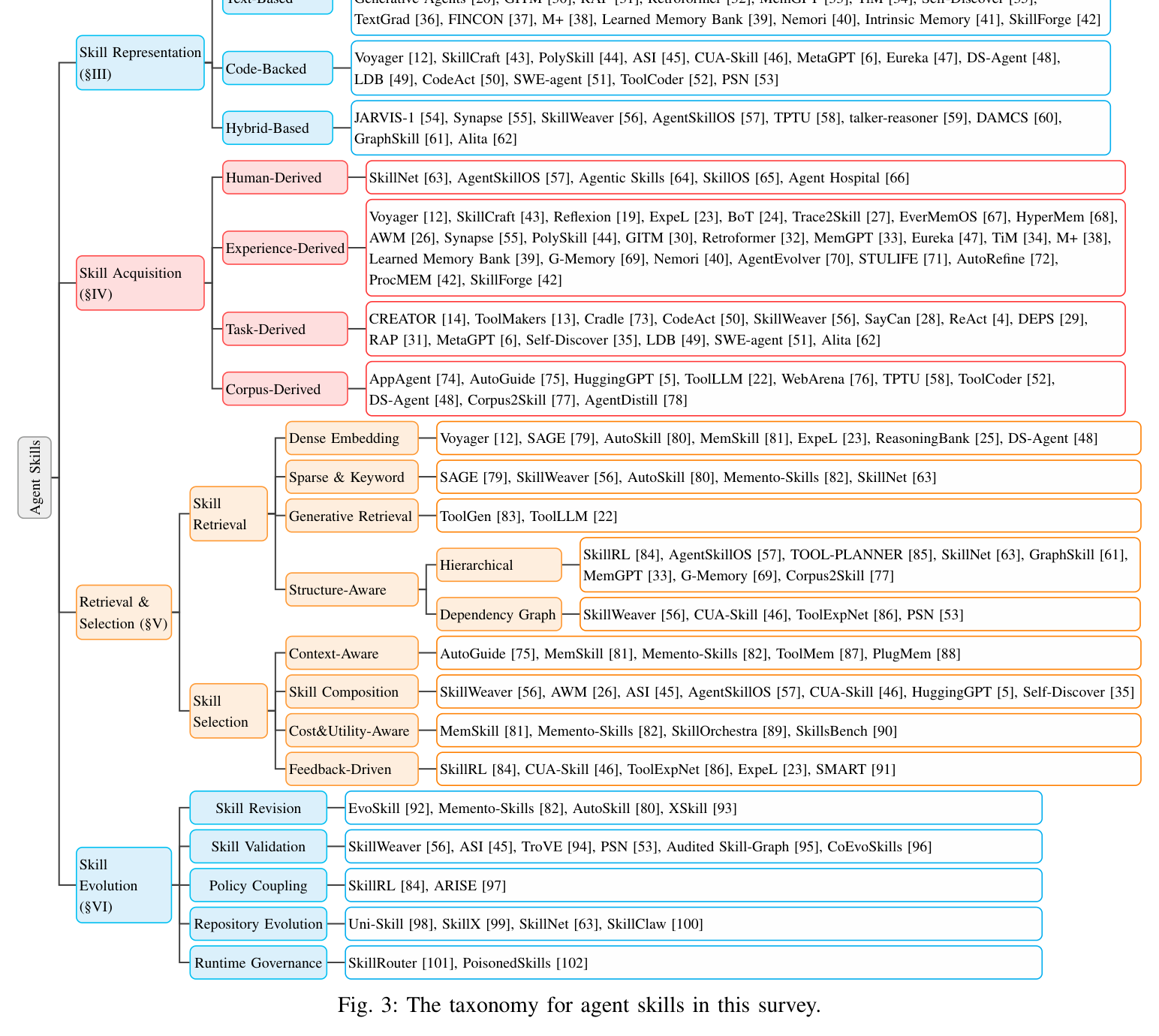
Paper's Figure 3, verbatim (caption: "The taxonomy for agent skills in this survey.").
This is the paper's primary structural contribution — a forest diagram showing the four lifecycle stages and their sub-taxonomies. Representation branches into text-backed/code-backed/hybrid; acquisition branches into four source families each with specific processing operations; retrieval separates from selection with distinct paradigms; evolution decomposes into five stages with specific operators and checks.
The agent loop that skills augment is formalized as:
$$o_{t} \rightarrow r_{t} \rightarrow a_{t} \rightarrow o_{t+1}$$
where $o_t$ = observation, $r_t$ = reasoning state, $a_t$ = action. Skills intervene at the $r_t \rightarrow a_t$ transition by providing pre-compiled procedural guidance that bypasses redundant reasoning.
The closed feedback loop (execution → evolution → retrieval) is the structural insight that distinguishes this taxonomy from simpler pipeline models. Failed executions trigger skill revision; validated revisions update repository indexes; updated indexes change future retrieval behavior.
§4 作者证明 #
无形式化作者证明 — 仅实证
This is a survey paper without novel formal claims or experimental validation. The paper's contributions are taxonomic and organizational rather than algorithmic.
| Check | Status |
|---|---|
| 1. Formal definition internally consistent | ✓ — $S = (M, \mathcal{R}, \mathcal{C})$ tuple is well-defined; degenerate case ($\mathcal{R} = \emptyset$) acknowledged |
| 2. Taxonomy exhaustive over cited literature | ✓ — 122 papers mapped; no cited work falls outside the four lifecycle stages |
| 3. Lifecycle stages mutually exclusive | Partial — boundary cases acknowledged (SKILL0 internalizes skills via RL, opposing externalization thesis) |
| 4. Success-rate model | N/A — no empirical sweep; SkillsBench cited as external evidence of non-monotonic skill utility |
| 5. Failure mode classification | Implicit — §VII identifies acquisition quality, retrieval scalability, evolution asymmetry, confounded gains |
| 6. Coverage of ecosystem | ✓ — Table I shows 5 platforms with 700k+ total skills; growth curve (Fig. 2) covers 2023–2026 |
What could have been bounded: The survey could have provided formal coverage metrics (what fraction of the agent-skills design space is addressed by existing work) or a rigorous gap analysis showing which lifecycle stage combinations remain unexplored. The taxonomy's completeness claim is informal.
Agent-specific asks:
§5 实验与数据 #
As a survey, this paper synthesizes findings rather than producing new experimental data. The key empirical evidence is organized below.
Ecosystem scale (Table I) #
| Platform | Scale | Notes |
|---|---|---|
| SkillNet | 300k+ | Shared infrastructure with ontology |
| ClawHub | 40k+ | Multi-user collective evolution |
| SkillHub | 80k+ | General skill hosting |
| SkillsMP | 700k+ | Largest ecosystem |
| Skills.sh | 90k+ | Community-driven |
These numbers demonstrate that agent-skill ecosystems have achieved non-trivial scale, validating the paper's premise that lifecycle management (not just creation) is the bottleneck.
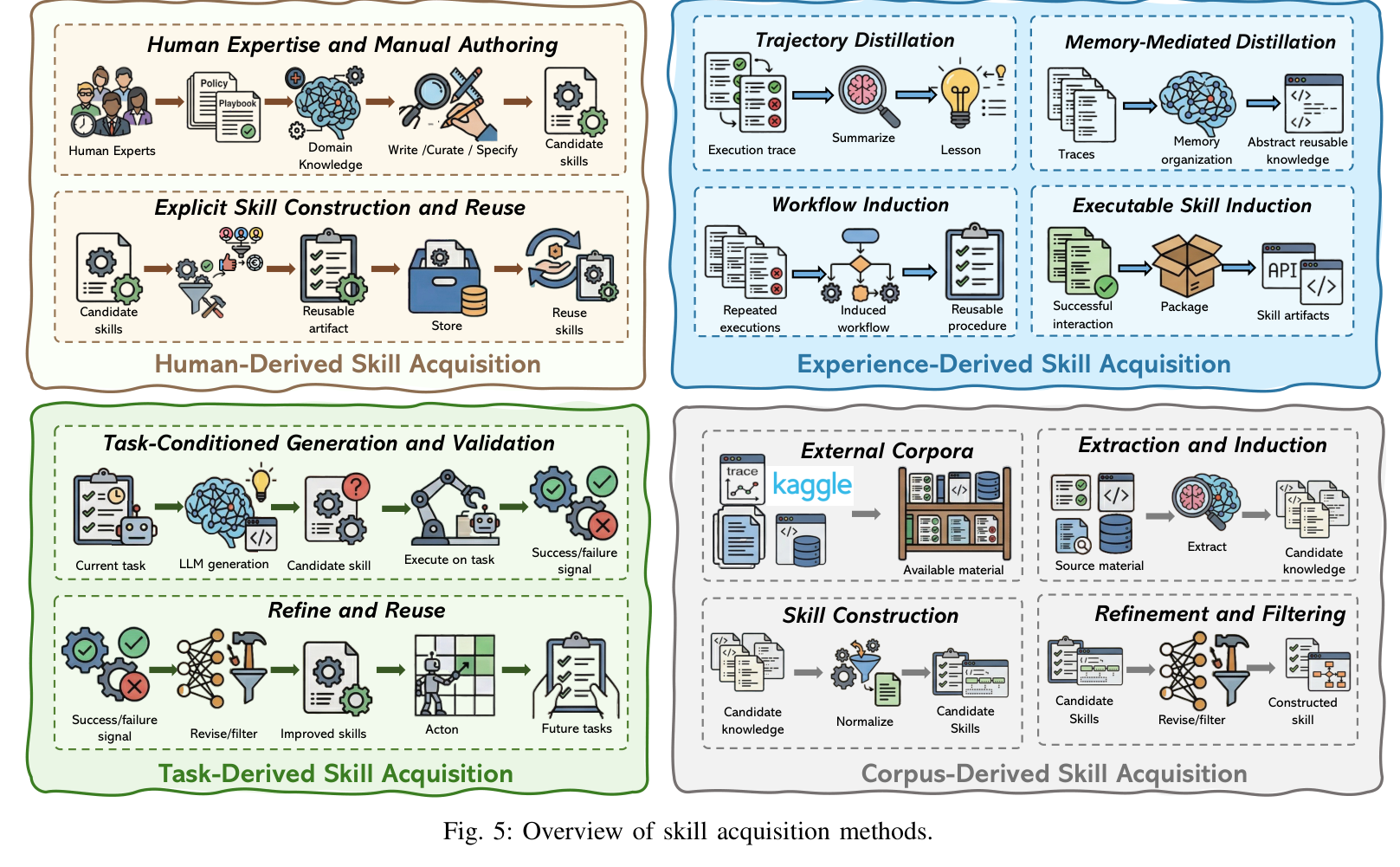
Paper's Figure 5, verbatim (caption: "Overview of skill acquisition methods.").
This figure maps the four acquisition families and their processing operations: selection, abstraction/summarization, memory organization, and procedural packaging. The most heavily studied family is experience-derived (Table II has 18 representative methods), while corpus-derived remains least explored.
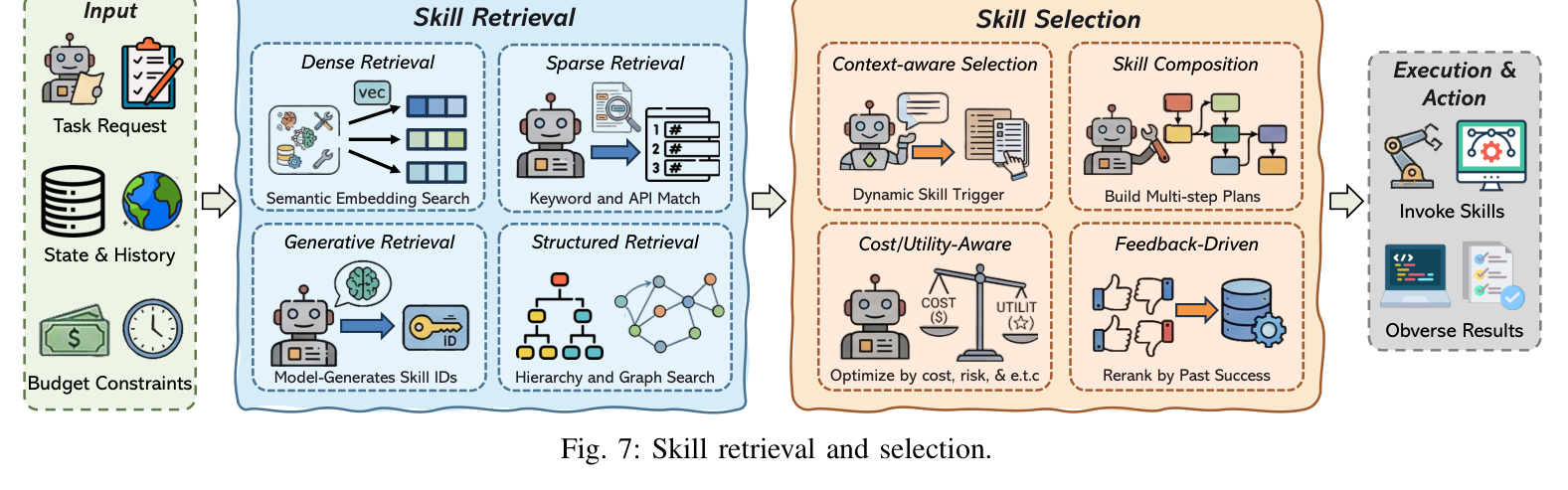
Paper's Figure 7, verbatim (caption: "Skill retrieval and selection.").
The retrieval/selection pipeline separates candidate recall (retrieval) from execution-oriented decision making (selection). Four retrieval paradigms (dense/sparse/generative/structure-aware) feed into four selection perspectives (context-aware/composition/cost-utility/feedback-driven). The field is moving from one-shot relevance matching toward multi-signal, execution-aware candidate recall.
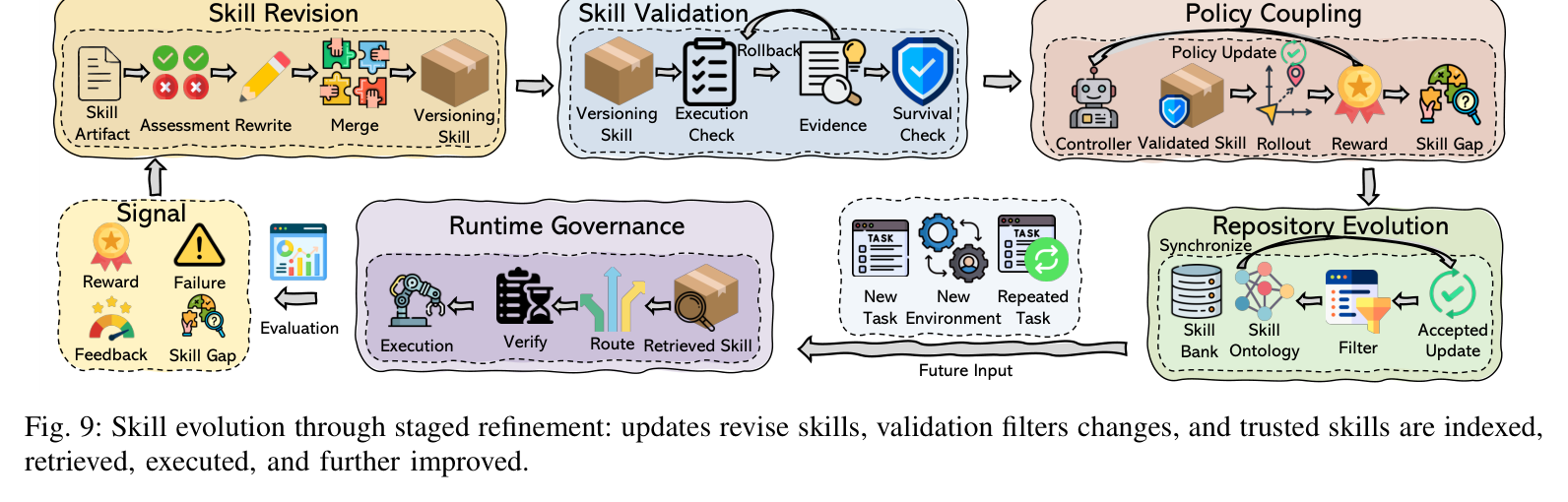
Paper's Figure 9, verbatim (caption: "Skill evolution through staged refinement: updates revise skills, validation filters changes, and trusted skills are indexed, retrieved, executed, and further improved.").
The five evolution stages form a pipeline with gates: revision must pass validation before entering the trusted repository; validated skills become available for retrieval; execution outcomes close the loop. Key insight: systems are better at adding skills than safely rewriting or retiring them (asymmetric revision problem).
Key quantitative claims from surveyed papers #
§6 论证链 #
| Step | Claim | Evidence | Link |
|---|---|---|---|
| 1 | Tool access alone insufficient for reliable agent behavior | MCP solves interoperability but not the procedural problem; SkillsBench shows negative utility possible | §I, §II-C, §V-B3 |
| 2 | The "procedural gap" requires externalizing know-how into reusable artifacts | Formal definition $S = (M, \mathcal{R}, \mathcal{C})$ captures the minimal structure needed; 700k+ skills on SkillsMP demonstrate ecosystem demand | §II-D, Table I |
| 3 | Skills must be represented with appropriate resource configurations | Three configurations (text/code/hybrid) trade off interpretability vs execution reliability vs coordination cost | §III |
| 4 | Acquisition requires multiple complementary source families | Four families (human/experience/task/corpus) each cover distinct provenance; no single family dominates | §IV-E |
| 5 | Retrieval/selection is a two-stage pipeline moving from relevance to execution-awareness | Semantic retrieval opens candidate set; selection must incorporate state, cost, composition constraints, feedback | §V |
| 6 | Evolution is not one-shot but a five-stage governance cycle | Revision → validation → policy coupling → repository → governance; asymmetric revision + security (PoisonedSkills) demonstrate evolution is harder than acquisition | §VI, §VII-C |
| 7 | The lifecycle forms a closed loop: evolution outcomes feed back to retrieval | Updated/retired skills change retrieval behavior; confounded gains require causal attribution across the loop | §VI-E, §VII-C, §VIII-5 |
The argument chain is internally consistent: each stage's insufficiency motivates the next, culminating in the closed-loop claim that all four stages must be co-designed.
§7 实现 cross-reference #
[实现未公开]
The survey references an associated resource repository at https://github.com/JayLZhou/Awesome-Agent-Skills (a curated paper list), but does not provide implementation code.
关键实现细节: