Speculative Interaction Agents: Building Real-Time Agents with Asynchronous I/O and Speculative Tool Calling
§1 TL;DR #
借鉴硬件投机执行思想,将 agent 的推理-行动循环与用户输入流、工具执行流解耦(Asynchronous I/O),并允许在信息不完整时投机发起工具调用、事后修正(Speculative Tool Calling),配合 clock-based SFT 训练将 3B 边缘模型的端到端延迟降低 1.6–2.2×,同时保持接近非流式基线的准确率。
§2 Q1 / Q2 / Q3 #
Q1 痛点 #
实时 voice agent 需要 <1s 响应延迟,但标准 agentic workflow 中模型必须:(1) 等待用户完整输入后才开始推理;(2) 每次 tool call 后阻塞等待返回结果才能继续。两者叠加导致多步工具调用场景下延迟达数秒,无法满足实时交互体验。
Q2 方法 #
Asynchronous I/O: 将 agent 的 think-act 循环与用户输入流、环境响应流解耦。用户输入以
Speculative Tool Calling: 在信息不完整时投机发起 tool call,通过 DAG 依赖追踪管理 in-flight 调用。工具按副作用分为 safe(只读,可投机执行)和 unsafe(写操作,缓存直到 commit point)。模型可通过相同 ID 修改或
核心技术壁垒: Safe/unsafe 分类 + DAG 依赖追踪 + commit-point 语义的组合设计。这是本文最难复现的 insight:必须同时正确处理投机执行、依赖传播取消、不可逆操作的原子提交,且不引入正确性回归。该设计从硬件投机执行(Yeager, 2002)迁移到 agent 工具调用领域,是一个非显然的跨域类比。
Q3 结果 #
- Cloud(OpenAI Realtime API): 1.3–1.7× 延迟降低,准确率几乎持平(71.0 vs 71.6 HotpotQA; 53.2 vs 54.9 TinyAgent)
- Edge(Qwen2.5-3B / Llama-3.2-3B + SI-SFT): 1.6–2.2× 延迟降低,准确率接近非流式 SFT baseline(67.5 vs 68.6 HotpotQA Qwen; 65.2 vs 66.8 TinyAgent Llama)
- 限制:在自然语音数据集(Human Instructions)上 SI-SFT 实际退化——延迟反而增加(14.3s vs 9.3s),准确率下降(13.6 vs 22.0 Qwen),暴露了对 degenerative repeated-action 行为的脆弱性
§3 架构 / 方法图 #
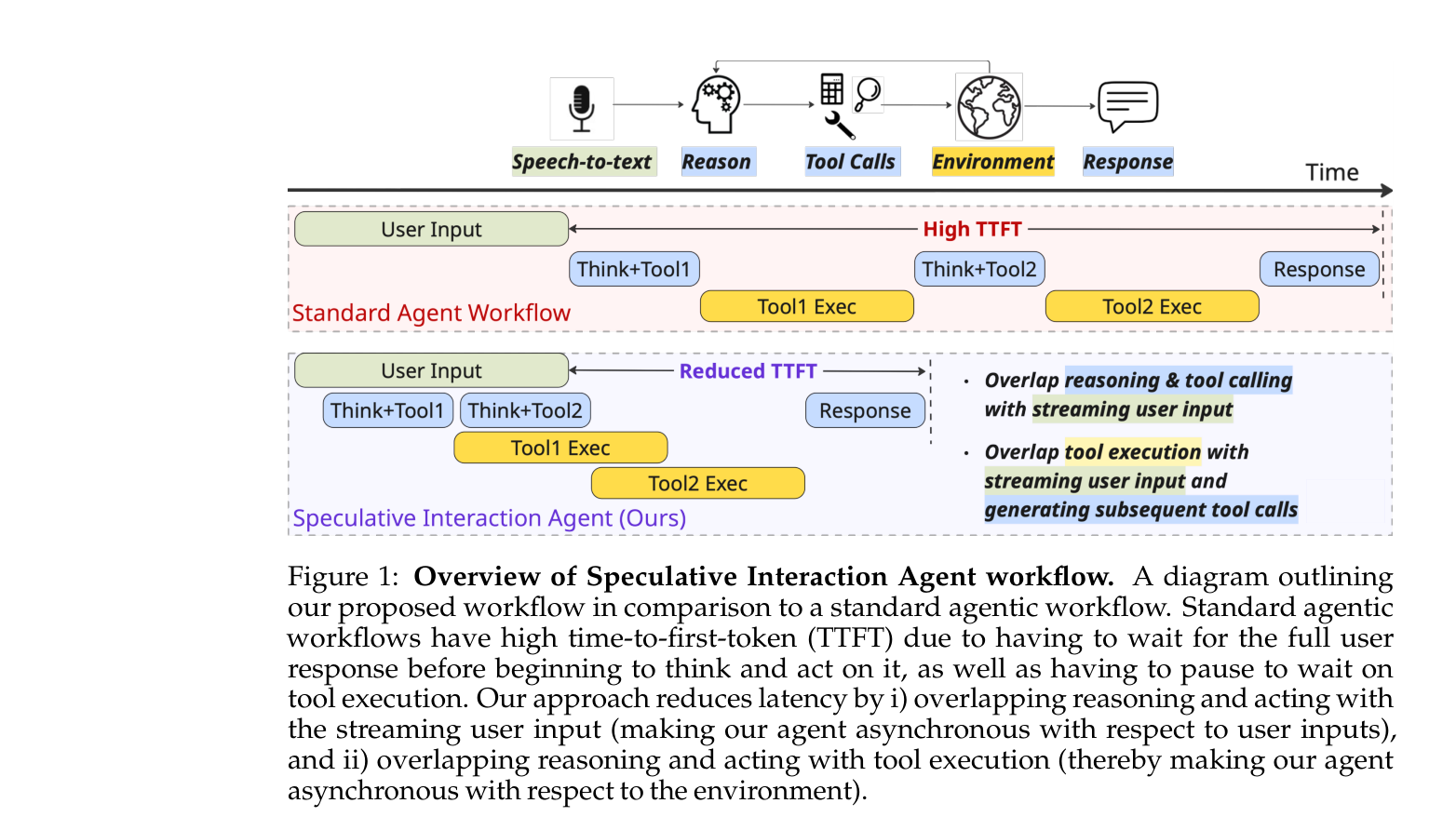
Paper Figure 1: 标准 agentic workflow(上)必须串行等待完整用户输入和每次工具返回;Speculative Interaction Agent(下)将推理与 I/O 重叠,大幅降低 time-to-first-token。
该图直观展示了延迟优化的核心机制:agent 不再阻塞于用户输入完成或工具执行返回,而是在等待期间持续产生推理和新的工具调用。
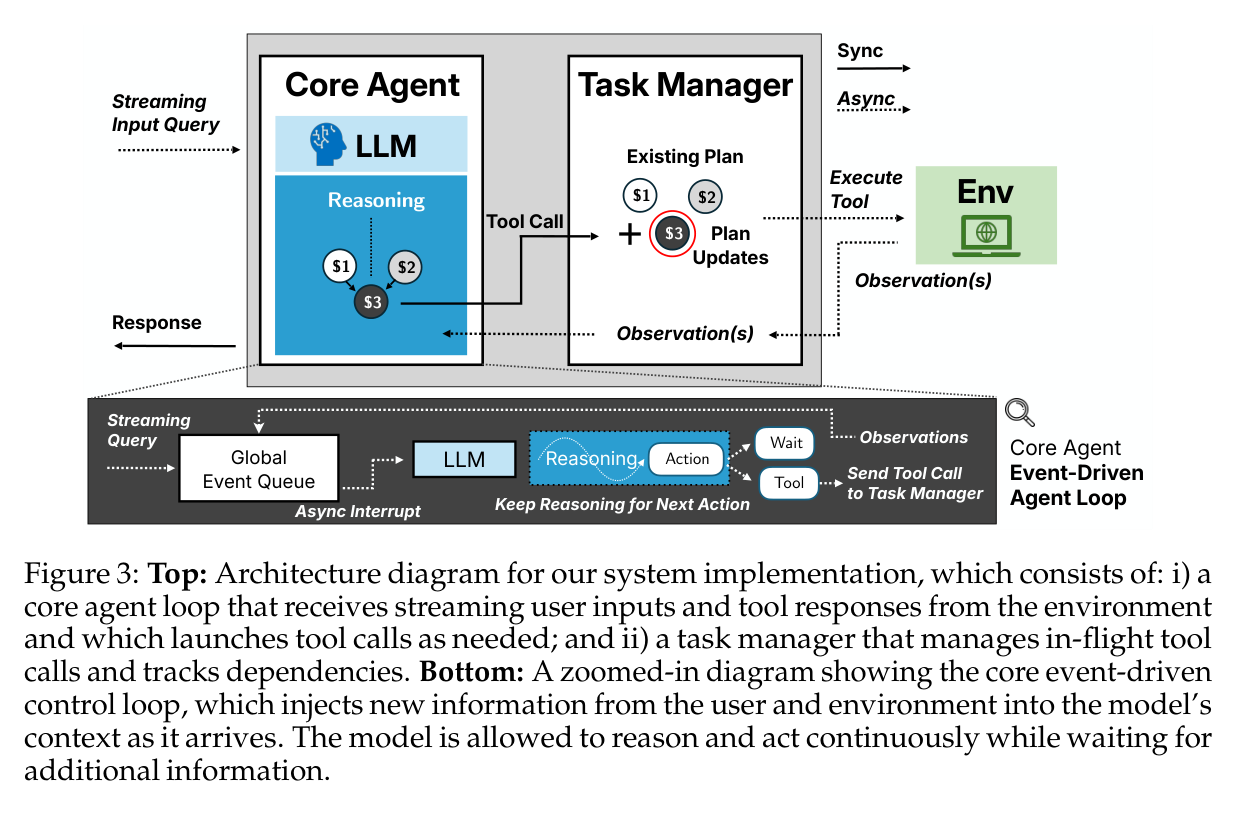
Paper Figure 3: 系统实现的两层架构。上层为 core agent loop(event-driven,接收流式用户输入和工具响应,发起工具调用);下层为 task execution manager(管理 in-flight 调用的 DAG 依赖、safe/unsafe 分类、并行执行)。
架构解耦使得 agent 推理逻辑与工具执行管理独立演进。Core agent loop 基于 vLLM 的 interruptible streaming 实现,收到新事件时中断当前生成、注入新 context 后继续。Task manager 借鉴 LLMCompiler 的 DAG 执行但增加了动态修改/移除、投机保持和 commit-point 逻辑。
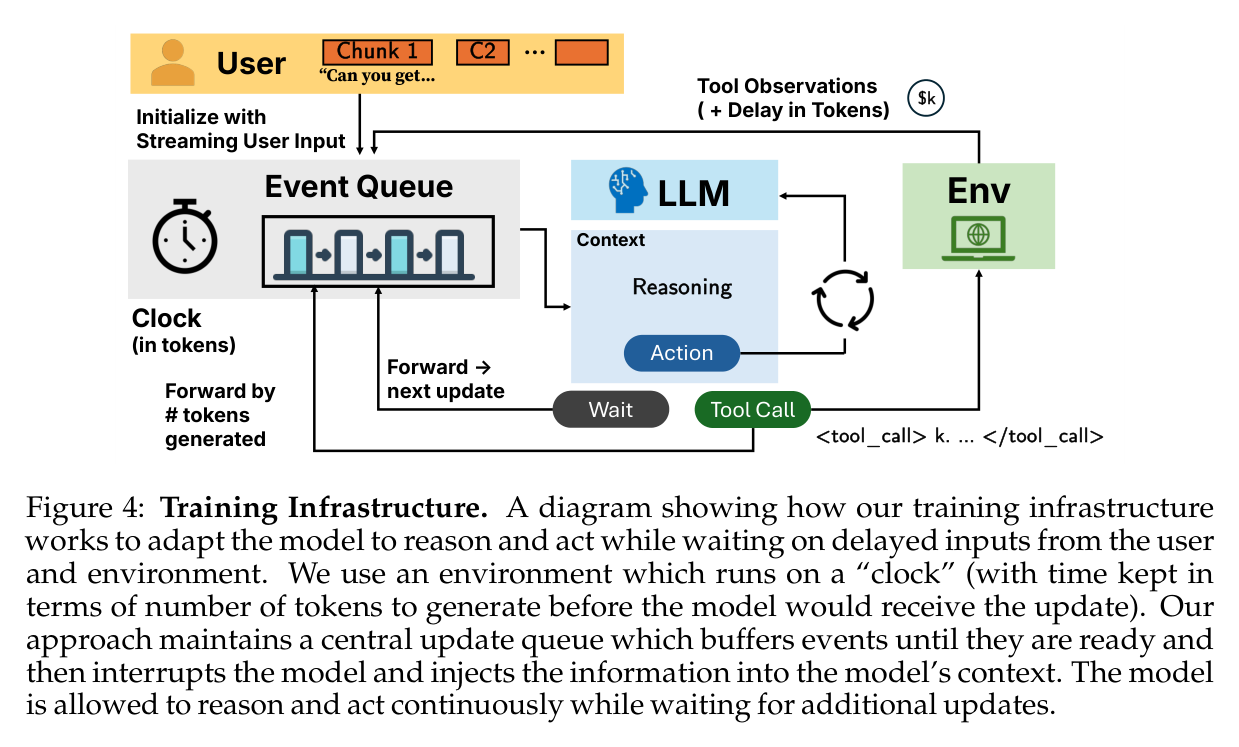
Paper Figure 4: 训练基础设施。Central update queue 按 token 计数(clock)缓冲事件,到达时机时中断模型生成并注入新信息,模拟推理时的异步交互行为。
Clock-based 训练将 wall-clock 时间映射为 token 数量(基于假设的 tokens-per-second 速率),使得离线 SFT 可以忠实模拟在线流式交互行为,无需真实实时系统支持。
§4 作者证明 #
无形式化作者证明 — 仅实证。
本文无数学收敛证明或理论 bound。所有声称基于实验验证。以下为关键实证 check:
| # | Check | 结果 |
|---|---|---|
| 1 | 延迟降低单调性 vs. 基线 | ✓ 所有 clean benchmark 配置下 SI-SFT 延迟 < baseline SFT |
| 2 | 准确率损失可控 | ✓ Cloud: -0.6/-1.7pp; Edge: -1.1/-1.6pp (HotpotQA/TinyAgent) |
| 3 | SI-SFT vs. normal SFT 的必要性 | ✓ Normal SFT 用于 SI format 时准确率崩溃(33.4% vs 67.5% Qwen HotpotQA) |
| 4 | Safe/unsafe 分类正确性 | 隐含验证:state-based evaluation 通过意味着 unsafe 工具未被错误执行 |
| 5 | 跨模型泛化 | ✓ Qwen2.5-3B 和 Llama-3.2-3B 均有效 |
| 6 | 失败模式识别 | ✓ Human Instructions 暴露了 degenerative 行为,作者诚实报告 |
可被 bound 但未被 bound 的量: 给定 tool latency 分布和用户输入速率,最优延迟下界可通过排队论模型建立(M/G/1 with preemption),但作者未做此分析。
§5 实验与数据 #
主结果:Cloud API(Table 1) #
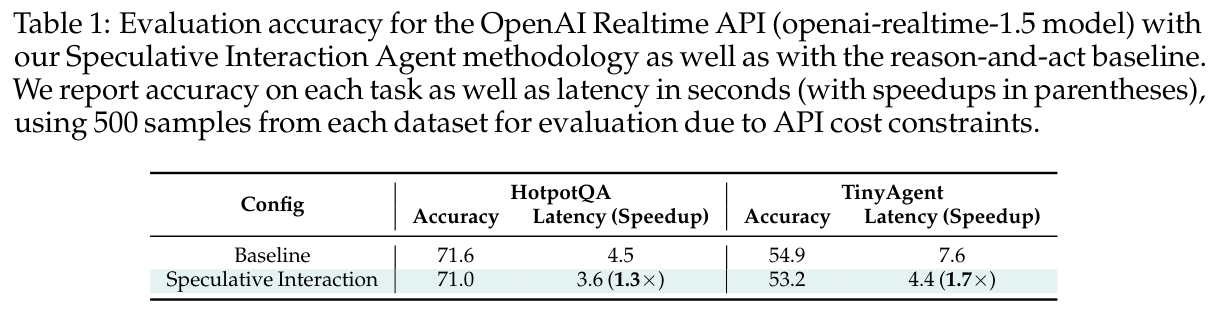
Paper Table 1: 在 openai-realtime-1.5 上的评估(500 samples/dataset)。Speculative Interaction 以轻微准确率损失换取 1.3×/1.7× 延迟降低。
Cloud 模型无需微调,仅靠 in-context examples 引导行为。1.7× 在 TinyAgent(多步工具调用更多)上的加速大于 HotpotQA(仅搜索工具)的 1.3×,印证了工具调用越密集、异步重叠收益越大。
主结果:Edge 模型(Table 2) #
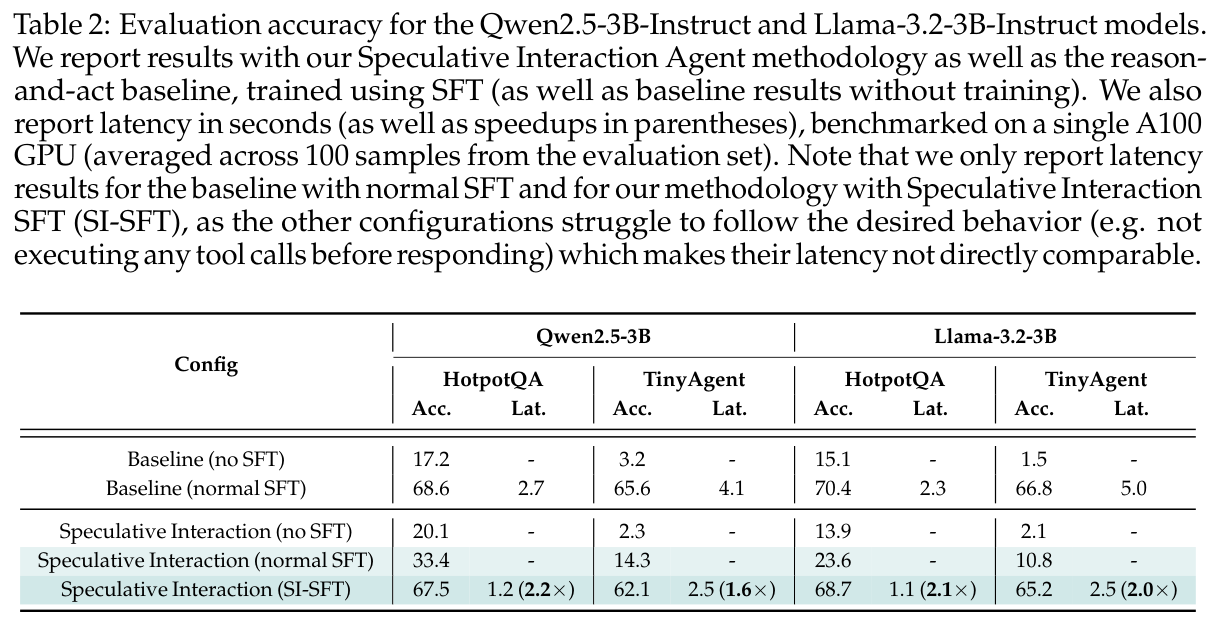
Paper Table 2: Qwen2.5-3B 和 Llama-3.2-3B 在 HotpotQA/TinyAgent 上的评估。SI-SFT 实现 2.2×/2.1×/2.0×/1.6× 加速,准确率接近非流式 SFT。
关键对照实验:
- No SFT + SI format → 近乎随机(20.1% Qwen HotpotQA):证明 3B 模型无法 zero-shot 理解异步格式
- Normal SFT + SI format → 严重退化(33.4%):标准 SFT 数据不含流式中断模式,模型学到的行为无法迁移
- SI-SFT → 67.5%(接近 baseline SFT 的 68.6%):clock-based 训练数据是使方法奏效的关键
自然语音评估(Table 3) #
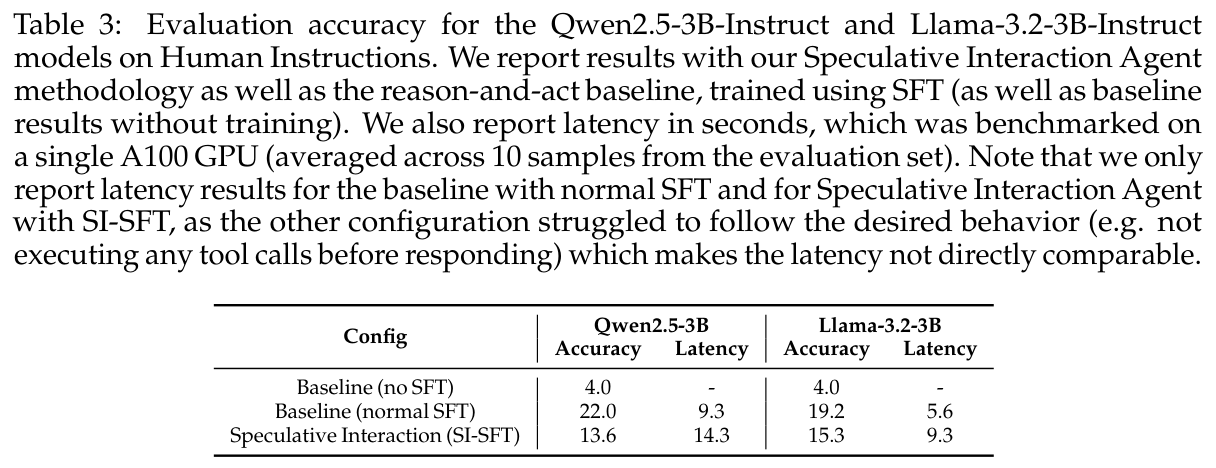
Paper Table 3: 在 177 条真实语音指令上的评估。SI-SFT 准确率和延迟均劣于 baseline SFT,暴露方法对自然语音 disfluency 的脆弱性。
Human Instructions 数据集包含填充词(um, yeah)、在线纠正、意图变更等自然语音特征。SI-SFT 在此场景下产生 degenerative repeated-action 行为,导致延迟反而增加。这表明 clean benchmark 上的加速无法直接推广到 production voice agent 场景,需要更鲁棒的训练策略。
关键实验设置 #
- 推理硬件:单 A100 GPU
- Latency 评估:TTS (Kokoro-82M) + forced alignment (WhisperX) 模拟真实语音流式到达
- Tool latency: HotpotQA 用真实延迟,TinyAgent 用 U(0.5, 1.0)s
- 训练:LLaMA-Factory, 1 epoch, batch 16, lr 3e-5, cosine scheduler
- SI-SFT 数据:10% 含错误工具调用 + 纠正轨迹
§6 论证链 #
| Step | 论证 | 支撑 |
|---|---|---|
| 1 | 实时 voice agent 需要 <1s 延迟,但标准 agent loop 因串行等待 user input + tool execution 导致多秒延迟 | Miller 1968 (1s threshold); 实测 baseline 4.5–7.6s (Table 1) |
| 2 | 将 agent reasoning 与 I/O 解耦(Async I/O)允许重叠处理,类比 CPU pipeline 的 memory-level parallelism | Gim et al. 2024 (async tool call); Chiang et al. 2025a (streaming input) |
| 3 | 投机执行 tool call 可进一步隐藏延迟,但需解决正确性:safe/unsafe 分类 + commit-point 语义 | 类比 MIPS R10000 store buffer (Yeager 2002); DAG 依赖追踪 (Kim et al. 2024 LLMCompiler) |
| 4 | 3B 边缘模型无法 zero-shot 理解异步格式,需 clock-based SI-SFT 训练 | Table 2: no-SFT 20.1%, normal-SFT 33.4%, SI-SFT 67.5% |
| 5 | 在 clean benchmark 上实现 1.6–2.2× 加速且准确率损失 <2pp | Table 1 + Table 2 |
| 6 | 在自然语音上方法退化,表明 training distribution 与真实分布的 gap 是当前主要限制 | Table 3: 延迟增加,准确率下降 |
§7 实现 cross-reference #
[实现未公开] — 作者未开源代码仓库。
核心技术壁垒: Safe/unsafe 工具分类 + DAG commit-point 投机执行语义。复现难点在于:(1) 正确传播取消到依赖链;(2) commit-point 的触发条件判定(final query received + no further edits);(3) 中断-注入-恢复的 generation 状态管理需要 serving framework 层支持(vLLM interruptible streaming)。
关键实现细节:
- Interrupt masking in training: SFT loss 不计算被中断时模型生成的最后一个 token。这避免模型学习到在任意位置提前停止的 spurious pattern,是保证训练与推理行为一致性的关键细节。
- Token-clock 时间转换: 将 wall-clock delay(用户说话时间、工具执行时间)统一转换为 token 计数(基于采样的 100–200 tok/s),使得离线 SFT 数据生成可以忠实模拟在线异步行为。训练和评估使用相同的转换参数确保分布一致。