MUSE-Autoskill: Self-Evolving Agents via Skill Creation, Memory, Management, and Evaluation
MUSE-Autoskill: Self-Evolving Agents via Skill Creation, Memory, Management, and Evaluation #
§1 TL;DR #
MUSE-Autoskill 将 agent skill 从一次性生成产物升级为有完整生命周期(创建→记忆→管理→评估→迭代)的可进化资产;在 SkillsBench 51 任务上以 68.40% 领先同 backbone 三 agent,自生成 skill 在 35 task 上达 87.94% 超越人工 skill,且可零修改迁移至其他 agent。
§2 Q1 / Q2 / Q3 #
Q1 痛点 #
现有 automatic skill 系统将 skill 视为静态孤立产物,存在四个实际断层:
- 创建–使用断裂:skill 生成脱离 agent runtime 上下文,生成的 skill 无法利用 agent 实际运行信息
- 无结构化 per-skill 记忆:跨任务积累的经验无处沉淀,每次调用 skill 都从零开始
- 缺少评估/迭代:生成后无 unit-test 驱动的验证,skill 质量无法持续提升
- 上下文管理缺失:长任务下 flat conversation history 截断或溢出,信息丢失
- Creation — 通过内置
skill_create工具在 ReAct 循环中即时生成结构化 skill 包(SKILL.md + scripts/ + tests/),消除创建–使用断裂 - Memory — 三层记忆:short-term(当前任务 context)、long-term(跨 session 通用经验)、skill-level(每个 skill 的
.memory.md积累使用经验) - Management — catalog 式 progressive disclosure + 合并/裁剪机制保持 skill bank 精简可扩展
- Evaluation — 每个 skill 包含 tests/ 目录,注册前必须通过全部 unit test;运行时 feedback 持续监控
- Refinement — test 失败自动触发
update_skill修补循环 - Skill 注册 gating:每个新创建的 skill 包必须通过其
tests/目录中的全部 pytest-compatible test 后才能注册进 Skill Bank。这是 skill 质量的硬约束——Appendix B 明确说明 "failed tests block registration"。 - Catalog progressive disclosure:Skill Bank 可能包含 100+ skill,但系统仅在 system prompt 注入 name + description 的 YAML catalog(~5–10K tokens),agent 通过
read_skill按需拉取完整 SKILL.md body,避免 prompt 线性膨胀。 - Context compression 的 KEEP_FIRST/KEEP_LAST=5 选择:确保 task framing(前 5 turn)和 working memory(后 5 turn)始终 verbatim 传入 LLM,中间段才做 summarization。Appendix D 的 COMPRESS_TOKEN_THRESHOLD=180K 设在 200K context limit 的 90% 处。
现有方法(Voyager、AutoSkill、EvoSkill、SkillGen、SkillOS)各覆盖生命周期部分阶段,但无一同时满足 per-skill memory + unit-test 评估 + 自动迭代 + cross-agent 迁移。
Q2 方法 #
MUSE-Autoskill 将 skill 生命周期形式化为 5 阶段闭环:
上下文管理采用 DAG 结构 + 两级自适应压缩:Level-1 对单个超限 node 原位摘要;Level-2 将中间 span 合并为 synthetic summary node。原始 node 通过 immutable history pointer 保留完整回放能力。
核心技术壁垒:将 skill 创建嵌入 ReAct runtime loop(而非后处理),配合 per-skill memory 实现经验积累。这要求 agent 在推理中自主决策何时创建 skill、如何从成功轨迹蒸馏、如何将跨任务经验写回 .memory.md——是工程整合难度而非单一算法突破。
Q3 结果 #
| 指标 | 数值 |
|---|---|
| SkillsBench 51-task with human skills | 68.40%(vs Codex 67.28%, Hermes 61.21%) |
| 人工 skill lift | +15.21 pp |
| 自生成 skill(35 task) | 87.94%(超越人工 skill ceiling) |
| Cross-agent 迁移(→ Hermes) | +10.51 pp,关闭 79% 人工 skill gap |
| 自生成 skill token 节约 | −20% tokens, −37% latency vs human skills |
| Skill 生成成本回本 | ≈3 次复用 |
§3 架构 / 方法图 #
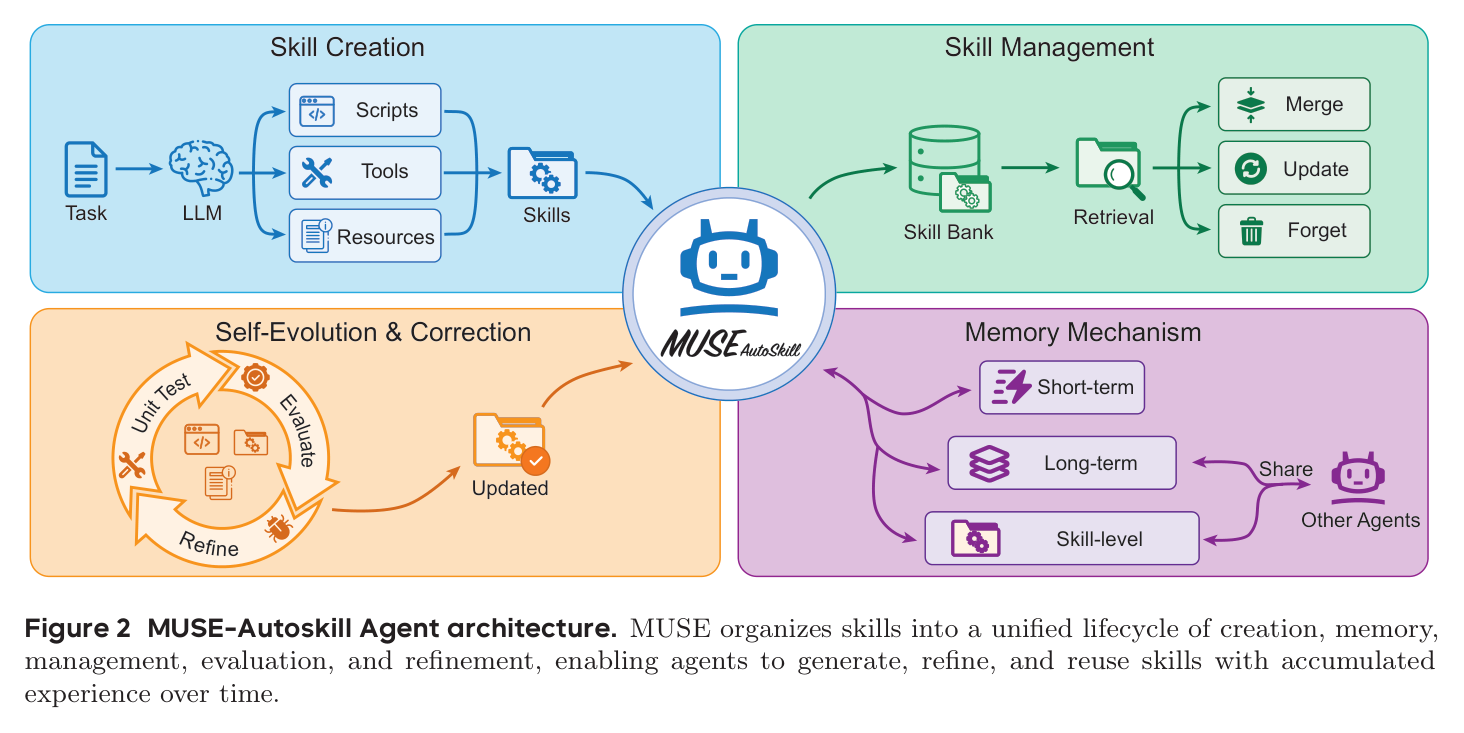
Paper Figure 2: MUSE-Autoskill Agent architecture. MUSE organizes skills into a unified lifecycle of creation, memory, management, evaluation, and refinement, enabling agents to generate, refine, and reuse skills with accumulated experience over time.
图中展示了 MUSE 的核心循环:Master Agent 运行 ReAct loop(Planning → Action → Observation),在 Action 阶段通过 Skill Bank 检索已有 skill 或调用 Skill Creator 生成新 skill 包。Evaluator 运行 bundled tests,pass 则注册并追加 memory,fail 则触发 Refiner 修补后重新入循环。
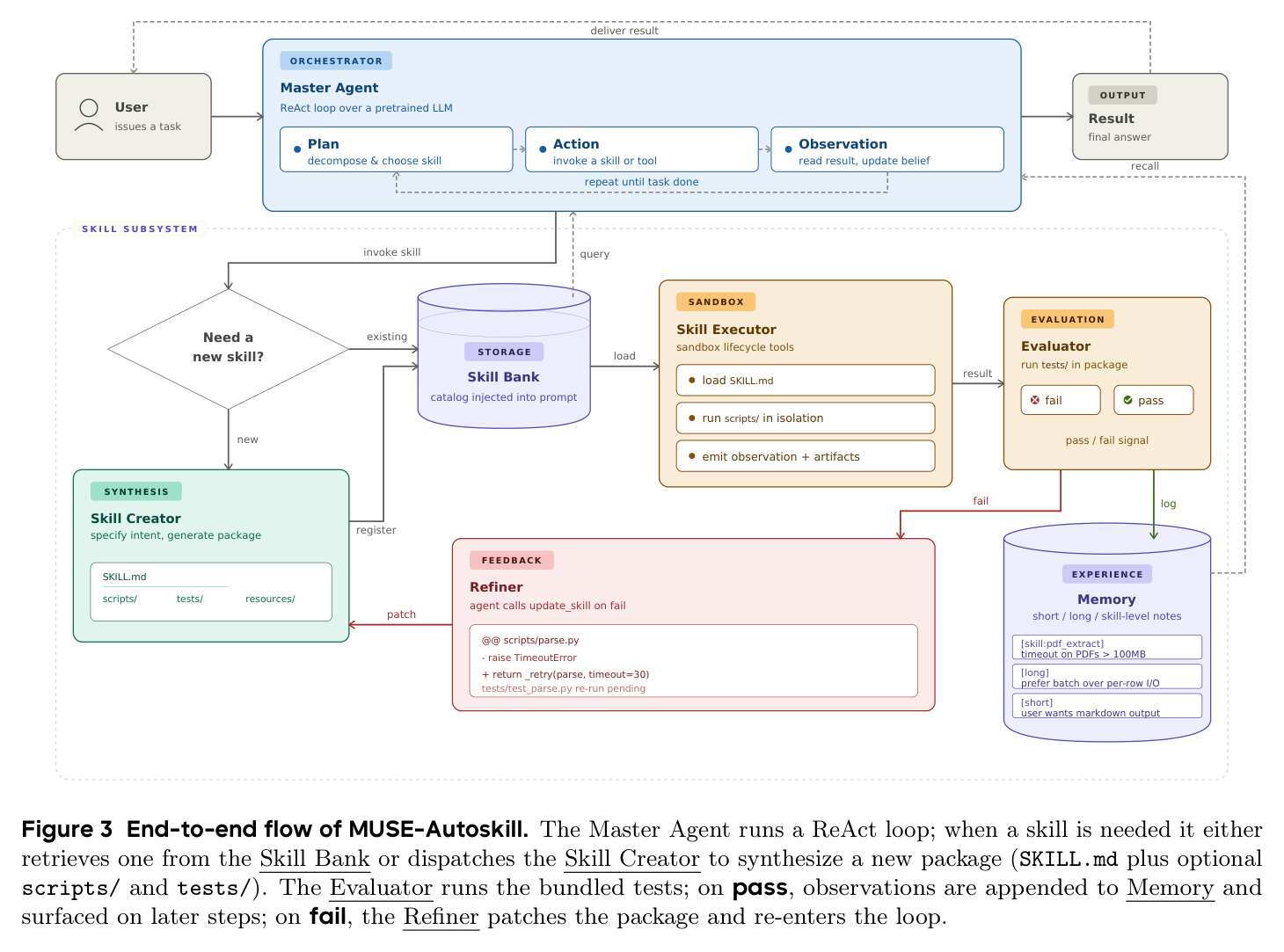
Paper Figure 3: End-to-end flow of MUSE-Autoskill. The Master Agent runs a ReAct loop; when a skill is needed it either retrieves one from the Skill Bank or dispatches the Skill Creator to synthesize a new package (SKILL.md plus optional scripts/ and tests/). The Evaluator runs the bundled tests; on pass, observations are appended to Memory and surfaced on later steps; on fail, the Refiner patches the package and re-enters the loop.
该图清晰展示了 skill 从创建到验证到注册的完整 data path,以及 fail 路径如何形成 closed-loop refinement。

Paper Figure 4: Adaptive context compression over a DAG of ReAct turns. Each turn is a (plan, action, observation) triple; the first KEEP_FIRST and last KEEP_LAST turns are always pinned and only the middle is eligible for compression. Level-1 rewrites oversized turns in place; Level-2 merges the compressible span into one synthetic node.
三层示意图展示了 context 从完整链到 Level-1 单点压缩到 Level-2 整段合并的渐进退化过程,原始 turn 通过 immutable pointer 保持完整可回放。
§4 作者证明 #
无形式化作者证明 — 仅实证。 本文不包含收敛性证明或形式化成功率模型。最接近形式规范的是 Appendix E 的 compression pseudocode。
以下为 agent-specific 实证检查项:
| # | 检查项 | 结论 |
|---|---|---|
| 1 | Success-rate sweep (task difficulty × tool set × backbone) | 仅单 backbone (GPT-5.5),无 model-size ablation;per-domain breakdown 提供 difficulty axis |
| 2 | Latency budget per turn | Table 6: median 411s/15 turns with generated skill; Table 11: MUSE median 604–634s total, 18–19 turns |
| 3 | Failure mode classification | Appendix I 分 16 失败 task 为 2 类:specialized production tooling (6/16) 和 numerically-heavy non-textual reasoning (10/16) |
| 4 | Backbone sensitivity | 未测试——仅 GPT-5.5;cross-agent 实验 (MUSE→Hermes) 间接证明 skill portability 而非 backbone portability |
| 5 | Skill quality validation | §4.6 人工审计 35 skill:无 verifier output hardcoding, 无 task-ID branching |
| 6 | Regression analysis | hvac-control 80%→20% 回退分析:source-trajectory-specific calibration assumptions |
可被形式化但未被 bound 的量:(1) skill 生成成功率 vs task difficulty 的下界;(2) context compression 后信息保留率的理论 guarantee。
§5 实验与数据 #
5.1 Overall performance #
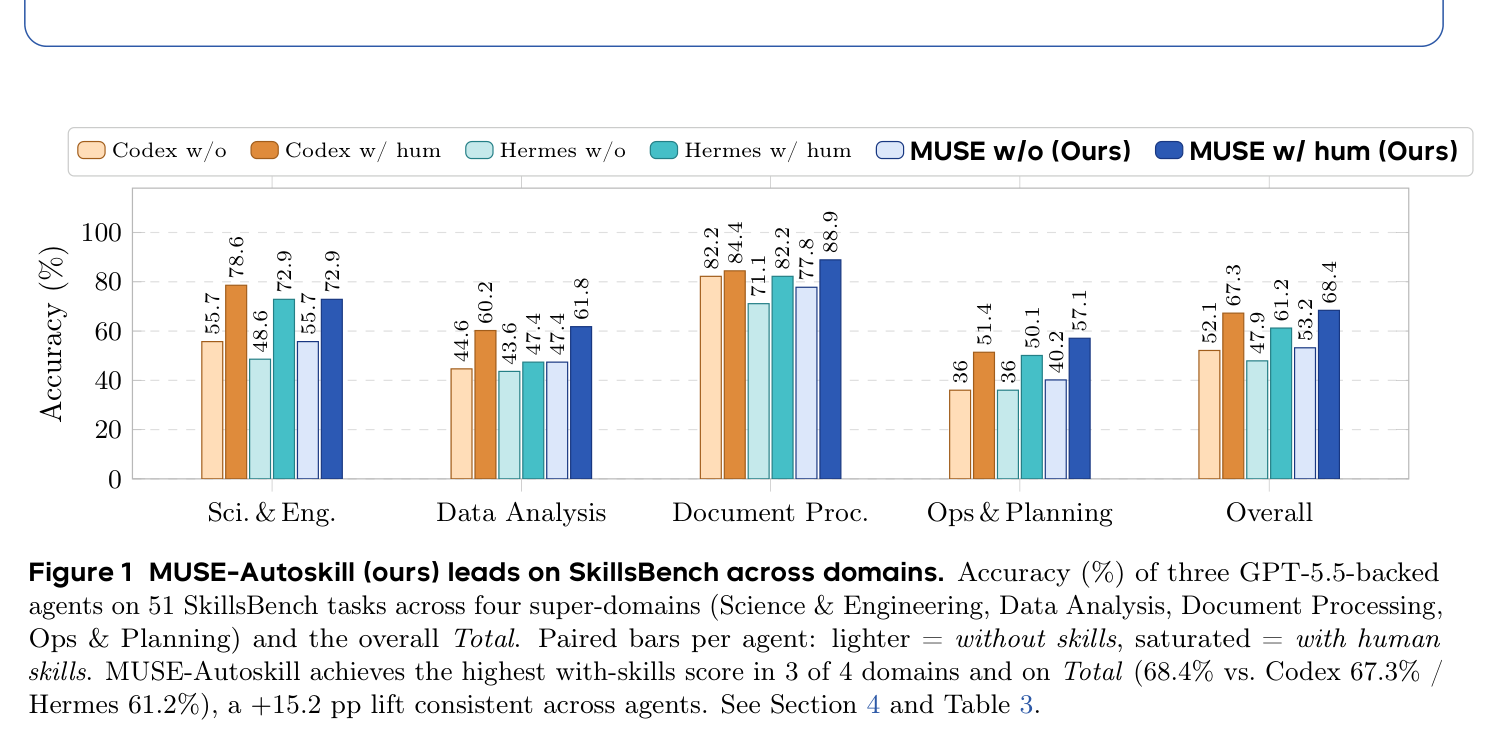
Paper Figure 1: Accuracy (%) of three GPT-5.5-backed agents on 51 SkillsBench tasks across four super-domains. MUSE-Autoskill achieves the highest with-skills score in 3 of 4 domains and on Total (68.4%), a +15.2 pp lift consistent across agents.
三个 agent 在四个 super-domain 的对比表明 skill usage 是 agent 设计中的一等公民——所有 agent 均获 13–15 pp 提升,MUSE 在 Data Analysis、Document Processing、Ops & Planning 三域领先。
5.2 Self-generated skills vs human skills #
| Configuration | Accuracy (51 tasks) |
|---|---|
| MUSE without skills | 53.19% |
| MUSE with human skills | 68.40% |
| MUSE self-created skills | 60.35% |
| MUSE self-created (35 tasks with skill) | 87.94% |
关键发现:bottleneck 在 Phase 1 覆盖率(16 task 无成功轨迹可供蒸馏),而非 skill 生成质量本身。
5.3 Pareto optimality of generated skills #
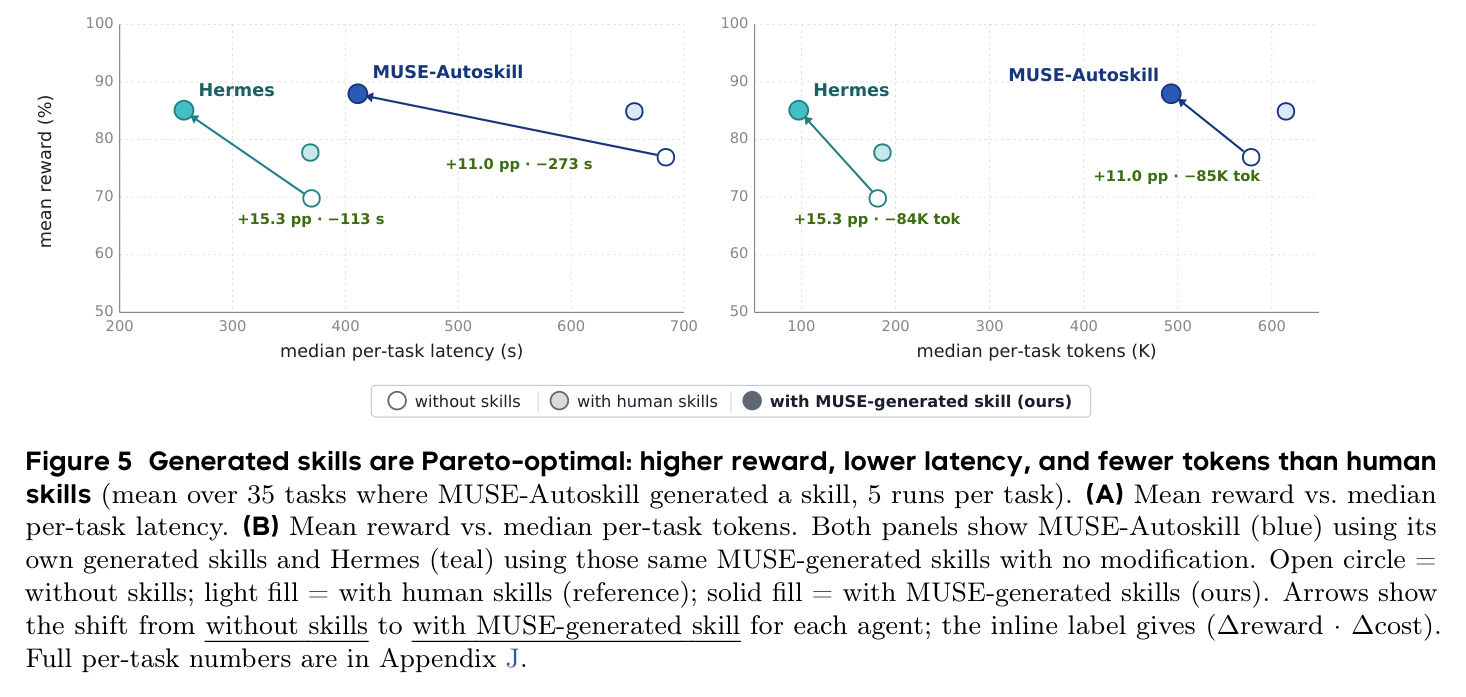
Paper Figure 5: Generated skills are Pareto-optimal: higher reward, lower latency, and fewer tokens than human skills (mean over 35 tasks). (A) Mean reward vs. median per-task latency. (B) Mean reward vs. median per-task tokens.
Generated-skill 点在两个维度(reward-latency 和 reward-tokens)均处于 Pareto 前沿——2.2× 长的 SKILL.md 反而节省 token 和时间,因为程序化描述减少了 agent 推理步骤。
5.4 Skill anatomy comparison #
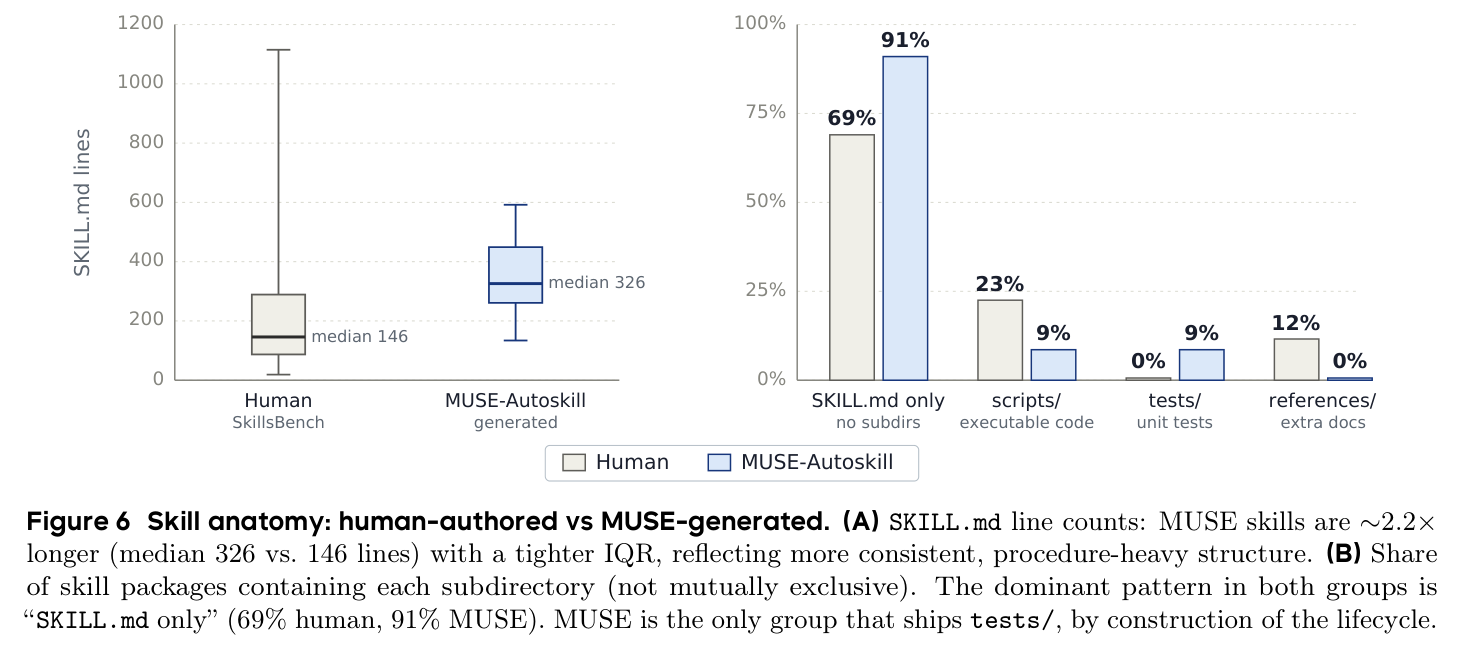
Paper Figure 6: (A) SKILL.md line counts: MUSE skills are ~2.2× longer (median 326 vs. 146 lines). (B) Share of skill packages containing each subdirectory.
MUSE 生成的 skill 结构更完整:包含显式 input/output schema、failure mode 列表、step-by-step procedure。MUSE 是唯一生成 tests/ 目录的系统。
5.5 Cross-agent transfer #
| Configuration | Hermes | MUSE |
|---|---|---|
| Without skills | 47.89% | 53.19% |
| With MUSE-generated skills | 58.40% | 60.35% |
| With human skills | 61.21% | 68.40% |
Hermes 与 MUSE 使用同一套 generated skills 时仅差 ~2 pp(58.40% vs 60.35%),证明 skill 是外部化知识资产而非绑定特定 agent runtime 的行为。
§6 论证链 #
| Step | 论点 | 支撑证据 | 强度 |
|---|---|---|---|
| 1 | 现有 skill 系统仅覆盖生命周期部分阶段 | Table 1: 9 个 baseline 无一全覆盖 5 阶段 + cross-agent + training-free | 强——文献清晰 |
| 2 | 统一生命周期 + runtime 创建消除 4 个 gap | §3 architecture: skill_create 内嵌 ReAct loop + .memory.md + tests/ gating + 两级压缩 | 中——设计论证,定性 |
| 3 | Human skills 普遍提升 agent performance | Table 2: 三 agent 均 +13–15 pp;Table 3 四域一致 | 强——51 task × 5 runs |
| 4 | 自生成 skill 质量可超越人工 | Table 4: 35-task subset 87.94% vs 68.40% human ceiling | 中——conditioned on Phase 1 success(仅 68.6% coverage) |
| 5 | Skill 作为外部化资产可零修改迁移 | Table 5: Hermes +10.51 pp,关闭 79% gap;MUSE vs Hermes 仅差 2 pp | 强——cross-agent 实验设计清晰 |
| 6 | 更长 skill 反而更高效 | Table 6 + Figure 5: 2.2× lines, −20% tokens, −37% latency | 中——机制解释合理(减少推理步骤)但仅 35 task 验证 |
| 7 | Bottleneck 在覆盖率而非 skill 质量 | Appendix I: 16 失败 task 集中在 specialized tooling + numerical reasoning | 中——定性分析,未量化 difficulty metric |
§7 实现 cross-reference #
[实现未公开]
论文未开源代码仓库。从 §3 和 Appendix B/C/E 可还原以下关键实现细节:
关键实现细节:
Production deployments 提及:SkillMarket(用户侧 skill 创建)、ArkClaw(skill 检索集成)、SkillHub(hosted lifecycle service),但均未公开代码。