τ₀-WM: A Unified Video-Action World Model for Robotic Manipulation
τ₀-WM: A Unified Video-Action World Model for Robotic Manipulation — L2 #
1. TL;DR #
One shared Wan video-diffusion backbone exposes two interfaces: a Video Action Model (VAM, 5.5B) that jointly predicts future latents + action chunks, and an Action-Conditioned Video Simulator (ACVS) that scores candidate actions. Heterogeneous 27.3K-h data with supervision masks + a test-time propose→score→rectify loop lift success.
2. Q1 / Q2 / Q3 #
Q1 — 痛点 (Problem formulation) #
Robot manipulation demands both executable actions and the ability to anticipate their physical consequences before execution. The data landscape forces a trade-off: robot demonstrations are action-grounded but narrow; broad video (egocentric human, UMI-style) is predictive but lacks a deployable action space. Formally, prior VAMs treat video prediction as an auxiliary objective; the goal here is to make a single predictive representation serve policy proposal, consequence imagination, and action revision simultaneously, while letting each heterogeneous source supervise only the signals it actually contains.
The learning objective is a dual flow-matching loss. For VAM, over targets $\mathbf{z}=\mathbf{z}_{t+1:t+H_v}$ (future latents) and $\mathbf{a}=\mathbf{a}_{t:t+H_a-1}$ (action chunk):
$$\mathcal{L}_{\mathrm{VAM}}=\mathbb{E}\Big[\lambda_{z}\|f_{\theta}^{z}(\tilde{\mathbf{z}},u_{z},\mathbf{c}_{t},\mathbf{p})-\mathbf{v}_{\mathbf{z}}\|_{2}^{2}+\lambda_{a}\|f_{\theta}^{a}(\tilde{\mathbf{a}},u_{a},\mathbf{s}_{t},\mathbf{h})-\mathbf{v}_{\mathbf{a}}\|_{2}^{2}\Big]$$
Assumptions: samples are treated as i.i.d. draws; the expectation is over a heterogeneous mixture where a per-sample supervision mask zeroes losses for absent modalities (e.g. egocentric video contributes only the $\|\cdot\|_z$ term). No Markov / stationarity guarantee is stated; the model is an amortized conditional velocity field, not a value-iteration scheme.
Inputs/outputs of one step: VAM consumes (multi-view observation $\mathbf{o}_t$, instruction $\mathbf{p}$, state $\mathbf{s}_t$) and produces (future latents $\hat{\mathbf{z}}$, action chunk $\hat{\mathbf{a}}$). ACVS consumes (memory observations, instruction, a candidate action) and produces (imagined rollout $\hat{\mathbf{z}}$, dense reward $\hat{\mathbf{r}}$).
Q2 — 方法 (Method) #
Build everything on one shared Wan2.2-TI2V-5B video diffusion backbone (+ Wan VAE). Expose two interfaces:
- VAM (policy): 5B video DiT + 0.5B DiT action branch coupled by cross-attention → jointly denoises future latents and action chunk (Eq. 1/2).
- ACVS (evaluator): same backbone, action branch removed; candidate actions are injected as conditions (Eq. 4) and it predicts a dense reward trajectory (Eq. 3/5).
- Loss decomposition (Eq. 2) — two flow-matching terms; the $\|\cdot\|_z$ term enforces future-visual dynamics, the $\|\cdot\|_a$ term enforces executable action grounding. With $\lambda_z=\lambda_a=1$, both weighted equally; masking makes the $\|\cdot\|_a$ term drop out for action-free (egocentric) samples. ✔ dimensionally consistent (velocity residuals in $\ell_2$).
- ACVS loss (Eq. 5) — structurally identical to Eq. 2 but the action term is swapped for a reward-velocity term $\|g_\phi^r(\tilde{\mathbf{r}},u_r,\mathbf{h})-\mathbf{v}_\mathbf{r}\|_2^2$; $\mathbf{h}$ is now action-conditioned. Consistent: reward is regressed via the same flow machinery. ✔
- Action conditioning (Eq. 4) — $\mathbf{c}^a_\ell=\psi_D(\mathbf{b}_\ell)$, $\mathbf{m}^a_\ell=\psi_{6D}(\mathbf{b}_\ell)$: two MLP projections per future slot into diffusion-time and AdaLN embeddings. Consistent with per-slot temporal alignment; observation slots stay unconditioned. ✔
- RCS (Eq. 6/7) — $S_{\mathrm{RCS}}^{(i)}=-\mathcal{E}_{\mathrm{RCS}}^{(i)}$, $i^\star=\arg\max_i S_{\mathrm{RCS}}^{(i)}$: negative re-denoising error → higher consistency with the learned action manifold. Sign convention is coherent (low error = high score). ✔
- Escalation rule (Eq. 8) — LAR triggers when $S_{\mathrm{RCS}}^{(i^\star)}<\gamma$, the exact negation of the Alg. 1 return condition $S_{\mathrm{RCS}}^{(i^\star)}\geq\gamma$. Internally consistent with the pseudocode. ✔ (RHS of the inequality was truncated in the source HTML; reconstructed from Alg. 1.)
- Rollout value & selection (Eq. 10/11) — $J^{(i)}=\max_{0\le q}[\text{reward over rollout}]$, $j^\star=\arg\max_i J^{(i)}$: take max task-progress over the imagined horizon, then pick the best candidate. Consistent with dense-reward semantics; note Eq. 10 RHS was image-only in the source, reconstructed as a max over the rollout. ✔
- Dual-path action conditioning in ACVS — Eq. 4 injects actions through two separate paths (diffusion-time embedding via $\psi_D$ and AdaLN modulation via $\psi_{6D}$), broadcast across spatial tokens/views only for the aligned future slot; observation slots remain unconditioned. A single conditioning stream would be the naive (and likely weaker) choice.
- Deliberately failure-heavy simulator data + reproducibility caution — ACVS is trained with intentionally negative rewards on failed subtask segments and augmented with recovery trajectories (§V-C), and the main-paper numbers are reported without
torch.compile(§-B4) because diffusion sampling can amplify compiler-level numerical drift into different outputs. Deployment fits a single RTX 5090 at ~140–220 ms/query for the 5.5B model (§-A2).
Train jointly on 27.3K h of heterogeneous data (17.8K robot + 6.5K UMI + 3.0K egocentric) using modality-specific supervision masks. At deployment, run a coarse-to-fine loop: sample N candidates from VAM, filter by a lightweight Re-denoising Consistency Score (RCS), and only escalate to expensive ACVS rollout scoring + rectification (LAR) when the best candidate is below threshold $\gamma$.
核心技术壁垒: the shared backbone with two interfaces trained on one masked mixture. The hard-to-replicate insight is not any single loss but that VAM (action-generating) and ACVS (action-conditioned) reuse the identical video-generation substrate and the same 27.3K-h masked data, so that "propose" and "evaluate what-if" share one learned dynamics prior — enabling the test-time rectification step to close on a self-consistent representation. Replicating this requires assembling the heterogeneous corpus, the mask bookkeeping, and the Cosmos-style dual-path action conditioning simultaneously (elaborated in §7).
Q3 — 结果 (Results) #
τ₀-WM achieves the highest average success rate on four unseen precision tasks (Toolbox, School Bag, Faucet, Badminton) across three embodiments, beating $\pi_{0.5}$ and Fast-WAM — though $\pi_{0.5}$ is competitive on Toolbox and Faucet stays low for everyone. Heterogeneous pre-training lifts zero-shot avg from 0.14 → 0.55; test-time computation lifts single-attempt avg from 0.43 (none) → 0.50 (RCS) → 0.60 (RCS+LAR), beating CFG (0.20) and ACG (0.38).
3. 架构 / 方法图 #
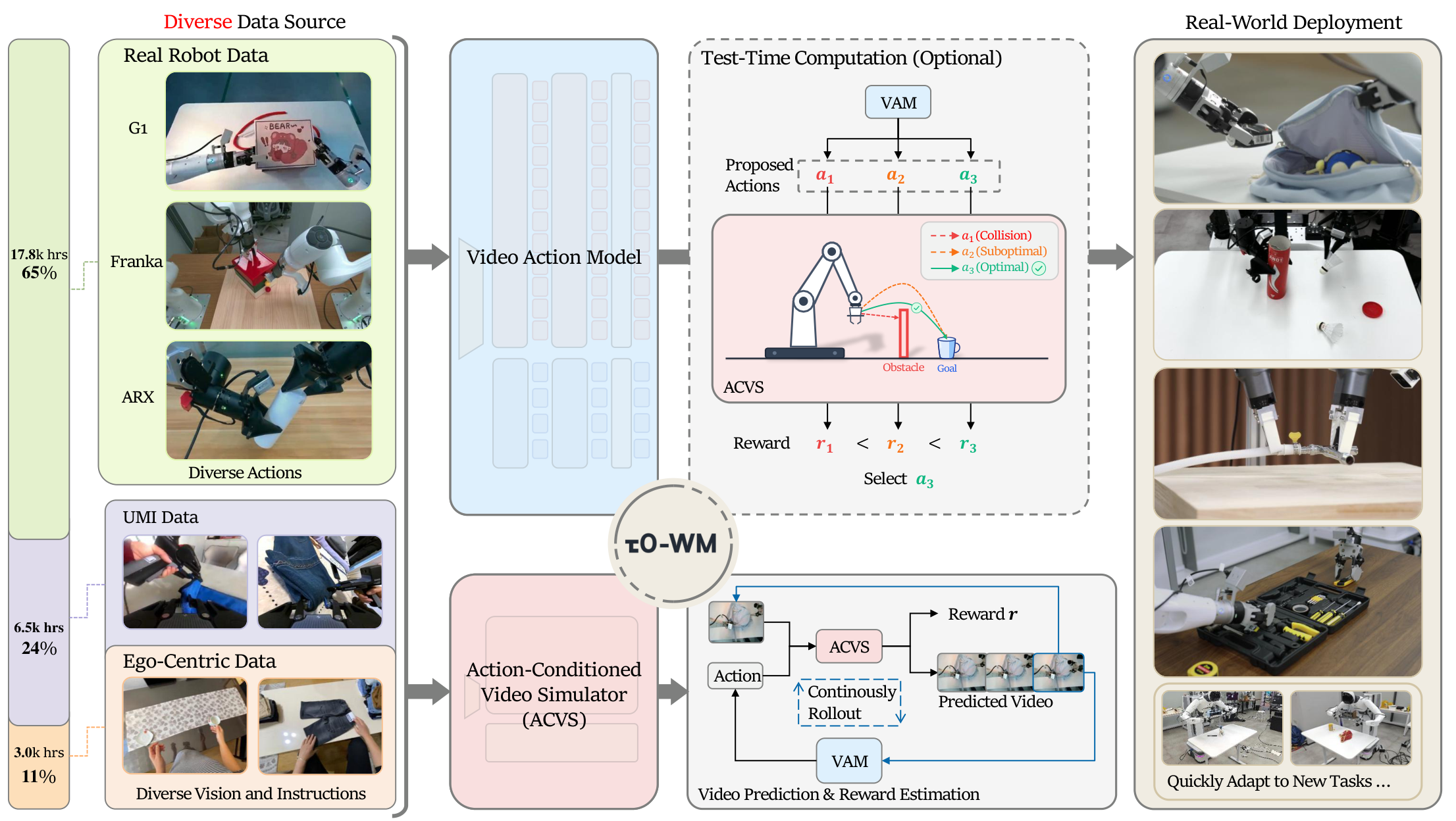
Paper's Figure 1 (caption: "Overview of the τ₀-WM framework. Heterogeneous interaction data from real robots, UMI-style collection, and egocentric human videos are used to train a Video Action Model and an Action-Conditioned Video Simulator...").
This overview establishes the paper's central data→model→deployment story: three heterogeneous data sources feed two model interfaces, which then serve a deployment-time propose/evaluate/rectify loop. Notice that the two interfaces are drawn as sharing the same predictive substrate rather than as separate modules — the load-bearing design claim of the whole paper.
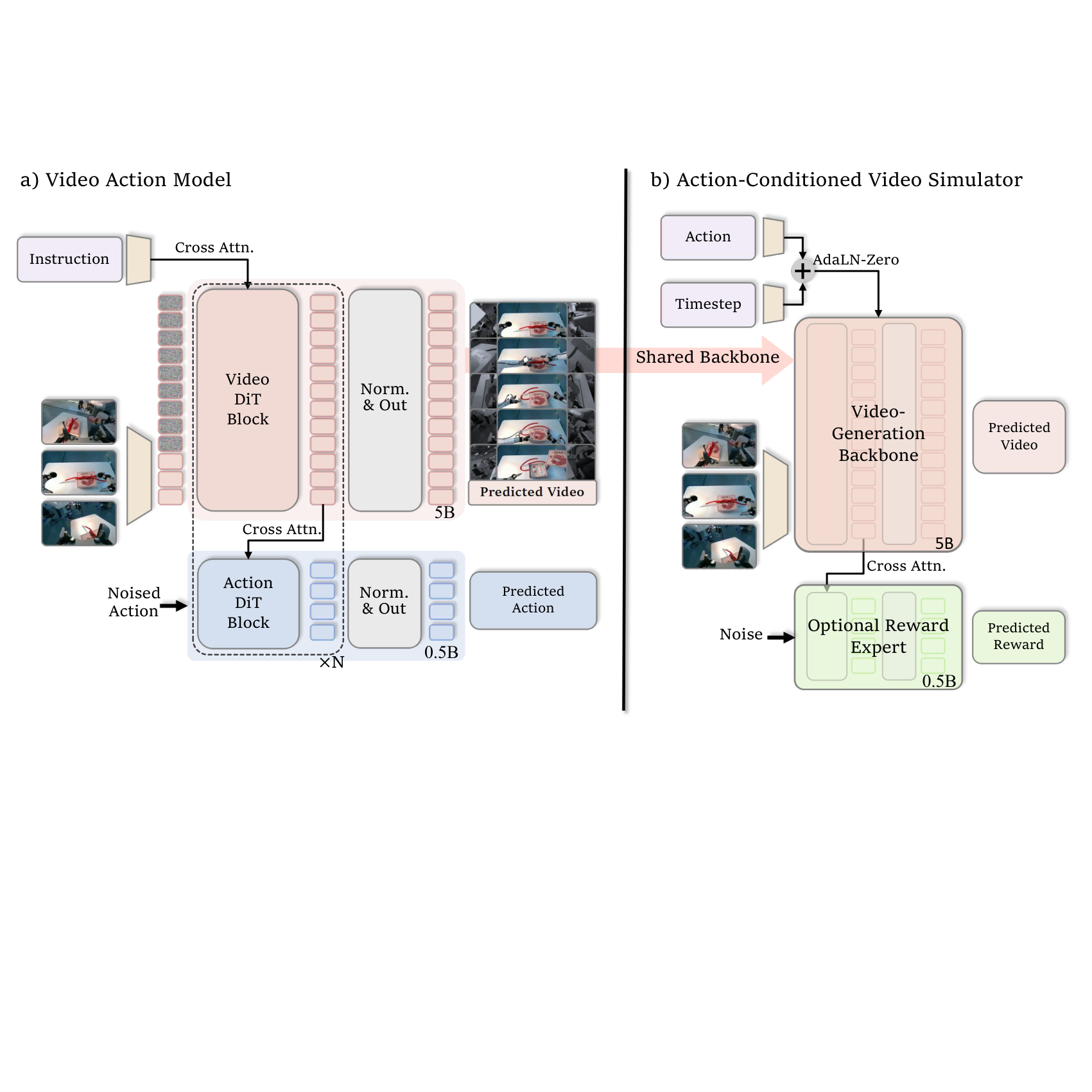
Paper's Figure 2 (caption: "Architecture of τ₀-WM. The Video Action Model (VAM) serves as the policy interface... The Action-Conditioned Video Simulator (ACVS) serves as the evaluation interface, reusing the video-generation backbone to roll out VAM-proposed action chunks and predict dense reward scores...").
Fig. 2(a) shows VAM: the current observation latent is kept clean as context while future slots are noised; the 0.5B action DiT cross-attends into intermediate video features $\mathbf{h}$ at matched transformer stages, so instruction-aware, dynamics-relevant visual features flow into action generation. Fig. 2(b) shows ACVS reusing the same backbone but replacing the action branch with an action-conditioning path (Eq. 4) plus a reward head. The reader should notice the backbone is literally shared — the only structural difference is whether the action is an output (VAM) or a clean condition (ACVS).
4. 作者证明 #
无形式化作者证明 — 仅实证。The paper offers no convergence theorem, variance bound, or sample-complexity lemma; all guarantees are empirical (success-rate tables). Below are the 6 minimum checks against the formal definitions it does provide.
Notation table
| Symbol | Meaning |
|---|---|
| $F_\theta$ / $G_\phi$ | VAM (params $\theta$) / ACVS (params $\phi$) |
| $\mathbf{o}_t,\mathbf{p},\mathbf{s}_t$ | multi-view observation, instruction, robot state |
| $\hat{\mathbf{z}}_{t+1:t+H_v}$ | future video latents over horizon $H_v$ |
| $\hat{\mathbf{a}}_{t:t+H_a-1}$ | continuous action chunk over horizon $H_a$ |
| $\mathbf{c}_t$ | clean encoded visual context |
| $\mathbf{h}$ | intermediate video features consumed by action/reward branch |
| $\tilde{\mathbf{z}},\tilde{\mathbf{a}},\tilde{\mathbf{r}}$ | flow-noised latent / action / reward inputs |
| $u_z,u_a,u_r$ | flow noise levels |
| $\mathbf{v}_\mathbf{z},\mathbf{v}_\mathbf{a},\mathbf{v}_\mathbf{r}$ | flow-matching velocity targets |
| $\bar{\mathbf{a}}$ | candidate (clean-condition) action chunk |
| $\hat{\mathbf{r}}_{t:t+H_a-1}$ | predicted dense reward trajectory |
| $S_{\mathrm{RCS}}^{(i)}$ | re-denoising consistency score of candidate $i$ |
| $J^{(i)}$ | rollout value (max task progress) of candidate $i$ |
| $\gamma$ | RCS reliability threshold |
方程物理意义 — the mapping $F_\theta(\mathbf{o}_t,\mathbf{p},\mathbf{s}_t)\rightarrow(\hat{\mathbf{z}}_{t+1:t+H_v},\hat{\mathbf{a}}_{t:t+H_a-1})$ (Eq. 1) says one forward pass yields both imagined visuals and executable actions; ACVS $G_\phi(\mathbf{o}_{t-M:t},\mathbf{p},\bar{\mathbf{a}})\rightarrow(\hat{\mathbf{z}},\hat{\mathbf{r}})$ (Eq. 3) is a forward-dynamics-style "what if I do $\bar{\mathbf{a}}$" evaluator.
6 minimum checks:
A desirable-but-absent guarantee: a bound relating RCS (an in-distribution consistency proxy) to actual task success would justify the $\gamma$ threshold; the paper sets $\gamma$ empirically instead.
5. 实验与数据 #
Setup: four unseen precision tasks across AGIBOT-G01, ARX, and dual-arm Franka; metric = task success rate; single-attempt, 20 repeats for the TTC ablation. Baselines: $\pi_{0.5}$, Fast-WAM (main), CFG and ACG (guidance).
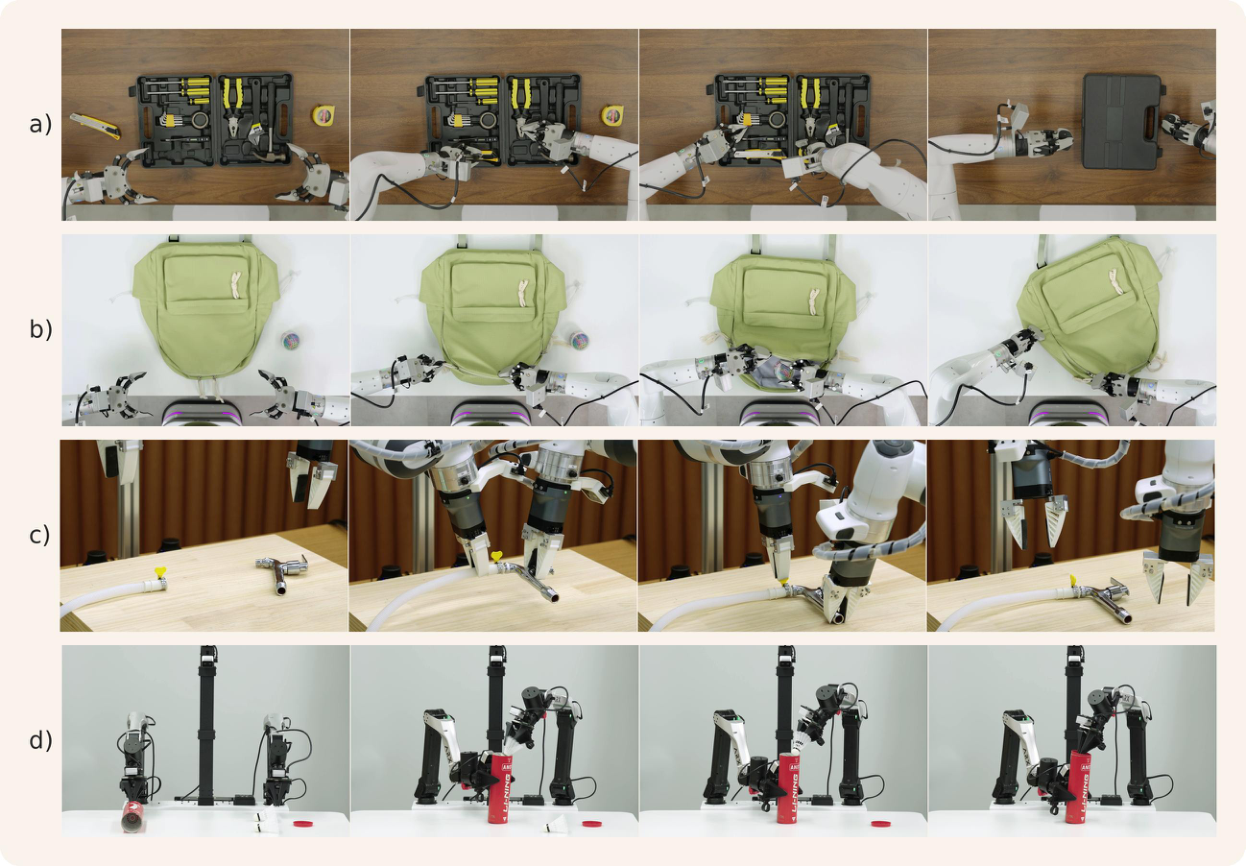
Paper's Figure 3 (caption: "Illustrations of our evaluation tasks. (a) Toolbox... (b) School Bag... (c) Faucet... (d) Badminton.").
The four tasks are deliberately long-horizon and precision-sensitive (sequential zipper manipulation, hose alignment/securing), and all are excluded from pre-training. This is what makes the results a generalization test rather than an in-distribution recall test; Faucet in particular requires strict geometric alignment and remains unsaturated for every method.
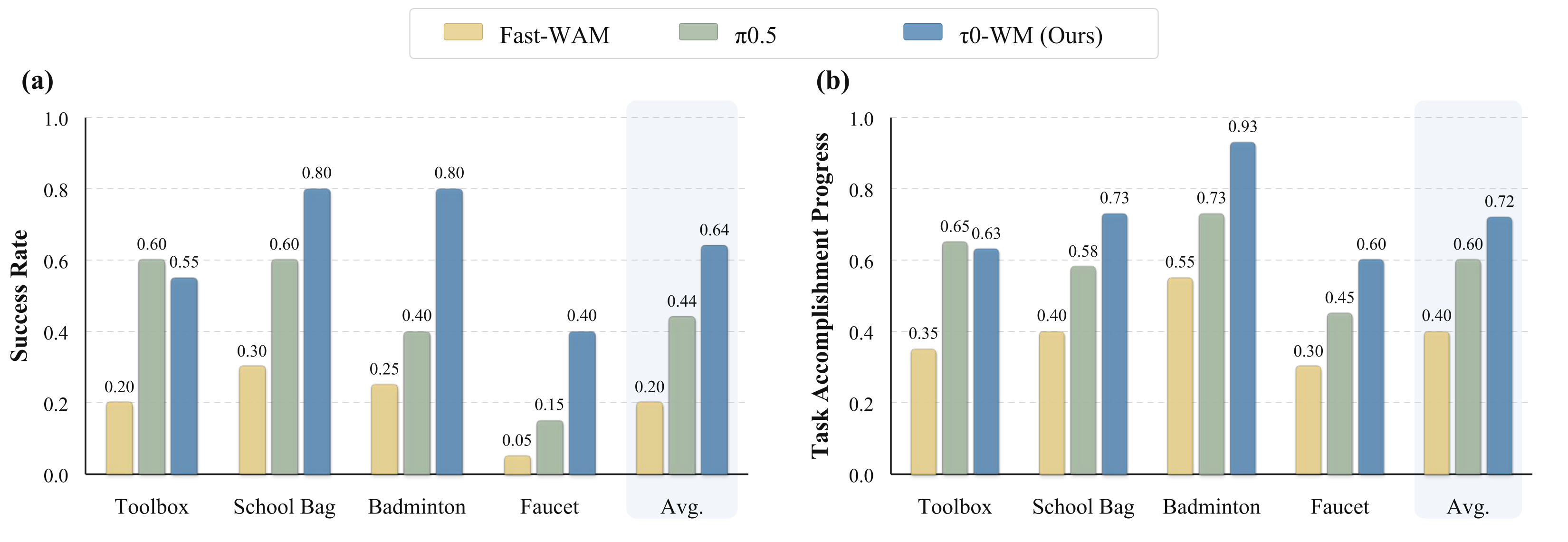
Paper's Figure 4 (caption: "Comparison of different models in terms of success rate and task accomplishment progress...").
Fig. 4 reports both binary success rate and stepwise task-accomplishment progress per task and averaged. The reader should notice τ₀-WM wins on average and on most tasks, but the win is not uniform: $\pi_{0.5}$ is competitive on Toolbox and Faucet is a near-failure region for all methods — the paper is candid that the benchmark is not saturated. (Numeric bar heights are image-only in the source export.)
Ablation — data composition (Table I): adding UMI+Ego to robot-only data.
| Setting | Data | Clean | Clut. | Avg. |
|---|---|---|---|---|
| Zero-shot (Pen→holder) | Robot | 0.22 | 0.06 | 0.14 |
| Zero-shot (Pen→holder) | Robot+UMI+Ego | 0.56 | 0.53 | 0.55 |
| SFT (Object-wipe-place) | Robot | 0.85 | 0.55 | 0.70 |
| SFT (Object-wipe-place) | Robot+UMI+Ego | 0.90 | 0.75 | 0.83 |
The zero-shot gain (0.14→0.55) is far larger than the SFT gain (0.70→0.83), and the SFT benefit concentrates in the cluttered variant (0.55→0.75), supporting the claim that broad video mostly improves general priors and robustness rather than adaptation speed.
Ablation — test-time computation (Table II): single attempt, no retries.
| Variant | Tissue → Box | Pen → Box | Avg. |
|---|---|---|---|
| w/o TTC | 0.55 | 0.30 | 0.43 |
| w. CFG | 0.25 | 0.15 | 0.20 |
| w. ACG | 0.40 | 0.35 | 0.38 |
| w. RCS | 0.65 | 0.35 | 0.50 |
| w. RCS + LAR | 0.70 | 0.50 | 0.60 |
Two takeaways: (1) generation-time guidance (CFG, ACG) actually hurts relative to no TTC here, whereas explicit candidate-then-future evaluation helps; (2) the largest LAR gain is on Pen→Box (0.30→0.50), the more alignment-sensitive placement task, matching the argument that future-conditioned rectification helps precise placement.
6. 论证链 #
| # | Claim | Support (paper-internal) |
|---|---|---|
| 1 | Heterogeneous data can be trained jointly without discarding weak sources | Modality-specific supervision masks (§III unified supervision; Eq. 2 expectation over mixed samples) zero out unsupported loss terms per sample |
| 2 | Shared predictive representation benefits both proposal and evaluation | VAM and ACVS reuse the same Wan backbone + same 27.3K-h mixture (§IV-B, §V-B); ACVS only removes the action branch and adds action conditioning (Eq. 4) |
| 3 | Joint video+action modeling improves policy quality over action-only | Table I / Fig. 4: highest average success; qualitative corrective-action behavior on Toolbox attributed to future-visual-outcome modeling (§VII-A) |
| 4 | Broad video primarily improves priors/robustness, not adaptation speed | Table I: zero-shot avg 0.14→0.55 (large) vs SFT 0.70→0.83 (smaller, concentrated in cluttered) |
| 5 | Cheap RCS filter + selective expensive LAR recovers difficult states | Table II: RCS raises 0.43→0.50, LAR further to 0.60; coarse-to-fine escalation gated by $\gamma$ (Alg. 1, Eq. 8) preserves real-time cost in the common case |
7. 实现 cross-reference #
[实现未公开] — no training/inference code is released in the L1 source; only the project page (https://finch.agibot.com/research/tau0-wm) is referenced. Closest open references implied by the paper: Wan2.2-TI2V-5B backbone [39], the DiT action decoder [33], flow matching [30], and the Cosmos action-conditioning design [2] adopted for ACVS.
核心技术壁垒 (detailed): the single hardest thing to replicate is the unified masked-mixture training of a shared backbone across two interfaces. It is not enough to reimplement Eq. 2 or Eq. 5 in isolation — the payoff (a test-time rectification loop where LAR re-queries VAM on ACVS's winning future latent, Alg. 2) only works because VAM and ACVS share the same learned dynamics prior over the same 27.3K-h corpus with correct per-sample mask bookkeeping. Assembling that heterogeneous corpus (17.8K robot + 6.5K UMI + 3.0K egocentric) and getting the supervision masks to route each of {video, action, reward} losses correctly is the replication bottleneck; the individual losses are standard flow matching.
关键实现细节 (easy-to-miss tricks):