Agentic CPU-GPU Scheduling for Heterogeneous AI Workloads
Agentic CPU-GPU Scheduling for Heterogeneous AI Workloads — L2 #
1. TL;DR #
把异构工具调度形式化为「每个工具选 gpu_now / gpu_queue / cpu 三选一、受 VRAM 预算约束」的 DAG makespan 最小化问题;用「LLM 决策 + 算法监控器扩展观测」的协同设计,在 13 个场景全部达到暴力枚举最优映射,零离线训练,胜过 HEFT/UCB1/StarPU/all-GPU。核心是观测与决策分离。
2. Q1 / Q2 / Q3 #
Q1 — 痛点 #
现有 agentic 编排框架(LangGraph、LangChain)对所有 GPU-capable 工具默认走 GPU-first 策略,但这被证明是次优的:
- 19 个工具中真正 GPU-preferred 的只有 11 个($s>5\times$),4 个 ambiguous($0.5\leq s\leq 5\times$),1 个 CPU-preferred(doc_merger,$0.4\times$,因 PCIe 传输开销主导),3 个 device-neutral(无 GPU 实现)。
- 静态 profile 在运行时会失效,原因有二:Factor A(GPU 利用率争用) 让并发工具的单工具时延比隔离时高 43–250%、E2E 达隔离上界的 $2.7\times$;Factor B(VRAM 容量争用) 让 all-GPU 映射直接 OOM 而非仅仅变慢。
- 经典方法都不合适:HEFT/bandit 用固定或局部估计,抓不到争用下的全局交互;RL device placement 需要数千 episode 离线训练、跨 workload 泛化差。
Q2 — 方法 #
设计一个 agentic scheduler,把 LLM 与算法化 runtime monitor 组成闭环(Figure 2):offline profiler 产出 tool cards → LLM scheduler 消费 cards + 运行时反馈、输出下一轮 device mapping → runtime monitor 观测执行结果、更新时延估计、在内存压力下暴露有界 what-if 探测。
核心技术壁垒:monitor 的设计原则是只扩展 LLM 能观测到的信息、绝不规定采用哪个映射(running averages / symmetric reprobe / swap reprobe / exploration hints),使 LLM 在不枚举 $3^n$ 完整映射空间的前提下,把「组合上遥远」的替代方案变成一条被实测过的 what-if 证据(详见 §7)。
Q3 — 结果 #
跨 13 个场景(串行 S1–S4、并行争用 S5–S10、VRAM 受限三选一 S11–S13)全部达到暴力枚举 oracle 映射:S1–S10 上 LLM 与 UCB1 都 10/10(HEFT-CF 2/10,StarPU 6/10),但 LLM 从 profile card 在 round 0 就达到、UCB1 需多轮探索;三选一场景 S11/S12/S13 分别在 R2/R1/R3 收敛到 oracle。零离线训练。
3. 架构 / 方法图 #
系统是三组件闭环:offline profiler → tool cards → LLM scheduler → device mapping → DAG execution → runtime monitor → 反馈回 prompt。
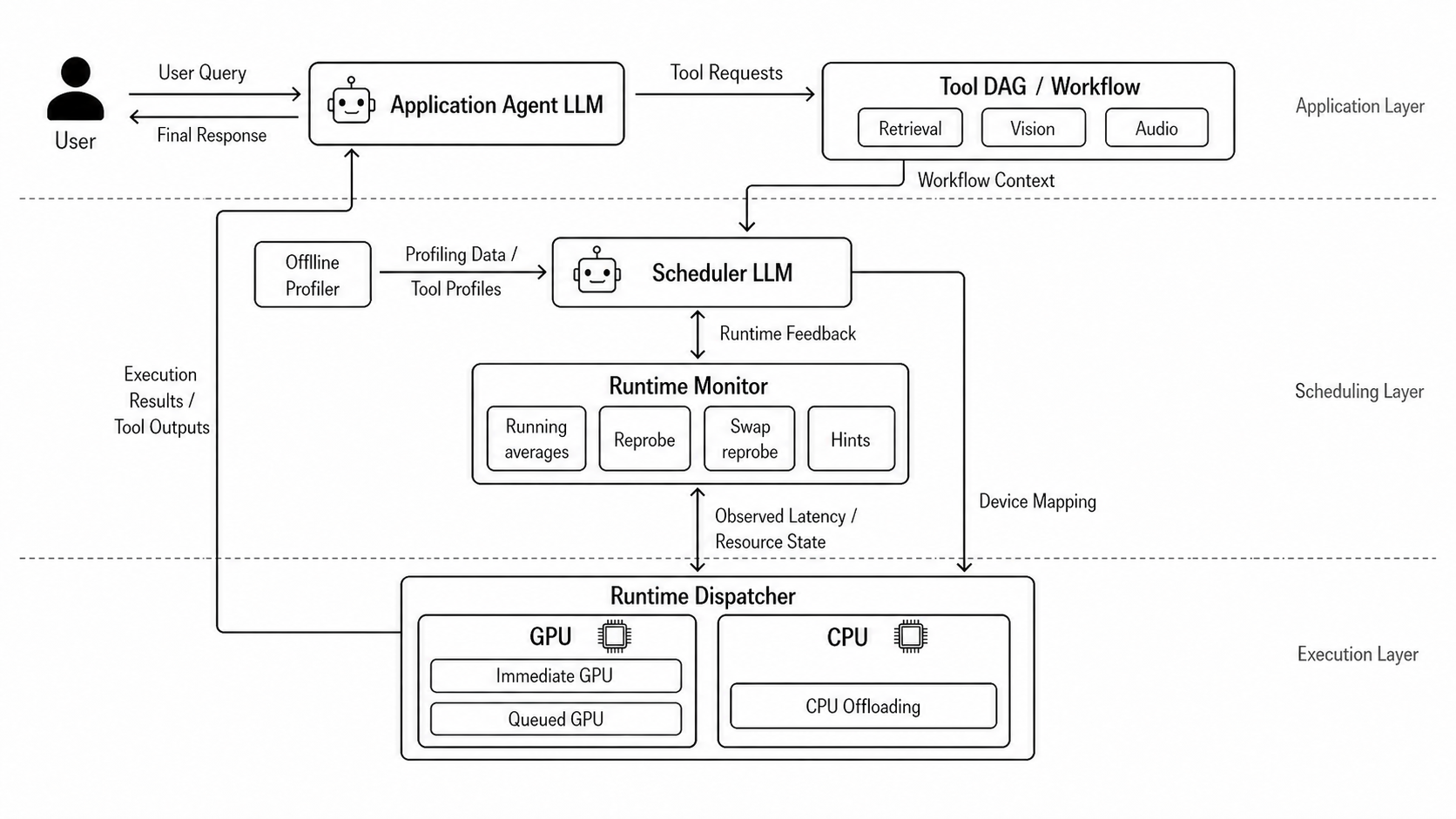
Paper's Figure 2, verbatim (caption: "System architecture. The offline profiler generates tool cards; the LLM scheduler selects a device mapping; the runtime monitor feeds back measured latency, feasibility, and bounded what-if probes for subsequent scheduling rounds.").
这张图是理解全文的关键:注意 monitor 位于 DAG 执行与 LLM 之间,它不计算调度,只把上一轮映射的后果转成可追加到下一轮 prompt 的观测。这正是「观测/决策分离」的物理落点。
问题本身的动机由 Figure 1 给出——同一 DAG 在 GPU-first(被争用串行化)与 dependency-aware(并行)两种放置下 E2E 差异巨大:
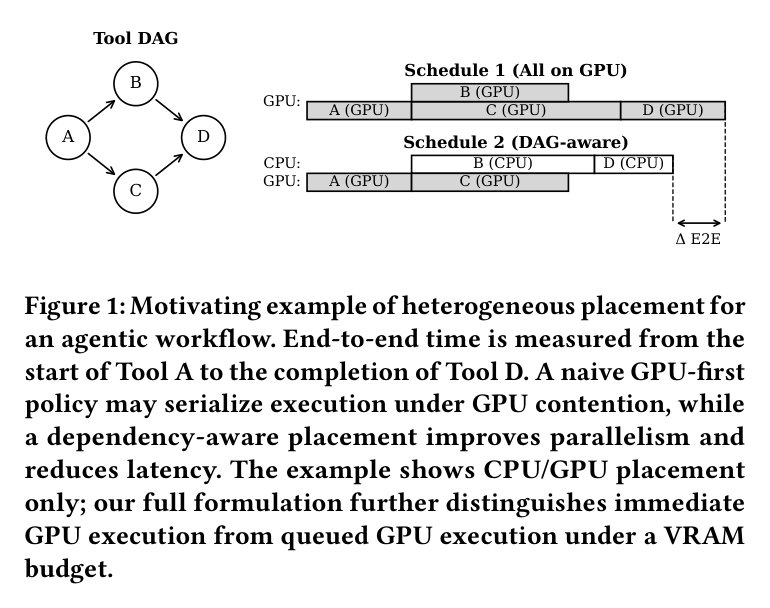
Paper's Figure 1, verbatim (caption: "Motivating example of heterogeneous placement for an agentic workflow ... A naive GPU-first policy may serialize execution under GPU contention, while a dependency-aware placement improves parallelism and reduces latency ...").
图中只展示 CPU/GPU 二元放置;完整形式化进一步把「立即 GPU」与「排队 GPU」在 VRAM 预算下区分开——这是本文相对经典二元调度的关键词汇扩展。
monitor 的每轮过程由 Algorithm 1 描述,其结构最好用状态流表达(原文无对应流程图):
这里唯一的「主动」分支(reprobe → 失败触发 swap reprobe)就是 §4.5 里 S13 的 C↔B 交换被发现的机制路径。
4. 作者证明 #
无形式化作者证明 — 仅实证。 本文明确承认「no formal convergence guarantee」(§5):monitor 引导 LLM 在 1–3 轮内到达 oracle 是本套件上的经验观察,exploration policy 仍是启发式,未证明「任意起点都能到达全局最优」。理想情况下应给出的保证是:在有界 reprobe/swap 预算下,从任意可行起点到达 oracle 的收敛性或后悔界。
尽管如此,问题的形式化 (§2.1) 是严谨的。记号表:
| 符号 | 含义 |
|---|---|
| $G=(V,E)$ | 工作流 DAG,节点=工具调用,边=数据依赖 |
| $a_v$ | 节点 $v$ 的执行模式 |
| $\mathcal{A}$ | 三模式集合 |
| $\tau(v,a_v)$ | $v$ 在模式 $a_v$ 下的时延(含 load-in / 排队开销) |
| $\pi:V\to\mathcal{A}$ | 放置策略 |
| $\mathcal{G}_{\mathrm{now}}(t)$ | 时刻 $t$ 处于 gpu_now 的活跃任务集 |
| $m(v)$ | $v$ 的 VRAM 占用 |
| $M$ | GPU 容量 |
| $C_v$ | 放置 $\pi$、调度 $S$ 下 $v$ 的完成时间 |
四个 load-bearing 方程与物理意义:
动作集(把二元放置扩为三选一,gpu_queue 是本文形式化新意):
$$a_{v}\in\mathcal{A}=\{\texttt{cpu},\texttt{gpu\_now},\texttt{gpu\_queue}\}.$$
VRAM 预算约束(只有 gpu_now 计入同时占用;排队任务顺序 admit、等待时不占):
$$\sum_{v\in\mathcal{G}_{\mathrm{now}}(t)}m(v)\leq M.$$
端到端时延为 sink 节点完成时间的最大值(makespan,用 max 而非 sum,因为输出以最后一个 sink 完成为准):
$$T_{\mathrm{e2e}}(G,\pi,S)=\max_{v\in\mathrm{Sink}(G)}C_{v}.$$
目标是在依赖可行 + GPU 内存可行下最小化 makespan:
$$\min_{\pi,S}\;T_{\mathrm{e2e}}(G,\pi,S).$$
最小 6 项检查:
- 量纲/单位一致:$\tau, C_v, T_{\mathrm{e2e}}$ 均为时间(ms);$m(v), M$ 均为内存(MB)。✓
- 约束覆盖三模式:cpu 不占 GPU;gpu_now 占 VRAM;gpu_queue 等待时不占、admit 时付 load 开销。三种模式与 Eq (2) 求和范围(仅 $\mathcal{G}_{\mathrm{now}}$)自洽。✓
- 目标可行域非空:全 cpu 映射总是可行(不触碰 VRAM),故 (4) 的可行集非空。✓
- makespan 单调性:把某工具从慢设备移到快设备(不违反约束)不会增大对应路径完成时间——与 Table 2 中 oracle 把 vector_search 移 CPU 后 E2E 从 988→812 ms 一致。✓
- NP-hardness 归约:去掉 gpu_queue 后即「带资源容量约束的前驱约束异构调度」,已知 NP-hard;加入 gpu_queue 只扩大放置空间,难度不降。✓
- 约束-目标耦合:VRAM 约束 (2) 与目标 (4) 通过 $\mathcal{G}_{\mathrm{now}}$ 耦合——把工具塞进 gpu_now 降低隔离时延但可能触发争用或 OOM,正是 §2.1 para 5 描述的三向 trade-off。✓
- amplified tools:base 工具太短无法产生稳定争用,作者把同一计算重复 $k$ 次构造
bert_base_x12等放大工具,保持计算画像、把时延/内存压力缩放到研究争用所需区间(§3.1)——不做放大就复现不出 Table 2 的争用数字。 - VRAM 测量漂移的容忍:Figure 7 显式披露 prompt 里的 mem=627/463/417 与主表 656/486/442 因重新 profiling 而不一致,但 LLM 只对「它在 prompt 里实际看到的值」推理,故收敛不受影响(Figure 7 caption)——揭示该设计对 profile 噪声的鲁棒性来自「就地观测」而非精确标定。
method-core 的 before/after diff(相对经典异构调度):
| before(HEFT/StarPU/RL placement) | after(本文) |
|---|---|
| 二元 CPU/GPU 放置,无内存约束 | 三选一 {cpu, gpu_now, gpu_queue} + 显式 VRAM 预算 |
| 依赖手工 cost model 或数千 episode 训练 | LLM in-context 推理,零训练 |
| 固定/局部估计,抓不到争用全局交互 | monitor 把争用后果实测成 running avg / what-if 反馈 |
| 调度器自己探索完整映射(如 bandit 逐 arm) | monitor 有界 reprobe/swap 暴露替代,LLM 直接改写 |
5. 实验与数据 #
工具库画像是全文实证基座——19 工具在 NVIDIA RTX A5500 + AMD EPYC 7713 上隔离测 30 次取中位数:
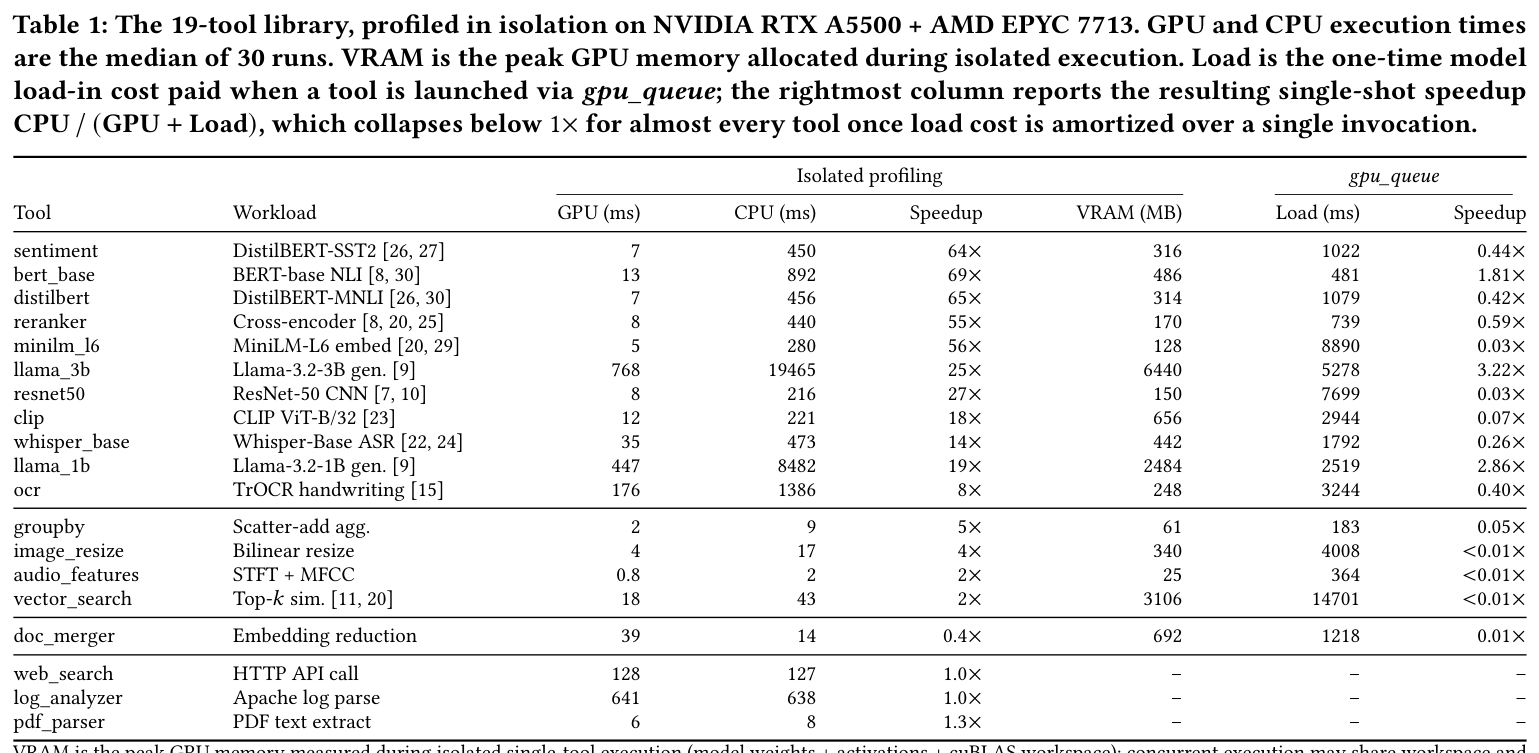
Paper's Table 1, verbatim (caption: "The 19-tool library, profiled in isolation ... the rightmost column reports the resulting single-shot speedup CPU/(GPU+Load), which collapses below 1× for almost every tool once load cost is amortized over a single invocation.").
读者应注意最右列:gpu_queue 单次调用 speedup 对除 bert_base(1.81×)、llama_1b(2.86×)、llama_3b(3.22×) 外全部塌到 1× 以下——说明排队模式几乎从不在单次调用速度上取胜,它的价值在于可行性(VRAM 压力下)。
争用如何击穿静态 profile 由 Table 2(场景 S5)给出:
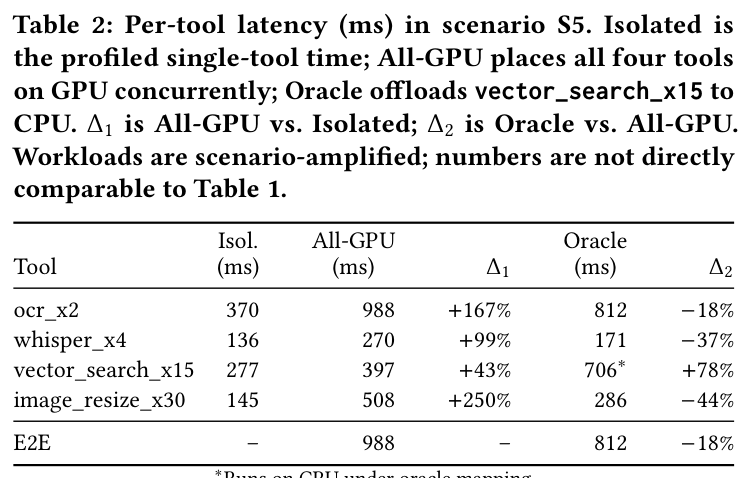
Paper's Table 2, verbatim (caption: "Per-tool latency (ms) in scenario S5. Isolated ... All-GPU ... Oracle offloads vector_search_x15 to CPU. Δ1 is All-GPU vs. Isolated; Δ2 is Oracle vs. All-GPU ...").
关键反直觉点:oracle 把 vector_search_x15 移到 CPU,它自己慢了 78%,但另外三个工具各获 18–44% 缓解,E2E 从 988→812 ms。正确决策跟随争用结构而非任一工具的隔离 profile。
主结果是归一化到 oracle 的 E2E(S1–S10,1.0 即 oracle 下界):
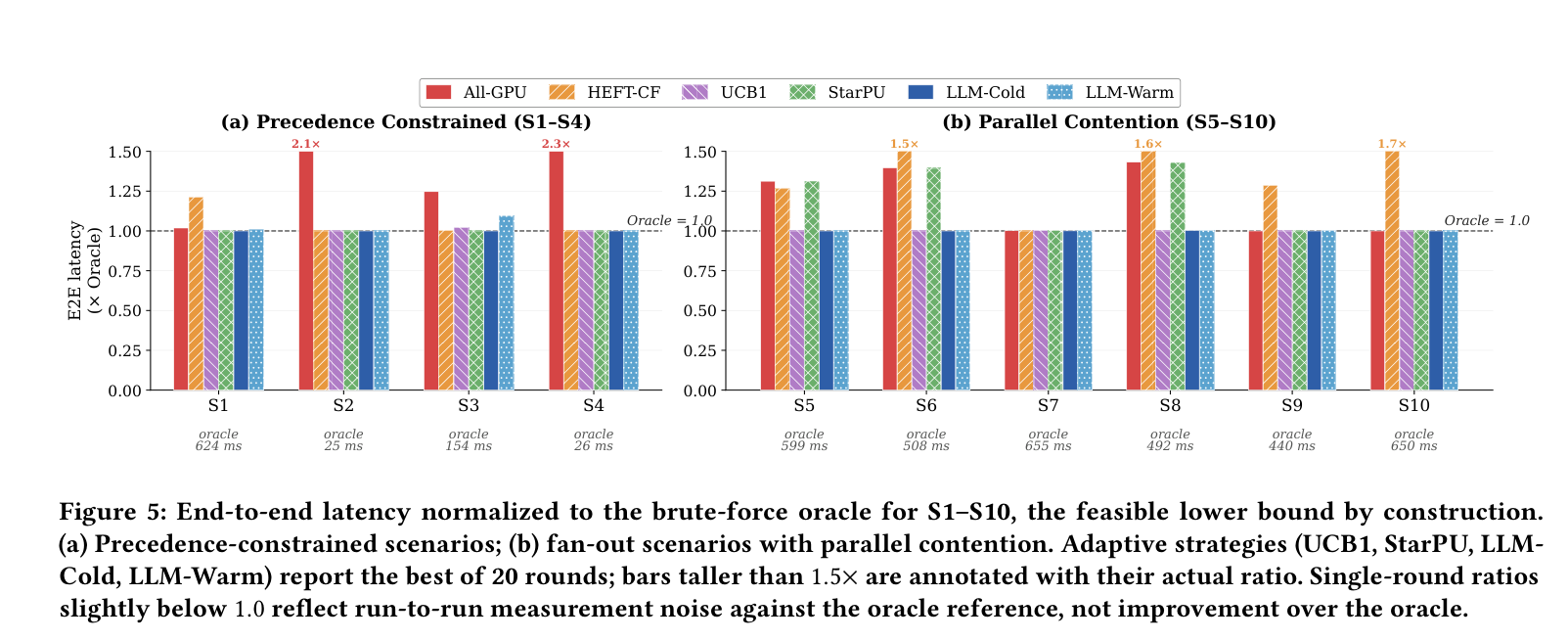
Paper's Figure 5, verbatim (caption: "End-to-end latency normalized to the brute-force oracle for S1–S10 ... (a) Precedence-constrained; (b) fan-out with parallel contention. Adaptive strategies report the best of 20 rounds ...").
在高增益场景 S2/S4,agentic scheduler 冷/热启动都达 oracle,分别较 all-GPU 提速 $2.60\times$ / $2.83\times$;fan-out (b) 面板上策略分化更明显——HEFT-CF 6 个里只 1 个 4/4,StarPU 退化到 all-GPU 吃满争用惩罚。
映射精度对照见 Table 4:
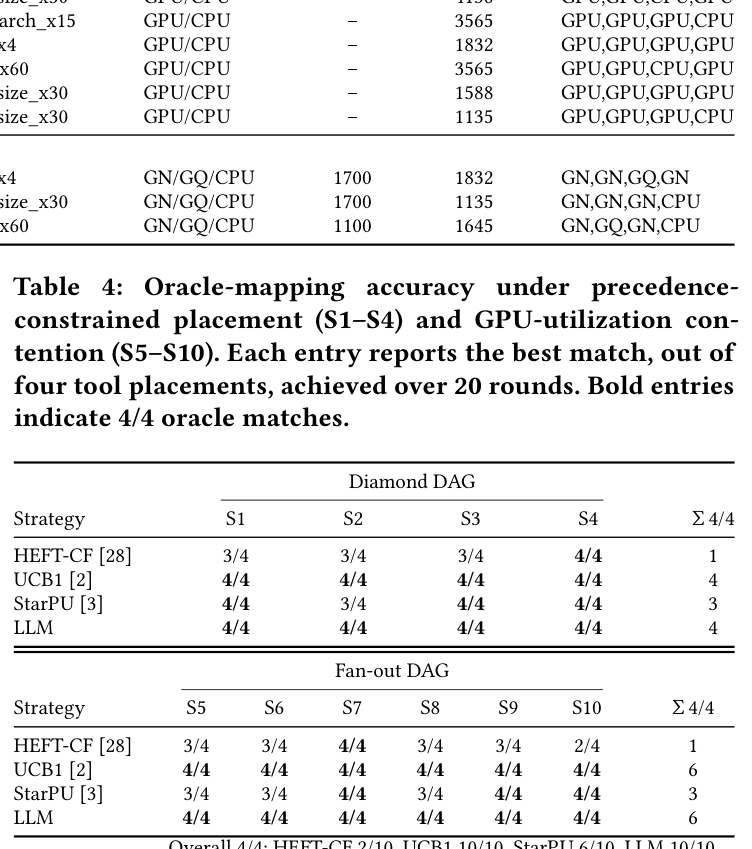
Paper's Table 4, verbatim (caption: "Oracle-mapping accuracy under precedence-constrained placement (S1–S4) and GPU-utilization contention (S5–S10). Each entry reports the best match, out of four tool placements, achieved over 20 rounds. Bold entries indicate 4/4 oracle matches.").
总计:HEFT-CF 2/10、UCB1 10/10、StarPU 6/10、LLM 10/10。LLM 与 UCB1 精度打平,但 LLM 在 round 0 从 card 直达,UCB1 需逐 arm 探索——这是「同精度、更省探索」的核心卖点。
三选一 VRAM 受限结果见 Table 5:
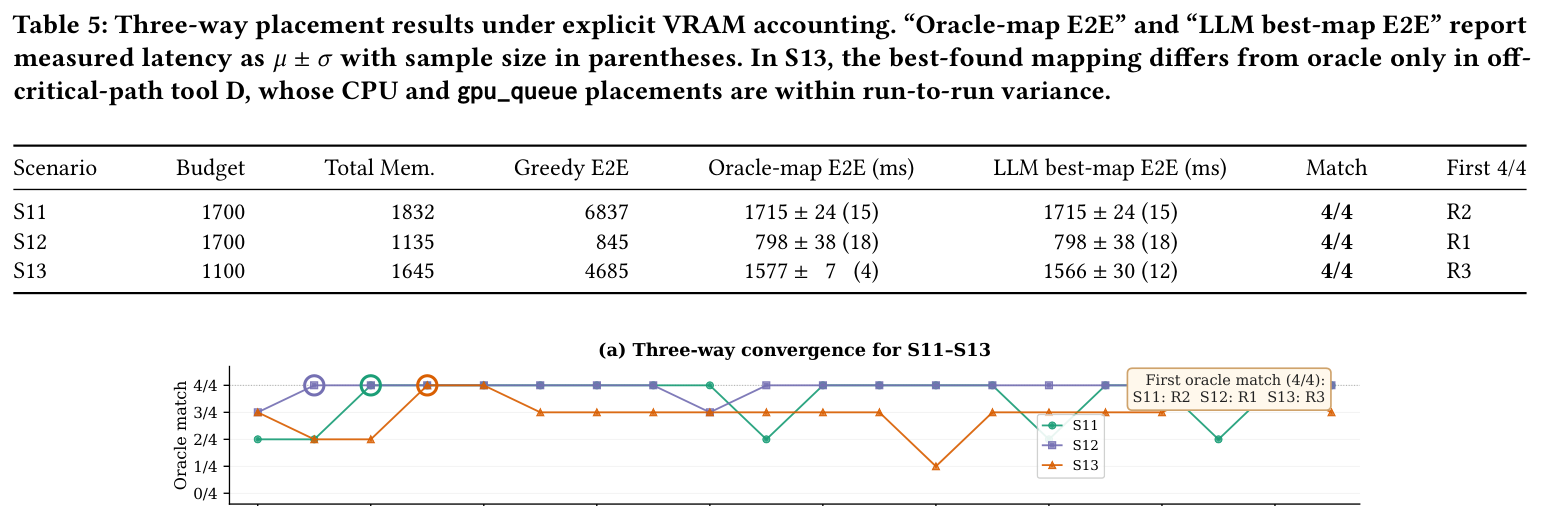
Paper's Table 5, verbatim (caption: "Three-way placement results under explicit VRAM accounting. 'Oracle-map E2E' and 'LLM best-map E2E' report measured latency as μ±σ ... In S13, the best-found mapping differs from oracle only in off-critical-path tool D ...").
memory-aware greedy 基线在 S11/S13 分别 6837/4685 ms,而 LLM 达 oracle(S11 1715 ms、S13 1566 ms)——greedy 发现不了「把一个强 GPU 工具推到 gpu_queue 反而腾出 VRAM 放更值钱的立即 GPU 工具」。
6. 论证链 #
| # | 步骤 | 依据(paper-internal) |
|---|---|---|
| 1 | GPU-first 默认策略次优:19 工具中仅 11 真 GPU-preferred,1 个 CPU-preferred,杠杆主要来自 4 个 ambiguous 工具 | Table 1 speedup 列 |
| 2 | 静态 profile 在运行时失效:Factor A 使单工具时延 +43–250%、E2E 达 $2.7\times$;Factor B 使 all-GPU 直接 OOM | Table 2;Table 1 Load 列;S13 R0 OOM |
| 3 | 因此需要 monitor 提供 §2.3 缺失的可观测性;monitor 只扩展观测、不做决策 | §2.3 收尾;§3.2 monitor 定位 |
| 4 | 有 profile 时 LLM 靠 ratio test 在 round 0 直出 oracle(S5:C 的 CPU 时间可藏在争用后的 GPU 瓶颈之后);无 profile 时 monitor 的 what-if(D→gpu:625ms < 当前 best 751ms)纠正错误语义先验 | Figure 3;Figure 4 |
| 5 | VRAM 受限下单工具 reprobe 不够,失败触发 swap reprobe,暴露 C↔B 两工具交换(A+C=1098MB≤1100MB),R3 达 oracle | §4.5 三阶段;Algorithm 1 L3–14 |
| 6 | 每个 monitor 机制都必要:去掉任一机制 S13 掉到 1/4,LLM-only 直接 OOM 0/4 | Appendix A / Table 6 |
7. 实现 cross-reference #
[实现未公开] —— L1 未记录任何开源仓库或 file:line。调度 LLM 为 DeepSeek-R1-Distill-Qwen-32B-AWQ,由 vLLM 服务,跑在与工具执行 GPU 分离的专用 GPU 上(§3.3),但代码与 prompt 完整模板未公开。最接近的可复现参照:monitor 是纯算法组件(Algorithm 1 已给伪代码),LLM 调用可用任意 vLLM/OpenAI-兼容后端复刻。
核心技术壁垒(展开):难以复制的不是 LLM 本身、也不是任一单独探测,而是 monitor「只暴露实测证据、绝不推荐映射」的克制式接口设计。它把三类信息喂给 prompt——running averages(应对 Factor A 争用)、single-tool reprobe(应对 Factor B 单工具替代)、swap reprobe(应对必须两工具交换才能腾 VRAM 的情形)——却始终不附带 recommendation。这个「观测/决策分离」让 LLM 能在不枚举 $3^n$ 的前提下把组合上遥远的映射(如 S13 的 C↔B 交换)当作一条已被测量的 what-if 采纳,同时保留在 monitor 证据与软性 ratio 规则冲突时推翻规则的自由(Figure 4 中 round-3 flip D)。Appendix A 的消融证明四个机制互补不冗余——去掉任一个都塌到 1/4 或 OOM,说明壁垒在于机制组合 + 接口克制,而非某个单点。
关键实现细节(易漏 trick):