The Collaboration Tax: How Much LLM Multi-Agent Systems Pay to Coordinate
The Collaboration Tax: How Much LLM Multi-Agent Systems Pay to Coordinate — L2 #
1. TL;DR #
When two LLMs each hold half of a solo-trivial puzzle and must talk to solve it,
they lose performance versus one agent given the whole thing. This "collaboration
tax" obeys two no-exception orderings (Spatial ≻ Relational ≻ CSP; shrinks with
capability), is driven by a 4-stage conversational cascade not a reasoning deficit,
is regression-predictable ($R^2=0.475$), and a prompt fix recovers ~38%.
2. Q1 / Q2 / Q3 #
Q1 — 痛点 (what problem) #
Multi-agent LLM systems are deployed everywhere, but there is no **model- and
task-agnostic* account of what coordination costs* when two LLMs that could each
solve a task alone must instead split the information and talk. Prior work measures
coordination on one task type at a time (mazes, Overcooked, debate) and reports an
isolated number with no known sign, no decomposition across task structure, and no
mechanism. Three concrete unknowns: (RQ1) does a systematic cost exist and what sets
its size — capability, task structure, or their interaction; (RQ2) where in a
conversation does it fail — reasoning, information access, communication, or
verification; (RQ3) is it reducible by prompting alone, without retraining.
Scope: closed, dyadic, multi-turn cooperation under private information. Each
agent is fully autonomous (no human in the loop); the only interaction channel is a
turn-based text dialogue capped at 50 exchanges. Task class is *solo-tractable by
construction* — the difficulty is manufactured entirely by splitting the instance.
Q2 — 方法 (the approach) #
- Formalise the cost as the team-decentralisation loss of a two-player
- Operationalise on 32 tasks in 3 families chosen for *distinct grounding
- Measure across 11 models / 7 providers in solo-full, homogeneous, and
- Explain with a 4-stage LLM-judge cascade (Grounding → Querying → Integration
- Predict the tax from conversation features (ridge regression) and fix it
- Two no-exception orderings. Within every one of the 11 models: Spatial ≻
- Mechanism is conversational, not cognitive. Four grounding stages each
- Predictable. Out-of-fold ridge $R^2 = 0.475$ (Spearman $\rho=0.760$); transfers
- Partly fixable. The all-four prompt intervention closes 38.3% of the tax
- Heterogeneous pairs pull toward the strong member, not the midpoint; yet all
- solo-full — one agent gets the merged instance $v_1 \cup v_2$, answers in one
- homogeneous — two instances of the same model get $v_1$ and $v_2$; they
- heterogeneous — identical, but the two roles are different models.
- Dimensional consistency — every term lives in $[0,1]$ (score space); $\hat\tau$
- Sign/limit — non-negativity. Prop 1: if the paired answer is measurable in
- Degenerate limit — union-necessity. If the partition is degenerate ($v_1=x$),
- Equivalence check. Prop 2: $\text{tax}>0 \iff v(\{1,2\})<\max(v(\{1\}),v(\{2\}))$
- Estimator consistency. With a deterministic grader, the only variance is
- Boundary / failure of the guarantee. The non-negativity is a policy-consistency
- Backbone requirement (§7-style read): the ordering holds across 11 models from
- Failure-mode taxonomy (App B): 700 failure descriptions → 16 behaviour clusters
- Intervention clauses (the entire §5.5 result) are given word-for-word in
- Hyperparameters fully pinned in Appendix J: agents temperature 0.7 / top-p 0.95
- Graders are deterministic procedures named per family (Appendix F): BFS for
ACTI!+ critic symmetry. Termination requires the explicit markerACTI!- Anti-bias cluster naming (App B). When auto-naming the 16 failure clusters, a
- Predecessor / baseline: Davidson et al. 2025, "The Collaboration Gap"
cooperative game with private views (Marschak 1955; Shapley 1953). Tax =
best-single-agent value − paired value. Two propositions pin its sign (≥0 under
information-dominance) and its meaning (positive tax ⇔ max-superadditivity
violation).
friction*: Spatial (reference-frame alignment), Relational (lexical/category
alignment), CSP (indexing/ordinal alignment). Each task is solo-trivial,
union-necessary, algorithmically graded in $[0,1]$, and multiply expressible.
heterogeneous modes, 50 rollouts/cell.
→ Re-derivation), validated against 4 human annotators.
with four stage-targeted prompt clauses, ablated leave-one-out.
核心技术壁垒 (the single hardest-to-replicate insight): the *task-construction discipline* that turns "coordination cost" into a clean, decomposable scalar. The binding requirement is multiply-expressible — the same content has several equivalent surface forms (coordinate origins, axis orderings, naming conventions), so an agent cannot win by blindly concatenating the partner's raw view. That single property converts the measurement from an information-accessibility probe into a coordination-competence probe, and it is what makes every other result (the two orderings, the cascade, the intervention deltas) attributable to coordination rather than to missing bits. Reproducing the headline numbers without reproducing this property silently measures a different quantity. See §7.
Q3 — 结果 (what was shown) #
Relational ≻ CSP. Across models: the gap shrinks monotonically with capability —
weakest models lose ~half their solo success, top-tier models still pay a positive
tax.
discriminate success from failure; Integration (L3) is the strongest single
predictor and the only stage with positive marginal contribution in a
multi-feature regression.
to held-out heterogeneous cells at $R^2 = 0.41$. "Capability sets the intercept;
conversation shape sets the slope."
overall (CI above zero on every category), and each category has a different
bottleneck layer: Spatial→L4, Relational→L1, CSP→L2.
six pairs violate max-superadditivity and both members' Shapley values fall below
their solo payoffs — the weak agent cannot free-ride, and the strong agent is
taxed for pairing.
3. 架构 / 方法图 #
3.1 The measurement pipeline #
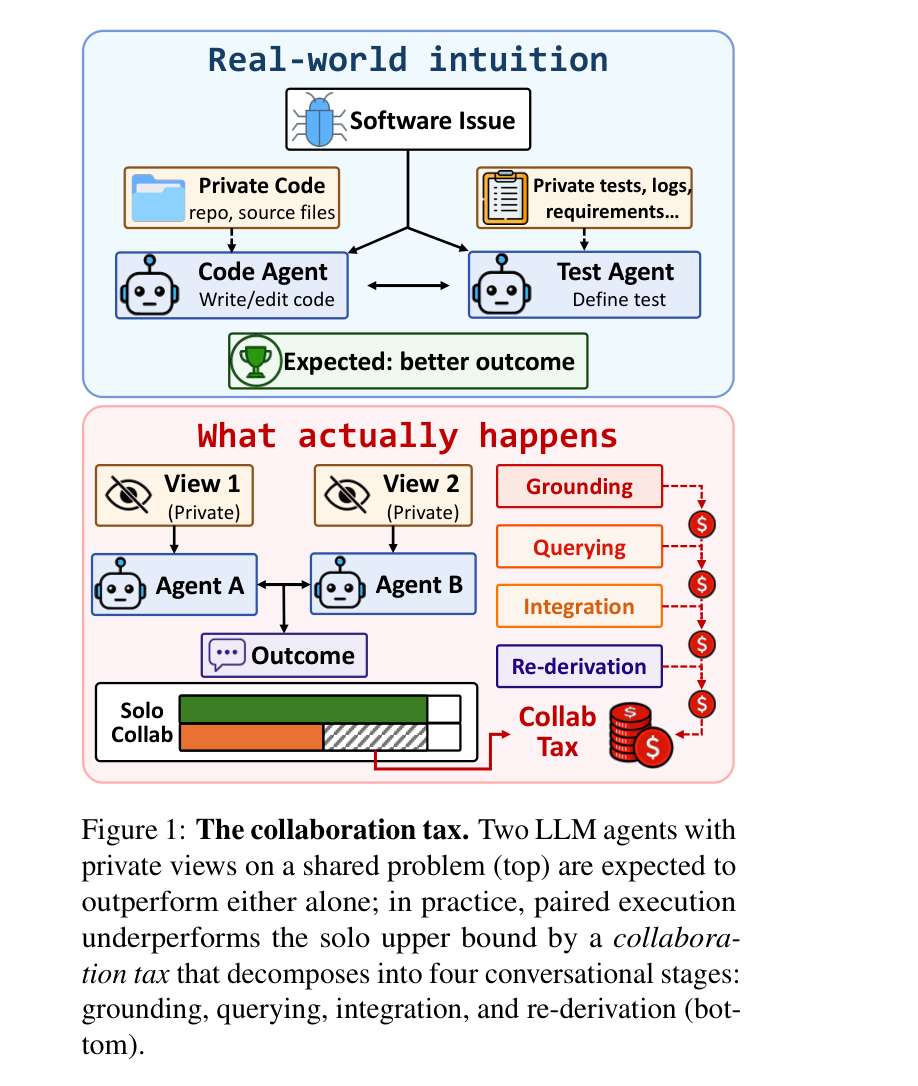
Paper's Figure 1. Top ("Real-world intuition"): two agents with private views of a
shared software issue are expected to outperform either alone. Bottom ("What
actually happens"): paired performance falls below the solo upper bound, and the
shortfall — the collaboration tax — decomposes into the four conversational stages
(grounding, querying, integration, re-derivation) that the rest of the paper
measures. This figure is load-bearing: it frames the tax as a *gap below a solo
ceiling*, which is exactly what Eq.1 estimates.
The experimental scaffold is deliberately minimal so that any measured loss is
coordination, not capability:
completion, then a critic pass may revise it (the critic also exists in collab
mode, so it is a fairness control, not an advantage).
exchange messages (each prefixed [other agent]:) until one emits the termination
marker ACTI! with a candidate answer, or 50 exchanges elapse.
3.2 The agent loop (one turn) #
The per-turn state machine each agent runs, annotated with the four cascade stages
that can silently fail. A failure at any stage is not an exception the agent sees —
it manifests only as a wrong final answer, which is why the authors must recover the
stages post-hoc from the transcript.
Planning style is implicit ReAct-without-tools: think in natural language, "act"
only by messaging the partner, verify by re-derivation. There is no backtracking
primitive — an agent cannot undo a committed message; the only recovery is further
dialogue within the 50-turn budget. Decomposition is bottom-up: agents assemble a
joint answer from two partial views rather than top-down subtask allocation.
4. 作者证明 #
Unusually for an agent paper, the core construct is backed by a formal cooperative-game
model (Definition 1 + Propositions 1–4), not only empirics. Below is the notation,
the physical meaning of each equation, and the minimum checks.
Notation table #
| Symbol | Meaning |
|---|---|
| $T=(\mathcal{X},\mu,U)$ | task: instance space, instance distribution, deterministic grader |
| $U:\mathcal{X}\times\mathcal{A}\to[0,1]$ | grader; continuous partial-credit score |
| $v_1(x),v_2(x)$ | the two private views; $v_1(x)\cup v_2(x)=x$ (union-necessary) |
| $\Pi(M_1,M_2;v_1,v_2)$ | paired execution protocol (the dialogue) |
| $V_\text{solo}$ | best single-agent value on the full instance |
| $V_\text{pair}$ | expected paired value on split views |
| $v(\{i\}),v(\{1,2\})$ | characteristic-function values: singleton / coalition payoff |
| $\phi_i$ | Shapley value (fair share) of player $i$ |
| $\hat{\tau}(M,T)$ | operational estimator: 50-rollout cell-mean of the tax |
Equations & physical meaning #
Operational estimator (what is actually measured):
$$\hat{\tau}(M, T) = s_{\text{solo-full}}(M, T) - s_{\text{homo}}(M, T)$$
Theoretical tax as a cooperative-game gap:
$$\text{tax}((M_1, M_2), T) = V_{\text{solo}} - V_{\text{pair}} = \max(v(\{1\}), v(\{2\})) - v(\{1,2\})$$
Shapley allocation in a 2-player game (average marginal contribution over 2 orderings):
$$\phi_i = \tfrac{1}{2}\big(v(\{i\}) + v(\{1,2\}) - v(\{j\})\big),\quad j\neq i$$
Subadditivity ⇒ both members lose, equally:
$$\phi_i - v(\{i\}) = \tfrac{1}{2}\big(v(\{1,2\}) - v(\{1\}) - v(\{2\})\big) < 0$$
The first equation is the measurement; the second gives it a sign and a name (gap
below the best coalition member); the Shapley pair shows that a subadditive team
docks both players below their solo value by the same absolute amount,
independent of who is stronger — which is why even a weak agent paired with gpt-5
cannot free-ride.
Six minimum checks #
and $\text{tax}$ are differences of scores, so bounded in $[-1,1]$. ✓
$(v_1,v_2)$ and $V_\text{solo}$ is realised by the optimal measurable policy on
$x$, then the paired policy lies in the same feasible set, so $V_\text{solo}\ge
V_\text{pair}\Rightarrow\text{tax}\ge0$. ✓
the paired protocol can emulate solo exactly, forcing $\text{tax}=0$ by
construction (App A.6). The construct only measures something when neither view
determines the answer. ✓
— a positive tax is a max-superadditivity violation, not merely correlated with
one. ✓
agent stochasticity, absorbed by within-cell 50-rollout averaging; a stochastic
grader would add an independent noise source making $\hat\tau$ inconsistent at
finite sample (App A.6). ✓
claim; empirically $\hat\tau<0$ for claude-sonnet-4-5 and DeepSeek-V4-Pro on CSP,
because real LLM policies are stochastic and context-dependent — the paired context
can activate a better decision distribution than solo. The authors flag this as
expected, not a contradiction (App A.7). ✓
*What could have been bounded but was not*: the residual tax under the all-four
intervention. The classical equality (tax = 0 iff communication suffices to
reconstruct $v_1\cup v_2$) needs unbounded message exchange; the 50-turn cap makes
the residual partly a protocol-bound artefact rather than a pure coordination
deficit. No convergence rate in turns is proven — the agent-paper norm (success is
measured, not bounded) holds here for the intervention, even though the tax itself
is formalised.
5. 实验与数据 #
5.1 The gap landscape — two orderings #
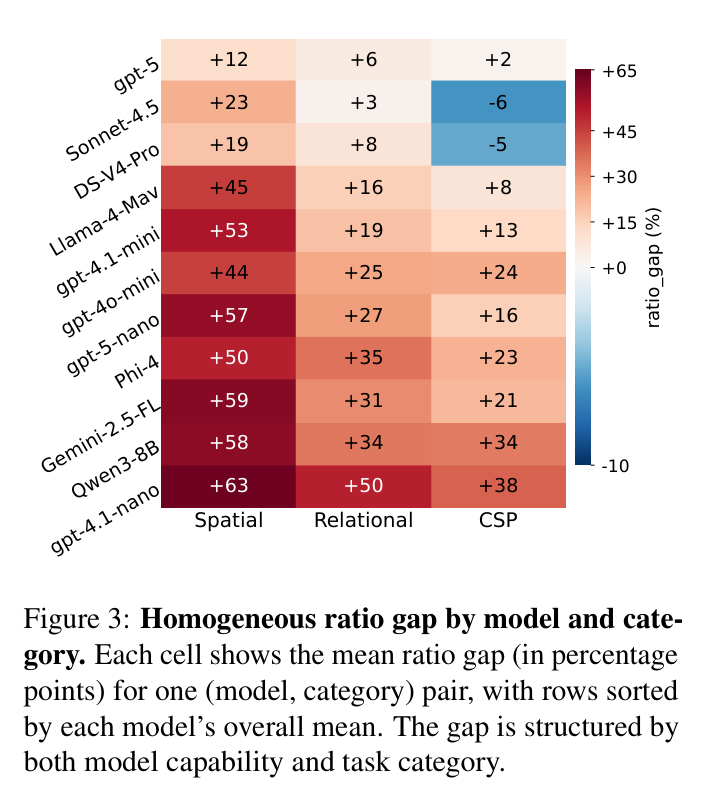
Paper's Figure 3. Rows are the 11 models sorted by overall mean; columns are the
three families. Reading across any row gives Spatial > Relational > CSP (e.g.
gpt-4.1-nano: +63 / +50 / +38). Reading down any column the gap grows as
capability falls (Spatial: gpt-5 +12 → gpt-4.1-nano +63). Notice the two blue cells —
Sonnet-4.5 (−6) and DS-V4-Pro (−5) on CSP — the empirically negative tax that
check #6 above anticipates: strong models on the lowest-friction family occasionally
do better paired than solo.
5.2 Mechanism — the four-stage cascade #
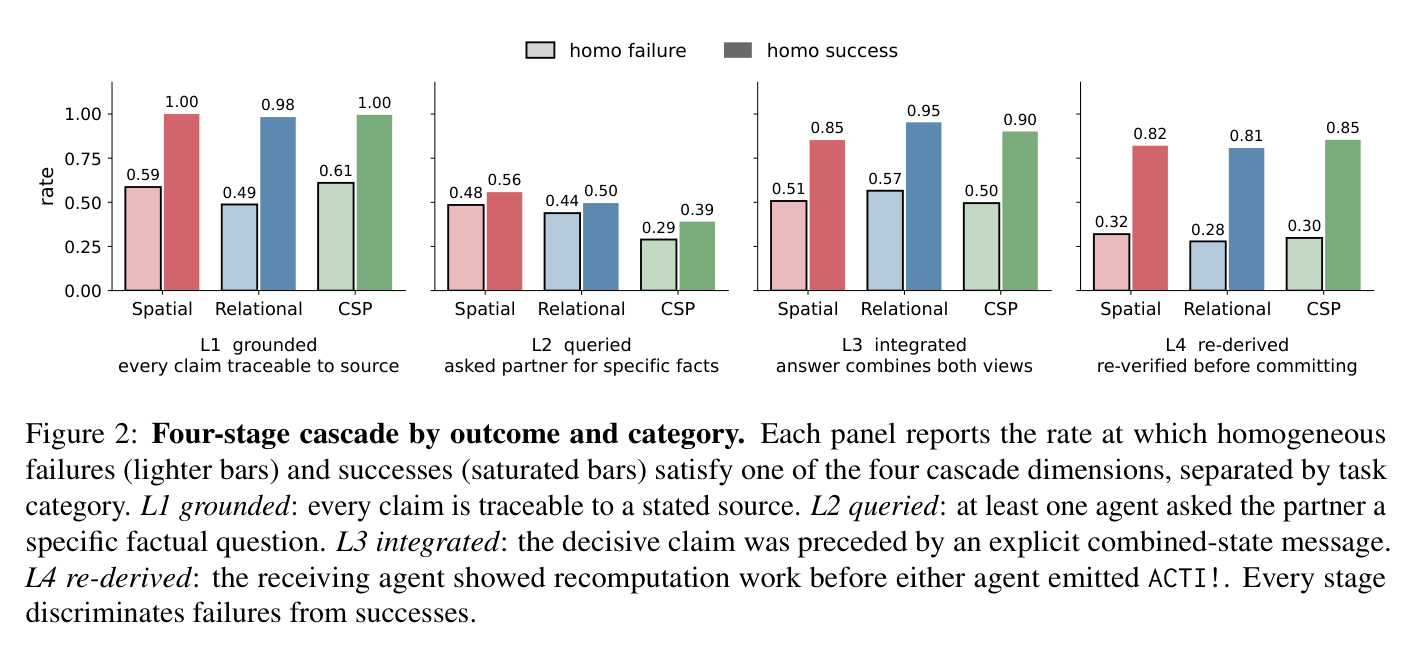
Paper's Figure 2. Each panel is one cascade stage; bars give the rate at which
homogeneous failures (light) vs successes (saturated) satisfy that stage, by
category. Every stage separates the two outcomes, but the gap is largest where the
category's bottleneck lives: L2 queried shows the widest success/failure split on
CSP (0.39 vs 0.29 — successful CSP pairs explicitly elicit cross-half capacity
facts), while L1 grounded is near-ceiling for successes everywhere (≈0.98–1.00).
L3 integrated has the largest absolute separation (e.g. CSP 0.90 vs 0.50), matching
the claim that integration carries the unique predictive signal.
5.3 Predictability #
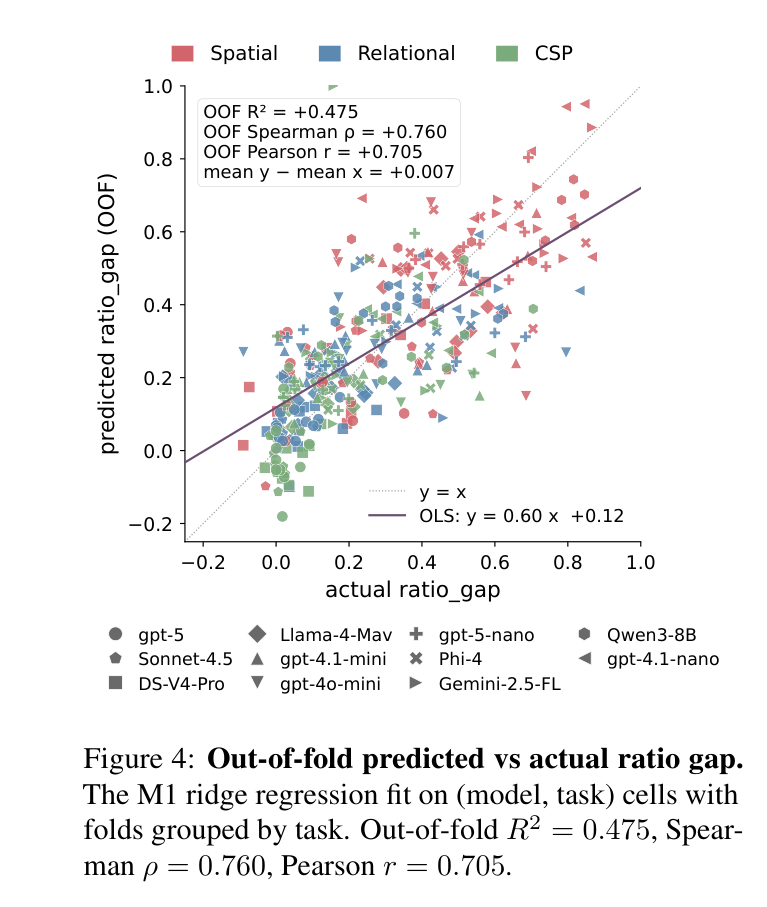
Paper's Figure 4. Each marker is a (model, task) cell; folds are grouped by task
(leave-one-task-out). The regression on conversation features (cascade-stage presence,
turn counts) hits out-of-fold $R^2 = 0.475$, Spearman $\rho=0.760$, with the OLS fit
$y=0.60x+0.12$ tracking the $y=x$ diagonal. The near-zero mean offset
($\overline{y}-\overline{x}=+0.007$) means the predictor is unbiased in level — it
captures the shape of a conversation well enough to forecast its tax before grading
the answer.
5.4 Intervention — stage-targeted prompt clauses #
Table 1 — Stage-targeted prompt-intervention ablation (reproduced from the paper;
$\Delta s_\text{homo}$ = absolute lift vs no-intervention baseline; % closed =
fraction of the tax recovered; ± = half-width of 95% CI; bold = column max):
| Condition | Spatial Δs | Spatial %closed | Relational Δs | Relational %closed | CSP Δs | CSP %closed | Overall Δs | Overall %closed |
|---|---|---|---|---|---|---|---|---|
| All four | +0.051±.026 | +27.1±12.3 | +0.072±.029 | +41.4±38.0 | +0.111±.074 | +52.5±32.3 | +0.079±.031 | +38.3±14.1 |
| no L1 | +0.066±.027 | +37.3±16.2 | −0.005±.038 | −2.4±25.4 | +0.093±.065 | +45.6±35.3 | +0.051±.033 | +27.7±15.1 |
| no L2 | +0.034±.048 | +12.1±26.0 | +0.030±.030 | +18.4±21.2 | +0.055±.028 | +28.2±20.5 | +0.040±.022 | +18.4±13.4 |
| no L3 | +0.059±.018 | +30.3±9.9 | +0.044±.042 | +27.5±36.8 | +0.119±.078 | +55.2±22.1 | +0.075±.035 | +36.3±13.5 |
| no L4 | −0.004±.027 | +2.3±12.5 | +0.015±.035 | +2.8±37.5 | +0.064±.063 | +29.4±25.6 | +0.027±.030 | +9.9±13.4 |
The leave-one-out rows localise each category's bottleneck: dropping L4 collapses
Spatial lift to +2.3% (re-derivation is what fixes spatial paths); dropping L1
flips Relational negative (−2.4%, grounding is the lexical-alignment bottleneck);
dropping L2 halves CSP lift. One genuinely counterintuitive cell: on CSP, no L3
(+55.2%) slightly beats all four (+52.5%) — adding the integration clause
marginally hurts CSP, unexplained in the main text (within overlapping CIs).
5.5 Heterogeneous pairs & the cooperative-game audit #
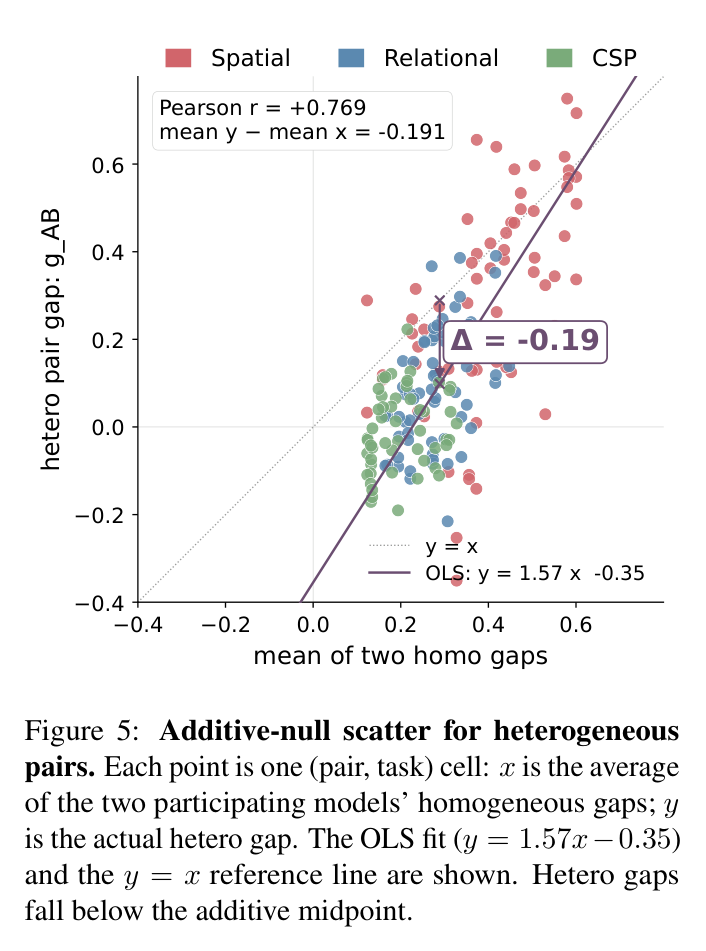
Paper's Figure 5. Each point is a (pair, task) cell: $x$ = mean of the two members'
homogeneous gaps, $y$ = actual hetero gap. Points sit systematically below the
$y=x$ additive line (mean offset $\Delta=-0.19$; OLS slope 1.57), i.e. the pair gap is
pulled toward the stronger member rather than the average. The Shapley audit
confirms the cost is shared, not free-ridden:
Table 2 — Cooperative-game values & Shapley allocations (six hetero pairs):
| Pair | $v(\{1\})$ | $v(\{2\})$ | $v(\{1,2\})$ | $\phi_1$ | $\phi_2$ |
|---|---|---|---|---|---|
| Sonnet × nano | 0.869 | 0.352 | 0.731 | 0.624 | 0.107 |
| nano × Sonnet | 0.352 | 0.869 | 0.732 | 0.108 | 0.624 |
| nano × gpt-5 | 0.352 | 0.932 | 0.756 | 0.088 | 0.668 |
| gpt-5 × nano | 0.932 | 0.352 | 0.706 | 0.643 | 0.063 |
| DeepSeek × nano | 0.802 | 0.352 | 0.728 | 0.589 | 0.139 |
| nano × DeepSeek | 0.352 | 0.802 | 0.718 | 0.134 | 0.584 |
Every row satisfies $v(\{1,2\})<\max(v(\{1\}),v(\{2\}))$ (max-superadditivity
violated), and every $\phi_i flesh. Qwen3-8B up to gpt-5 — the method of measurement needs no special backbone, but the magnitude of the tax is strongly backbone-dependent (weak models pay ~2× the strong-model tax). No minimum model size is required for the phenomenon to appear; it appears most in small models. → mapped onto the 4 cascade stages. Dominant cluster is L3 the single largest failure class. Judge validated at Cohen's κ ∈ [0.67,0.73] for L1–L3, κ=0.51 for L4 (re-derivation is the fuzziest to define). [实现未公开] — the L1 record carries no public code/repo URL for the task suite, the cascade judge, or the evaluation harness. The reproducible artefacts are the verbatim specifications inside the paper's appendices: Appendix G.1 — e.g. the L3 Integration Block: *"Before proposing final answer, send a message combining your view with your partner's view. Explicitly list: (1) facts from my view, (2) facts from partner's view, (3) derived conclusions using both."* These four strings are the implementation of the intervention. / max 2000 tokens/turn; graders temperature 0.2 / top-p 1.0 / max 500 tokens; turn cap 50; 50 rollouts/cell. Spatial shortest paths, a relational query against a ground schema for Relational, a constraint checker with partial credit for CSP. The irreplaceable piece is multiply-expressible task construction (§4.1 req 4, App A.6). The maze grader, for instance, enumerates *16 equivalent coordinate representations (origins × axis orderings) and accepts the move sequence if any* scheme interprets it correctly. This is what defeats the trivial "pass-through" strategy where an agent just forwards its partner's raw view: because the two views can be expressed in different reference frames, concatenation without re-grounding produces a wrong answer. Remove this property and the tax collapses to an information-accessibility measure (any sufficiently long dialogue reconstructs $v_1\cup v_2$ and tax→0). Reproducing it requires, per family, (a) a canonical ground-truth solver and (b) a representation enumerator that certifies equivalence across surface forms — the part a re-implementer is most likely to skip, which would silently change what is being measured. with a candidate; crucially the solo-full control also gets a critic pass (App H: ~1–2 pp lift, far below the tax), so the critic is a fairness equaliser — without it, solo-full would be under-powered and the tax over-stated. black-list forbids generic words (verify, share, communicate, cross-check, …), forcing concrete behavioural names ( this black-list lets the LLM relabel every cluster as "poor communication" and the cascade mapping becomes circular. (arXiv:2511.02687) — split-view mazes; this paper generalises from one task type to a 32-task, 3-family suite with a heterogeneous-pair matrix and a formal game model.5.6 Backbone sensitivity & failure classes #
moved_without_confirming_layout (n=109, Spatial/cube), confirming integration as
6. 论证链 (paper-internal) #
# Step Mechanism / evidence in the paper 1 Define the construct Tax = $\max(v(\{1\}),v(\{2\}))-v(\{1,2\})$; Prop 1 gives sign ≥0 under information-dominance; Prop 2 equates positive tax with a max-superadditivity violation (§3, App A). 2 Isolate coordination from capability Four task-design requirements — solo-trivial, union-necessary, algorithmically graded, multiply-expressible — force any measured loss to be coordination, not problem difficulty or missing information (§4.1, App A.6). 3 Measure structure 32 tasks × 11 models × modes, 50 rollouts/cell → two no-exception orderings: Spatial≻Relational≻CSP within each model, monotone-with-capability across models (Fig 3, §5.2). 4 Locate the failure A 4-stage LLM-judge cascade separates success from failure in every stage; L3 integration is the strongest single predictor and only positive marginal feature (Fig 2, §5.3). 5 Show it is lawful, not noise Ridge regression on conversation features predicts the tax out-of-fold at $R^2=0.475$, transferring to hetero cells at 0.41 — "capability sets the intercept, conversation shape sets the slope" (Fig 4, §5.4). 6 Make it actionable Four stage-targeted prompt clauses recover 38.3% of the tax overall, with a category-specific dominant bottleneck exposed by leave-one-out (Table 1, §5.5). 7 Generalise to mixed pairs Hetero gap is pulled below the additive midpoint toward the strong member; all six pairs violate max-superadditivity and both Shapley shares drop below solo (Fig 5, Table 2, §6).
7. 实现 cross-reference #
核心技术壁垒 — dedicated note #
关键实现细节 (easy-to-miss tricks) #
failed_to_confirm_wall_layout). Skipping
关系 #