Kimi K2.6: Advancing Open-Source Coding
Kimi K2.6: Advancing Open-Source Coding #
Moonshot AI (Kimi Team) | 2026-04 | https://www.kimi.com/blog/kimi-k2-6 HF Model: https://huggingface.co/moonshotai/Kimi-K2.6 Category: llm | Tags: agent, coding, agent-swarm, MoE, MLA, quantization Read: 2026-04-21
TL;DR #
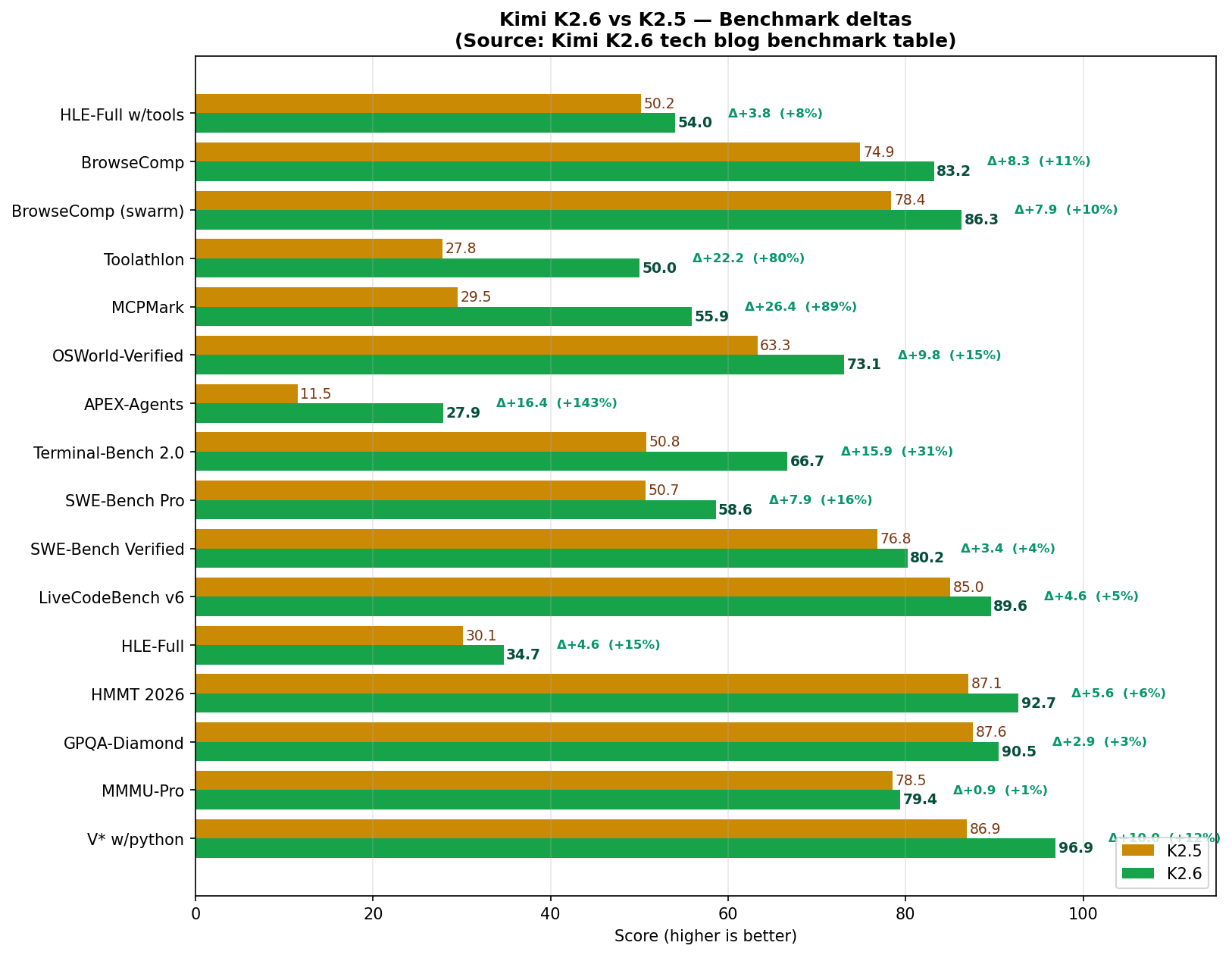
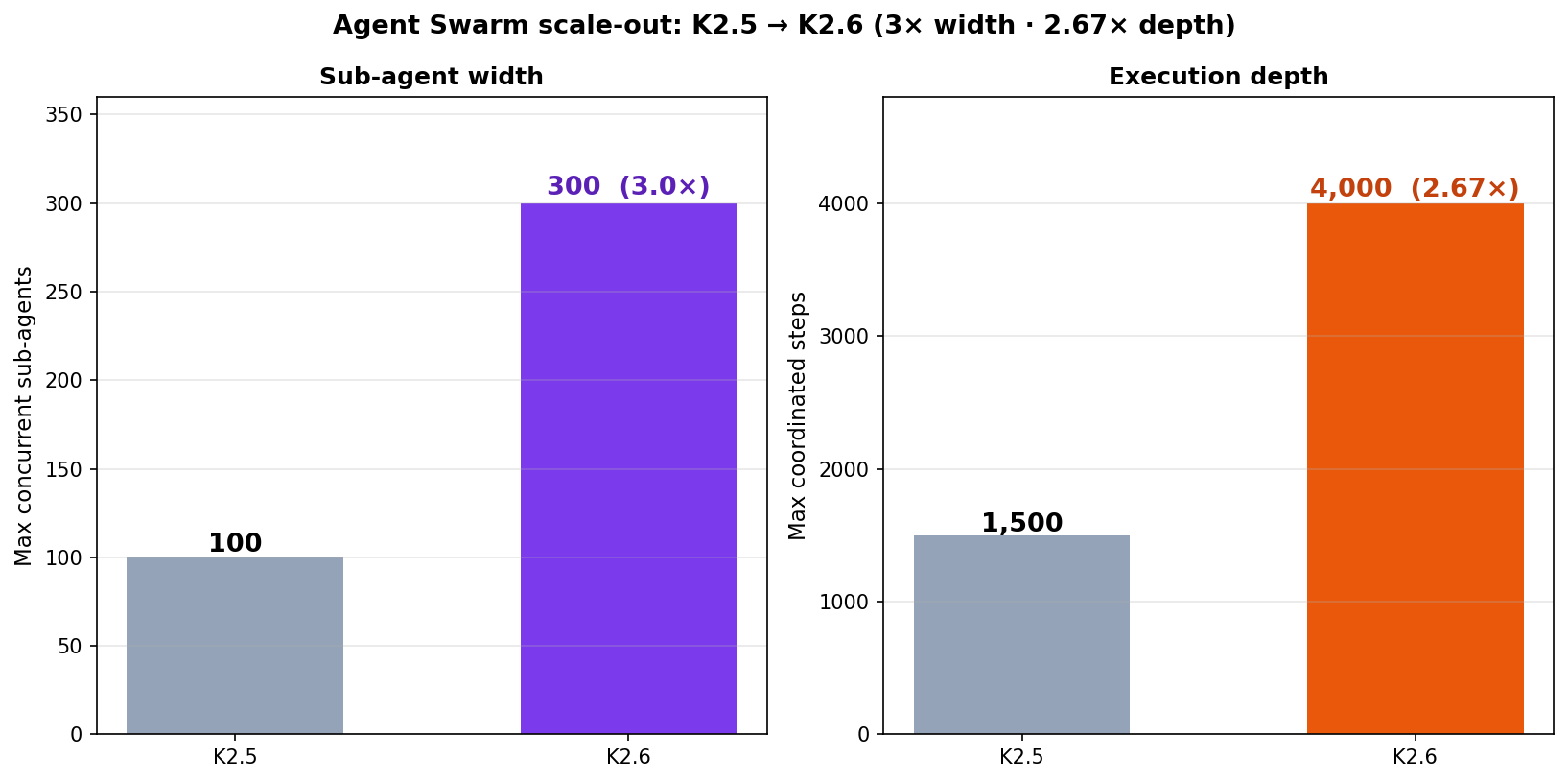
Kimi K2.6 是 K2.5 的 post-training + 量化 + orchestration 发布,不是新底模。config.json 与 K2.5 的关键维度逐字相同(61L · d=7168 · MLA · 384E top-8 + 1 shared · YaRN 64× → 262K context),主要变化全部在:(1) 默认 INT4 compressed-tensors 出版(仅量化 routed MoE experts,attention + shared + head 保留 FP16);(2) 长程 agentic coding RL(单次 4000+ 工具调用 · 12-13 小时自主执行 · 改 4000+ LoC),是迄今开源模型最极端的长程 coding 证据;(3) Agent Swarm 横向扩到 300 sub-agent × 4000 步(K2.5 是 100 × 1500);(4) 新开 Claw Groups 异构 agent 编排范式。Benchmark 最大跳跃在 agentic 工具调用:Toolathlon 27.8→50.0(+80%)、MCPMark 29.5→55.9(+89%)、Terminal-Bench 2.0 50.8→66.7(+31%),在 coding + 长程 agent 类 benchmark 基本与 Claude Opus 4.6 / GPT-5.4 持平,纯 reasoning(HLE-Full / AIME / HMMT)仍略逊 Gemini 3.1 Pro / GPT-5.4。
核心三问 (Q1/Q2/Q3) #
Q1: 试图解决什么核心痛点? 开源 agentic 模型在持续小时级的 coding / 工具调用场景下掉链子——模型会在几十次 tool call 之后丢掉目标、做出回退式修改、或把简单任务做成 quick-hack。Kimi K2.5 已经证明架构可用,但长程稳定性、工具调用成功率、跨 session 编排仍是短板。
Q2: 怎么解? 保持 K2 / K2.5 的 1T 级 MoE + MLA 主干不动(config.json 完全相同),把所有工程投入放在 (a) 长程 coding 的 agentic RL(blog 报告 4-13 小时连续 rollout、1000-4000 次 tool call、14 轮内部迭代);(b) Agent Swarm 3× 扩容(100→300 sub-agent, 1500→4000 coordinated steps);(c) Claw Groups 异构 agent 编排(K2.6 当协调器,子 agent 可跑任何模型、部署在 laptop / 手机 / 云);(d) 默认 compressed-tensors INT4 量化发布,让 1.04T MoE 主模型单 8×H200 节点可服务。
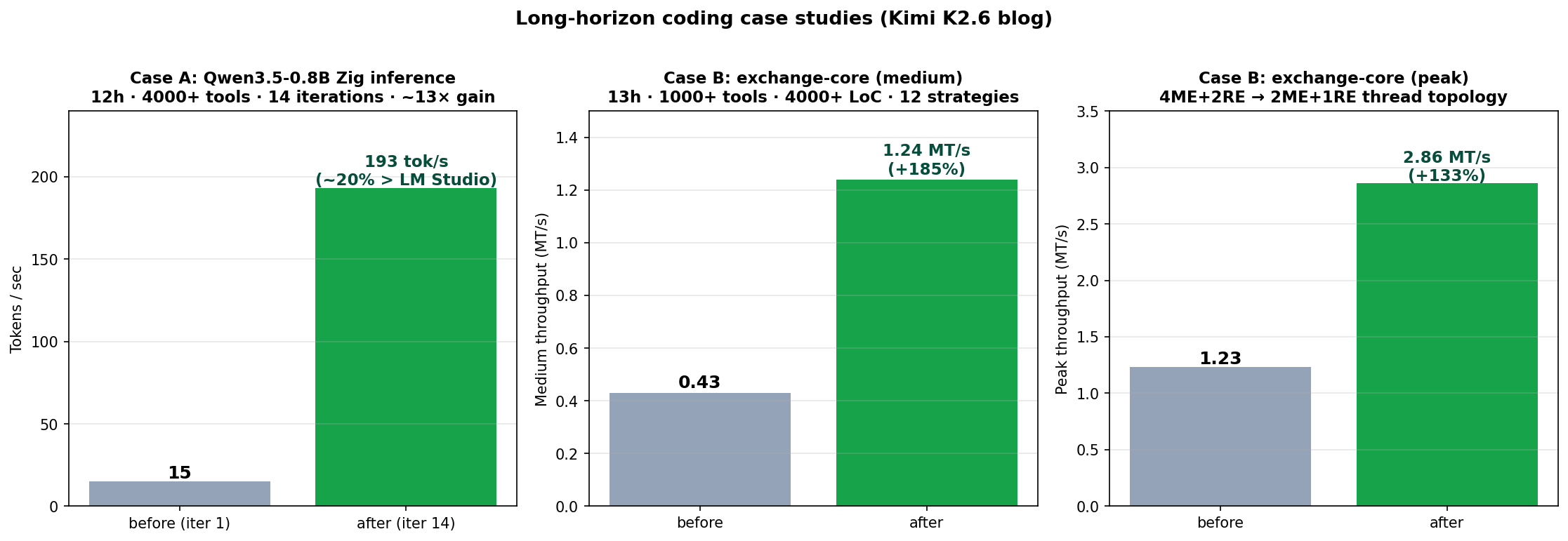
Q3: 最终效果? 在 agentic / coding benchmark 上跳跃最显著:Toolathlon 27.8 → 50.0(+80%), MCPMark 29.5 → 55.9(+89%), Terminal-Bench 2.0 50.8 → 66.7(+31%), SWE-Bench Pro 50.7 → 58.6(+16%), BrowseComp (swarm) 78.4 → 86.3。长程 case study:Zig 语言 + Mac 环境,12 小时 4000+ 工具调用把 Qwen3.5-0.8B 推理从 15 tok/s 提到 193 tok/s(~13×,比 LM Studio 快 20%);exchange-core(8 年老 OSS 撮合引擎)13 小时 1000+ 工具调用修改 4000+ LoC,medium throughput +185% / peak throughput +133%。
Core Contribution #
Kimi K2.6 以 Kimi K2.5 的 1T MoE + MLA + MoonViT 多模态主干 整模复用为前提,通过 长程 agentic coding RL 把单次工具调用/代码编辑会话从"分钟级"推到"4-13 小时、4000+ 次工具调用"级别;同时把 Agent Swarm 扩到 300 sub-agent × 4000 steps 并打开 Claw Groups 异构 agent 编排层;默认以 INT4 compressed-tensors 发布,单节点可服务 1.04T 主模型。
Summary #
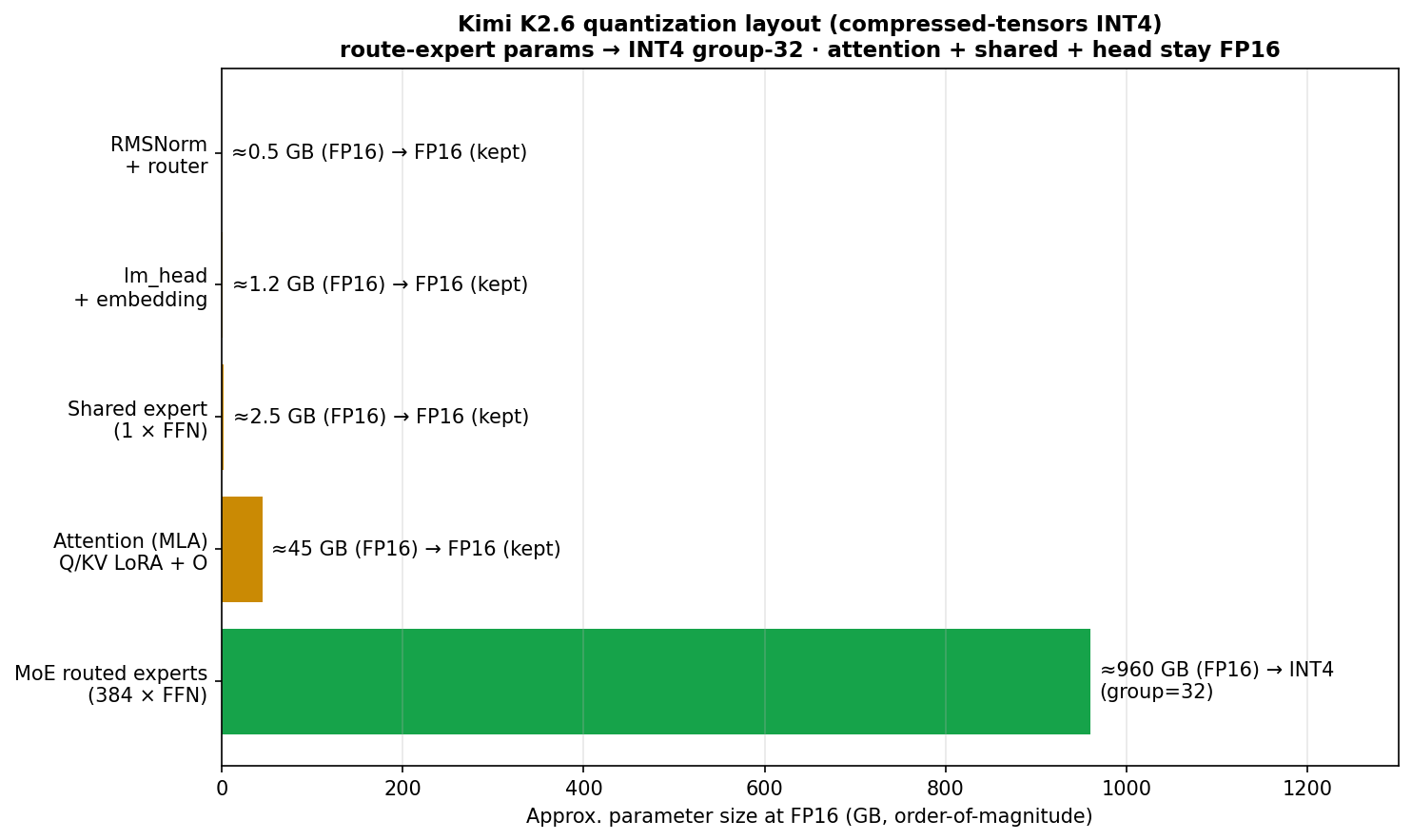
Kimi K2.6 的发布哲学延续 K2.5 的"主干别动、创新放在训练和 orchestration"路线——并把它做到极致。HuggingFace config.json 显示,K2.6 的所有架构维度与 K2.5 字字相同:DeepseekV3ForCausalLM 作为文本主干(61 层,d_model=7168,MLA with q_lora=1536 / kv_lora=512 / qk_nope_head_dim=128 / qk_rope_head_dim=64 / v_head_dim=128,64 heads),384 routed experts top-8 + 1 shared expert(expert hidden=2048 SwiGLU),首层 dense(first_k_dense_replace=1),sigmoid + noaux_tc 路由,routed_scaling_factor=2.827,YaRN factor=64 扩到 262,144 context;视觉侧仍是 MoonViT-3D(27 层,d=1152,patch=14,sd2_tpool 2×2 空间 merge,vocab=163,840)。唯一的 config 新增项是 quantization_config——INT4 symmetric group_size=32 的 compressed-tensors pack-quantized 权重,仅作用在 routed MoE experts(lm_head、self_attn.、shared_experts.、mlp.(gate|up|down)_proj 全部在 ignore 名单里保持 FP16)。
真正的"新内容"完全在 post-training 和 orchestration 层:(1) 长程 agentic coding RL —— blog 两个 flagship case 证明模型能连续 4-13 小时、1000-4000+ 次工具调用、14 轮迭代下持续改善一个真实 OSS 代码库的性能(Zig 推理 15→193 tok/s,exchange-core +185% MT/s);(2) Agent Swarm 规模 3× —— 从 K2.5 的 100 sub-agent × 1500 步扩到 K2.6 的 300 sub-agent × 4000 步,且产物形态从"搜索/报告"扩展到"documents + websites + slides + spreadsheets 同轨输出";(3) Skills —— 把高质量 PDF / slides / sheets 吸收为"结构 + 风格 DNA"可复用模板(McKinsey 式 PPT、astro-paper 可视化风格等);(4) Claw Groups 研究预览 —— 异构 agent 编排层,K2.6 做协调器,子 agent 可跑任何模型、部署在 laptop / 手机 / 云,人和 agent 以"真正合作者"身份同台协作。
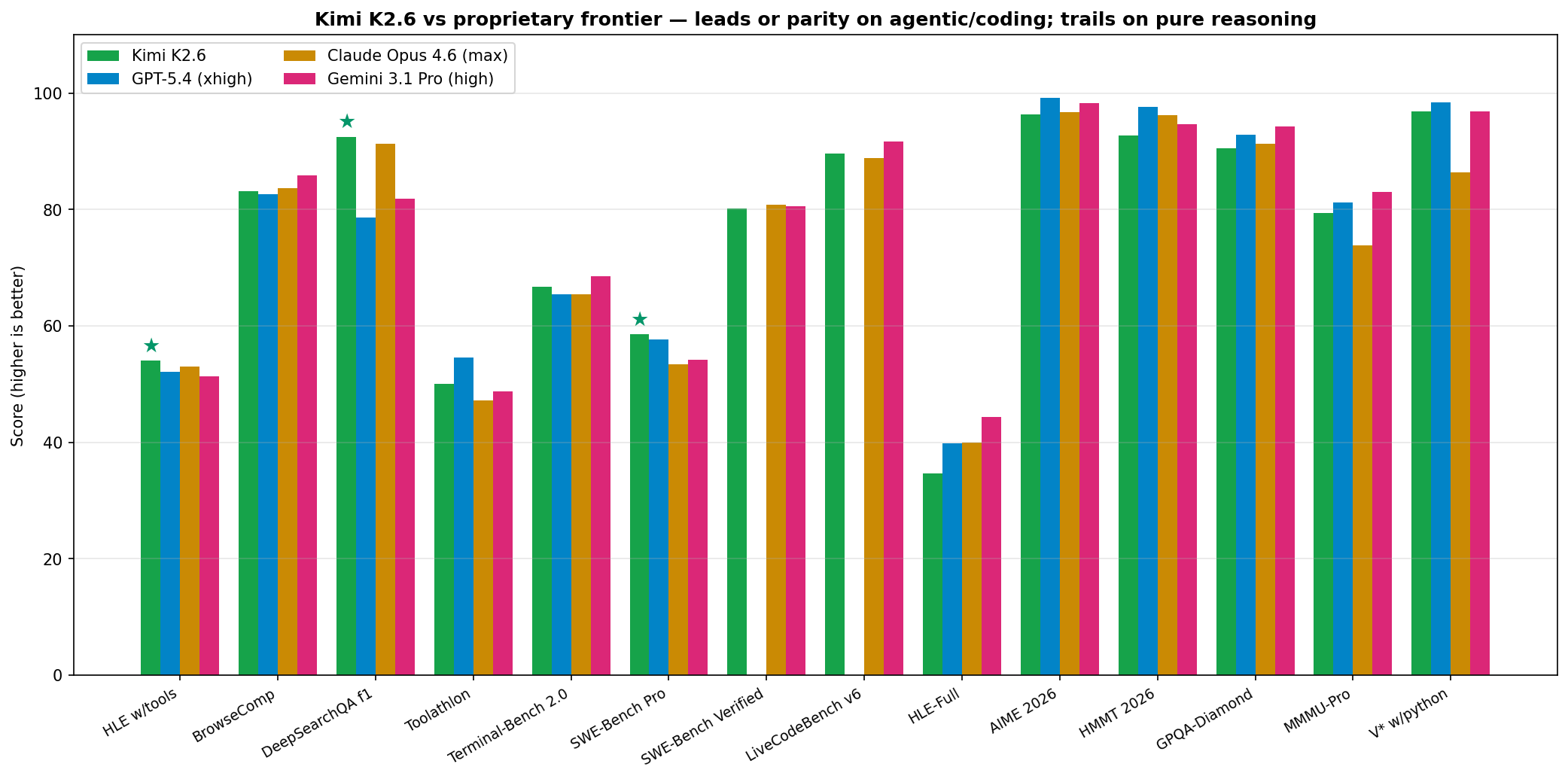
效果上,在 agentic + coding benchmark 基本追平 Claude Opus 4.6 / GPT-5.4(SWE-Bench Pro 58.6 领先、Terminal-Bench 2.0 66.7 仅次 Gemini 3.1 Pro 68.5、DeepSearchQA f1 92.5 大幅领先闭源对手);在纯 reasoning(HLE-Full 34.7 vs Gemini 44.4 / GPT 39.8,AIME 2026 96.4 vs GPT 99.2)上仍略逊顶尖闭源。视觉侧小幅提升但仍非重点(MMMU-Pro 78.5→79.4,BabyVision 36.5→39.8)。
Key Findings #
- 架构 = K2.5 verbatim:HF config.json 字段对齐,61L · d=7168 · MLA 同维度 · 384 routed + 1 shared experts · YaRN factor=64 · 262K context。不是新底模。
- 默认 INT4 发布:compressed-tensors
pack-quantizedINT4 symmetric group_size=32,仅作用于 routed MoE experts (~98% 参数);attention / shared expert / lm_head / embedding 保留 FP16。 - 长程 coding 能力显著:Zig + Mac 12 小时 4000+ tool calls 把 Qwen3.5-0.8B 推理从 15→193 tok/s(~13×,20% 快于 LM Studio);exchange-core 13 小时 1000+ tools 改 4000+ LoC,+185% medium / +133% peak throughput。
- Agent Swarm 3× 扩容:100 sub-agent / 1500 steps → 300 sub-agent / 4000 steps;BrowseComp(swarm) 78.4 → 86.3;输出形态扩到多产物(docs + sites + slides + sheets 同一 run 产出)。
- Claw Groups 新范式:异构 agent / 异构设备 / 跨厂商模型的编排层,K2.6 做协调器(task-skill matching、failure detection、lifecycle management),人和 agent 作为 peer。
- Skills:把高质量文档(PDF / slides / 数据表)吸收为结构+风格模板,复用于未来任务。
- Agentic 工具调用是最大跳跃:Toolathlon 27.8→50.0(+80%)、MCPMark 29.5→55.9(+89%)、APEX-Agents 11.5→27.9(+143%)、Terminal-Bench 2.0 50.8→66.7(+31%)。
- SWE-Bench Pro 58.6 领先 Claude Opus 4.6(53.4)、GPT-5.4(57.7)、Gemini 3.1 Pro(54.2)——在大型真实代码库类 benchmark 正式登顶。
- 推荐推理超参数:temperature=1.0, top-p=1.0, context=262,144(与 K2.5 一致,blog 脚注明确)。
- Vercel 报 Next.js benchmark +50% 对 K2.5;factory.ai 报 +15%;CodeBuddy 报代码准确率 +12%、长上下文稳定 +18%、工具调用成功率 96.6%。
Limitations #
- Blog 不是技术报告:没有 GPU-hours、token 总数、训练 data mix、post-training loss / reward 具体细节、ablation,全部 recipe 只能从 K2 / K2.5 论文反推。
- 多轮 agentic RL 的 reward/policy 细节缺失:blog 只给"能做到"的案例,不给"怎么训"的方程或数据量。
- 纯 reasoning 仍略逊闭源:HLE-Full 34.7(GPT 39.8, Claude 40.0, Gemini 44.4)、AIME 2026 96.4(GPT 99.2, Gemini 98.3)、HMMT 2026 92.7(GPT 97.7, Claude 96.2),数学/长推理仍差 3-8 分。
- Claw Groups 是 research preview:没有量化的可靠性 / 召回率指标,异构 agent 场景下 coordinator 决策质量未披露。
- 视觉能力提升有限:MMMU-Pro 78.5→79.4(+0.9),BabyVision 仍 39.8 远低于 GPT-5.4 的 49.7,视觉不是本次发布重点。
- APEX-Agents 绝对值低:K2.6 27.9 vs Claude 33.0 / GPT 33.3,说明复杂 API 编排(涉及外部金融运行时)仍是短板。
- INT4 下长程 coding 性能 vs BF16 无消融,难判断 quant 是否损害长程稳定性。
Infrastructure Impact #
- Algorithm: 长程 agentic RL(4-13 小时 rollout)把传统 RLHF/GRPO 的 step horizon 延长两三个数量级;trajectory level reward + tool-use success 成为主信号。K2.5 已用 MuonClip + token-level log-ratio clip + KL + Toggle,K2.6 blog 未披露是否调整。
- Kernel: 依旧是 DeepSeek-V3 家族 MLA kernel + sigmoid noaux_tc MoE routing;新增compressed-tensors INT4 pack-quantized 解压与 GEMM 融合 kernel(vLLM / SGLang 已支持);routed expert INT4 × bf16 activation 的 group-wise dequant 路径成为部署关键。
- Framework: vLLM / SGLang
kimi_k25.py模型文件直接复用(DeepseekV3ForCausalLM+KimiK25ForConditionalGeneration),新增compressed-tensorsquant 分支;调度器需要支持长程 agentic 会话的 prefix-cache 跨小时复用(4-13h rollout 的 262K 上下文反复增长)。 - LLM: 证明"架构到此为止,继续提升靠训练 + 编排"对 1T MoE 依然奏效;INT4 routed-only 量化是 1T MoE 实用化的 reference point。
- Agent: 开源侧首次公布 300 sub-agent × 4000 步 agent swarm、12+ 小时 4000+ tool calls 的长程 coding rollout;Claw Groups 把异构 agent 编排提到正式产品层,挑战 LangGraph / AutoGen 等现有框架。
- Code: Kimi Code(配套 CLI)、OpenClaw(24/7 背景 agent)、Claw Groups(异构编排层)三个产品级 runtime 同步落地,形成从模型→CLI→背景 agent→异构编排的完整开源 agent 栈。
Key Figures #
Deep Analysis (llm) #
模型架构 #
架构 1 · Top-level Multimodal Pipeline #
KimiK25ForConditionalGeneration = MoonViT3dPretrainedModel + K2VLMultiModalProjector + DeepseekV3ForCausalLM (验证来源: sglang kimi_k25.py:678-793)
[N_patches, 3, 14, 14]
NaViT packed, T=1 image, T=4 video"]:::input ids["input_ids
[B, S_text]"]:::input subgraph VIS["vision_tower = MoonViT3dPretrainedModel (vllm kimi_k25_vit.py:548)"] direction TB pe["patch_embed
Conv2d(3, 1152, k=14, s=14)
+ pos_emb 64×64×4 divided_fixed"]:::vision enc["encoder
27× MoonViTEncoderLayer
d=1152, 16 heads × 72 head_dim
FFN=4304, GELU_tanh, attn_bias=True"]:::vision merge["tpool_patch_merger sd2_tpool
[T,H,W,1152] → [T,H/2,W/2,4608]
+ temporal pool over T"]:::vision pe --> enc --> merge end mmp["mm_projector = K2VLMultiModalProjector
(sglang kimi_k25.py:572)
pre_norm 1152 / Linear 4608→4608 / GELU / Linear 4608→7168"]:::vision emb["embed_tokens
Embedding(163840 → 7168)"]:::text fuse["general_mm_embed_routine
scatter image embeds into text stream
at <pipe;kimi_k25_video_placeholder&pipe;> (id=163605)"]:::fuse subgraph LM["language_model = DeepseekV3ForCausalLM (sglang kimi_k25.py:711)"] direction TB l0["Layer 0 (dense):
MLA + DeepseekV2MLP(7168→18432→7168, SwiGLU)"]:::lm lN["Layers 1-60 (sparse MoE):
MLA + DeepseekV2MoE
384 routed top-8 + 1 shared expert"]:::lm norm["final RMSNorm(7168)"]:::lm head["lm_head Linear(7168 → 163840)"]:::lm l0 --> lN --> norm --> head end logits["logits [B, S, 163840]
next-token / tool-call / text"]:::out pix --> pe merge --> mmp ids --> emb mmp --> fuse emb --> fuse fuse -->|"[B, S, 7168]"| l0 head --> logits
易错点 cheatsheet:
- 模型类名在 K2.6 仍是
KimiK25ForConditionalGeneration(HF auto_map 未变), 代码路径 100% 复用 K2.5; 只是 quant_config 传compressed-tensors分支。 <|kimi_k25_video_placeholder|>token id = 163605 (HF config.json 明确)。- 图像 / 视频共用
vision_tower + mm_projector, 只靠grid_thws的 T 维区分。
架构 2 · Decoder Layer (MLA + MoE) 内部展开 #
DeepseekV2DecoderLayer (sglang deepseek_v2.py:1596); layer 0 走 dense, layer 1-60 走 MoE (first_k_dense_replace=1)。
RMSNorm(7168, eps=1e-5)"]:::norm subgraph MLA["self_attn = DeepseekV2AttentionMLA (deepseek_v2.py:1130)"] direction TB subgraph QPATH["Q path"] direction TB qa["q_a_proj
Linear(7168 → 1536)
q_lora_rank"]:::q qan["q_a_layernorm RMSNorm(1536)"]:::q qb["q_b_proj
Linear(1536 → 12288)
ColumnParallel, = 64 × (128+64)"]:::q qs["split + reshape →
Q_nope [64, 128] + Q_rope [64, 64]"]:::q qr["RoPE(Q_rope)
rotary_dim=64, θ=50000
YaRN factor=64"]:::rope qa --> qan --> qb --> qs --> qr end subgraph KVPATH["KV path"] direction TB kva["kv_a_proj_with_mqa
Replicated Linear(7168 → 576)
= kv_lora(512) + qk_rope(64)"]:::kv kvs["split: c_kv [..,512] + k_pe [..,64]"]:::kv kvan["kv_a_layernorm RMSNorm(512)"]:::kv kvb["kv_b_proj
Linear(512 → 16384)
ColumnParallel, = 64 × (128+128)"]:::kv kvout["K_nope[64,128] + V[64,128] + K_rope[1,64 shared]
KV cache = c_kv + k_pe = 576 fp/token"]:::kv kva --> kvs --> kvan --> kvb --> kvout end attn_core["Attention core
softmax(Q · K^T / √192) · V
qk_head_dim=192, v_head_dim=128, heads=64"]:::attn op["o_proj
RowParallel Linear(8192 → 7168)"]:::q qr --> attn_core kvout --> attn_core attn_core --> op end res1["x + attn(x)"]:::res ln2["post_attention_layernorm
RMSNorm(7168, eps=1e-5)"]:::norm subgraph MOE["mlp (layer 1-60) = DeepseekV2MoE (deepseek_v2.py:354)"] direction LR gate_m["MoEGate (deepseek_v2.py:268)
F.linear(x, W[384, 7168])
+ sigmoid + noaux_tc top-8
+ e_score_correction_bias
🟢 FP16 kept"]:::gate routed["384 routed experts (top-8 active)
each = DeepseekV2MLP(7168→2048→7168, SwiGLU)
routed_scaling_factor = 2.827
🔴 INT4 compressed-tensors
(group_size=32, symmetric, pack-quantized)"]:::moe_routed shared["1 shared expert (always active)
DeepseekV2MLP(7168→2048→7168, SwiGLU)
🟢 FP16 kept
(matches ignore regex)"]:::moe_shared combine["combine
topk · routed(x) + α · shared(x)"]:::attn gate_m --> routed --> combine shared --> combine end dense0["(ONLY layer 0) mlp = DeepseekV2MLP
Linear(7168→18432) / SwiGLU / Linear(18432→7168)
🟢 FP16 kept"]:::moe_shared res2["x + MoE(x) or x + MLP(x) at layer 0"]:::res x --> ln1 --> qa ln1 --> kva op --> res1 --> ln2 ln2 --> gate_m ln2 --> shared ln2 -.-> dense0 combine --> res2 dense0 -.-> res2
关键常量 (来自 HF config.json, 与 mermaid 图的值一致):
| config 字段 | 值 | 出现位置 |
|---|---|---|
hidden_size | 7168 | x.shape[-1] 处处 |
q_lora_rank / kv_lora_rank | 1536 / 512 | q_a_proj / kv_a_proj_with_mqa 输出 |
qk_nope_head_dim / qk_rope_head_dim / v_head_dim | 128 / 64 / 128 | 每 head 维度 split |
num_attention_heads | 64 | MLA 不做 GQA |
n_routed_experts / num_experts_per_tok | 384 / 8 | MoE |
moe_intermediate_size | 2048 | 每 expert FFN 中间维 |
routed_scaling_factor | 2.827 | combine 乘性放大 |
first_k_dense_replace | 1 | layer 0 走 dense |
易错点:
- MLA heads=64, 不是 GQA (
num_key_value_heads=64看似 MHA, 实际是 MLA 用 latent 压缩代替 GQA) - K_rope 跨 64 heads 共享单份, 不是 64 份 per-head
- KV cache 只存 576 fp/token (
kv_lora_rank + qk_rope_head_dim); K_nope / V 由 kv_b_proj 运行时展开, 不进 cache - INT4 边界正则陷阱:
re:.mlp\.(gate|up|gate_up|down)_proj.匹配DeepseekV2MLP的属性名 → layer 0 dense 和 shared expert 都 命中 ignore, 保 FP16。真正 INT4 的是mlp.experts.N.*(FusedMoE)
架构 3 · MoonViT-3D Vision Tower #
(T, H, W) packed
T=1 image, T=4 video"]:::input subgraph PE["Patch Embedding (vllm kimi_k25_vit.py:183)"] direction TB conv["Conv2d(3, 1152, k=14, s=14, bias=True)"]:::vit pos["Learnable2DInterp PosEmb divided_fixed
64×64 spatial × 4 time bins"]:::vit conv --> pos end subgraph ENC["MoonViT3dEncoder · 27× layer (vllm kimi_k25_vit.py:463)"] direction TB att["Attention: qkv_proj 1152→3456 / 2D RoPE / spatial_temporal / o_proj 1152→1152
16 heads × 72 head_dim, attn_bias=True"]:::vit mlp["MLP2: Linear 1152→4304 / gelu_pytorch_tanh / Linear 4304→1152"]:::vit att -->|residual| mlp end subgraph MERGE["tpool_patch_merger sd2_tpool (kimi_k25_vit.py:523)"] direction TB s2["spatial 2×2 merge
[T, H, W, 1152] → [T, H/2, W/2, 4608]"]:::merge tp["temporal pool over T
(video: 4 frames → 1 token)"]:::merge s2 --> tp end subgraph PROJ["K2VLMultiModalProjector (sglang kimi_k25.py:572)"] direction TB pn["pre_norm LayerNorm(1152, eps=1e-5)
⚠ applied BEFORE reshape"]:::proj reshape["view(-1, 4608)"]:::proj l1["Linear(4608 → 4608, bias=True)"]:::proj act["GELU"]:::proj l2["Linear(4608 → 7168)
= text_hidden_size"]:::proj pn --> reshape --> l1 --> act --> l2 end vout["image/video embeds
[N_tok, 7168]
→ fused into text stream"]:::out vin --> conv pos --> att mlp --> s2 tp --> pn l2 --> vout
易错点 (容易看 paper 看错的地方):
- head_dim = 72 (非 2 幂) — 继承自 SigLIP-SO-400M, 不是 Kimi 独创
pre_norm在 reshape 之前 —K2VLMultiModalProjector.forward先对[N_patches, 1152]做 LayerNorm, 再view(-1, 4608)。"先 merge 再 norm" 是天真实现, K2.x 不是这样linear_2输出是 7168, 不是 1152 — sglang 的K2VLMultiModalProjector用text_hidden_size(7168)。注意 vLLM 的旧同名类用mm_hidden_size(1152) 是 legacy 路径- temporal pool 取均值, 不拼接 — 视频 4 帧打包后经
sd2_tpool只保留 1 帧等效
架构 4 · INT4 Quantization Layout #
K2.6 config.json 唯一比 K2.5 新增的字段: quantization_config。
format: pack-quantized
status: compressed"]:::ignore qgroup["group_0.targets: [Linear]
num_bits=4, type=int, symmetric=true,
strategy=group, group_size=32"]:::int4 qignore["ignore:
• lm_head
• re:.*self_attn.*
• re:.*shared_experts.*
• re:.*mlp\\.(gate&pipe;up&pipe;gate_up&pipe;down)_proj.*"]:::fp16 qkv["kv_cache_scheme: null
→ KV cache 保 FP16"]:::fp16 end subgraph INT4_Z["🔴 真正 INT4 的参数 (~92% 参数)"] direction TB routed["model.layers.[1-60].mlp.experts.[0-383].(gate&pipe;up&pipe;down)_proj
60 × 384 × 3 = 69,120 个 Linear
FP16 原始 ≈ 925 GB
INT4 压缩后 ≈ 245 GB
(3.77× shrink)"]:::int4 end subgraph FP16_Z["🟢 FP16 保留 (~53 GB)"] direction TB fp_attn["self_attn (MLA 所有投影)
61L × (q_a + q_b + kv_a + kv_b + o)
≈ 44 GB"]:::fp16 fp_shared["shared_experts
60L × 1 × 3 投影 ≈ 2.5 GB"]:::fp16 fp_dense["Layer 0 dense mlp
3 × (7168×18432)/2 ≈ 0.8 GB"]:::fp16 fp_head["lm_head + embed_tokens
2 × (7168 × 163840) ≈ 4.7 GB"]:::fp16 fp_vision["MoonViT-3D + mm_projector
≈ 1 GB (not Linear targets)"]:::fp16 fp_misc["MoEGate + RMSNorm + biases ≈ 0.5 GB"]:::fp16 end total["Total deployed ≈ 298 GB
单 8×H200 (1128 GB HBM) 舒适
262K KV cache / seq ≈ 290 MB (MLA latent)"]:::ignore qgroup --> routed qignore --> fp_attn qignore --> fp_shared qignore --> fp_dense qignore --> fp_head qkv --> fp_vision routed --> total fp_attn --> total fp_shared --> total
量化策略推理:
group_size=32是 AWQ 家族细粒度设置, 精度损失通常 <0.5 MMLUsymmetric避免 zero-point 存储开销, 只存 FP16 scale per group- routed experts only 因为 MLA + shared expert 每 token 必经, 量化误差累积敏感; routed experts 由 top-8 路由, 每个权重训练信号更分散, 能承受 4-bit
- 不是 W4A4, 是 W4A16 weight-only — 激活 FP16 避免精度悬崖
kv_cache_scheme = null→ KV cache 仍 FP16 (MLA 的 576 fp/token 本就紧凑)
{{drawio:kimi-k2-6_arch.drawio#page=0&height=700}}
1. Architecture (code-verified walkthrough) #
1a. Top-level wiring (对应上方「架构 1」) #
关键代码锚点 (走读时在你本地编辑器打开):
| 代码锚点 | 做什么 |
|---|---|
sglang/kimi_k25.py:678 | class KimiK25ForConditionalGeneration — 三件套顶层构造器 |
sglang/kimi_k25.py:700-717 | 构造 vision_tower / mm_projector / language_model 三件套的位置 |
sglang/kimi_k25.py:728 | get_image_feature — 图像路径入口 |
sglang/kimi_k25.py:774 | forward → general_mm_embed_routine 合流 |
关键易错点:
- 模型类名在 K2.6 仍是
KimiK25ForConditionalGeneration— HF auto_map 未变, 代码路径 100% 复用 K2.5 <|kimi_k25_video_placeholder|>token id = 163605 (HF config.json) — 图像 embed 合流的锚点 token- 区分 "图像路径" 与 "视频路径": 二者走同一
vision_tower + mm_projector, 只是grid_thws的 T 维不同 (image T=1, video T=4) - MLA heads 数 = 64, 不是 GQA — config 的
num_key_value_heads=64看似 "同 MHA", 实际是 MLA 用 latent 压缩代替 GQA, 两种机制不同 - K_rope 跨所有 64 heads 共享 —
kv_a_proj_with_mqa输出里的 64-dimk_pe段是单份, 不是 64 份 per-head - KV cache 只存 576 float/token =
kv_lora_rank(512) + qk_rope_head_dim(64);K_nope和V通过kv_b_proj运行时展开, 不进 cache - INT4 quant 边界的正则陷阱:
re:.mlp\.(gate|up|gate_up|down)_proj.匹配的是DeepseekV2MLP内部的属性名gate_proj/up_proj/down_proj. 因为 layer 0 dense 和 shared expert 都是DeepseekV2MLP实例, 它们的 proj 同时命中 ignore pattern → FP16 保留。真正走 INT4 的是mlp.experts.N.*(FusedMoE的 routed experts)。详见上方「架构 4」 - head_dim = 72 是 "非 2 幂" — 继承自 SigLIP-SO-400M, 不是 Kimi 独创
pre_norm在 reshape 之前 —K2VLMultiModalProjector.forward先对[N_patches, 1152]做 LayerNorm, 再view(-1, 4608)merge。"先 merge 再 norm" 是天真实现, K2.x 不是这样linear_2输出是 7168, 不是 1152 — sglang 的K2VLMultiModalProjector用text_hidden_size(7168). 注意 vLLM 的同名类用mm_hidden_size(1152) 是旧路径, K2.5/K2.6 走 sglang 路径- temporal pool 对 T=4 取均值, 不是拼接 — 视频 4 帧打包后经
sd2_tpool只保留 1 帧的 H×W×4608 等效 .self_attn.→ 所有 MLA 投影(q_a/q_b、kv_a/kv_b、o_proj)保持 FP16;.shared_experts.→ 1 个 shared expert 的 gate/up/down 保持 FP16;.mlp\.(gate|up|gate_up|down)_proj.→ 注意这个正则通常匹配 dense 层的 MLP 投影 —— 也就是第 0 层(首 dense 层)的 FFN 保持 FP16;lm_head→ 输出头保持 FP16;- 剩下被量化的是:routed MoE experts(383 层 × 384 experts × 3 个 FFN 投影矩阵),这些是参数量的绝对主体(~960/1050 GB FP16 → ~240/260 GB INT4)。
- group_size=32 是 AWQ / GPTQ 惯用的细粒度 group-wise 量化设置,精度损失通常 <0.5 MMLU;
- symmetric INT4 避免 zero-point 存储开销,只存 scale (FP16 per-group);
- routed experts only 的策略反映了一个 empirical fact:MLA / shared expert / lm_head 的量化对精度更敏感(activation magnitude 更大、梯度更集中),routed experts 由于路由 sparsity 使每个权重看到的训练信号更分散、更能承受低比特;
- 该策略与 DeepSeek-V3 / Qwen3-MoE 社区的部署配方一致,是 MoE INT4 的"standard practice"。
- Pretraining:
[未披露,推测复用 K2.5 基础 checkpoint] - SFT:
[未披露]— 但 blog 强调长程 coding 案例证据,推测专门构造了长程 coding SFT trace - RL:
[未披露]— 推测延续 K2.5 token-level log-ratio clip + KL penalty + MuonClip + Toggle,但 reward horizon 显著扩大到 4-13 小时 tool-use rollout - GPU 型号 / 节点 / 互联:[blog 未披露]
- 总 GPU-hours:[blog 未披露]
- MFU / HFU:[blog 未披露]
- Wall-clock time:[blog 未披露] — 但从 K2.5 (2026-02) 到 K2.6 (2026-04) 仅 ~2 个月,说明增量训练窗口相对较短,佐证"post-training 主导"的判断。
- Trajectory-level reward 能在几千步 tool-use 后仍保持 gradient signal 不爆炸 / 不 vanishing(PARL 的 annealed 多项 reward 提供了基础)
- Tool-call success 的稀疏 reward 下如何避免模型学到"早早收手"(过早提交的短视策略)——blog 强调 "less likely to make coding errors or use hacks"(factory.ai 引述),这通常需要显式的 "patience bonus" 或 hierarchical critic
- 基础设施:单条 rollout 4-13 小时意味着 单 episode 占用 GPU 数小时,RL 训练 batch size 难以推高——必须通过 off-policy reuse、replay buffer、或大规模并行 rollout cluster 平摊
- Reward model 的长程跨度:普通 LLM-as-judge 不可能读完 4000 次 tool call 的完整 trace,需要分层 judge / milestone reward
- Pack-quantized format:每 8 个 INT4 weight pack 到一个 INT32 word,存储 + dequant 都有 fast SIMD 路径(vLLM / llm-compressor / compressed-tensors 库原生支持)
- group_size=32 比 AWQ 默认 128 更细,精度更高但 dequant 开销也更大(每 32 个权重一组 scale factor)
- Symmetric int + minmax observer:最简配置,适合 post-training quantization;不需要校准集的复杂 AWQ / GPTQ 流程
- Ignore 正则的精妙:不仅不量化 attention(标准操作),连 shared expert 都保留 FP16 —— shared expert 是每 token 必经之路,小幅量化误差会放大,保留 FP16 是明智权衡
- 推理时 workflow:INT4 pack → 动态 dequant 到 FP16 → GEMM → 激活也是 FP16。不是 W4A4,是 W4A16 weight-only quantization——活化值不量化避免精度悬崖
- Agentic tool use 是最大跳跃:Toolathlon (+80%)、MCPMark (+89%)、APEX-Agents (+143%) —— 远超 coding / reasoning 的单位数增幅。这强烈支持"K2.6 的 RL 重点就在长程工具调用"的判断。
- SWE-Bench Pro 58.6 全场最高 —— 开源模型在真实大型代码库类 benchmark 正式登顶(SWE-Bench Pro 比 Verified 更难,涉及多文件重构和跨模块依赖)。
- DeepSearchQA 92.5 大幅领先闭源(GPT 78.6 / Gemini 81.9,仅 Claude 91.3 接近)—— Kimi 在搜索+阅读类任务的优势进一步拉大。
- AIME / HMMT / GPQA 纯数学/科学推理仍差 3-8 分(vs GPT/Gemini)—— 数学 long-chain reasoning 是 K2 系列长期短板,本次未重点优化。
- MMMU-Pro +0.9 极小幅提升 —— 视觉能力与 K2.5 几乎一致,符合"架构不动、训练重点在 agentic"的判断。
- BrowseComp 单机 83.2 vs swarm 86.3:swarm 带来 +3.1 绝对分,swarm 对 K2.5 带来 +3.5(75→78.4),swarm 的增益基本恒定——swarm 扩 3× 主要用于更复杂的多产物任务(见 §5c),不是为了刷 BrowseComp。
- 选真实 OSS 仓库 + OOD 编程语言(Zig、老旧 Java、Rust)作为 rollout 环境
- Rollout 限额放到 4-13 小时 / 1000-4000+ tool calls / 10-15 iterations
- Reward 不依赖单次对错,而是最终性能指标(throughput、latency、test pass rate)+ 过程质量(是否用 flame graph 分析、是否正确识别瓶颈)
- 沿用 K2.5 的 token-level log-ratio clip + KL penalty + MuonClip + Toggle
- Zig 12h case: 15 → 193 tok/s (~13× gain, 20% > LM Studio)
- exchange-core 13h case: +185% medium / +133% peak throughput
- SWE-Bench Pro +7.9, Terminal-Bench 2.0 +15.9
- K2.6 退居协调者(coordinator),不再假设 sub-agent 同模型
- 子 agent 自带 skill profile / tool inventory / memory context
- Coordinator 做:task-skill matching、failure detection、task reassign / regen、deliverable lifecycle
- 人和 agent 作为 peer,不只是 user↔agent 二元关系
- Blog 明确提及 Kimi 内部营销团队已 dogfood:Demo Maker + Benchmark Maker + Social Media Agent + Video Maker 协作
- Orchestrator 感知 sub-agent skill profile → 匹配 task
- 发现 stall / failure → 自动 reassign 或 regenerate subtask
- 全生命周期管理:initiation → validation → completion
- 100 个半导体资产 × 5 个量化策略,以 McKinsey PPT skill 输出 executive presentation
- 高质量 astro paper 吸收后,生成 40 页 7000 词的研究论文 + 20,000+ 条数据集 + 14 张 astronomy-grade 图表
- 最低硬件服务于合理质量:INT4 下 ~258 GB 权重,单 8× H200 (141GB) 或 单 8× H100 (80GB) 紧凑 都能跑,推荐前者留 headroom for long-context KV cache
- 推荐并行策略:TP=8 (单节点) 足够;跨节点 TP+EP 适合高并发(64+ seq)
- 开源协议:modified-MIT(与 K2.5 一致)
- Fine-tuning 友好度:LoRA 可行(attention 和 shared expert 保留 FP16,量化的 routed experts 理论上也可 PEFT,但 INT4 + LoRA 合并需要 dequant 流程);全量微调需要先从 INT4 反量化到 BF16 再训
- API/CLI:Kimi.com / Kimi App / API / Kimi Code 四端可用
- 推荐推理超参:temperature=1.0, top-p=1.0, context=262,144(blog 脚注 1)
- 第三方部署:Kimi Vendor Verifier (KVV) 已上线,推荐通过它验证不同 provider 的 inference accuracy
- 开源模型 vs 闭源前沿:coding + agentic 类基准基本追平或超越 Claude Opus 4.6 / GPT-5.4;纯 reasoning 仍落后 3-8 分
- 开源生态:与 Qwen3 / DeepSeek-V3.x / GLM-5.x 同期;K2.6 的 agent 编排层(Claw Groups)是开源侧首次做异构 agent 生态的系统性尝试
- 本次发布的里程碑:
- 开源 1T MoE 单节点部署的 reference point(INT4 routed-only 是模板)
- 开源 agent 小时级长程 rollout 的第一批可验证证据(Zig 12h / exchange-core 13h / on-call 5 days)
- 开源 agent swarm 300 × 4000 步规模的第一批实际部署
- 前瞻:K3 系列应该会是架构级 redesign(目前 K2 系列架构已迭代 3 次——K2、K2.5、K2.6——全部复用同一 backbone,说明瓶颈正从架构转向 RL / 编排)
- 前代开源模型(Llama / Qwen / DeepSeek / 早期 K2)在几十次 tool call 后就开始退化;
- 闭源旗舰(GPT-5.x / Claude Opus 4.x)已展示 4+ 小时 autonomous coding(Claude Computer Use / Deep Research),开源社区没有对应物;
- K2.6 选择在 agentic 工具调用 + 长程编程 这条轴上做极限,是瞄准开源生态最大短板的战术选择。
- 上下文爆炸:context-window 增长到几十万 token 时模型开始忘早期决策;
- 工具调用失败率累积:单次 95% 成功率 → 1000 次调用后 ≈5% 完成率;
- 无异构编排能力:假设所有 agent 同模型同配置,生态无法接纳第三方 agent。
- No formal SJM — blog 不给 scaling law、不给 loss 方程、不给收敛定理
- Empirical-only 作者证明 via (a) case studies + (b) benchmark table:
- 两个 flagship case:Zig 12h (15→193 tok/s) + exchange-core 13h (+185%/+133%) 提供能力上界的存在性证明——至少模型在特定 OOD 场景下可以持续工作 13 小时并产出 meaningful 性能提升;
- Benchmark 表:30+ 个 benchmark 上的 K2.6 / K2.5 / GPT-5.4 / Claude 4.6 / Gemini 3.1 Pro 对比,支持"agentic + coding 领先、reasoning 略逊"的定性判断
- 11 家第三方评测(baseten / blackbox.ai / codebuddy / factory.ai / fireworks / Hermes / kilo / Ollama / opencode / qoder / Vercel)提供生态级交叉验证——虽然缺少独立 third-party audit
- Case study 只 2 个,样本量小,可能挑选偏差
- 11 家合作伙伴都是 launch partner,有商业动机
- Blog 没披露失败率 / 中断率——12h 的 case 是 "happy path",不知道平均 rollout 有多少会崩
- Benchmark 脚注里 HLE-Full w/tools 用的是 "discard all but latest" context management,这是配得上高分的评测配置而非统一标准;不同 provider 可能不同配置
- 无 closed-form 可以把 "agentic RL 4000 step rollout" 映射到 Toolathlon 50.0 ——blog 本就是"we did X and measured Y"的演示性质,不是"从模型一阶推导出 Y"
- 唯一的一阶映射:INT4 量化 → ~258 GB → 单 8 卡节点可行(§3c)——这是纯工程推算,不需要论文支持
- Rollout cost:单条轨迹占用 GPU 4-13 小时,要做 batch size > 几百的 RL 需要几百到几千张 GPU 专门跑 rollout(不含 policy update),这已经是大型训练集群的量级;
- Reward model 跨步:标准 LLM-as-judge 无法评价 4000 步 tool-use trace,需要分层 judge(milestone reward + final reward)或 external oracle(测试通过率、性能数字等可执行信号);
- Stability:token-level log-ratio clip 在短 rollout 上证明 work,但在 4000+ step 长轨迹上很可能出现 gradient spike / loss explosion——blog 未披露稳定性技巧,这是核心 know-how。
- [攻击 step 1]: "饱和点已近" 是真的吗?架构仍有空间(e.g. 从 MLA 切到 Kimi Linear、从 Dense MoE 切到 fine-grained MoE);K2.6 的选择可能是工程资源约束下的局部最优而非全局最优。但 K3 推测确实会改架构,说明 Moonshot 内部也意识到这一点。笔者承认不完全确定——可能"架构不改"是因为市场窗口压力,而非真相信饱和。
- [攻击 step 3]: 2 个 case study(Zig + exchange-core)样本量太小,不足以证明"所有长程 coding 都能稳定做到 13 小时"。存在性证明 $\neq$ 分布稳定性证明。如果让模型 1000 个类似任务上 repeat,可能只有 20-30% 能 13 小时 unbroken。
- [攻击 step 3, ecosystem reality check]: OpenAI Operator、Anthropic Claude Code、Google Jules 等闭源 agent 在 2025-2026 都已展示小时级 autonomous coding,长程 rollout RL 并非 K2.6 独有;开源要 catch up 即可,不一定有 paradigm-shift 级价值。
- [攻击 step 5]: INT4 routed-only 会降低长程 coding 稳定性吗?blog 没给出 BF16 vs INT4 的长程 ablation。如果 INT4 在 4000 step rollout 上累积误差显著,"普惠"承诺就要打折扣。
- [绑定 step 1]: 完全绑 K2.5 backbone —— 如果架构级缺陷(e.g. MLA 在极长上下文下有已知缺陷)暴露,K2.6 也跑不掉。Term gate: "backbone" 这里是 DeepSeek-V3 家族 MLA + MoE, 近 2 年(2024-2026)Kimi 系列已三次证明这个 backbone 稳,Plausibility gate: 短期内不会有颠覆性替代(Kimi Linear 2510.26692 等只是变体),绑定是安全 bet。
- [绑定 step 3]: 绑 trajectory-level RL + 外部可验证 reward —— 这要求任务有可执行 oracle(测试、性能数字)。在没有 oracle 的领域(创意写作、开放性咨询),K2.6 的长程能力不能直接迁移。Term gate: "oracle" = 客观可执行 reward, Plausibility gate: coding / 数据分析 / 执行自动化有 oracle, 这些正是开源最需要的垂类, 所以绑定可接受。
- [绑定 step 5]: 绑 MoE sparse → routed experts 占 ~92% 参数 这一结构假设, 让 INT4-routed-only 能 cover 大头权重。如果未来模型走 fine-grained MoE(如 8 expert × 8× more params)或 Dense-MoE 混合, 这个量化模板就要重设计。Term gate: "MoE sparsity" = routed >> shared+attention 的参数占比, Plausibility gate: 主流 MoE 模型(DeepSeek, Kimi, Qwen3-MoE)都符合这一结构, 安全 bet。
- [绑定 step 2]: 绑 Claw Groups 异构 agent 模式流行 —— 如果市场仍偏好单厂商垂直 agent 栈(Anthropic 自家 Computer Use、Google 自家 Jules),Claw Groups 的生态路径会压缩。medium-beta 预测,1-2 年后再看。
- 第三方集成密度:11 家伙伴(含 Vercel AI Gateway、Ollama、Fireworks、baseten、factory.ai 等)在 launch day 已上线,反应速度是开源模型中罕见
- 开源 agent 框架(LangGraph / AutoGen / CrewAI)可能被迫增加 Claw Groups 兼容性抽象
- Kimi Vendor Verifier (KVV) 反向约束第三方部署质量——这是开源生态"可信推理"的新基础设施
- 会推动 Terminal-Bench 2.0 / MCPMark / Toolathlon / APEX-Agents 成为更主流的 agent 评测标准
config.json.text_config.architectures = ["DeepseekV3ForCausalLM"]→ 文本主干 100% DeepSeek-V3 风格auto_map.AutoModel = "modeling_kimi_k25.KimiK25ForConditionalGeneration"→ 模型类名 K25 未变 → K2.6 不需要新 modeling 代码, 只需加载权重 + 处理 compressed-tensors 量化vision_config.merge_type = "sd2_tpool"+patch_size=14+merge_kernel_size=[2,2]→ MoonViT-3D 完全同 K2.5(SigLIP-SO-400M 派生 + 2×2 spatial merge + temporal pool)rope_scaling.type = "yarn"+factor=64+original_max_position_embeddings=4096→ YaRN 64× 扩到 262,144,与 K2.5 一致quantization_config.quant_method = "compressed-tensors"+format = "pack-quantized"→ 唯一的部署层新增- 长程 RL 训练基础设施到底长什么样?每 rollout 4-13 小时,如何 batch、如何 off-policy、单 episode 能不能 replay 重用?
- INT4 vs BF16 在长程 coding 上的对比:blog 没给 ablation,quant 会不会累积误差导致 4000 step rollout 稳定性下降?
- Claw Groups coordinator 如何训练?PARL 式的 orchestrator RL 够吗?异构 sub-agent 的 skill profile 如何表示?
- Skills 内部机制:是 template + few-shot prompting?还是真的把 structural DNA 作为可检索 embedding?
- Toolathlon / MCPMark 的 +80% / +89% 跳跃是否可归因于训练集泄露?RL 阶段的任务分布如何隔离?
- K3 会是什么样? K2 系列三次迭代都复用同一 backbone,K3 是否会切换到 Kimi Linear / 全局 attention 变体?
- RL 长程 trajectory level 的 credit assignment 具体怎么做?MuonClip 在 4000 step rollout 上需要哪些 stability tweaks?
- SWE-Bench Pro 58.6 全场最高:真实大型代码库能力从哪来?训练集是否包含类似规模的 OSS patch history?
1b. Text decoder layer (MLA + MoE) (对应上方「架构 2」) #
关键代码锚点:
| 代码锚点 | 做什么 |
|---|---|
sglang/deepseek_v2.py:1596 | class DeepseekV2DecoderLayer — 单层构造, 判 MoE vs dense |
sglang/deepseek_v2.py:1732-1736 | _is_layer_sparse = layer_id >= first_k_dense_replace(1) — layer 0 走 dense, layer 1-60 走 MoE |
sglang/deepseek_v2.py:1130 | class DeepseekV2AttentionMLA — MLA 的 q_a/q_b/kv_a/kv_b/o 投影构造 |
sglang/deepseek_v2.py:1191-1239 | q_a_proj + q_a_layernorm + q_b_proj 的构造逻辑 (有 fused_qkv_a_proj_with_mqa 融合路径) |
sglang/deepseek_v2.py:1219-1290 | kv_a_proj_with_mqa + kv_a_layernorm + kv_b_proj 构造 |
sglang/deepseek_v2.py:1556-1582 | prepare_qkv_latent + rebuild_cp_kv_cache — KV cache 的 576 float 布局位置 |
sglang/deepseek_v2.py:354 | class DeepseekV2MoE — gate + routed + shared + combine |
sglang/deepseek_v2.py:268 | class MoEGate — sigmoid + noaux_tc top-8 路由 |
sglang/deepseek_v2.py:189 | class DeepseekV2MLP — routed expert / shared expert / layer 0 dense FFN 都是这个类 |
关键常量 (来自 config.json):
| config 字段 | 值 | 架构图位置 |
|---|---|---|
hidden_size | 7168 | 所有 x.shape[-1] 标注 |
q_lora_rank / kv_lora_rank | 1536 / 512 | q_a_proj / kv_a_proj_with_mqa 的输出维 |
qk_nope_head_dim / qk_rope_head_dim / v_head_dim | 128 / 64 / 128 | Q/K/V split 之后的每 head 维度 |
num_attention_heads | 64 | heads 数 (MLA 不做 GQA) |
n_routed_experts / num_experts_per_tok | 384 / 8 | MoE page 的 routed experts 盒子 |
moe_intermediate_size | 2048 | 每个 expert 的 FFN 中间维 |
routed_scaling_factor | 2.827 | combine 阶段的乘性放大 |
first_k_dense_replace | 1 | 决定 layer 0 走 DeepseekV2MLP 而非 MoE |
易错点:
1c. Vision tower (MoonViT-3D) (对应上方「架构 3」) #
关键代码锚点:
| 代码锚点 | 做什么 |
|---|---|
vllm/kimi_k25_vit.py:183 | class MoonVision3dPatchEmbed — Conv2d(3,1152,k=14,s=14) + pos emb |
vllm/kimi_k25_vit.py:126 | class Learnable2DInterpPosEmbDivided_fixed — 64×64×4 divided_fixed grid |
vllm/kimi_k25_vit.py:340 | class MoonViTEncoderLayer — 单层 encoder (attention + MLP2) |
vllm/kimi_k25_vit.py:463 | class MoonViT3dEncoder — 27 层堆叠, video_attn_type="spatial_temporal" |
vllm/kimi_k25_vit.py:523 | tpool_patch_merger — sd2_tpool 合并: spatial 2×2 merge + temporal pool |
sglang/kimi_k25.py:572 | class K2VLMultiModalProjector — 4608 → 4608 GELU → 7168 (= text_hidden_size) |
关键常量:
| config 字段 | 值 |
|---|---|
vt_num_hidden_layers | 27 |
vt_hidden_size | 1152 (= 16 heads × 72 head_dim) |
vt_intermediate_size | 4304 |
patch_size | 14 |
merge_kernel_size | [2, 2] |
merge_type | sd2_tpool |
init_pos_emb_height/width/time | 64 / 64 / 4 |
mm_hidden_size / text_hidden_size | 1152 / 7168 |
易错点 (容易看 paper 看错的地方):
1d. INT4 Quantization Layout #
详见 §1b 最后一段 + §3 Quantization & Compression。Page 4 把 quantization_config.ignore 正则精确 mapping 到 forward 图里的具体 nn.Module, 用红框标 INT4 区, 绿框标 FP16 保留区, 附每个区的 GB 估算。
1e. Paper × Implementation Cross-reference #
因为 K2.6 和 K2.5 架构完全一样,本节重点是"证明等价"和"指出 config 的唯一增量"。
| 来源 | URL / 路径 | K2.5 | K2.6 | 结论 |
|---|---|---|---|---|
| HF config | https://huggingface.co/moonshotai/Kimi-K2.6/raw/main/config.json | — | ✅ 本次参考 | K2.6 唯一新增 quantization_config 字段 |
| HF config (K2.5 比对) | moonshotai/Kimi-K2.5/config.json | ✅ | — | |
| HF modeling | auto_map → modeling_kimi_k25.KimiK25ForConditionalGeneration | ✅ 同 | ✅ 同 | 类名仍是 KimiK25 — 说明架构 完全复用 K2.5 代码路径 |
| Text backbone | text_config.architectures = ["DeepseekV3ForCausalLM"] | ✅ | ✅ | 同 |
| SGLang 实现 | sglang/python/sglang/srt/models/kimi_k25.py (895 LOC) | ✅ | ✅ | 应可直接加载 K2.6 权重(处理 compressed-tensors 分支即可) |
| vLLM 实现 | vllm/vllm/model_executor/models/kimi_k25.py (440 LOC) | ✅ | ✅ | 同 |
| vLLM ViT | vllm/vllm/model_executor/models/kimi_k25_vit.py | ✅ | ✅ | 同 |
| 前代论文 | Kimi K2.5 arXiv:2602.02276 | ✅ 详见 notes | 复用 | K2.6 blog 未发论文 |
精确对照 K2.6 config.json 关键字段(与 K2.5 config.json 逐字比对):
| 字段 | K2.5 | K2.6 | 一致? |
|---|---|---|---|
num_hidden_layers | 61 | 61 | ✅ |
hidden_size | 7168 | 7168 | ✅ |
intermediate_size (dense) | 18432 | 18432 | ✅ |
moe_intermediate_size | 2048 | 2048 | ✅ |
num_attention_heads | 64 | 64 | ✅ |
num_key_value_heads | 64 | 64 | ✅ |
q_lora_rank | 1536 | 1536 | ✅ |
kv_lora_rank | 512 | 512 | ✅ |
qk_nope_head_dim / qk_rope_head_dim / v_head_dim | 128 / 64 / 128 | 128 / 64 / 128 | ✅ |
n_routed_experts | 384 | 384 | ✅ |
num_experts_per_tok | 8 | 8 | ✅ |
n_shared_experts | 1 | 1 | ✅ |
first_k_dense_replace | 1 | 1 | ✅ |
routed_scaling_factor | 2.827 | 2.827 | ✅ |
scoring_func / topk_method | sigmoid / noaux_tc | sigmoid / noaux_tc | ✅ |
vocab_size | 163840 | 163840 | ✅ |
max_position_embeddings | 262144 | 262144 | ✅ |
rope_theta | 50000 | 50000 | ✅ |
rope_scaling.factor | 64 | 64 | ✅ |
vision_config.vt_num_hidden_layers | 27 | 27 | ✅ |
vision_config.vt_hidden_size | 1152 | 1152 | ✅ |
vision_config.patch_size | 14 | 14 | ✅ |
vision_config.merge_kernel_size | [2,2] | [2,2] | ✅ |
vision_config.merge_type | sd2_tpool | sd2_tpool | ✅ |
quantization_config | ❌ (BF16) | ✅ 新增 INT4 pack-quantized | ❌ 唯一差异 |
结论:从 HF 配置文件判断,K2.6 不是新模型,而是 K2.5 的权重更新 + 默认量化发布。架构诊断深度分析 → 直接沿用 K2.5 notes 的 §1a / §1c 的 MLA / MoE / MoonViT 展开,本笔记不再重复。
1f. Quantization Layout (唯一的架构级新增) #
K2.6 的 quantization_config 结构:
"quantization_config": {
 "quant_method": "compressed-tensors",
 "format": "pack-quantized",
 "quantization_status": "compressed",
 "config_groups": {
 "group_0": {
 "targets": ["Linear"],
 "weights": {
 "num_bits": 4, "type": "int", "symmetric": true,
 "strategy": "group", "group_size": 32,
 "observer": "minmax"
 }
 }
 },
 "ignore": [
 "lm_head",
 "re:.*self_attn.*",
 "re:.*shared_experts.*",
 "re:.*mlp\\.(gate|up|gate_up|down)_proj.*"
 ]
}
解读(必须细读 ignore 正则):
量化策略推理:
1g. 计算规模推算 #
1.04T total / 32B active 的分布(推算自 config.json):
| 参数块 | 每 token 激活 | FP16 总大小 (GB) | K2.6 quant |
|---|---|---|---|
| Routed MoE experts (384 × 60 层 × 3 × (7168×2048) / 2 hidden) | 8×60×3×(7168×2048)/2 ≈ 27 B active | ~930 | INT4 g=32 → ~235 GB |
| Shared expert (60 × 3 × 7168×2048 / 2) | 60×3×(7168×2048)/2 ≈ 1.3 B active | ~2.5 | FP16 保留 |
| Dense MLP 第 0 层 (3 × 7168×18432 / 2) | 0.2 B | ~0.8 | FP16 保留 |
| MLA (61 × (q_a + q_b + kv_a + kv_b + o)) | ~2.5 B | ~5 | FP16 保留 |
| Embedding + lm_head (2 × 7168 × 163840) | — | ~4.7 | FP16 保留 |
| MoonViT-3D (27 × full stack) | — | ~0.5 | FP16 保留 |
| Total | ~32 B active | ~1043 | ~258 GB INT4 总权重 |
~258 GB 意味着 单节点 8×H200 (141 GB HBM × 8 = 1128 GB) 有充足空间同时承载 262K context 下几百到几千 token 的 KV cache——这正是 K2.6 默认 INT4 发布的部署语境。MLA 的 KV cache 576 float/token 在 262K 下约 1.2 GB/seq,余量足以支持多并发。
2. Scale & Training — 如何训出来的 #
2a. 规模清单(同 K2.5) #
| 维度 | 数值 |
|---|---|
| 总参数 | ~1.04 T (MoE) |
| 激活参数 | ~32 B |
| 主干层数 × d_model | 61 × 7168 |
| Expert × top-k | 384 routed top-8 + 1 shared |
| Vision 塔 | 27 × 1152, 16 heads |
| Context | 262,144 (YaRN factor=64, orig 4096) |
| Vocab | 163,840 |
| 默认部署精度 | INT4 (MoE routed only) + FP16 (others) |
| Blog 推荐推理超参 | temperature=1.0, top-p=1.0 |
2b. 训练数据 [blog 未披露,沿用 K2.5 推断] #
Blog 对预训练数据完全未披露。由于架构与 K2.5 同,可合理假设 K2.6 复用 K2.5 的 15T text + 1T ViT + 15T joint 预训流水线,主要重做 post-training(尤其 agentic RL 和 coding SFT)。
2c. Training Compute [未披露] #
2d. Training Recipe(重建,大部分靠 K2.5 推断) #
| Stage | K2.5 (已披露) | K2.6 (推断/blog) |
|---|---|---|
| Text Pretrain | 15T tokens | 复用 K2.5 checkpoint(推测) |
| ViT Stage | ~1T | 复用 |
| Joint Pretrain | ~15T, vision:text=10:90 | 复用 |
| Mid-train (long ctx) | 500B → 200B, 32K → 262K | 复用 |
| Zero-vision SFT | text-only + IPython | 可能微调 |
| Joint Multimodal SFT | 合成 + 人工 | 可能微调 |
| Joint Multimodal RL | 按 ability 组织 | 显著重做——长程 coding / 工具调用 reward |
| Agent Swarm RL (PARL) | 100 × 1500 ceiling | 300 × 4000 ceiling, 新增 Skills |
| Quantization | 未默认量化 | INT4 compressed-tensors 出厂 |
2e. 训练技术(主要推断) #
| 类别 | K2.5 已用 | K2.6 blog 信号 |
|---|---|---|
| Optimizer | MuonClip | [推测沿用] |
| RL objective | token-level log-ratio clip + KL penalty | [推测沿用,但 rollout horizon 显著扩大] |
| Reward | rule + vision-specific + GRM + LLM-judge | [推测扩充 tool-call success + perf regression 等长程 signal] |
| Token efficiency | Toggle (budget/full alternation) | [推测延续] |
| Long-context | YaRN factor=64 | 同 |
| Quantization | [无] | compressed-tensors INT4 g=32 symmetric |
| Agent training | PARL (orchestrator RL, frozen sub-agents) | PARL + 3× swarm 扩容 + Skills 概念 |
2f. 核心训练壁垒 #
真正难复现的一件事:长程 agentic rollout 的 reward shaping 和稳定性。blog 报告的案例(12-13 小时、4000+ tool calls)远超当前 RL 基础设施的典型 rollout 长度(分钟到小时)。这需要:
这个工程壁垒可能是开源社区短期无法复现 K2.6 长程 coding 能力的核心原因。
3. Quantization & Compression(本次发布的唯一架构级动作) #
3a. Compressed-tensors INT4 #
完整配置见 §1b。关键观察:
3b. 量化对 KV cache 的影响 #
没有影响。kv_cache_scheme: null 明确未量化 KV cache,这与 MLA 的设计契合——MLA latent 每 token 仅 576 float(512 + 64 RoPE),FP16 就 1.15 KB/token,262K ≈ 290 MB/seq,已经足够小,不需要 KV 量化。
3c. 推理成本估计(部署视角) #
| 部署场景 | 硬件 | 权重 | KV cache (262K, 1 seq) | Note |
|---|---|---|---|---|
| Single seq | 4× H100 80GB (NVL4) | ~258 GB INT4 | ~290 MB (MLA FP16) | 勉强(320 GB total,需 TP+EP) |
| Single node | 8× H100 80GB | ~258 GB | 64× 290MB = 18 GB | 舒适 |
| Single node | 8× H200 141GB | ~258 GB | 100× 290MB = 29 GB | 可跑 100+ seq 并发 |
| 2 node | 16× H100 / 16× H200 | ~258 GB | 几乎无限 | 大规模推理 |
对比 K2.5 BF16 需要 ~2.1 TB 权重,必须 16× H100 以上节点;K2.6 INT4 把门槛拉到单 8 卡节点,这是开源 1T MoE 部署门槛的重要拐点。
4. Performance — 跨 benchmark 全景 #
4a. 主 benchmark 表(全部引自 blog) #
| Benchmark | K2.6 | K2.5 | Δ | GPT-5.4 | Claude 4.6 | Gemini 3.1 Pro |
|---|---|---|---|---|---|---|
| Agentic | ||||||
| HLE-Full w/tools | 54.0 | 50.2 | +3.8 | 52.1 | 53.0 | 51.4 |
| BrowseComp | 83.2 | 74.9 | +8.3 | 82.7 | 83.7 | 85.9 |
| BrowseComp (agent swarm) | 86.3 | 78.4 | +7.9 | — | — | — |
| DeepSearchQA f1 | 92.5 | 89.0 | +3.5 | 78.6 | 91.3 | 81.9 |
| DeepSearchQA accuracy | 83.0 | 77.1 | +5.9 | 63.7 | 80.6 | 60.2 |
| Toolathlon | 50.0 | 27.8 | +22.2 (+80%) | 54.6 | 47.2 | 48.8 |
| MCPMark | 55.9 | 29.5 | +26.4 (+89%) | 62.5\* | 56.7\* | 55.9\* |
| APEX-Agents | 27.9 | 11.5 | +16.4 (+143%) | 33.3 | 33.0 | 32.0 |
| OSWorld-Verified | 73.1 | 63.3 | +9.8 | 75.0 | 72.7 | — |
| Coding | ||||||
| Terminal-Bench 2.0 | 66.7 | 50.8 | +15.9 | 65.4\* | 65.4 | 68.5 |
| SWE-Bench Pro | 58.6 | 50.7 | +7.9 | 57.7 | 53.4 | 54.2 |
| SWE-Bench Multilingual | 76.7 | 73.0 | +3.7 | — | 77.8 | 76.9\* |
| SWE-Bench Verified | 80.2 | 76.8 | +3.4 | — | 80.8 | 80.6 |
| LiveCodeBench v6 | 89.6 | 85.0 | +4.6 | — | 88.8 | 91.7 |
| SciCode | 52.2 | 48.7 | +3.5 | 56.6 | 51.9 | 58.9 |
| Reasoning | ||||||
| HLE-Full | 34.7 | 30.1 | +4.6 | 39.8 | 40.0 | 44.4 |
| AIME 2026 | 96.4 | 95.8 | +0.6 | 99.2 | 96.7 | 98.3 |
| HMMT 2026 | 92.7 | 87.1 | +5.6 | 97.7 | 96.2 | 94.7 |
| GPQA-Diamond | 90.5 | 87.6 | +2.9 | 92.8 | 91.3 | 94.3 |
| Vision | ||||||
| MMMU-Pro | 79.4 | 78.5 | +0.9 | 81.2 | 73.9 | 83.0\* |
| BabyVision | 39.8 | 36.5 | +3.3 | 49.7 | 14.8 | 51.6 |
| V* w/python | 96.9 | 86.9 | +10.0 | 98.4\* | 86.4\* | 96.9\* |
\* = blog re-evaluated under same conditions (标注原文脚注 1)
4b. 关键观察 #
5. Key Innovations (本次发布) #
5a. 长程 Agentic Coding RL #
问题:短程 RL 训练出来的模型在分钟级任务很好,但 3 小时以上会退化——上下文漂移、目标遗忘、回滚到错误假设、过早提交的 hack solution。
K2.6 的做法(推断自 blog 案例 + K2.5 论文):
measured impact:
通用性:仅适用于有明确外部 reward 的场景(代码性能、测试通过率),不能直接迁移到自由对话 / 创意写作。
5b. Claw Groups — 异构 Agent 编排 #
问题:K2.5 的 Agent Swarm 假设所有 sub-agent 跑同一个 K2.5 frozen 权重;实际用户的 agent 生态是异构的(不同厂商模型、不同设备、不同工具栈)。
K2.6 的做法:
机制(blog 描述,未量化):
通用性:挑战 LangGraph / AutoGen 等现有框架的"homogeneous agent + explicit graph"假设;如果 coordinator 可靠性足够高,可能成为开源 multi-agent 新范式。
5c. Skills — 结构化 DNA 可复用 #
问题:当前 LLM 处理高质量文档(McKinsey PPT、astro paper)只能"一次性阅读",每次从零理解;想复用"这种风格"很难。
K2.6 的做法:吸收高质量 PDF / slides / sheets 的结构 + 风格 DNA作为 skill,之后 agent 可调用这个 skill 让新 task 产出同样风格/质量的产物。Blog 举例:
机制:blog 未披露,推测是template extraction + few-shot conditioning:从示例文档抽结构 (sections, slide layouts, data table schemas) + 风格 (tone, figure style, color palette) 存到可检索的 skill repo,task-time 由 K2.6 读入并 condition 生成。
通用性:需要高质量 input;容易被现有方案(RAG + 风格 prompting)近似,但把它作为一等公民 agent 能力暴露给终端用户是产品级创新。
5d. INT4 默认发布 #
已在 §3 详述。核心价值:把 1T MoE 部署门槛从 "16+ GPU 节点" 拉到 "单 8 卡节点",对开源生态可部署性是质的变化。
6. Infrastructure Impact #
| Layer | Impact |
|---|---|
| Algorithm | 长程 agentic RL(几千步 tool-use rollout)把 trajectory horizon 拉到前所未见水平;Claw Groups coordinator 训练是新的多 agent RL 子方向;Skills 把模板提取/复用提到一等公民 |
| Kernel | 无新 kernel 需求(复用 DeepSeek-V3 MLA + MoE 路径);compressed-tensors INT4 dequant + GEMM 融合在 vLLM/SGLang 已成熟 |
| Framework | 调度器需支持 4-13 小时长程 session 的 prefix-cache 跨会话复用;coordinator 需新的 task queue / failure detection / heterogeneous agent routing 抽象;长程 agentic RL 训练栈需支持超长 rollout 的 off-policy reuse |
| LLM | 证明"架构 freeze + 训练/部署大改"对 1T MoE 仍奏效;INT4 routed-only 量化是 MoE 部署的 reference point |
| Agent | 开源侧长程 coding / swarm 扩容 / 异构编排三合一发布,raising the bar for LangGraph/AutoGen/CrewAI 等现有框架;Toolathlon +80% / MCPMark +89% 的跳跃会把整个开源 agent 生态向 K2.6 的评测配置迁移 |
| Code | Kimi Code(CLI)、OpenClaw(24/7 代理)、Claw Groups(异构编排层)同步落地形成完整 agentic coding 栈;第三方集成(Vercel AI Gateway、Ollama、baseten、fireworks、blackbox.ai、factory.ai、codebuddy.ai、qoder.com、opencode.ai、hermes-agent、kilo.ai)说明生态反应速度快 |
7. Deployment Considerations #
8. Position in Landscape #
Logic Flow Reconstruction #
时代定位 #
2026 年 Q2,开源 1T MoE 生态已过"架构 low-hanging fruit"阶段——MLA、MoE、YaRN 都是社区共识。竞争重心从"模型够不够好"转移到"模型能不能做长活":
背景 (Context) #
现有开源 agent 框架(LangGraph, AutoGen, CrewAI)在长程任务上有三类问题:
约束推导 (为何不可 X?) #
| 替代方案 | 为何 K2.6 不采用 | 约束证据 |
|---|---|---|
| 换架构(新 MoE / SSM / 线性注意力) | 2 个月迭代窗口太短;K2 栈已被 vLLM/SGLang 深度集成 | config.json 逐字未变 |
| 更大底模(2T、3T) | 1T MoE 已在 8×H100 单节点紧张,再大必须强制多节点 → 部署生态收窄 | INT4 发布恰好把门槛压到单节点 |
| 纯 SFT 做长程 | 长程工具调用的 reward 无法在 SFT 阶段人工标注(1 条轨迹 = 几万 token),必须依赖 过程奖励 + 最终奖励的 RL | blog 强调"less likely to hack"—— SFT 无法显式惩罚 hack |
| 同构 swarm(K2.5 路线) | 生态接纳度低,只能做 Kimi 自己的子 agent;限制第三方 agent 接入 | Claw Groups 的异构需求 |
| W4A4 全量化 | MLA + shared expert 对量化误差敏感,全量化会掉 MMLU/GPQA 2-5 分 | ignore 名单排除 self_attn 和 shared_experts |
破局 (Insight) #
用一句话抓住关键:当底模架构达到"够用"的饱和点,下一步的杠杆是把 RL rollout horizon 从分钟级推到小时级——本质是让模型在训练阶段就"体验过"数千步 tool use 的长时依赖,把长程规划能力"刻进"权重里。
类比:就像一个刚会写 CRUD 的初级工程师(K2.5)vs. 一个能独立重构遗留系统的中级工程师(K2.6)——二者的差别不在算法知识,而在耐心 + 系统性 + 对失败的鲁棒性,这些都是通过大量真实项目的反馈循环磨出来的,而不是更多理论书。
作者证明 #
博客性质决定 作者证明 只有 empirical form(不是 technical report),因此:
可攻击面:
从 作者证明 到 reported numbers 的一阶映射:
核心技术壁垒 #
最难复现的一件事(见 §2f):长程 agentic RL 的 trajectory-level reward shaping + rollout 基础设施。具体三个难点:
论证链重构 (Argument Chain Reconstruction) #
| Step | Premise (cite) | Conclusion | Evidence |
|---|---|---|---|
| 1 | K2.5 架构已能支持 1T MoE + MLA + 262K context(K2.5 paper Table 1, config.json) | 继续在底模上改性价比不高,饱和点已近 | K2.6 config.json 与 K2.5 逐字相同 |
| 2 | 开源 agent 在几十次 tool call 后退化(benchmark 数据 K2.5 Toolathlon 27.8 / MCPMark 29.5) | 长程 agentic 稳定性是最大短板 | Toolathlon / MCPMark 分数水平 |
| 3 | 长程 RL rollout(4000+ step, 4-13h)能在训练时"刻入"长程规划 | 这是攻克 step 2 的钥匙 | Zig/exchange-core 两个 13h case 的存在性证明 |
| 4 | + Agent Swarm 3× 扩容 + Claw Groups 异构编排,把单 agent 突破放大到 multi-agent 系统 | 形成从模型能力→编排能力→生态接纳的完整栈 | 300 sub-agent / Skills / 11 合作伙伴 |
| 5 | + INT4 默认发布把部署门槛从多节点拉到单节点 | 让上述能力普惠开源社区 | compressed-tensors config + ~258 GB 推算 |
| Final | K2.6 在"底模冻结 + RL/编排/量化三轴并行"策略下,是开源 agent 生态在 2026 Q2 的最佳可部署选项 | benchmark 表 + 案例 + 第三方评价 |
Load-bearing steps: 1, 3, 5(若其中任一 false,整个论点失效)。
Decorative steps: 4(Claw Groups 即使未发布,K2.6 本身仍有价值,但 step 5 不行,因为 1T 模型不普惠部署就没有开源价值)。
质疑假设 (Challenge Assumptions, chain-anchored) #
设计绑定批判 (Design Binding, chain-anchored) #
生态影响追踪 (Ecosystem Influence) #
Implementation References (paper × code cross-check) #
| 来源 | 路径 | 用途 |
|---|---|---|
| HF config | https://huggingface.co/moonshotai/Kimi-K2.6/raw/main/config.json | K2.6 架构 + 量化 ground truth |
| HF config (K2.5 对照) | https://huggingface.co/moonshotai/Kimi-K2.5/raw/main/config.json | 证明 K2.6 架构未变 |
| HF modeling | modeling_kimi_k25.KimiK25ForConditionalGeneration (trust_remote_code) | 类名仍是 K25,说明 K2.6 完全复用 K2.5 代码 |
| SGLang | sglang/python/sglang/srt/models/kimi_k25.py (895 LOC) | 端到端 multimodal 推理路径 |
| vLLM | vllm/vllm/model_executor/models/kimi_k25.py (440 LOC) + kimi_k25_vit.py | 多模态 processor + ViT |
| Blog | https://www.kimi.com/blog/kimi-k2-6 | 发布信息、benchmark、case study、合作伙伴引言 |
| K2.5 论文 | arXiv:2602.02276 → notes/2602.02276.md | 继承架构、训练细节、PARL 公式 |
| K2 论文 | arXiv:2507.20534 | 最早的 K2 主干设计 |
| 外部参考 | Kimi Linear arXiv:2510.26692 | K2 系列的 linear attention 变体方向 |
Paper × code 对照核验: